


 |
市場調查報告書
商品編碼
2116370
北美汽車引擎機油:市場佔有率分析、產業趨勢與統計及成長預測(2026-2031)North America Automotive Engine Oils - Market Share Analysis, Industry Trends & Statistics, Growth Forecasts (2026 - 2031) |
||||||

※ 本網頁內容可能與最新版本有所差異。詳細情況請與我們聯繫。
根據 Mordor Intelligence 預測,北美汽車機油市場將從 2025 年的 28 億升萎縮至 2026 年的 27.9 億公升,然後從 2026 年到 2031 年以 -0.45% 的複合年成長率成長,到 2031 年達到 27.3 億升。
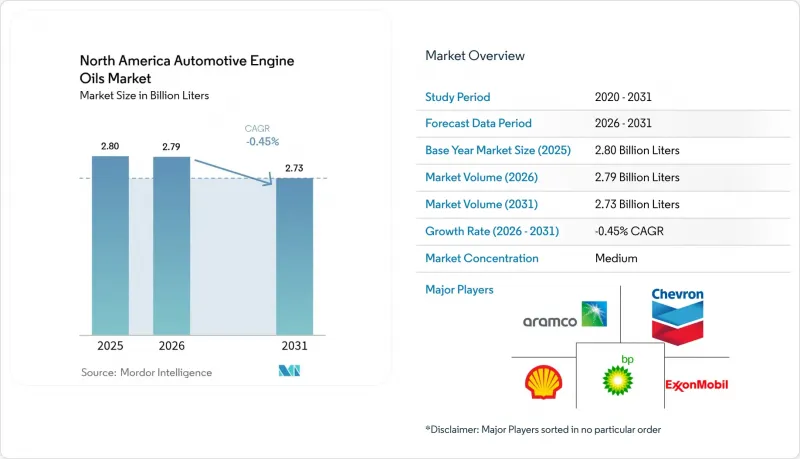
本報告按產品類型(乘用車引擎油、重型車輛機油、摩托車機油)、基礎油(礦物油、合成油、半合成油、生物基油)和地區(美國、加拿大、墨西哥)進行細分。市場預測以體積(公升)為單位。
北美汽車機油市場趨勢與洞察
更嚴格的燃油經濟性和溫室氣體排放法規正在推動對優質食用油的需求。
美國環保署 (EPA) 第三階段溫室氣體排放法規要求汽車製造商 (OEM) 到 2045 年將重型車輛的二氧化碳排放量減少約 50%。為此,潤滑油製造商計劃於 2026 年將低黏度 PC-12 重型車輛潤滑油商業化。車輛測試表明,這種潤滑油可節省高達 3% 的燃油。乘用車 ILSAC GF-7 標準中類似的效率要求,推動了對具有更高高溫剪切穩定性的 0W-16 和 0W-20 合成潤滑油的需求。 CITGARD 的現場測試數據顯示,車輛從 15W-40 潤滑油換用最佳化的 10W-30 配方後,燃油效率提高了 2.1%。儘管隨著各州和聯邦政府碳排放減排政策的趨同,整體銷售量有所下降,但由於一系列法規的推動,優先考慮耐久性的高階潤滑油市場仍然保持強勁勢頭。能夠證明其產品符合美國石油學會 (API) 新耐久性測試標準的潤滑油製造商,將有機會贏得市場佔有率。
採用原廠提供的合成油進行工廠加註,徹底改變了產品線。
北美汽車製造商正將合成油規格納入原廠加註機油標準,以延長保固期並滿足渦輪增壓引擎的熱負荷要求。通用汽車(GM)的「dexos1 Gen3」規格進一步收緊了油泥和低速早燃(LSPI)的限制,有效地將全合成0W-20或5W-30機油的使用標準化,應用於新車領域。在重型車輛領域,主要卡車OEM廠商目前已批准使用10W-30 FA-4機油,加速了其在售後市場的普及。埃克森美孚預測,到2030年,高性能潤滑油市場將成長80%,並正在增加PAO(聚對苯二甲酸乙二醇酯)的產量,以支持與OEM廠商的合作。即使換油週期延長,合成油的價格仍然居高不下,這緩解了擁有先進基礎油生產能力的供應商的銷售下滑壓力。
電動車和混合動力汽車的加速普及將降低石油需求。
2024年,插電式汽車銷售創下歷史新高。美國能源部預測,到2032年,電動車銷量將達到5,500萬輛,取代相當一部分石油消耗。混合動力汽車仍需要潤滑,但由於引擎間歇運轉且負載條件最佳化,其潤滑需求量較低。各州的零排放法規(例如加州的「先進清潔汽車II」計畫)進一步縮小了服務市場。雖然用於電力驅動橋和溫度控管的新型液壓油正在湧現,但由於「可重複填充」的設計和油底殼容量的減少,這些新型液壓油的需求仍然遠低於傳統液壓油。
細分市場分析
乘用車機油目前佔總銷售量的62.75%,但由於電動車日益普及,這一細分市場正在萎縮。在北美汽車引擎油市場,乘用車引擎油(PCMO)的消費量在2019年至2024年間達到峰值,但此後隨著電池動力汽車佔有率的擴大,銷售量開始下降。儘管如此,符合ILSAC GF-7標準的合成機油的市場佔有率仍在持續成長,使供應商能夠維持銷售。 OEM廠商對Dexos1 Gen3和GF-7的工廠灌裝要求進一步促進了經銷商的銷售,而快修連鎖店則透過提升銷售0W-20全合成機油來維持每次保養的銷量。
重型機油銷售量(公升)位居第二,儘管燃油效率計劃限制了銷售量,但貨運量的成長仍為其帶來了收益。車隊初步試驗表明,改用新型 FA-4 10W-30 機油可提高燃油效率 1-4%,足以證明其溢價的合理性。在預測期內,由於電動機車、踏板車和電動自行車的日益普及,摩托車機油的銷量降幅預計最小,複合年成長率僅為 -0.35%。電池壽命的提升、充電基礎設施的完善以及整體性能的提高,使得電動二輪車成為消費者更經濟實惠、更實用、更具吸引力的選擇。
其他好處:
- Excel格式的市場預測(ME)表
- 3個月的分析師支持
目錄
第1章:引言
- 研究假設和市場定義
- 調查範圍
第2章:調查方法
第3章執行摘要
第4章 市場狀況
- 市場概覽
- 市場促進因素
- 更嚴格的 CAFE 和溫室氣體 (GHG) 法規正在推動對低黏度、高性能潤滑油的需求。
- 在OEM工廠的機油填充中,合成油和0W-XX級機油的使用正在逐漸增加。
- 車輛平均使用壽命的延長推高了售後市場的石油消耗量。
- 增加共享出行和最後一公里配送的車輛行駛里程
- 具有ESG背景的再精煉基油混合物的推廣。
- 市場限制因素
- 純電動車和混合動力汽車的加速普及正在降低石油需求。
- 關於延長換油週期的原廠建議
- API III/IV類基油的供應鏈壓力
- 價值鍊和通路分析
- 波特五力模型
- 法律規範
- 汽車產業的發展趨勢
第5章 市場規模與成長預測
- 依產品類型
- 乘用車引擎機油(PCMO)
- 0W-XX
- 5W-XX
- 10W-XX
- 15W-XX
- 單級
- 其他年級
- 重型機油(HDMO)
- 0W-XX
- 5W-XX
- 10W-XX
- 15W-XX
- 單級
- 其他年級
- 摩托車機油(MCO)
- 0W-XX
- 5W-XX
- 10W-XX
- 15W-XX
- 單級
- 其他年級
- 乘用車引擎機油(PCMO)
- 依基料
- 礦物
- 合成
- 半合成
- 生物基
- 按地區
- 美國
- 加拿大
- 墨西哥
第6章 競爭情勢
- 市場集中度
- 策略趨勢
- 市佔率(%)** / 排名分析
- 公司簡介
- AMSOIL INC.
- BP plc
- Chevron Corporation
- CITGO Petroleum Lubricants
- Exxon Mobil Corporation
- FUCHS
- HollyFrontier(Petro-Canada Lubricants)
- Idemitsu Lubricants America
- Kendall Motor Oil
- LIQUI MOLY
- Lucas Oil Products, Inc.
- Motul
- Phillips 66 Lubricants
- Shell plc
- TotalEnergies
- Saudi Arabian Oil Co.
第7章 市場機會與未來展望
第8章:執行長面臨的關鍵策略挑戰
According to Mordor Intelligence, the North America automotive engine oils market size is expected to grow from 2.80 Billion Liters in 2025 to 2.79 Billion Liters in 2026 and is forecast to reach 2.73 Billion Liters by 2031 at -0.45% CAGR over 2026-2031.
This report is Segmented by Product Type (Passenger Car Motor Oil, Heavy Duty Motor Oil, and Motorcycle Engine Oil), Base Stock (Mineral, Synthetic, Semi-Synthetic, and Bio-Based), and Geography (United States, Canada, and Mexico). The Market Forecasts are Provided in Terms of Volume (Litres).
North America Automotive Engine Oils Market Trends and Insights
Tightening CAFE and GHG Regulations Drive Premium Oil Demand
The Environmental Protection Agency's Phase 3 greenhouse-gas program compels OEMs to cut heavy-duty CO2 by roughly 50% by 2045, prompting lubricant makers to commercialize lower-viscosity PC-12 heavy-duty oils in 2026 that can unlock up to 3% fuel savings in fleet trials. Similar efficiency imperatives under ILSAC GF-7 for passenger cars are driving demand for 0W-16 and 0W-20 synthetics, which offer improved high-temperature shear stability. Field data from CITGARD tests confirm a 2.1% fuel-economy gain when fleets switch from 15W-40 to optimized 10W-30 formulations. As state and federal carbon-reduction policies converge, the regulatory cascade secures a durable premium segment, even as aggregate volumes decline. Blenders able to validate performance under the American Petroleum Institute's new durability tests are positioned to capture share.
OEM Factory-Fill Synthetic Adoption Reshapes Product Mix
North American vehicle makers are embedding synthetic specifications in factory fill to meet warranty extensions and thermal load demands in turbocharged engines. General Motors' dexos1 Gen3 specification imposes tighter sludge and LSPI limits, effectively standardizing the use of full synthetic 0W-20 or 5W-30 in new cars. In the heavy-duty sector, leading truck OEMs are now approving 10W-30 FA-4 oils, which is accelerating aftermarket acceptance. ExxonMobil forecasts 80% growth in high-value performance lubricants by 2030 and is expanding PAO output to support OEM partnerships. Synthetics command a higher price-mix even as drain intervals lengthen, cushioning revenue decline for suppliers with advanced base-stock capacity.
Accelerating BEV and Hybrid Penetration Reduces Oil Demand
Plug-in sales reached new highs in 2024, and the Department of Energy projects 55 million EVs by 2032, displacing a substantial fraction of oil consumption. Hybrids still require lubricant, but at lower volumes because engines operate intermittently and at optimized loads. State-level zero-emission mandates-California's Advanced Clean Cars II being a notable example-further compress the serviceable market. While new fluids for e-axles and thermal management emerge, fill-for-life designs and smaller sump volumes render these a fraction of traditional demand.
Other drivers and restraints analyzed in the detailed report include:
- Rising Average Vehicle Age Boosts Aftermarket Consumption
- Growing Ride-Hailing and Last-Mile Delivery Miles
- Extended OEM Drain-Interval Recommendations
For complete list of drivers and restraints, kindly check the Table Of Contents.
Segment Analysis
Passenger car motor oil currently accounts for 62.75% of the total volume, yet the adoption of electric vehicles sets the segment on a downward slope. The North America automotive engine oils market recorded its peak PCMO consumption during 2019-2024, after which volumes started to shrink as battery-only cars expanded their share. Despite that contraction, synthetics aligned with ILSAC GF-7 continue to capture market share, allowing suppliers to defend their revenue. OEM factory-fill mandates for Dexos1 Gen3 and GF-7 spark stronger pull-through at dealerships, while quick-lube chains upsell 0W-20 full synthetic oils to maintain ticket size.
Heavy-duty motor oil ranks second by liters and benefits from freight growth, even as efficiency programs temper volume. Fleet pilots have shown that switching to new FA-4 10W-30 oils can unlock fuel-economy gains of 1-4%, supporting price premiums. Over the forecast period, motorcycle engine oil is expected to slip least, with a -0.35% CAGR, owing to the growing popularity of electric motorcycles, scooters, and e-bikes. Improvements in battery life, charging infrastructure, and overall performance have made electric two-wheelers a more affordable, practical, and attractive option for consumers.
Complete Report Scope:
- By Product Type
- Passenger Car Motor Oil (PCMO)
- 0W-XX
- 5W-XX
- 10W-XX
- 15W-XX
- Monogrades
- Other Grades
- Heavy Duty Motor Oil (HDMO)
- 0W-XX
- 5W-XX
- 10W-XX
- 15W-XX
- Monogrades
- Other Grades
- Motorcycle Engine Oil (MCO)
- 0W-XX
- 5W-XX
- 10W-XX
- 15W-XX
- Monogrades
- Other Grades
- Passenger Car Motor Oil (PCMO)
- By Base Stock
- Mineral
- Synthetic
- Semi-Synthetic
- Bio-Based
- By Geography
- United States
- Canada
- Mexico
List of Companies Covered in this Report:
- AMSOIL INC.
- BP plc
- Chevron Corporation
- CITGO Petroleum Lubricants
- Exxon Mobil Corporation
- FUCHS
- HollyFrontier (Petro-Canada Lubricants)
- Idemitsu Lubricants America
- Kendall Motor Oil
- LIQUI MOLY
- Lucas Oil Products, Inc.
- Motul
- Phillips 66 Lubricants
- Shell plc
- TotalEnergies
- Saudi Arabian Oil Co.
Additional Benefits:
- The market estimate (ME) sheet in Excel format
- 3 months of analyst support
TABLE OF CONTENTS
1 Introduction
- 1.1 Study Assumptions and Market Definition
- 1.2 Scope of the Study
2 Research Methodology
3 Executive Summary
4 Market Landscape
- 4.1 Market Overview
- 4.2 Market Drivers
- 4.2.1 Tightening CAFE and GHG regulations driving demand for low-viscosity, high-performance oils
- 4.2.2 OEM factory-fill shift toward synthetics and 0W-XX grades
- 4.2.3 Rising average vehicle age boosting aftermarket oil consumption
- 4.2.4 Growing ride-hailing and last-mile delivery fleet miles
- 4.2.5 ESG-driven uptake of re-refined base-oil blends
- 4.3 Market Restraints
- 4.3.1 Accelerating BEV and hybrid penetration lowering oil demand
- 4.3.2 Extended OEM drain-interval recommendations
- 4.3.3 Supply-chain pressure on API Group III/IV base stocks
- 4.4 Value Chain and Distribution Channel Analysis
- 4.5 Porter's Five Forces
- 4.5.1 Threat of New Entrants
- 4.5.2 Bargaining Power of Suppliers
- 4.5.3 Bargaining Power of Buyers
- 4.5.4 Threat of Substitutes
- 4.5.5 Industry Rivalry
- 4.6 Regulatory Framework
- 4.7 Automotive Industry Trends
5 Market Size and Growth Forecasts (Volume)
- 5.1 By Product Type
- 5.1.1 Passenger Car Motor Oil (PCMO)
- 5.1.1.1 0W-XX
- 5.1.1.2 5W-XX
- 5.1.1.3 10W-XX
- 5.1.1.4 15W-XX
- 5.1.1.5 Monogrades
- 5.1.1.6 Other Grades
- 5.1.2 Heavy Duty Motor Oil (HDMO)
- 5.1.2.1 0W-XX
- 5.1.2.2 5W-XX
- 5.1.2.3 10W-XX
- 5.1.2.4 15W-XX
- 5.1.2.5 Monogrades
- 5.1.2.6 Other Grades
- 5.1.3 Motorcycle Engine Oil (MCO)
- 5.1.3.1 0W-XX
- 5.1.3.2 5W-XX
- 5.1.3.3 10W-XX
- 5.1.3.4 15W-XX
- 5.1.3.5 Monogrades
- 5.1.3.6 Other Grades
- 5.1.1 Passenger Car Motor Oil (PCMO)
- 5.2 By Base Stock
- 5.2.1 Mineral
- 5.2.2 Synthetic
- 5.2.3 Semi-Synthetic
- 5.2.4 Bio-Based
- 5.3 By Geography
- 5.3.1 United States
- 5.3.2 Canada
- 5.3.3 Mexico
6 Competitive Landscape
- 6.1 Market Concentration
- 6.2 Strategic Moves
- 6.3 Market Share (%)**/Ranking Analysis
- 6.4 Company Profiles (includes Global level Overview, Market level overview, Core Segments, Financials as available, Production Capacity, Strategic Information, Market Rank/Share for key companies, Products and Services, and Recent Developments)
- 6.4.1 AMSOIL INC.
- 6.4.2 BP plc
- 6.4.3 Chevron Corporation
- 6.4.4 CITGO Petroleum Lubricants
- 6.4.5 Exxon Mobil Corporation
- 6.4.6 FUCHS
- 6.4.7 HollyFrontier (Petro-Canada Lubricants)
- 6.4.8 Idemitsu Lubricants America
- 6.4.9 Kendall Motor Oil
- 6.4.10 LIQUI MOLY
- 6.4.11 Lucas Oil Products, Inc.
- 6.4.12 Motul
- 6.4.13 Phillips 66 Lubricants
- 6.4.14 Shell plc
- 6.4.15 TotalEnergies
- 6.4.16 Saudi Arabian Oil Co.
7 Market Opportunities and Future Outlook
- 7.1 White-space and Unmet-need Assessment
8 Key Strategic Questions for CEOs

 印尼汽車機油市場:市場佔有率分析、產業趨勢與統計及成長預測(2026-2031)越南汽車引擎油:市場佔有率分析、產業趨勢與統計及成長預測(2026-2031)馬來西亞汽車機油:市場佔有率分析、產業趨勢與統計及成長預測(2026-2031)中國汽車引擎油市場:市場佔有率分析、產業趨勢與統計及成長預測(2026-2031年)印度汽車機油:市場佔有率分析、產業趨勢與統計及成長預測(2026-2031)德國汽車引擎機油:市場佔有率分析、產業趨勢與統計及成長預測(2026-2031)歐洲汽車引擎機油:市場佔有率分析、產業趨勢與統計及成長預測(2026-2031)法國汽車引擎油:市場佔有率分析、產業趨勢與統計及成長預測(2026-2031)
 汽車機油市場:2026-2032年全球市場預測(按產品類型、車輛類型、應用、最終用戶和分銷管道分類)東非汽車機油:市場佔有率分析、產業趨勢與統計及成長預測(2026-2031 年)