


 |
市場調查報告書
商品編碼
2116377
德國汽車引擎機油:市場佔有率分析、產業趨勢與統計及成長預測(2026-2031)Germany Automotive Engine Oils - Market Share Analysis, Industry Trends & Statistics, Growth Forecasts (2026 - 2031) |
||||||

※ 本網頁內容可能與最新版本有所差異。詳細情況請與我們聯繫。
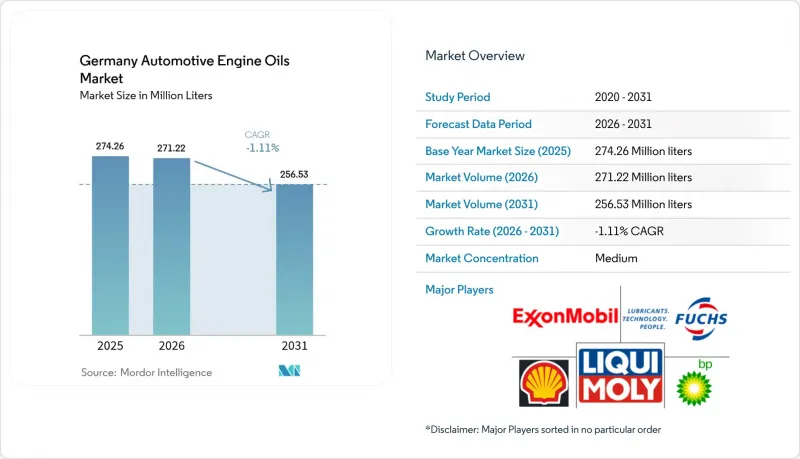
根據 Mordor Intelligence 估計,2025 年德國汽車機油市值為 2.7426 億公升,低於 2026 年的 2.7122 億升,預計到 2031 年將達到 2.5653 億升,預測期(2026-2031 年)的複合年成長率為 -1.11%。
本報告依產品類型(乘用車機油(0W-XX、5W-XX、10W-XX、15W-XX、單級油及其他等級)、重型車輛機油(0W-XX、5W-XX、10W-XX、15W-XX、單級油及其他等級)、摩托車引擎油(0W-XX、等))和基料(礦物油、合成油、半合成油、生物基油)進行分類。市場預測以銷售量(公升)為單位。
德國汽車機油市場趨勢與洞察
歐盟7標準為提高燃油效率所採取的措施正在加速低黏度合成油的普及。
旨在減少顆粒物和氮氧化物排放的歐盟7排放標準要求汽車製造商指定使用0W-20甚至0W-16潤滑油,以最大限度地減少內部摩擦並滿足公共道路排放氣體檢驗要求。儘管由於符合這些法規的新ACEA標準導致銷量下降,但德國汽車機油市場仍依靠合成化學技術支撐。從2025年起,梅賽德斯-奔馳的MB 229.71和寶馬的Longlife-22FE++將成為混合動力汽油車型的強制性標準,這兩種標準都要求潤滑油具有極高的穩定性,且SAPS(鹼性硫酸鹽)含量極低。已獲得這些認證的潤滑油製造商可以設定更高的價格,因為複製這些測試規程需要花費數百萬歐元,並且需要18個月的時間。因此,歐7法規已將德國汽車機油市場從一個監管力量轉變為一個利潤成長的驅動力,推動了銷售模式從簡單的「按升銷售」轉向「證明生命週期性能」。這種正面影響在經銷商通路最為明顯,OEM 專用機油已經佔合成 PCMO銷售量的三分之二以上。
德國汽車擁有人口的老化推高了汽車保養和機油補充的需求。
到2025年,德國微型車的平均車齡將達到9.5年,比2020年整整長一年。這將導致車輛擁有周期延長,並擴大售後市場機會。老舊引擎通常會出現竄氣和墊片洩漏的情況,因此需要在兩次定期保養之間增加機油添加量,並且需要使用5W-30等粘度等級的機油,這種機油適用於老款歐5排放標準的車輛。維修店報告稱,車齡超過8年的車輛在兩次定期保養之間需要添加0.4升機油,這在一定程度上抵消了因電池式電動車普及而導致的銷售量下滑。商用貨車和重型卡車也出現了類似的趨勢,車隊管理人員正在延長車輛更換週期,以應對殘值的不確定性。這些趨勢支撐了德國汽車機油市場對添加了密封調節劑和清潔劑的高里程機油的穩定需求。提供包含濾清器和機油的保養套裝的供應商正在利用這一趨勢,即使來訪頻率保持不變,也能提高每次保養的收入。
歐盟煉油廠重組將影響基礎油供應和價格。
殼牌預計於2025年下半年對其韋瑟林工廠進行改造,專注於生產III類基礎油,從而減少I類基礎油的產量,並可能導致短鏈油供應趨緊。英國油公司(BP)正在減少其蓋爾森基興工廠的原油加工量,以降低碳排放強度,這將導致其基礎油加氫處理系統所需的本地真空瓦斯油產量下降。儘管III類基礎油現貨價格在2025年初有所下跌,但小型調和商反映難以簽署多年期契約,加劇了供應鏈風險。德國對進口基礎油的依賴程度日益加深,買家面臨著經由ARA樞紐運輸運費波動的風險。大型綜合石油公司透過內部轉移定價維持利潤率,而獨立潤滑油生產商則面臨成本轉嫁延遲的問題,這給其息稅折舊攤提前利潤(EBITDA)帶來了壓力。因此,產能轉移將在預測期內對德國汽車引擎油市場構成結構性拖累。
細分市場分析
到2025年,乘用車引擎油將佔德國汽車引擎油市場的62.35%。這反映了德國歷來以汽車為中心的旅遊基礎設施和完善的經銷商服務網路。儘管以高階品牌為首的電動車的日益普及正在逐步削弱乘用車引擎油(PCMO)的整體需求,但該細分市場仍然佔據德國汽車機油市場的相當大佔有率,尤其是在需要低SAPS 0W-20配方的高溫渦輪增壓汽油引擎領域。雖然摩托車機油的銷售量遠低於乘用車,但預計其複合年成長率(CAGR)將是最低的,僅為-0.95%,因為休閒騎行文化,尤其是在巴伐利亞州和巴登-符騰堡州,將支撐銷售量(ICE)摩托車的需求直至2030年代中期。德國高速公路網路上的貨運趨勢與重型車輛機油的需求密切相關。車隊遠端資訊處理技術的廣泛應用,使得歐VI柴油引擎更傾向於選擇具有較低高溫高剪切黏度(HTHS)保持率和較長換油週期的10W-30 CK-4配方。因此,德國汽車引擎油市場呈現兩極化的趨勢。傳統的PCMO級機油(適用於舊款轎車)市場佔有率正在迅速萎縮,而專為豪華混合動力汽車設計的OEM專用合成機油則保持著穩定的市場佔有率。
車隊管理人員優先考慮提高燃油效率和減少停機時間,這促使重型柴油機油 (HDMO) 供應商採用 FA-4 5W-30 混合油,以降低長途運輸的燃油成本。同時,乘用車機油 (MCO)負責人正利用長效單酯來提高平均零售價格。像梅賽德斯-奔馳 GLC 400e 這樣的原廠配套混合模式需要雙效配方,既能抑制低速火花點火 (LSPI),又能保護催化劑,這使得德國整合商獲得了先發優勢。在所有價格區間,德國汽車機油市場都重視那些既能滿足歐 7 廢氣後處理系統耐久性要求,又能滿足客戶對高階品牌價值期望的化學技術。
其他好處:
- Excel格式的市場預測(ME)表
- 3個月的分析師支持
目錄
第1章:引言
- 研究假設和市場定義
- 調查範圍
第2章:調查方法
第3章執行摘要
第4章 市場狀況
- 市場概覽
- 市場促進因素
- 歐盟7燃油效率提升計畫正在加速低黏度合成油的普及應用。
- 德國汽車擁有人口的老化增加了對汽車保養和更換的需求。
- OEM對長效換油產品的認證正在推動高階機油的轉變。
- 隨著修訂後的「VerpackG 2025」法律的實施,生物基油和再精煉油引起了人們的關注。
- B2B2C電子商務平台正在徹底改變工廠的採購系統。
- 市場限制因素
- 歐盟煉油廠的合理化調整正在影響基礎油的供應和價格。
- 德國將於2025年開始徵收化學品稅,這將增加添加劑的成本。
- 假精油在網路市場上流通,損害了品牌信任度。
- 價值鍊和通路分析
- 波特五力模型
- 法律規範
- 汽車產業的發展趨勢
第5章 市場規模與成長預測
- 依產品類型
- 乘用車引擎機油(PCMO)
- 0W-XX
- 5W-XX
- 10W-XX
- 15W-XX
- 單級
- 其他年級
- 重型機油(HDMO)
- 0W-XX
- 5W-XX
- 10W-XX
- 15W-XX
- 單級
- 其他年級
- 摩托車機油(MCO)
- 0W-XX
- 5W-XX
- 10W-XX
- 15W-XX
- 單級
- 其他年級
- 乘用車引擎機油(PCMO)
- 依基料
- 礦物
- 合成
- 半合成
- 生物基
第6章 競爭情勢
- 市場集中度
- 策略趨勢
- 市佔率和排名分析
- 公司簡介
- ADDINOL
- AVISTA OIL
- BP Plc
- Chevron Corporation
- ENI
- Exxon Mobil Corporation
- FUCHS
- LIQUI MOLY
- Lukoil
- Motul
- PETRONAS Lubricants International
- Ravensberger Schmierstoffvertrieb GmbH
- Repsol
- ROWE MINERALOLWERK GMBH
- SCT Lubricants
- Shell plc
- TotalEnergies
第7章 市場機會與未來展望
第8章:執行長面臨的關鍵策略挑戰
According to Mordor Intelligence, the Germany automotive engine oils market size was valued at 274.26 Million liters in 2025 and estimated to decline from 271.22 Million liters in 2026 to reach 256.53 Million liters by 2031, at a CAGR of -1.11% during the forecast period (2026-2031).
This report is Segmented by Product Type (Passenger Car Motor Oil (0W-XX, 5W-XX, 10W-XX, 15W-XX, Monogrades, and Other Grades); Heavy Duty Motor Oil (0W-XX, 5W-XX, 10W-XX, 15W-XX, Monogrades, and Other Grades); Motorcycle Engine Oil (0W-XX, 5W-XX, 10W-XX, and More) )and Base Stock (Mineral, Synthetic, Semi-Synthetic, and Bio-Based). The Market Forecasts are Provided in Terms of Volume (Litres).
Germany Automotive Engine Oils Market Trends and Insights
Euro-7 Fuel-Economy Push Accelerates Low-Viscosity Synthetic Adoption
Euro-7 tailpipe standards reduce particulate and NOx emissions, prompting OEMs to prescribe 0W-20 and even 0W-16 lubricants that minimize internal friction and meet on-road emissions verification requirements. New ACEA sequences aligned with these limits ensure that the German automotive engine oil market remains anchored to synthetic chemistries, despite a decline in unit volume. Mercedes-Benz MB 229.71 and BMW Longlife-22FE++ are now mandatory for post-2025 hybrid gasoline models, each requiring ultra-stable low-SAPS formulations. Lubricant blenders that already hold these approvals can charge a premium because replicating the testing protocol costs several million euros and takes 18 months. Euro-7 thus converts regulation into a margin growth lever inside the Germany automotive engine oils market, reinforcing a shift from selling liters to selling lifecycle performance credentials. The upside is most visible in dealership channels, where OEM-specific oils already account for more than two-thirds of synthetic PCMO throughput.
Ageing German Car Parc Lifts Maintenance and Top-Up Demand
Germany's average light-vehicle age reached 9.5 years in 2025, a full year higher than in 2020, lengthening ownership cycles and expanding aftermarket opportunities. Older engines typically experience higher blow-by and gasket seepage, which raises mid-interval top-up requirements and necessitates the use of viscosity grades such as 5W-30, which are suited to legacy Euro-5 fleets. Workshops report that cars older than eight years require an additional 0.4 liters of make-up oil between scheduled services, which partially compensates for the volume dip induced by the uptake of battery-electric vehicles. Commercial vans and rigid trucks exhibit a similar pattern, with fleet managers extending replacement timelines to hedge against uncertainty in residual value. This demography underpins steady demand in the German automotive engine oils market for high-mileage formulations featuring seal conditioners and detergency boosters. Suppliers with bundled filter-and-oil service kits have leveraged the trend, raising per-visit revenue even as visit frequency stabilizes.
EU Refinery Rationalisation Swings Base-Oil Availability and Price
Shell will repurpose its Wesseling site to focus on Group III production from late 2025, trimming Group I and tightening short-chain supply. BP is reducing Gelsenkirchen crude runs to lower carbon intensity, thereby shrinking local vacuum gas-oil streams that feed base-oil hydrotreaters. Spot Group III prices dipped in early 2025; however, smaller blenders report difficulty in locking multi-year contracts, thereby elevating supply-chain risk. Import reliance has risen to of German base-oil demand, exposing buyers to freight volatility through ARA hubs. Large integrated majors preserve margins by using internal transfer pricing, while independent lubricators face a cost pass-through lag that compresses EBITDA. Capacity shifts, therefore, act as a structural drag on the German automotive engine oils market during the forecast horizon.
Other drivers and restraints analyzed in the detailed report include:
- OEM Long-Drain Approvals Stimulate Premium Oil Upgrades
- Bio-Based and Re-Refined Oils Gain Traction Post-VerpackG 2025 Amendment
- Counterfeit Oils on Online Marketplaces Erode Brand Trust
For complete list of drivers and restraints, kindly check the Table Of Contents.
Segment Analysis
Passenger Car Motor Oil accounted for 62.35% of the German automotive engine oil market in 2025, reflecting Germany's historic car-centric mobility infrastructure and well-developed dealership maintenance network. EV uptake, led by premium brands, is starting to erode aggregate PCMO demand; yet, the sub-segment still secures a share of the German automotive engine oils market, particularly for high-temperature, turbocharged gasoline engines that require low-SAPS 0W-20 formulations. Motorcycle Engine Oil, though much smaller in volume, will post the mildest volume decline at a -0.95% CAGR because leisure riding culture, particularly in Bavaria and Baden-Wurttemberg, sustains ICE two-wheelers well into the 2030s. Heavy-duty motor oil demand remains linked to freight-corridor activity on Germany's Autobahn network, where fleet telematics favor extended-drain 10W-30 CK-4 formulations with mild HTHS retention for Euro VI diesel engines. The German automotive engine oil market, therefore, exhibits a two-speed profile: conventional PCMO grades in older sedans contract sharply, while OEM-specific synthetics for luxury hybrids capture a resilient wallet share.
Fleet managers prioritize fuel economy and downtime reduction, prompting HDMO suppliers to adopt FA-4 5W-30 blends that deliver fuel savings in long-haul operations. Meanwhile, MCO marketers utilize extended shelf-life monoesters to increase average selling prices at retail. OEM-filled hybrid models, such as the Mercedes-Benz GLC 400e, require dual-purpose formulations that control LSPI and maintain catalyzer protection, giving German integrators early-mover leverage. Across every product bracket, the German automotive engine oils market rewards chemistry capable of meeting both Euro-7 after-treatment durability and customer perception of premium brand value.
Complete Report Scope:
- By Product Type
- Passenger Car Motor Oil (PCMO)
- 0W-XX
- 5W-XX
- 10W-XX
- 15W-XX
- Monogrades
- Other Grades
- Heavy Duty Motor Oil (HDMO)
- 0W-XX
- 5W-XX
- 10W-XX
- 15W-XX
- Monogrades
- Other Grades
- Motorcycle Engine Oil (MCO)
- 0W-XX
- 5W-XX
- 10W-XX
- 15W-XX
- Monogrades
- Other Grades
- Passenger Car Motor Oil (PCMO)
- By Base Stock
- Mineral
- Synthetic
- Semi-Synthetic
- Bio-Based
List of Companies Covered in this Report:
- ADDINOL
- AVISTA OIL
- BP Plc
- Chevron Corporation
- ENI
- Exxon Mobil Corporation
- FUCHS
- LIQUI MOLY
- Lukoil
- Motul
- PETRONAS Lubricants International
- Ravensberger Schmierstoffvertrieb GmbH
- Repsol
- ROWE MINERALOLWERK GMBH
- SCT Lubricants
- Shell plc
- TotalEnergies
Additional Benefits:
- The market estimate (ME) sheet in Excel format
- 3 months of analyst support
TABLE OF CONTENTS
1 Introduction
- 1.1 Study Assumptions and Market Definition
- 1.2 Scope of the Study
2 Research Methodology
3 Executive Summary
4 Market Landscape
- 4.1 Market Overview
- 4.2 Market Drivers
- 4.2.1 Euro-7 fuel-economy push accelerates low-viscosity synthetic adoption
- 4.2.2 Ageing German car parc lifts maintenance and top-up demand
- 4.2.3 OEM long-drain approvals stimulate premium oil upgrades
- 4.2.4 Bio-based and re-refined oils gain traction post-VerpackG 2025 amendment
- 4.2.5 B2B2C e-commerce platforms reshape workshop procurement
- 4.3 Market Restraints
- 4.3.1 EU refinery rationalisation swings base-oil availability and price
- 4.3.2 2025 German Chemicals Tax lifts additive costs
- 4.3.3 Counterfeit oils on online marketplaces erode brand trust
- 4.4 Value Chain and Distribution Channel Analysis
- 4.5 Porter's Five Forces
- 4.5.1 Threat of New Entrants
- 4.5.2 Bargaining Power of Suppliers
- 4.5.3 Bargaining Power of Buyers
- 4.5.4 Threat of Substitutes
- 4.5.5 Industry Rivalry
- 4.6 Regulatory Framework
- 4.7 Automotive Industry Trends
5 Market Size and Growth Forecasts (Volume)
- 5.1 By Product Type
- 5.1.1 Passenger Car Motor Oil (PCMO)
- 5.1.1.1 0W-XX
- 5.1.1.2 5W-XX
- 5.1.1.3 10W-XX
- 5.1.1.4 15W-XX
- 5.1.1.5 Monogrades
- 5.1.1.6 Other Grades
- 5.1.2 Heavy Duty Motor Oil (HDMO)
- 5.1.2.1 0W-XX
- 5.1.2.2 5W-XX
- 5.1.2.3 10W-XX
- 5.1.2.4 15W-XX
- 5.1.2.5 Monogrades
- 5.1.2.6 Other Grades
- 5.1.3 Motorcycle Engine Oil (MCO)
- 5.1.3.1 0W-XX
- 5.1.3.2 5W-XX
- 5.1.3.3 10W-XX
- 5.1.3.4 15W-XX
- 5.1.3.5 Monogrades
- 5.1.3.6 Other Grades
- 5.1.1 Passenger Car Motor Oil (PCMO)
- 5.2 By Base Stock
- 5.2.1 Mineral
- 5.2.2 Synthetic
- 5.2.3 Semi-Synthetic
- 5.2.4 Bio-Based
6 Competitive Landscape
- 6.1 Market Concentration
- 6.2 Strategic Moves
- 6.3 Market Share (%)/Ranking Analysis
- 6.4 Company Profiles (includes Global level Overview, Market level overview, Core Segments, Financials as available, Production Capacity, Strategic Information, Market Rank/Share for key companies, Products and Services, and Recent Developments)
- 6.4.1 ADDINOL
- 6.4.2 AVISTA OIL
- 6.4.3 BP Plc
- 6.4.4 Chevron Corporation
- 6.4.5 ENI
- 6.4.6 Exxon Mobil Corporation
- 6.4.7 FUCHS
- 6.4.8 LIQUI MOLY
- 6.4.9 Lukoil
- 6.4.10 Motul
- 6.4.11 PETRONAS Lubricants International
- 6.4.12 Ravensberger Schmierstoffvertrieb GmbH
- 6.4.13 Repsol
- 6.4.14 ROWE MINERALOLWERK GMBH
- 6.4.15 SCT Lubricants
- 6.4.16 Shell plc
- 6.4.17 TotalEnergies
7 Market Opportunities and Future Outlook
- 7.1 White-space and Unmet-need Assessment
8 Key Strategic Questions for CEOs

 印尼汽車機油市場:市場佔有率分析、產業趨勢與統計及成長預測(2026-2031)越南汽車引擎油:市場佔有率分析、產業趨勢與統計及成長預測(2026-2031)馬來西亞汽車機油:市場佔有率分析、產業趨勢與統計及成長預測(2026-2031)中國汽車引擎油市場:市場佔有率分析、產業趨勢與統計及成長預測(2026-2031年)北美汽車引擎機油:市場佔有率分析、產業趨勢與統計及成長預測(2026-2031)印度汽車機油:市場佔有率分析、產業趨勢與統計及成長預測(2026-2031)歐洲汽車引擎機油:市場佔有率分析、產業趨勢與統計及成長預測(2026-2031)法國汽車引擎油:市場佔有率分析、產業趨勢與統計及成長預測(2026-2031)
 汽車機油市場:2026-2032年全球市場預測(按產品類型、車輛類型、應用、最終用戶和分銷管道分類)東非汽車機油:市場佔有率分析、產業趨勢與統計及成長預測(2026-2031 年)