


 |
市場調查報告書
商品編碼
2116386
印尼汽車機油市場:市場佔有率分析、產業趨勢與統計及成長預測(2026-2031)Indonesia Automotive Engine Oils - Market Share Analysis, Industry Trends & Statistics, Growth Forecasts (2026 - 2031) |
||||||

※ 本網頁內容可能與最新版本有所差異。詳細情況請與我們聯繫。
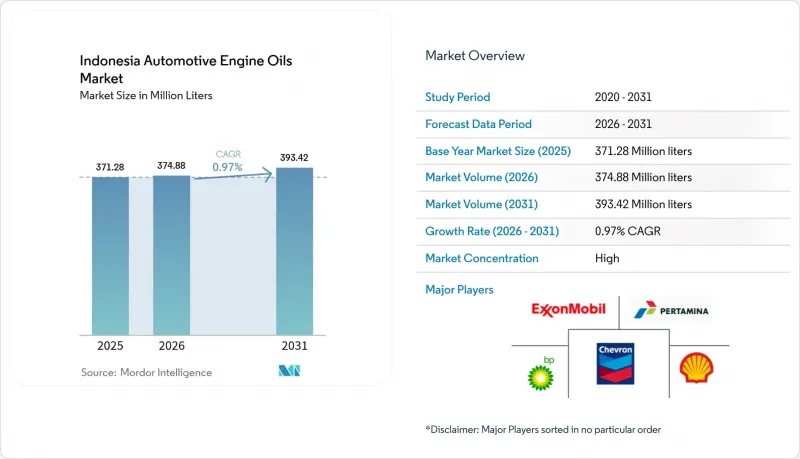
據 Mordor Intelligence 稱,2025 年印尼汽車機油市值為 3.7128 億公升,預計到 2031 年將達到 3.9342 億公升,而 2026 年為 3.7488 億升,預測期(2026-2031 年)的複合年成長率為 0.97%。
本報告按產品類型(乘用車引擎油、單級油、重型車輛引擎油、摩托車引擎油)和基料(礦物油、合成油、半合成油、生物基油)進行細分。市場預測以體積(公升)為單位。
印尼汽車機油市場趨勢及洞察
車輛保有量的快速成長正在推動需求成長。
印尼擁有1.38億輛汽車(包括1.13億輛摩托車),為售後潤滑油市場創造了前所未有的商機。由於政府的稅收優惠政策,2022年2月汽車銷量達81,230輛,較上年同期成長65%。乘用車和摩托車數量的成長直接導致潤滑油更換頻率增加,而新建收費公路也提高了平均行駛里程。這些因素正推動印尼汽車機油市場從簡單的替換需求轉向銷售量,因為新車數量持續超過報廢車輛數量。
OEM規格正朝著更先進的配方方向發展。
全球和本地汽車製造商正在將汽油引擎的機油標準統一為API SP或更高等級,並建議使用0W或5W黏度等級的機油,以最佳化溫度控管和燃油效率。雖然摩托車應用領域向API SN標準的過渡速度較慢,但預計到2027年也將迎頭趕上。包括Motul在內的高階品牌已經開始推薦使用10W-30和10W-40合成機油,以應對日益嚴格的排放氣體法規。在合成機油技術領域擁有先發優勢的供應商可以獲得兩位數的利潤率,同時也能幫助維修店了解黏度變化。消費者越來越重視更好的冷啟動保護和更長的換油週期,這正在加速印尼汽車機油市場的優質化。
延長換油週期可以降低機油消耗量。
合成機油可以每行駛10,000公里更換一次,而傳統混合機油的更換週期僅為5,000公里。在最新的低成本環保車中,更嚴格的公差和更小的承油盤減少了每次保養所需的機油量。車隊管理人員更傾向於使用價格較高的合成機油,因為這樣可以降低每公里的使用壽命成本,提高每公升機油的收益,並減少機油的絕對消耗量。在摩托車領域,循環系統的改進延長了機油的使用壽命,但在交通堵塞時頻繁的走走停停會部分抵消延長保養週期的好處。
細分市場分析
到2025年,乘用車引擎油將佔印尼汽車機油市場總銷售量的63.62%。 API SP標準的升級和0W-20黏度等級的採用正在推動優質化。 OEM工廠的灌裝合約確保了早期銷售量和品牌忠誠度,這種趨勢也蔓延到了售後市場。重型車輛機油廣泛應用於物流和農業領域,符合B40標準的配方正成為必需品。
預計到2031年,摩托車機油的銷售量將以1.14%的複合年成長率成長。在都市區持續騎行會增加潤滑油的負荷,導致更頻繁的換油。 JASO MB自動離合器設計標準創造了差異化機會,例如,殼牌Advance City踏板車(於2025年6月上市)所使用的全合成機油。隨著可支配收入的增加,騎士們正從20W-50礦物油轉向10W-40半合成機油,從而推高了每公升機油的平均銷售量。
其他好處:
- Excel格式的市場預測(ME)表
- 3個月的分析師支持
目錄
第1章:引言
- 研究假設和市場定義
- 調查範圍
第2章:調查方法
第3章執行摘要
第4章 市場狀況
- 市場概覽
- 市場促進因素
- 汽車擁有量迅速增加
- 原始設備製造商力推低黏度潤滑油
- 摩托車擁有量增加
- 政府對清潔引擎的激勵措施
- 增加叫車數量
- 市場限制因素
- 增加排空間隔
- 電動摩托車的普及率
- 假冒或受污染的潤滑劑
- 價值鍊和通路分析
- 波特五力模型
- 法律規範
- 汽車產業的發展趨勢
第5章 市場規模與成長預測
- 依產品類型
- 乘用車引擎機油(PCMO)
- 0W-XX
- 5W-XX
- 10W-XX
- 15W-XX
- 單級
- 其他年級
- 重型機油(HDMO)
- 0W-XX
- 5W-XX
- 10W-XX
- 15W-XX
- 單級
- 其他年級
- 摩托車機油(MCO)
- 0W-XX
- 5W-XX
- 10W-XX
- 15W-XX
- 單級
- 其他年級
- 乘用車引擎機油(PCMO)
- 依基料
- 礦物
- 合成
- 半合成
- 生物基
第6章 競爭情勢
- 市場集中度
- 策略趨勢
- 市佔率和排名分析
- 公司簡介
- BP plc
- Chevron Corporation
- ENEOS Corporation
- Exxon Mobil Corporation
- FUCHS
- Gazpromneft-Lubricants Ltd.
- Idemitsu Kosan Co. Ltd.
- PETRONAS Lubricants International
- PT Pertamina
- PT Surganya Motor
- PT Wiraswasta Gemilang Indonesia
- Repsol
- Shell plc
- Sinopec Lubricant Co. Ltd.
- TOP 1 Oil Products Company
- TotalEnergies
第7章 市場機會與未來展望
第8章:執行長面臨的關鍵策略挑戰
According to Mordor Intelligence, the indonesian automotive engine oils market size was valued at 371.28 million liters in 2025 and estimated to grow from 374.88 million liters in 2026 to reach 393.42 million liters by 2031, at a CAGR of 0.97% during the forecast period (2026-2031).
This report is Segmented by Resin Type (Passenger Car Motor Oil, Monogrades, Heavy Duty Motor Oil, and Motorcycle Engine Oil (MCO)), Base Stock (Mineral, Synthetic, Semi-Synthetic, and Bio-Based). The Market Forecasts are Provided in Terms of Volume (Litres).
Indonesia Automotive Engine Oils Market Trends and Insights
Rapid Growth of Vehicle Parc Drives Base Demand
Indonesia's 138 million-unit vehicle population, including 113 million motorcycles, produces an unmatched aftermarket lubricant opportunity. Government tax incentives propelled car sales to 81,230 units in February 2022, a 65% year-on-year jump. More cars and two-wheelers translate directly into higher lubricant change frequencies, while new toll roads lengthen average kilometers traveled. These factors shift the Indonesian automotive engine oil market from pure replacement to incremental volume expansion as new vehicle additions consistently outrun fleet retirements.
OEM Specifications Shift Toward Advanced Formulations
Global and local automakers are standardizing on API SP or higher for gasoline engines and advocating 0W or 5W grades to optimize thermal management and fuel economy. Motorcycle applications lag at API SN but are expected to follow by 2027. Motul and other premium brands already promote 10W-30 and 10W-40 synthetics for future-proofing against tighter emission norms. Suppliers enjoying early-mover advantage in synthetic technology can achieve double-digit margin premiums while educating workshops on viscosity migration. Consumers gravitate toward better cold-start protection and extended service intervals, accelerating the premiumization of the Indonesia automotive engine oil market.
Lengthening Drain Intervals Reduce Consumption Frequency
Synthetic oils support 10,000-kilometer service intervals versus 5,000 kilometers for conventional blends. Newer low-cost green cars employ tighter tolerances and smaller sumps that cut per-service volumes. Fleet managers favor higher-priced synthetics because lifetime cost per kilometer falls, trimming absolute liters consumed even as revenue per liter rises. Motorcycles adopt improved circulation that extends oil life, yet congestion-induced stop-start driving partly offsets the interval expansion.
Other drivers and restraints analyzed in the detailed report include:
- Rising Motorcycle Ownership Sustains Volume Growth
- Government Incentives Accelerate Technology Adoption
- Electric Two-Wheelers Introduce Long-Term Displacement Risk
For complete list of drivers and restraints, kindly check the Table Of Contents.
Segment Analysis
The Indonesia automotive engine oil market size for passenger car motor oil accounted for 63.62% of the total volume in 2025. API SP upgrades and 0W-20 viscosity adoption underpin premiumization. OEM factory-fill contracts provide early volume security and brand loyalty that extend into the aftermarket. Heavy-duty motor oil serves logistics and agriculture, with B40-ready formulations becoming a prerequisite.
Motorcycle engine oil volume is projected to climb at a 1.14% CAGR through 2031. Continuous city riding elevates lubricant stress, supporting higher change frequencies. JASO MB specifications for automatic clutch designs create differentiation opportunities, illustrated by Shell Advance City Scooter's full-synthetic launch in June 2025. As disposable income rises, riders shift from mineral 20W-50 to semi-synthetic 10W-40, lifting average revenue per liter.
Complete Report Scope:
- By Product Type
- Passenger Car Motor Oil (PCMO)
- 0W-XX
- 5W-XX
- 10W-XX
- 15W-XX
- Monogrades
- Other Grades
- Heavy Duty Motor Oil (HDMO)
- 0W-XX
- 5W-XX
- 10W-XX
- 15W-XX
- Monogrades
- Other Grades
- Motorcycle Engine Oil (MCO)
- 0W-XX
- 5W-XX
- 10W-XX
- 15W-XX
- Monogrades
- Other Grades
- Passenger Car Motor Oil (PCMO)
- By Base Stock
- Mineral
- Synthetic
- Semi-Synthetic
- Bio-Based
List of Companies Covered in this Report:
- BP plc
- Chevron Corporation
- ENEOS Corporation
- Exxon Mobil Corporation
- FUCHS
- Gazpromneft-Lubricants Ltd.
- Idemitsu Kosan Co. Ltd.
- PETRONAS Lubricants International
- PT Pertamina
- PT Surganya Motor
- PT Wiraswasta Gemilang Indonesia
- Repsol
- Shell plc
- Sinopec Lubricant Co. Ltd.
- TOP 1 Oil Products Company
- TotalEnergies
Additional Benefits:
- The market estimate (ME) sheet in Excel format
- 3 months of analyst support
TABLE OF CONTENTS
1 Introduction
- 1.1 Study Assumptions and Market Definition
- 1.2 Scope of the Study
2 Research Methodology
3 Executive Summary
4 Market Landscape
- 4.1 Market Overview
- 4.2 Market Drivers
- 4.2.1 Rapid growth of vehicle parc
- 4.2.2 OEM push toward low-viscosity oils
- 4.2.3 Rising motorcycle ownership
- 4.2.4 Government incentives for cleaner engines
- 4.2.5 Ride-hailing fleet expansion
- 4.3 Market Restraints
- 4.3.1 Lengthening drain intervals
- 4.3.2 Uptake of electric two-wheelers
- 4.3.3 Counterfeit / adulterated lubricants
- 4.4 Value Chain and Distribution Channel Analysis
- 4.5 Porter's Five Forces
- 4.5.1 Threat of New Entrants
- 4.5.2 Bargaining Power of Suppliers
- 4.5.3 Bargaining Power of Buyers
- 4.5.4 Threat of Substitutes
- 4.5.5 Industry Rivalry
- 4.6 Regulatory Framework
- 4.7 Automotive Industry Trends
5 Market Size and Growth Forecasts (Volume)
- 5.1 By Product Type
- 5.1.1 Passenger Car Motor Oil (PCMO)
- 5.1.1.1 0W-XX
- 5.1.1.2 5W-XX
- 5.1.1.3 10W-XX
- 5.1.1.4 15W-XX
- 5.1.1.5 Monogrades
- 5.1.1.6 Other Grades
- 5.1.2 Heavy Duty Motor Oil (HDMO)
- 5.1.2.1 0W-XX
- 5.1.2.2 5W-XX
- 5.1.2.3 10W-XX
- 5.1.2.4 15W-XX
- 5.1.2.5 Monogrades
- 5.1.2.6 Other Grades
- 5.1.3 Motorcycle Engine Oil (MCO)
- 5.1.3.1 0W-XX
- 5.1.3.2 5W-XX
- 5.1.3.3 10W-XX
- 5.1.3.4 15W-XX
- 5.1.3.5 Monogrades
- 5.1.3.6 Other Grades
- 5.1.1 Passenger Car Motor Oil (PCMO)
- 5.2 By Base Stock
- 5.2.1 Mineral
- 5.2.2 Synthetic
- 5.2.3 Semi-Synthetic
- 5.2.4 Bio-Based
6 Competitive Landscape
- 6.1 Market Concentration
- 6.2 Strategic Moves
- 6.3 Market Share (%)/Ranking Analysis
- 6.4 Company Profiles (includes Global level Overview, Market level overview, Core Segments, Financials as available, Production Capacity, Strategic Information, Market Rank/Share for key companies, Products and Services, and Recent Developments)
- 6.4.1 BP plc
- 6.4.2 Chevron Corporation
- 6.4.3 ENEOS Corporation
- 6.4.4 Exxon Mobil Corporation
- 6.4.5 FUCHS
- 6.4.6 Gazpromneft-Lubricants Ltd.
- 6.4.7 Idemitsu Kosan Co. Ltd.
- 6.4.8 PETRONAS Lubricants International
- 6.4.9 PT Pertamina
- 6.4.10 PT Surganya Motor
- 6.4.11 PT Wiraswasta Gemilang Indonesia
- 6.4.12 Repsol
- 6.4.13 Shell plc
- 6.4.14 Sinopec Lubricant Co. Ltd.
- 6.4.15 TOP 1 Oil Products Company
- 6.4.16 TotalEnergies
7 Market Opportunities and Future Outlook
- 7.1 White-space and Unmet-need Assessment
8 Key Strategic Questions for CEOs

 越南汽車引擎油:市場佔有率分析、產業趨勢與統計及成長預測(2026-2031)馬來西亞汽車機油:市場佔有率分析、產業趨勢與統計及成長預測(2026-2031)中國汽車引擎油市場:市場佔有率分析、產業趨勢與統計及成長預測(2026-2031年)北美汽車引擎機油:市場佔有率分析、產業趨勢與統計及成長預測(2026-2031)印度汽車機油:市場佔有率分析、產業趨勢與統計及成長預測(2026-2031)德國汽車引擎機油:市場佔有率分析、產業趨勢與統計及成長預測(2026-2031)歐洲汽車引擎機油:市場佔有率分析、產業趨勢與統計及成長預測(2026-2031)法國汽車引擎油:市場佔有率分析、產業趨勢與統計及成長預測(2026-2031)
 汽車機油市場:2026-2032年全球市場預測(按產品類型、車輛類型、應用、最終用戶和分銷管道分類)東非汽車機油:市場佔有率分析、產業趨勢與統計及成長預測(2026-2031 年)