


 |
市場調查報告書
商品編碼
2099074
汽車金融科技:市場佔有率分析、產業趨勢與統計、成長預測(2026-2031)Automotive Fintech - Market Share Analysis, Industry Trends & Statistics, Growth Forecasts (2026 - 2031) |
||||||

※ 本網頁內容可能與最新版本有所差異。詳細情況請與我們聯繫。
據 Mordor Intelligence 稱,2025 年汽車金融科技市場價值 87.2 億美元,預計到 2031 年將從 2026 年的 98.9 億美元成長至 212.9 億美元,預測期(2026-2031 年)複合年成長率為 16.57%。
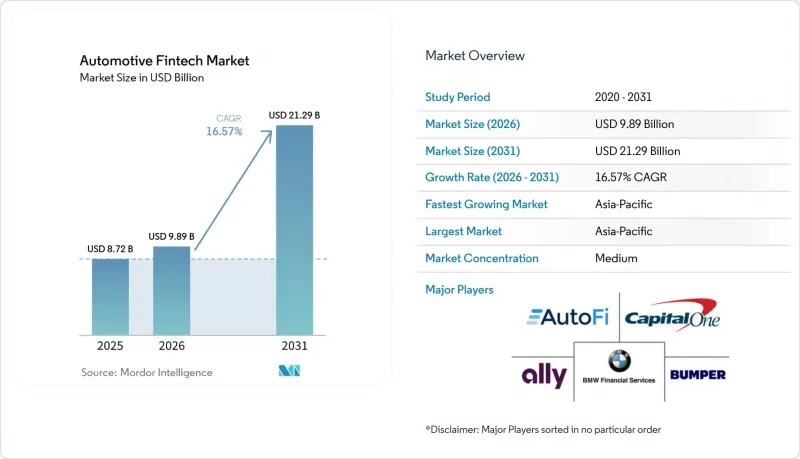
本報告按應用領域(支付、信貸/貸款、其他)、車輛類型(乘用車、商用車、其他)、經營模式(銀行即服務、金融科技合作、其他)、最終用戶(一般消費者、汽車製造商、其他)和地區(北美、南美、其他)進行細分。市場預測以美元計價。
全球汽車金融科技市場趨勢與洞察
對嵌入式汽車金融的需求日益成長
在汽車金融科技市場,融資正從經銷商的獨立環節轉向更廣泛、更數位化的購車流程。預先已通過核准的貸款方案正日益整合到汽車製造商的配置器、經銷商的行動應用以及互聯出行介面中,從而改變了初始信貸決策的製定地點。這意義重大,因為客戶現在可以在購車流程的早期階段,在傳統金融部門佔據主導地位之前,請先查看貸款條款。這種轉變削弱了仍然依賴經銷商主導融資的貸款機構的定價權,並使那些能夠在消費者初次徵兆購車意圖時就觸達他們的平台獲得了優勢。因此,在汽車金融科技市場,價值主張正從單純管理貸款餘額的公司轉向掌控數位化接點的公司。
數位經銷商和OEM金融生態系統的擴展
汽車金融科技市場正獲得汽車製造商和銀行的支持,他們正在建立以經銷商和品牌平台為核心的更廣泛的數位金融生態系統。大眾汽車集團旅遊部門預測,到2025年,新契約將達到1,150萬份,滲透率將從2024年的34.1%上升至37.2%。這表明,數位化金融的整合正在提升整個所有權週期內的轉換率。 2026年2月,本田汽車與法國農業信貸銀行個人金融與出行部門宣佈建立一項涵蓋八個國家的泛歐金融合作夥伴關係,該合作夥伴關係基於「本田金融服務」的白牌模式。這表明,即使是沒有專門金融子公司的汽車製造商也可以在多個市場擴展嵌入式金融服務。此類合作關係使品牌能夠更好地在各個管道標準化其信貸、租賃、服務和保險產品。因此,汽車金融科技市場正日益轉向平台主導模式,資料所有權和介面管理在策略上變得比分分店或經銷商的數量更重要。
涵蓋貸款、保險和支付等領域的監理法規十分複雜。
汽車金融科技市場面臨貸款、保險和支付領域日益分散的監管負擔。在美國,消費者金融保護局 (CFPB) 提議,到 2025 年 8 月,將汽車金融領域「大型業者」的提案貸款發放總額門檻提高至 105 萬筆。這可能會重新定義許多服務提供者的聯邦監管範圍。同時,各州在資訊揭露和貸款要求方面缺乏統一性,增加了為貸款機構、經銷商和嵌入式平台建立單一全國性合規模式的成本。在歐洲,支付監管也正在透過 PSD3 和 PSR 框架加強。隨著這些法規的實施,汽車產業的支付層將需要更嚴格的身份驗證、API 效能和管理標準。因此,與中型平台相比,能夠更容易承擔法律、營運和審計成本的大規模金融機構在汽車金融科技市場中具有優勢。
細分市場分析
到2025年,「信貸和貸款」將佔汽車金融科技市場57.6%的佔有率,成為最大的應用領域。這一主導地位反映了汽車金融交易的高價值以及貸款在車輛購買過程中扮演的核心角色,無論市場是已開發市場還是新興市場。此外,信貸產品仍然是金融科技整合最方便的切入點,因為它們已經與經銷商的銷售流程、汽車製造商(OEM)的專案以及消費者的購買決策緊密相連。人工智慧驅動的信用評估使貸款機構能夠將業務拓展到信用評級接近優質甚至更低的借款人,從而在無需相應擴展實體分支機構網路的情況下增加貸款發放量。汽車金融科技市場仍然依賴信貸作為其主要收入來源,因為貸款仍然是最大的交易量,並且是交叉銷售保險和服務產品的最清晰途徑。
支付是成長最快的領域,預計從2026年到2031年將以21.1%的複合年成長率成長。這表明汽車金融科技市場的下一階段正在從金融轉向交易基礎設施。 2025年12月,Element Fleet Management宣布收購Car IQ,旨在建立一個大規模的主導車輛的無卡支付平台。隨後,Element公佈了2026年第一季創紀錄的3.24億美元營收,年增17%。這個發展方向意義重大,因為開放回路型、代幣化和車輛原生支付可以將燃油、充電、通行費、停車費和維護費整合到同一交易層。保險仍然是第三大應用領域,隨著保險公司將保險整合到更廣泛的旅遊金融服務中,保險與信貸和支付的關聯日益緊密。因此,汽車金融科技產業正在從提供單一產品轉向提供整合金融體系,使融資、保險和支付在單一的用車體驗中相互補充。
到2025年,乘用車將佔汽車金融科技市場68.3%的佔有率,推動金融、保險和車載支付領域的交易量成長。這一地位反映了個人汽車貸款的巨大需求,以及數位化銷售、預先批准和保險商品搭售在消費管道的廣泛普及。由於乘用車領域已擁有成熟的品牌金融公司、經銷商網路和聯網汽車服務,因此它仍然是汽車製造商主導融資的最重要基礎。雖然市場佔有率領先並不一定意味著產品創新完全集中在乘用車領域,但它確實表明了目前最大的收入來源。汽車金融科技市場將繼續依賴乘用車金融交易量來支撐更廣泛的平台擴張的經濟效益。
預計2026年至2031年間,商用車市場將以19.4%的複合年成長率成長,使其成為汽車金融科技市場下一輪產品週期的核心。車隊資產會產生更豐富的關於車輛使用情況、路線、安全性和停機時間的數據流,為貸款機構和保險公司提供更深入的洞察,從而建立動態定價和還款模型。 Roadzen的「DrivebuddyAI」於2024年12月獲得AIS184認證,而印度自2026年4月起強制實施的商用車安全系統將進一步拓展面向車隊的金融產品的資料環境。儘管摩托車市場以金額為準仍然小規模,但在新興市場,電動車金融、經銷商主導的銷售和微型貸款結構至關重要,因此摩托車產品開發仍在積極進行中。因此,在汽車金融科技產業,儘管乘用車仍然是最大的收入來源,但商用車隊預計將推動遠端資訊處理技術相關的信用評估的發展。
區域分析
2025年,北美在汽車金融科技市場佔據了顯著佔有率。這得益於其強大的汽車信貸基礎設施、成熟的數位化貸款實踐以及成熟的經銷商軟體生態系統。根據Ally Financial的數據顯示,2025年第二季汽車貸款發放達110億美元,年增12.2%;全年保險承保額達到15億美元,創下公司上市以來的最高年度紀錄。 Capital One也於2026年透過推出「聊天客服」拓展了其數位化前端,使用戶能夠在經銷商網站上集中進行貸款比較、預約和預核准。加拿大和墨西哥則進一步增強了區域市場深度,尤其是在依賴跨境營運的車隊和物流支付應用領域。儘管合規要求日益嚴格,但北美汽車金融科技市場憑藉其規模、數據獲取管道和較高的客戶接受度,仍然保持著強大的吸引力。
預計到2025年,亞太地區將佔據汽車金融科技市場37.5%的佔有率,並且是成長最快的區域市場,到2031年複合年成長率將達到18.9%。中國憑藉其大規模的數位借貸和平台金融基礎設施仍然佔據重要地位,而印度則透過電動車貸款、非銀行金融公司(NBFC)的活動以及向主要大都會圈以外地區的滲透來加速成長。 2024-2025會計年度和2025-2026會計年度,資產管理規模(AUM)平均收入成長了60%,資產管理規模成長了45%,顯示對電動車融資的需求正在印度主要城市以外的地區蔓延。韓國、日本和澳洲繼續圍繞數位租賃和訂閱式金融發展,而東協市場則透過汽車製造商和銀行之間的合作以及數位信貸管道的增加而日益成熟。因此,儘管亞太地區的汽車金融科技市場從不同的起點發展,但都朝著進一步融合數位金融的方向發展。
歐洲是一個成熟的汽車金融科技市場,在OEM嵌入式金融和平台主導的服務整合方面展現出強勁的發展勢頭。大眾汽車集團出行部門報告稱,到2025年,歐洲的汽車金融科技滲透率將達到37.2%,活躍合約數量約為3000萬份,這體現了嵌入式金融在全部區域已部署的規模。本田與法國農業信貸銀行個人金融與旅遊部門於2026年2月達成的協議,新增了一種跨境白牌模式,有助於為那些沒有自有專用基礎設施的汽車製造商(OEM)實現金融交付的標準化。在南美洲,對非銀行信貸和數位支付基礎設施的需求持續旺盛,尤其是在傳統銀行服務滲透率較低的地區。在中東和非洲,透過BaaS沙盒和受監管的金融科技基礎設施,正在建立一個中期發展規劃。隨著汽車金融和支付層面的在地化程度不斷提高,汽車金融科技市場將為未來的進一步擴張奠定基礎。
其他好處:
- Excel格式的市場預測(ME)表
- 3個月的分析師支持
目錄
第1章:引言
- 研究假設和市場定義
- 調查範圍
第2章:調查方法
第3章執行摘要
第4章 市場狀況
- 市場概覽
- 市場促進因素
- 車載融資需求不斷成長
- 拓展數位經銷商和OEM金融生態系統。
- 擴大基於里程的保險和基於遠端資訊處理的保費設定產品。
- 人工智慧驅動的信用評估和詐欺預防
- 以電動車為中心,並商品搭售訂閱服務的資金籌措
- 跨平台身分、KYC 和同意架構的碎片化
- 市場限制因素
- 貸款、保險和支付領域的監管複雜性。
- 與傳統經銷商管理系統整合方面的摩擦
- 低利潤、低價服務支付用例的獲利難度。
- 與車輛、駕駛員和遠端資訊處理資料相關的資料權利和責任風險
- 價值鏈分析
- 監理情勢
- 技術展望
- 波特五力分析
第5章 市場規模與成長預測
- 透過使用
- 沉澱
- 信貸和貸款
- 保險
- 其他用途
- 車輛類型
- 搭乘用車
- 商用車輛
- 摩托車
- 按經營模式
- Banking-as-a-Service(BaaS)
- 金融科技夥伴關係
- 內部金融科技開發
- 第三方整合
- 最終用戶
- 一般消費者
- 汽車製造商
- 車主和物流公司
- 保險公司
- 行動服務供應商
- 經銷商和分銷商
- 按地區
- 北美洲
- 美國
- 加拿大
- 墨西哥
- 南美洲
- 巴西
- 阿根廷
- 其他南美國家
- 歐洲
- 英國
- 德國
- 法國
- 義大利
- 西班牙
- 其他歐洲國家
- 亞太地區
- 印度
- 中國
- 日本
- 澳洲
- 韓國
- 東南亞(新加坡、馬來西亞、泰國、印尼、越南、菲律賓)
- 其他亞太國家
- 中東和非洲
- 阿拉伯聯合大公國
- 沙烏地阿拉伯
- 南非
- 奈及利亞
- 其他中東和非洲國家
- 北美洲
第6章 競爭情勢
- 市場集中度
- 策略趨勢
- 市佔率分析
- 公司簡介
- Ally Financial Inc.
- AutoFi, Inc.
- BMW Financial Services
- Bumper International Limited
- Capital One Financial Corporation
- Carvana Co.
- CDK Global, LLC
- Clearcover, Inc.
- Cox Automotive, Inc.
- Credit Acceptance Corporation
- Ford Motor Credit Company LLC
- General Motors Financial Company, Inc.
- Honda Financial Services
- Lendbuzz, Inc.
- RouteOne LLC
- Santander Consumer USA Holdings Inc.
- Toyota Financial Services
- TrueCar, Inc.
- Volkswagen Financial Services AG
- Wells Fargo and Company
第7章 市場機會與未來展望
According to Mordor Intelligence, the automotive fintech market size was valued at USD 8.72 billion in 2025 and is estimated to grow from USD 9.89 billion in 2026 to reach USD 21.29 billion by 2031, at a CAGR of 16.57% during the forecast period (2026-2031).
This report is Segmented by Application (Payments, Credit and Lending, and More), by Vehicle Type (Passenger Cars, Commercial Vehicles, and More), by Business Model (Banking-As-A-Service, Fintech Partnerships, and More), by End-User (Retail Consumers, Automotive Manufacturers, and More), and by Geography (North America, South America, and More). The Market Forecasts are Provided in Terms of Value (USD).
Global Automotive Fintech Market Trends and Insights
Rising Demand for Embedded Vehicle Finance
The automotive fintech market is moving financing from a separate dealership step into the wider digital vehicle journey. Pre-approved offers are increasingly being placed inside OEM configurators, dealer mobile apps, and connected mobility interfaces, which changes where the first credit decision is made. This matters because the customer can now see terms earlier in the purchase path, before the traditional finance office becomes the main point of influence. That shift reduces pricing power for lenders that still depend on dealership-led origination and rewards platforms that can reach consumers at the first sign of purchase intent. The automotive fintech market is therefore seeing distribution value shift toward firms that control digital touchpoints rather than those that control only loan books.
Expansion of Digital Dealer and OEM Financing Ecosystems
The automotive fintech market is gaining support from OEMs and banks that are building wider digital financing ecosystems around dealership and brand platforms. Volkswagen Group Mobility signed 11.5 million new financing, leasing, service, and insurance contracts in 2025, and its penetration rate rose to 37.2% from 34.1% in 2024, showing that digital finance integration is boosting conversion across the ownership cycle. Honda and Credit Agricole Personal Finance & Mobility announced a pan-European financing partnership in February 2026 covering 8 countries under a white-label Honda Financial Services model, which shows how OEMs without a captive can still scale embedded finance across multiple markets. These arrangements improve brands' ability to standardize credit, leasing, service, and insurance offers across channels. The automotive fintech market is therefore becoming more platform-led, with data ownership and interface control carrying more strategic weight than branch or dealer presence alone.
Regulatory Complexity Across Lending, Insurance, and Payments
The automotive fintech market faces a regulatory burden that is becoming more fragmented across lending, insurance, and payments. In the United States, the CFPB proposed in August 2025 to raise the larger-participant threshold in automobile financing to as many as 1.05 million aggregate annual originations, which could reshape the federal supervision perimeter for many providers. At the same time, state-level disclosure and financing requirements are becoming less uniform, which increases the cost of building a single national compliance model for lenders, dealers, and embedded platforms. Europe is also moving toward tighter payment rules through the PSD3 and PSR framework, which means automotive payment layers will need stronger authentication, API performance, and control standards as rules are implemented. The automotive fintech market is, therefore, rewarding larger institutions that can more easily absorb legal, operational, and audit costs than mid-sized platforms.
Other drivers and restraints analyzed in the detailed report include:
- Growth of Usage-Based Insurance and Telematics-Priced Products
- AI-Led Credit Underwriting and Fraud Reduction
- Integration Friction with Legacy Dealer Management Systems
For complete list of drivers and restraints, kindly check the Table Of Contents.
Segment Analysis
Credit and Lending accounted for 57.6% of the Automotive fintech market in 2025, making it the largest application. This lead reflects the high value of auto financing transactions and the central role of loans in vehicle acquisition across both developed and emerging markets. Credit products also remain the easiest starting point for fintech integration because they already sit close to dealer sales processes, OEM programs, and consumer purchase decisions. AI-based underwriting is broadening lenders' reach into near-prime and thin-file borrower groups, helping raise origination volumes without requiring a matching increase in physical distribution. The automotive fintech market continues to rely on credit as its main revenue source because loans still account for the highest transaction volume and offer the clearest path to cross-selling insurance and service products.
Payments is the fastest-growing application, with a projected 21.1% CAGR from 2026 to 2031, which shows that the next phase of the automotive fintech market is moving beyond financing into transaction infrastructure. Element Fleet Management announced its acquisition of Car IQ in December 2025 to create a scaled platform for vehicle-initiated, card-free payments, and Element then reported record Q1 2026 revenue of USD 324 million, up 17% year on year. This direction matters because open-loop, tokenized, and vehicle-native payments can link fuel, charging, tolling, parking, and maintenance into the same transaction layer. Insurance remains the third-largest application and is becoming more tightly connected with credit and payments as providers bundle protection into broader mobility finance offers. The automotive fintech industry is therefore shifting from single-product delivery toward connected financial stacks where lending, insurance, and payments reinforce each other inside one ownership experience.
Passenger Cars accounted for 68.3% of the automotive fintech market in 2025, making them the volume driver across financing, insurance, and in-vehicle payments. This position reflects the scale of personal auto loan demand and the broad reach of digital sales, pre-qualification, and insurance bundling in consumer channels. Passenger cars also remain the most important base for OEM-led finance, as brand captives, dealer networks, and connected vehicle services are already well developed in this category. The share lead does not mean product innovation is concentrated only here, but it does show where the largest revenue pool still sits today. The automotive fintech market continues to depend on passenger car financing volumes to support the economics of broader platform expansion.
Commercial Vehicles are forecast to grow at a 19.4% CAGR from 2026 to 2031, positioning them at the center of the next product cycle in the automotive fintech market. Fleet assets generate richer streams of data on utilization, route behavior, safety, and downtime, which gives lenders and insurers better inputs for dynamic pricing and repayment models. Roadzen's DrivebuddyAI received certification under AIS184 in December 2024, and the April 2026 mandate for commercial vehicle safety systems in India is expanding the data environment that fleet finance products can use. Two-Wheelers remain smaller by value, but they continue to show strong product experimentation in emerging markets where EV financing, dealer-led distribution, and lower-ticket loan structures are important. The automotive fintech industry is therefore likely to see commercial fleets set the pace for telematics-linked underwriting even while passenger cars remain the largest revenue contributor.
Complete Report Scope:
- By Application
- Payments
- Credit and Lending
- Insurance
- Other Applications
- By Vehicle Type
- Passenger Cars
- Commercial Vehicles
- Two-Wheelers
- By Business Model
- Banking-as-a-Service (BaaS)
- Fintech Partnerships
- In-House Fintech Development
- Third-Party Integration
- By End User
- Retail Consumers
- Automotive Manufacturers
- Fleet Operators and Logistics Companies
- Insurance Companies
- Mobility Service Providers
- Dealers and Distributors
- By Geography
- North America
- United States
- Canada
- Mexico
- South America
- Brazil
- Argentina
- Rest of South America
- Europe
- United Kingdom
- Germany
- France
- Italy
- Spain
- Rest of Europe
- Asia-Pacific
- India
- China
- Japan
- Australia
- South Korea
- South East Asia (Singapore, Malaysia, Thailand, Indonesia, Vietnam, and Philippines)
- Rest of Asia-Pacific
- Middle East and Africa
- United Arab Emirates
- Saudi Arabia
- South Africa
- Nigeria
- Rest of Middle East and Africa
- North America
Geography Analysis
North America accounted for a substantial share of the automotive fintech market in 2025, supported by deep auto credit infrastructure, strong digital origination practices, and mature dealer software ecosystems. Ally Financial reported that Q2 2025 auto loan originations rose 12.2% year on year to USD 11 billion, while full-year 2025 insurance written premiums reached USD 1.5 billion, the highest annual figure since its IPO. Capital One also expanded the digital front end in 2026 with Chat Concierge, which brings comparison, scheduling, and financing pre-qualification into a single dealer website experience. Canada and Mexico add regional depth, especially in fleet and logistics payment use cases that depend on cross-border operations. The automotive fintech market in North America remains attractive because scale, data access, and customer readiness are strong, even as compliance obligations are becoming more stringent.
Asia-Pacific held 37.5% of the Automotive fintech market share in 2025 and is also the fastest-growing regional automotive fintech market at 18.9% CAGR through 2031. China remains important because of its large digital lending and platform finance base, while India is accelerating through EV lending, NBFC activity, and deeper reach into non-metro locations. AMU reported average 60% revenue growth across FY24-25 and FY25-26 and a 45% increase in managed AUM, showing how EV finance demand is widening beyond major Indian cities. South Korea, Japan, and Australia continue to build around digital leasing and subscription finance, while ASEAN markets are maturing through OEM-bank cooperation and broader digital credit access. The automotive fintech market in Asia-Pacific is therefore expanding from several different starting points, but all are moving toward stronger digital finance integration.
Europe represented an established automotive fintech market with strong momentum in OEM-embedded finance and platform-led service integration. Volkswagen Group Mobility reported a higher 2025 penetration rate of 37.2% and a portfolio of around 30 million active contracts, which shows the scale of embedded finance already operating across the region. Honda's February 2026 agreement with Credit Agricole Personal Finance & Mobility adds a cross-country white-label model that can help standardize financing delivery for an OEM without its own captive infrastructure. South America continues to show demand for non-bank credit and digital payment infrastructure, especially where traditional banking reach is more limited. Middle East and Africa are building a medium-term pipeline through BaaS sandboxes and regulated fintech infrastructure, which positions the automotive fintech market for broader expansion once vehicle finance and payment layers become more deeply localized.
- Ally Financial Inc.
- AutoFi, Inc.
- BMW Financial Services
- Bumper International Limited
- Capital One Financial Corporation
- Carvana Co.
- CDK Global, LLC
- Clearcover, Inc.
- Cox Automotive, Inc.
- Credit Acceptance Corporation
- Ford Motor Credit Company LLC
- General Motors Financial Company, Inc.
- Honda Financial Services
- Lendbuzz, Inc.
- RouteOne LLC
- Santander Consumer USA Holdings Inc.
- Toyota Financial Services
- TrueCar, Inc.
- Volkswagen Financial Services AG
- Wells Fargo and Company
Additional Benefits:
- The market estimate (ME) sheet in Excel format
- 3 months of analyst support
TABLE OF CONTENTS
1 INTRODUCTION
- 1.1 Study Assumptions and Market Definition
- 1.2 Scope of the Study
2 RESEARCH METHODOLOGY
3 EXECUTIVE SUMMARY
4 MARKET LANDSCAPE
- 4.1 Market Overview
- 4.2 Market Drivers
- 4.2.1 Rising Demand for Embedded Vehicle Finance
- 4.2.2 Expansion of Digital Dealer and OEM Financing Ecosystems
- 4.2.3 Growth of Usage-Based Insurance and Telematics-Priced Products
- 4.2.4 AI-Led Credit Underwriting and Fraud Reduction
- 4.2.5 EV-Centric Financing and Subscription Bundling
- 4.2.6 Cross-Platform Identity, KYC, and Consent Architecture Fragmentation
- 4.3 Market Restraints
- 4.3.1 Regulatory Complexity Across Lending, Insurance, and Payments
- 4.3.2 Integration Friction With Legacy Dealer Management Systems
- 4.3.3 Thin Monetization in Low-Margin, Low-Ticket Service-Payment Use Cases
- 4.3.4 Data Rights and Liability Risk Around Vehicle, Driver, and Telematics Data
- 4.4 Value Chain Analysis
- 4.5 Regulatory Landscape
- 4.6 Technological Outlook
- 4.7 Porter's Five Forces Analysis
- 4.7.1 Threat of New Entrants
- 4.7.2 Bargaining Power of Suppliers
- 4.7.3 Bargaining Power of Buyers
- 4.7.4 Threat of Substitutes
- 4.7.5 Industry Rivalry
5 MARKET SIZE AND GROWTH FORECASTS
- 5.1 By Application
- 5.1.1 Payments
- 5.1.2 Credit and Lending
- 5.1.3 Insurance
- 5.1.4 Other Applications
- 5.2 By Vehicle Type
- 5.2.1 Passenger Cars
- 5.2.2 Commercial Vehicles
- 5.2.3 Two-Wheelers
- 5.3 By Business Model
- 5.3.1 Banking-as-a-Service (BaaS)
- 5.3.2 Fintech Partnerships
- 5.3.3 In-House Fintech Development
- 5.3.4 Third-Party Integration
- 5.4 By End User
- 5.4.1 Retail Consumers
- 5.4.2 Automotive Manufacturers
- 5.4.3 Fleet Operators and Logistics Companies
- 5.4.4 Insurance Companies
- 5.4.5 Mobility Service Providers
- 5.4.6 Dealers and Distributors
- 5.5 By Geography
- 5.5.1 North America
- 5.5.1.1 United States
- 5.5.1.2 Canada
- 5.5.1.3 Mexico
- 5.5.2 South America
- 5.5.2.1 Brazil
- 5.5.2.2 Argentina
- 5.5.2.3 Rest of South America
- 5.5.3 Europe
- 5.5.3.1 United Kingdom
- 5.5.3.2 Germany
- 5.5.3.3 France
- 5.5.3.4 Italy
- 5.5.3.5 Spain
- 5.5.3.6 Rest of Europe
- 5.5.4 Asia-Pacific
- 5.5.4.1 India
- 5.5.4.2 China
- 5.5.4.3 Japan
- 5.5.4.4 Australia
- 5.5.4.5 South Korea
- 5.5.4.6 South East Asia (Singapore, Malaysia, Thailand, Indonesia, Vietnam, and Philippines)
- 5.5.4.7 Rest of Asia-Pacific
- 5.5.5 Middle East and Africa
- 5.5.5.1 United Arab Emirates
- 5.5.5.2 Saudi Arabia
- 5.5.5.3 South Africa
- 5.5.5.4 Nigeria
- 5.5.5.5 Rest of Middle East and Africa
- 5.5.1 North America
6 COMPETITIVE LANDSCAPE
- 6.1 Market Concentration
- 6.2 Strategic Moves
- 6.3 Market Share Analysis
- 6.4 Company Profiles (includes Global Level Overview, Market Level Overview, Core Segments, Financials as available, Strategic Information, Market Rank/Share, Products and Services, Recent Developments)
- 6.4.1 Ally Financial Inc.
- 6.4.2 AutoFi, Inc.
- 6.4.3 BMW Financial Services
- 6.4.4 Bumper International Limited
- 6.4.5 Capital One Financial Corporation
- 6.4.6 Carvana Co.
- 6.4.7 CDK Global, LLC
- 6.4.8 Clearcover, Inc.
- 6.4.9 Cox Automotive, Inc.
- 6.4.10 Credit Acceptance Corporation
- 6.4.11 Ford Motor Credit Company LLC
- 6.4.12 General Motors Financial Company, Inc.
- 6.4.13 Honda Financial Services
- 6.4.14 Lendbuzz, Inc.
- 6.4.15 RouteOne LLC
- 6.4.16 Santander Consumer USA Holdings Inc.
- 6.4.17 Toyota Financial Services
- 6.4.18 TrueCar, Inc.
- 6.4.19 Volkswagen Financial Services AG
- 6.4.20 Wells Fargo and Company
7 MARKET OPPORTUNITIES AND FUTURE OUTLOOK
- 7.1 White-Space and Unmet-Need Assessment

 中東和北非金融科技:市場佔有率分析、行業趨勢和統計數據以及成長預測(2026-2031 年)亞太地區金融科技:市場佔有率分析、產業趨勢與統計及成長預測(2026-2031)北美金融科技:市佔率分析、產業趨勢與統計及成長預測(2026-2031)德國金融科技:市場佔有率分析、產業趨勢與統計及成長預測(2026-2031)新加坡金融科技:市場佔有率分析、產業趨勢與統計及成長預測(2026-2031)歐洲金融科技:市場佔有率分析、產業趨勢與統計及成長預測(2026-2031)越南金融科技:市場佔有率分析、產業趨勢與統計及成長預測(2026-2031)馬來西亞金融科技:市場佔有率分析、產業趨勢與統計及成長預測(2026-2031)金融科技:市場佔有率分析、產業趨勢與統計、成長預測(2025-2030)印度金融科技:市場佔有率分析、產業趨勢與統計及成長預測(2026-2031)