


 |
市場調查報告書
商品編碼
2116295
亞太地區金融科技:市場佔有率分析、產業趨勢與統計及成長預測(2026-2031)Asia-Pacific Fintech - Market Share Analysis, Industry Trends & Statistics, Growth Forecasts (2026 - 2031) |
||||||

※ 本網頁內容可能與最新版本有所差異。詳細情況請與我們聯繫。
據 Mordor Intelligence 稱,亞太地區的金融科技市場規模預計在 2026 年達到 1,677.1 億美元,高於 2025 年的 1,448.7 億美元,預計到 2031 年將達到 3,481 億美元。
預計 2026 年至 2031 年的複合年成長率為 15.76%。
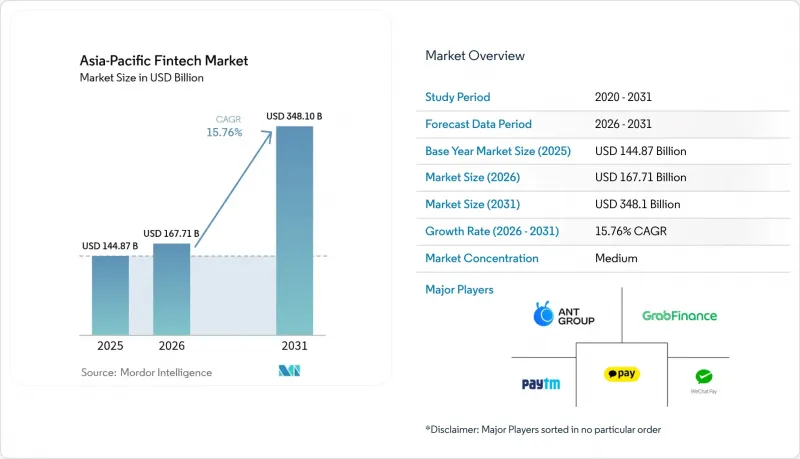
本報告按服務領域(數位支付、數位借貸和資金籌措、數位投資、保險科技、新型銀行)、最終用戶(個人、企業)、用戶介面(行動應用、網頁/瀏覽器、POS/物聯網設備)和地區(印度、中國、日本、澳洲、韓國、東南亞)進行細分。市場預測以美元計價。
亞太地區金融科技市場的趨勢與洞察。
即時支付網路在亞太地區的普及
印度的UPI、新加坡的PayNow和泰國的PromptPay等即時支付網路的部署正在消除支付延遲、降低交易手續費,並削弱消費者對現金的偏好。 2024年,UPI處理了1,310億筆交易,總額達1.8兆美元。 PayNow和PromptPay已實現互通性,使得前往泰國的遊客能夠以中間市場外匯向商家付款,且無需支付卡手續費。因此,即時支付基礎設施已成為金融科技應用可透過開放API利用的基礎層,為推出P2P轉帳、薪水支付和商家支付等產品創建了低程式碼路徑。由於2D碼支付終端成本低、現金轉換快,商家更傾向於使用QR碼支付,這導致卡片付款量下降,尤其是在25美元以下的交易中。世界各國政府持續補貼POS終端升級,顯示2020年代中期,即時推送支付將成為標準。
政府主導的普惠金融和電子身分計劃
數位身分框架透過大幅降低KYC(了解你的客戶)門檻,並將新用戶註冊所需時間從數天縮短至數分鐘,從而擴大了亞太地區金融科技市場的潛在基本客群。印度的「Aadhaar」系統支援超過13億個生物識別ID,使銀行、保險和投資應用程式能夠實現一鍵身份驗證。印尼的電子身分系統緊隨其後,涵蓋了2.7億公民,而菲律賓的目標是到2028年為5,000萬銀行帳戶的成年人提供服務。這些項目實現了資料欄位的標準化,從而實現了跨區域的互通性,並支援跨境金融產品的部署。服務供應商將獲客成本降低了高達40%,並將節省的資金重新分配到產品研發和地理擴張。這波普惠浪潮也推動了女性和農村微企業帳戶持有率的提高,並建立了一個將公共福利直接存入電子錢包帳戶的系統。
跨越多個分散司法管轄區的合規負擔
亞太地區各司法管轄區均有各自的支付許可、資本充足率和洗錢防制(AML)審查要求。印尼強制要求本地資料儲存和更高的儲備金標準,這與新加坡金融管理局(MAS)基於風險的監管框架相衝突。跨境支付服務提供者面臨著特別嚴峻的挑戰,因為每個國家和地區都維持著各自的反洗錢/反恐融資(AML/CTF)要求。因此,像Wise和Remitly這樣的平台不得不實施針對特定國家的合規體系,與在單一市場營運相比,營運成本預計會增加15%至20%。這種監管碎片化對缺乏資源應對多重管理體制的小規模金融科技新創公司影響尤為顯著,這使得擁有專門合規團隊的成熟公司獲得了競爭優勢。
細分市場分析
到2025年,數位支付將佔據64.93%的市場佔有率,而新銀行預計將成為成長最快的服務領域,到2031年複合年成長率將達到30.46%。這種成長差異反映了澳洲、香港和新加坡的放鬆管制,這使得以數位優先的支付服務提供者能夠獲得新的銀行牌照,而現有支付網路在主要市場正趨於成熟。菲律賓的Tonik銀行在成立三年內就吸引了200萬客戶,其提供的6%年儲蓄利率和低營運成本為其提供了保障。同時,澳洲的Judo銀行專注於透過數位管道向中小企業提供貸款,旨在從傳統企業銀行手中奪取市場佔有率。隨著監管的日益清晰,數位貸款和資金籌措持續穩定成長,尤其是在印度,印度儲備銀行(RBI)的指導方針允許金融科技公司和銀行透過合作進行聯合貸款。
在中國、印度和東南亞,中產階級財富累積的趨勢正推動數位投資和保險科技產業的發展。新加坡的StashAway和印尼的Bibit等智慧投顧平台,透過降低投資門檻和自動化投資組合管理,讓更多用戶參與投資。同時,保險科技公司透過將保險功能整合到電商和出行平台中,就觸達了以往服務不足的族群。金融服務融入超級應用生態系統,用戶可以透過熟悉的介面而非獨立的應用程式存取投資和保險產品,加速了金融服務的普及。
其他好處:
- Excel格式的市場預測(ME)表
- 3個月的分析師支持
目錄
第1章:引言
- 研究假設和市場定義
- 調查範圍
第2章:調查方法
第3章執行摘要
第4章 市場狀況
- 市場概覽
- 市場促進因素
- 即時支付基礎設施在亞太地區的普及。
- 政府主導的普惠金融和電子身分計劃
- 行動優先的超級應用生態系統正在加速普及。
- 從 2024 年開始,來自創業投資和企業的資金籌措動能預計將再次增強。
- 零售業 CBDC 試點計畫正在為可程式設計支付開闢應用場景。
- 受資訊揭露義務驅動的ESG相關金融科技模組
- 市場限制因素
- 跨多個司法管轄區的合規負擔分配
- 網路詐騙案件的增加及其造成的損失
- 有關資料本地化和雲端主權的法規阻礙了規模化發展。
- 有關人工智慧模型風險的新法規正在推高實施成本。
- 價值供應鏈分析
- 監理情勢
- 技術展望
- 波特五力模型
第5章 市場規模與成長預測
- 服務方案
- 數位支付
- 數位借貸和金融
- 數位投資
- 保險科技
- 新銀行
- 最終用戶
- 零售
- 公司
- 透過使用者介面
- 行動應用
- 網頁/瀏覽器
- POS/物聯網設備
- 按地區
- 印度
- 中國
- 日本
- 澳洲
- 韓國
- 東南亞
- 新加坡
- 馬來西亞
- 泰國
- 印尼
- 越南
- 菲律賓
- 其他亞太國家
第6章 競爭情勢
- 市場集中度
- 策略趨勢
- 市佔率分析
- 公司簡介
- Ant Group(Alipay)
- Tencent Holdings(WeChat Pay)
- Paytm(One97 Communications)
- Grab Financial Group
- Kakao Pay Corp.
- GCash(Mynt)
- Nium
- Afterpay(Block Inc.)
- Zip Co
- Tonik Bank
- TymeBank
- Judo Bank
- Revolut
- Wise plc
- Airwallex
- Xendit
- Ascend Money(TrueMoney)
- Kredivo Holdings
- KreditBee
- HashKey Group
- MioTech
第7章 市場機會與未來展望
According to Mordor Intelligence, Asia-Pacific fintech market size in 2026 is estimated at USD 167.71 billion, growing from 2025 value of USD 144.87 billion with 2031 projections showing USD 348.1 billion, growing at 15.76% CAGR over 2026-2031.
This report is Segmented by Service Proposition (Digital Payments, Digital Lending and Financing, Digital Investments, Insurtech, Neobanking), End-User (Retail, Businesses), User Interface (Mobile Applications, Web/Browser, POS/IoT Devices), and Geography (India, China, Japan, Australia, South Korea, South-East Asia). The Market Forecasts are Provided in Terms of Value (USD).
Asia-Pacific Fintech Market Trends and Insights
Real-Time Payment Rails Proliferation Across APAC
The rollout of instant payment networks such as India's UPI, Singapore's PayNow, and Thailand's PromptPay removes settlement lags, reduces interchange fees, and shifts consumer preference away from cash. UPI processed 131 billion transactions worth USD 1.8 trillion in 2024. PayNow and PromptPay achieved bilateral interoperability, allowing Singaporean tourists in Thailand to pay merchants at mid-market FX rates without card surcharges. Real-time rails consequently become embedded layers that fintech applications can tap through open APIs, creating low-code paths to launch P2P remittance, payroll, and merchant settlement products. Merchants favor QR rails for lower device costs and faster cash conversion, resulting in cannibalization of card volumes, especially under USD 25 ticket sizes. Governments continue subsidizing POS upgrades, signaling that instant push payments will remain the default standard by mid-decade.
Government-Led Financial Inclusion & e-ID Programs
Digital ID frameworks materially lower KYC friction, cut onboarding times from days to minutes, and thereby expand the Asia-Pacific fintech market addressable base. India's Aadhaar underpins over 1.3 billion biometric IDs, enabling one-tap verification across banking, insurance, and investment apps. Indonesia's e-ID scheme follows suit for 270 million citizens, while the Philippines targets 50 million unbanked adults by 2028. These programs standardize data fields, which allows regional interoperability and supports cross-border financial products. Providers reduce customer acquisition costs by up to 40%, reallocating savings toward product R&D and geographic expansion. The inclusion wave also drives account ownership among women and rural micro-enterprises, linking public welfare transfers directly into wallet accounts.
Fragmented Multi-Jurisdiction Compliance Burden
Each Asia-Pacific jurisdiction prescribes its own payment licenses, capital ratios, and AML tests. Indonesia mandates local data storage and higher reserve thresholds, clashing with Singapore's risk-based MAS framework. Cross-border payment providers face particular challenges as each jurisdiction maintains distinct AML/CTF requirements, forcing platforms like Wise and Remitly to implement country-specific compliance systems that increase operational costs by an estimated 15-20% compared to single-market operations. The fragmentation particularly impacts smaller fintech startups that lack resources to navigate multiple regulatory regimes, creating competitive advantages for established players with dedicated compliance teams.
Other drivers and restraints analyzed in the detailed report include:
- Mobile-First Super-App Ecosystems Accelerating Adoption
- Renewed VC & Corporate Funding Momentum Post-2024
- Escalating Cyber-Fraud Incidents and Associated Losses
For complete list of drivers and restraints, kindly check the Table Of Contents.
Segment Analysis
Neobanking represents the fastest-growing service segment at 30.46% CAGR through 2031, despite digital payments commanding 64.93% market share in 2025. This growth differential reflects regulatory liberalization across Australia, Hong Kong, and Singapore that enables new banking licenses for digital-first providers, while established payment networks reach maturity in core markets. Tonik Bank in the Philippines achieved 2 million customers within 3 years of launch by offering 6% annual savings rates enabled by lower operational costs, while Australia's Judo Bank focuses exclusively on SME lending through digital channels to capture market share from traditional business banking. Digital lending and financing maintain steady growth as regulatory clarity improves, particularly in India, where RBI guidelines enable fintech-bank partnerships for co-lending arrangements.
Digital investments and insurtech segments benefit from wealth accumulation trends across middle-class populations in China, India, and Southeast Asia. Robo-advisory platforms like Singapore's StashAway and Indonesia's Bibit democratize investment access through low minimum thresholds and automated portfolio management, while insurtech providers embed coverage within e-commerce and mobility platforms to reach previously underserved segments. The integration of financial services within super-app ecosystems accelerates adoption rates, as users access investment and insurance products through familiar interfaces rather than standalone applications.
Complete Report Scope:
- By Service Proposition
- Digital Payments
- Digital Lending and Financing
- Digital Investments
- Insurtech
- Neobanking
- By End-User
- Retail
- Businesses
- By User Interface
- Mobile Applications
- Web / Browser
- POS / IoT Devices
- By Geography
- India
- China
- Japan
- Australia
- South Korea
- South-East Asia
- Singapore
- Malaysia
- Thailand
- Indonesia
- Vietnam
- Philippines
- Rest of Asia-Pacific
List of Companies Covered in this Report:
- Ant Group (Alipay)
- Tencent Holdings (WeChat Pay)
- Paytm (One97 Communications)
- Grab Financial Group
- Kakao Pay Corp.
- GCash (Mynt)
- Nium
- Afterpay (Block Inc.)
- Zip Co
- Tonik Bank
- TymeBank
- Judo Bank
- Revolut
- Wise plc
- Airwallex
- Xendit
- Ascend Money (TrueMoney)
- Kredivo Holdings
- KreditBee
- HashKey Group
- MioTech
Additional Benefits:
- The market estimate (ME) sheet in Excel format
- 3 months of analyst support
TABLE OF CONTENTS
1 Introduction
- 1.1 Study Assumptions & Market Definition
- 1.2 Scope of the Study
2 Research Methodology
3 Executive Summary
4 Market Landscape
- 4.1 Market Overview
- 4.2 Market Drivers
- 4.2.1 Real-time payment rails proliferation across APAC
- 4.2.2 Government-led financial-inclusion & e-ID programs
- 4.2.3 Mobile-first super-app ecosystems accelerating adoption
- 4.2.4 Renewed VC & corporate funding momentum post-2024
- 4.2.5 Retail CBDC pilots unlocking programmable-payment use cases
- 4.2.6 ESG-linked fintech modules driven by disclosure mandates
- 4.3 Market Restraints
- 4.3.1 Fragmented multi-jurisdiction compliance burden
- 4.3.2 Escalating cyber-fraud incidents and associated losses
- 4.3.3 Data-localization / cloud-sovereignty rules hindering scale
- 4.3.4 Nascent AI-model-risk regulations raising deployment costs
- 4.4 Value / Supply-Chain Analysis
- 4.5 Regulatory Landscape
- 4.6 Technological Outlook
- 4.7 Porter's Five Forces
- 4.7.1 Threat of New Entrants
- 4.7.2 Bargaining Power of Suppliers
- 4.7.3 Bargaining Power of Buyers
- 4.7.4 Threat of Substitutes
- 4.7.5 Competitive Rivalry
5 Market Size & Growth Forecasts
- 5.1 By Service Proposition
- 5.1.1 Digital Payments
- 5.1.2 Digital Lending and Financing
- 5.1.3 Digital Investments
- 5.1.4 Insurtech
- 5.1.5 Neobanking
- 5.2 By End-User
- 5.2.1 Retail
- 5.2.2 Businesses
- 5.3 By User Interface
- 5.3.1 Mobile Applications
- 5.3.2 Web / Browser
- 5.3.3 POS / IoT Devices
- 5.4 By Geography
- 5.4.1 India
- 5.4.2 China
- 5.4.3 Japan
- 5.4.4 Australia
- 5.4.5 South Korea
- 5.4.6 South-East Asia
- 5.4.6.1 Singapore
- 5.4.6.2 Malaysia
- 5.4.6.3 Thailand
- 5.4.6.4 Indonesia
- 5.4.6.5 Vietnam
- 5.4.6.6 Philippines
- 5.4.7 Rest of Asia-Pacific
6 Competitive Landscape
- 6.1 Market Concentration
- 6.2 Strategic Moves
- 6.3 Market Share Analysis
- 6.4 Company Profiles (includes Global level Overview, Market level overview, Core Segments, Financials as available, Strategic Information, Market Rank/Share for key companies, Products & Services, and Recent Developments)
- 6.4.1 Ant Group (Alipay)
- 6.4.2 Tencent Holdings (WeChat Pay)
- 6.4.3 Paytm (One97 Communications)
- 6.4.4 Grab Financial Group
- 6.4.5 Kakao Pay Corp.
- 6.4.6 GCash (Mynt)
- 6.4.7 Nium
- 6.4.8 Afterpay (Block Inc.)
- 6.4.9 Zip Co
- 6.4.10 Tonik Bank
- 6.4.11 TymeBank
- 6.4.12 Judo Bank
- 6.4.13 Revolut
- 6.4.14 Wise plc
- 6.4.15 Airwallex
- 6.4.16 Xendit
- 6.4.17 Ascend Money (TrueMoney)
- 6.4.18 Kredivo Holdings
- 6.4.19 KreditBee
- 6.4.20 HashKey Group
- 6.4.21 MioTech
7 Market Opportunities & Future Outlook
- 7.1 Cross-border real-time remittance corridors (UPI-PayNow-PromptPay)
- 7.2 Embedded green-finance APIs for SME sustainability-linked loans

 中東和北非金融科技:市場佔有率分析、行業趨勢和統計數據以及成長預測(2026-2031 年)北美金融科技:市佔率分析、產業趨勢與統計及成長預測(2026-2031)德國金融科技:市場佔有率分析、產業趨勢與統計及成長預測(2026-2031)新加坡金融科技:市場佔有率分析、產業趨勢與統計及成長預測(2026-2031)歐洲金融科技:市場佔有率分析、產業趨勢與統計及成長預測(2026-2031)越南金融科技:市場佔有率分析、產業趨勢與統計及成長預測(2026-2031)馬來西亞金融科技:市場佔有率分析、產業趨勢與統計及成長預測(2026-2031)金融科技:市場佔有率分析、產業趨勢與統計、成長預測(2025-2030)印度金融科技:市場佔有率分析、產業趨勢與統計及成長預測(2026-2031)
 金融科技即服務 (FaaS) 市場 - 全球市場預測 2026-2032