

 |
市場調查報告書
商品編碼
2124692
越南金融科技:市場佔有率分析、產業趨勢與統計及成長預測(2026-2031)Vietnam Fintech - Market Share Analysis, Industry Trends & Statistics, Growth Forecasts (2026 - 2031) |
||||||

※ 本網頁內容可能與最新版本有所差異。詳細情況請與我們聯繫。
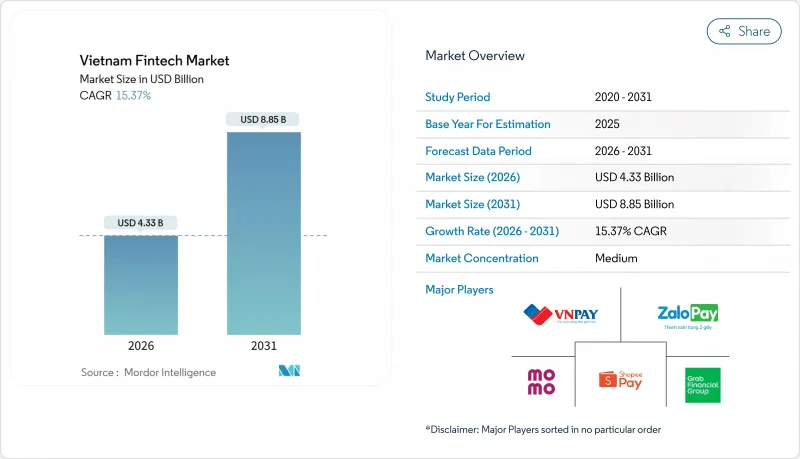
根據 Mordor Intelligence 預測,越南金融科技市場規模預計在 2026 年達到 43.3 億美元,年複合成長率為 15.37%,並在 2031 年達到 88.5 億美元。
本報告按服務業(數位支付、數位借貸和資金籌措、數位投資、保險科技、新型銀行)、終端用戶(個人、企業)、用戶介面(行動應用、網頁/瀏覽器、POS/物聯網設備)和地區(越南北部、中部和南部)進行細分。市場預測以美元計價。
越南金融科技市場的趨勢與洞察
智慧型手機和網路普及率高
越南智慧型手機和網際網路的高普及率為金融科技市場提供了結構性優勢,憑藉廣泛的網路連接,在支付、貸款、投資和保險等領域實現了「行動優先」的服務模式。資訊通訊部已將家庭光纖和4G網路覆蓋率提升至較高水平,降低了即時交易和開戶的門檻。國家規劃的目標是到2030年實現5G的大規模部署,以支援對延遲要求極高的下一代金融科技應用,例如即時信用評估和動態QR碼支付。這項基礎也體現在平台成長上,在數位基礎設施和用戶接受度的推動下,主流電子錢包和銀行應用程式正在迅速擴張。隨著用戶群的擴大,結合數位通路和本地代理商支援的混合模式持續拓展業務,即使在數位素養尚不高的地區也是如此,從而確保越南金融科技市場保持包容性和持續成長。
政府的無現金藍圖和國家數位轉型計劃
越南的無現金化藍圖和國家數位轉型計畫推動數位支付融入商業和公共服務的主流,加速了越南金融科技市場的成長。包括將扣款和福利與非現金憑證掛鉤在內的各項金融和行政措施,持續獎勵企業實現支付流程和記錄保存的數位化。政府優先推進的國家資料庫整合,正在提升身分、稅務和信用資料的質量,這些資料構成了數位化註冊、信用評估和反詐欺的基礎。銀行透過大規模部署生物識別身分驗證,進一步鞏固了這些成果,增強了安全性,降低了詐欺風險,並確保符合新的身分驗證規則。隨著薪資、退休金和補貼透過試點計畫在全國逐步轉移到數位管道,消費者轉換成本不斷上升,平台鎖定效應也日益加劇。這推動了越南金融科技市場整體的持續發展。
農村地區金融知識水準及信任度較低
越南超過70%的人口居住在主要城市以外的地區,因此,越南的金融科技市場依賴推廣模式來彌補信任、認知和產品理解的差距。政府專注於普惠金融和數位轉型的計畫正透過完善的基礎設施和電子服務,不斷深入農村地區。支付服務提供者、銀行和代理商正在試行混合服務模式,將行動端註冊與本地支援結合,以克服金融知識匱乏的障礙並建立信任。身分驗證服務的日益普及,包括晶片身分證和生物識別,也降低了詐欺風險,並增強了人們對數位管道的信心。在教育、申訴處理和代理商素質提升方面的持續努力,將決定投資和保險等高階產品在越南金融科技市場中向主要大都市以外地區擴展的速度。
細分市場分析
預計到2025年,數位支付將佔據71.73%的主導市場佔有率,而保險科技預計將成為成長最快的服務業,到2031年複合年成長率將達到31.28%,凸顯了越南金融科技市場的深度和廣度。同時,監管沙盒支援P2P借貸、信用評分和開放API等領域的試點項目,助力借貸和數據主導模式從概念驗證(PoC)過渡到大規模部署。新銀行正透過銀行支持的數位品牌和與科技公司的合作不斷發展,縮短了從客戶獲取到產品採用的流程。隨著平台提供者滿足日益成長的個人財富需求並降低准入門檻,透過股權拆分和自動化投資工具進行的數位投資正在不斷擴大。保險科技的成長得益於其嵌入式銷售和數位管道,這與鼓勵該行業增加外資和銷售管道現代化的政策環境相契合。
從成長結構角度來看,隨著支付產業的成熟以及其他產業在小規模基數的基礎上加速發展,越南金融科技市場預計將進一步演進。隨著帳戶持有量接近飽和,數位支付預計將保持15%左右的成長率,但商家拓展和B2B支付領域的新應用情境將持續支撐市場活力。保險科技的加速發展反映了保險公司向嵌入式模式和麵向消費者的數位體驗轉型過程中出現的「追趕」趨勢。貸款和金融業預計將受益於開放銀行的整合、信用資料的改進以及身分驗證流程的增強,這些因素共同降低了違約風險並擴大了目標需求。這些趨勢表明,越南金融科技產業正在從以支付主導轉向多元化的產品供應,預計這將拓展收入來源並實現獲利模式的多元化。
其他好處:
- Excel格式的市場預測(ME)表
- 3個月的分析師支持
目錄
第1章:引言
第2章:調查方法
第3章執行摘要
第4章 市場狀況
- 市場概覽
- 市場促進因素
- 智慧型手機和網路普及率高
- 政府的無現金藍圖和國家數位轉型計劃
- 中產階級對便利金融服務的需求日益成長
- NAPAS 247 即時QR CODE支付服務的擴展
- P2P借貸及開放銀行的監理沙盒
- 透過跨境電子商務流入的匯款
- 市場限制因素
- 農村地區金融知識水準低落和缺乏信任
- 各部門的KYC(了解你的客戶)規定不盡相同。
- 由於現金回饋大戰導致客戶獲取成本過高,難以持續。
- 雲端可用區限制和延遲問題
- 價值供應鏈分析
- 監理情勢
- 技術展望
- 波特五力模型
第5章 市場規模與成長預測
- 服務方案
- 數位支付
- 數位借貸金融
- 數位投資
- 保險科技
- 新銀行
- 最終用戶
- 零售
- 公司
- 透過使用者介面
- 行動應用
- 網頁/瀏覽器
- POS/物聯網設備
- 按地區
- 越南北部
- 越南中部
- 越南南部
第6章 競爭情勢
- 市場集中度
- 策略趨勢
- 市佔率分析
- 公司簡介
- M_Service(MoMo)
- VNPay
- ZaloPay(VNG)
- ShopeePay(Sea Ltd.)
- Grab Financial Group(Vietnam)
- BePay(Be Group)
- Timo Digital Bank
- Cake by VPBank
- TPBank
- Techcombank Digital
- Vietcombank Digital
- VPBank
- Payoo
- FinHay
- Infina
- Trusting Social
- Lendbiz
- Mirae Asset Finance Vietnam
- F88
- MFast
第7章 市場機會與未來展望
According to Mordor Intelligence, the Vietnam fintech market size is USD 4.33 billion in 2026 and is projected to reach USD 8.85 billion by 2031 at a 15.37% CAGR.
This report is Segmented by Service Proposition (Digital Payments, Digital Lending & Financing, Digital Investments, Insurtech, Neobanking), End-User (Retail, Businesses), User Interface (Mobile Applications, Web/Browser, POS/IoT Devices), and Geography (Northern Vietnam, Central Vietnam, Southern Vietnam). The Market Forecasts are Provided in Terms of Value (USD).
Vietnam Fintech Market Trends and Insights
High Smartphone & Internet Penetration
Smartphone and internet penetration are a structural advantage for the Vietnam fintech market, with widespread connectivity enabling mobile-first service delivery across payments, lending, investments, and insurance. The Ministry of Information and Communications has driven household fiber and 4G coverage to high levels, which has reduced access friction for real-time transactions and account onboarding. National planning targets 5G availability at scale by 2030, which supports the next wave of low-latency fintech use cases like instant credit decisioning and dynamic QR payments. Platform growth shows the effect of this base, as leading wallets and bank apps scaled rapidly on the back of digital infrastructure and user readiness. As participation widens, hybrid models that blend digital channels with local agent support continue to expand reach in areas where digital literacy is still maturing, keeping the Vietnam fintech market inclusive while sustaining growth.
Government Cashless Roadmap & National Digital Transformation Program
The cashless roadmap and the National Digital Transformation Program have accelerated the Vietnam fintech market by pushing digital payments into the mainstream of commerce and public services. Fiscal and administrative measures, including requirements that link deductions and benefits to non-cash evidence, have created persistent incentives for businesses to digitize payment flows and record-keeping. National database integration prioritized by the government is improving the quality of identity, tax, and credit data that underpin digital onboarding, underwriting, and fraud control. Banks have reinforced these gains by rolling out biometric ID-based authentication at scale, which has improved security outcomes and reduced fraud exposure alongside compliance with new verification rules. As payroll, pensions, and subsidy distribution migrate to digital channels through local pilots, consumer switching costs rise, and platform lock-in strengthens, supporting durable adoption across the Vietnam fintech market.
Low Financial Literacy & Trust in Rural Areas
Over 70% of the population lives outside the largest cities, which means the Vietnam fintech market depends on outreach models that address gaps in confidence, awareness, and product understanding. Government programs focused on financial inclusion and digital transformation continue to push acceptance infrastructure and e-services deeper into rural districts. Payment providers, banks, and agents are testing hybrid delivery that combines mobile onboarding with local assistance to bridge literacy constraints and build trust. Greater coverage of identity services, including chip-based IDs and biometric verification, is also reducing fraud risk and improving confidence in digital channels. A sustained focus on education, grievance redressal, and agent quality is likely to determine how quickly advanced products like investments and insurance scale beyond major urban corridors in the Vietnam fintech market.
Other drivers and restraints analyzed in the detailed report include:
- Rising Middle-Class Demand for Convenient Financial Services
- Expansion of NAPAS 247 Real-Time QR Rail
- Fragmented KYC Rules Across Ministries
For complete list of drivers and restraints, kindly check the Table Of Contents.
Segment Analysis
Digital payments held a commanding 71.73% share in 2025, while insurtech is forecast to be the fastest-growing service line at a 31.28% CAGR through 2031, underscoring the depth and breadth of the Vietnam fintech market. In parallel, the regulatory sandbox enables controlled pilots in P2P lending, credit scoring, and open APIs, which will support lending and data-led models as they transition from proof of concept to scaled deployment. Neobanking is advancing through bank-backed digital brands and partnerships with technology players that shorten the path from customer acquisition to product activation. Digital investments are expanding through fractional equity and automated saving tools, as platforms adapt to rising retail wealth and the need for low-barrier entry. Insurtech's growth is leveraging embedded distribution and digital channels, which aligns with the policy environment that has supported greater foreign investment into the sector and modernization of distribution.
From a growth-composition perspective, the Vietnam fintech market is set to evolve as payments mature and other verticals accelerate from a smaller base. Digital payments are likely to sustain mid-teen rates as account ownership nears saturation, while new use cases in merchant acquiring and B2B payments keep activity healthy. Insurtech's acceleration reflects a catch-up dynamic, as carriers pivot toward embedded models and consumer-grade digital experiences. Lending and financing are positioned to benefit from open-banking integration, improved credit data, and better verification, which together reduce default risk and increase addressable demand. These dynamics indicate a broader shift from a payments-led to a multi-product Vietnam fintech industry, which is likely to broaden revenue pools and diversify monetization.
Complete Report Scope:
- By Service Proposition
- Digital Payments
- Digital Lending & Financing
- Digital Investments
- Insurtech
- Neobanking
- By End-User
- Retail
- Businesses
- By User Interface
- Mobile Applications
- Web / Browser
- POS / IoT Devices
- By Geography
- Northern Vietnam
- Central Vietnam
- Southern Vietnam
List of Companies Covered in this Report:
- M_Service (MoMo)
- VNPay
- ZaloPay (VNG)
- ShopeePay (Sea Ltd.)
- Grab Financial Group (Vietnam)
- BePay (Be Group)
- Timo Digital Bank
- Cake by VPBank
- TPBank
- Techcombank Digital
- Vietcombank Digital
- VPBank
- Payoo
- FinHay
- Infina
- Trusting Social
- Lendbiz
- Mirae Asset Finance Vietnam
- F88
- MFast
Additional Benefits:
- The market estimate (ME) sheet in Excel format
- 3 months of analyst support
TABLE OF CONTENTS
1 Introduction
2 Research Methodology
3 Executive Summary
4 Market Landscape
- 4.1 Market Overview
- 4.2 Market Drivers
- 4.2.1 High smartphone & internet penetration
- 4.2.2 Government cash-less roadmap & National Digital Transformation Program
- 4.2.3 Rising middle-class demand for convenient financial services
- 4.2.4 Expansion of NAPAS 247 real-time QR rail
- 4.2.5 Regulatory sandbox for P2P lending & open banking
- 4.2.6 Cross-border e-commerce remittance inflows
- 4.3 Market Restraints
- 4.3.1 Low financial literacy & trust in rural areas
- 4.3.2 Fragmented KYC rules across ministries
- 4.3.3 Unsustainably high CAC from cashback wars
- 4.3.4 Limited cloud availability zones & latency issues
- 4.4 Value / Supply-Chain Analysis
- 4.5 Regulatory Landscape
- 4.6 Technological Outlook
- 4.7 Porter's Five Forces
- 4.7.1 Threat of New Entrants
- 4.7.2 Bargaining Power of Buyers
- 4.7.3 Bargaining Power of Suppliers
- 4.7.4 Threat of Substitutes
- 4.7.5 Competitive Rivalry
5 Market Size & Growth Forecasts
- 5.1 By Service Proposition
- 5.1.1 Digital Payments
- 5.1.2 Digital Lending & Financing
- 5.1.3 Digital Investments
- 5.1.4 Insurtech
- 5.1.5 Neobanking
- 5.2 By End-User
- 5.2.1 Retail
- 5.2.2 Businesses
- 5.3 By User Interface
- 5.3.1 Mobile Applications
- 5.3.2 Web / Browser
- 5.3.3 POS / IoT Devices
- 5.4 By Geography
- 5.4.1 Northern Vietnam
- 5.4.2 Central Vietnam
- 5.4.3 Southern Vietnam
6 Competitive Landscape
- 6.1 Market Concentration
- 6.2 Strategic Moves
- 6.3 Market Share Analysis
- 6.4 Company Profiles (includes Global level Overview, Market level overview, Core Segments, Financials as available, Strategic Information, Market Rank/Share for key companies, Products & Services, and Recent Developments)
- 6.4.1 M_Service (MoMo)
- 6.4.2 VNPay
- 6.4.3 ZaloPay (VNG)
- 6.4.4 ShopeePay (Sea Ltd.)
- 6.4.5 Grab Financial Group (Vietnam)
- 6.4.6 BePay (Be Group)
- 6.4.7 Timo Digital Bank
- 6.4.8 Cake by VPBank
- 6.4.9 TPBank
- 6.4.10 Techcombank Digital
- 6.4.11 Vietcombank Digital
- 6.4.12 VPBank
- 6.4.13 Payoo
- 6.4.14 FinHay
- 6.4.15 Infina
- 6.4.16 Trusting Social
- 6.4.17 Lendbiz
- 6.4.18 Mirae Asset Finance Vietnam
- 6.4.19 F88
- 6.4.20 MFast
7 Market Opportunities & Future Outlook
- 7.1 Green financing for rooftop solar boom
- 7.2 Embedded insurance in super-apps

 中東和北非金融科技:市場佔有率分析、行業趨勢和統計數據以及成長預測(2026-2031 年)亞太地區金融科技:市場佔有率分析、產業趨勢與統計及成長預測(2026-2031)北美金融科技:市佔率分析、產業趨勢與統計及成長預測(2026-2031)德國金融科技:市場佔有率分析、產業趨勢與統計及成長預測(2026-2031)新加坡金融科技:市場佔有率分析、產業趨勢與統計及成長預測(2026-2031)歐洲金融科技:市場佔有率分析、產業趨勢與統計及成長預測(2026-2031)馬來西亞金融科技:市場佔有率分析、產業趨勢與統計及成長預測(2026-2031)金融科技:市場佔有率分析、產業趨勢與統計、成長預測(2025-2030)印度金融科技:市場佔有率分析、產業趨勢與統計及成長預測(2026-2031)
 金融科技即服務 (FaaS) 市場 - 全球市場預測 2026-2032