


 |
市場調查報告書
商品編碼
2123731
印度金融科技:市場佔有率分析、產業趨勢與統計及成長預測(2026-2031)India Fintech - Market Share Analysis, Industry Trends & Statistics, Growth Forecasts (2026 - 2031) |
||||||

※ 本網頁內容可能與最新版本有所差異。詳細情況請與我們聯繫。
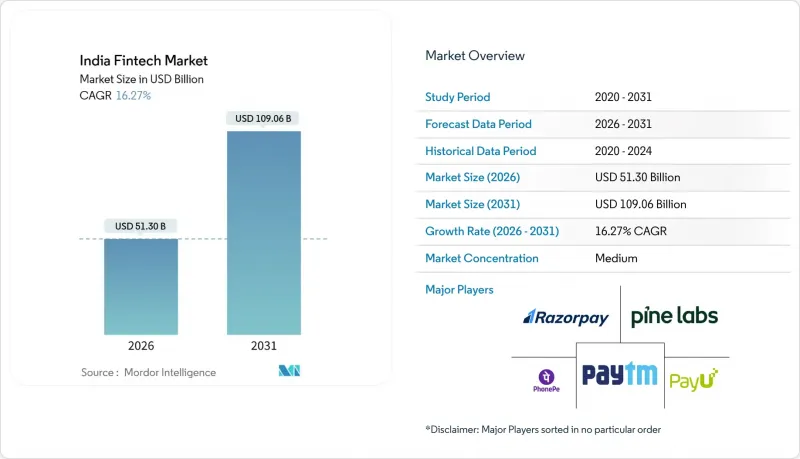
根據 Mordor Intelligence 預測,印度金融科技市場規模預計將在 2026 年達到 513 億美元,並在預測期(2026-2031 年)內以 16.27% 的複合年成長率成長,到 2031 年達到 1090.6 億美元。
本報告按服務(數位支付、數位借貸和資金籌措、數位投資、保險科技、新型銀行)、終端用戶(個人、企業)和用戶介面(行動應用、網頁/瀏覽器、POS/物聯網設備)進行分類。市場預測以美元計價。
印度金融科技市場的趨勢與洞察
政府建設的數位公共基礎設施(UPI、Aadhaar、OCEN)正在加速大眾市場的普及。
印度的即時支付基礎設施、基於Aadhaar的身份驗證以及可互通的資料共用平台正在攜手合作,消除先前阻礙大規模新客戶獲取和交易的障礙。 2023年,印度在全球即時支付市場的佔有率達到49%,支持商家接受模式,這些模式能夠從日常支付活動和海量日交易量中創造收入。截至2025年8月,Aadhaar驗證用戶已達22.1億,成人覆蓋率高達99.7%,彌合了KYC(了解你的客戶)差距,並縮短了印度金融科技市場的新客戶獲取流程。帳戶聚合網路將已授權使用者與超過26.1億個受支援的帳戶連接起來,使貸款機構和保險經銷商能夠在幾秒鐘內獲得檢驗的財務資料。這縮短了信用記錄有限的客戶的信用評估時間。隨著印度金融科技市場向半都市區和農村地區擴展覆蓋範圍,這些支付基礎設施正在共同產生規模經濟效益,從而推動支付、信貸、保險和投資等領域的綜合服務部署。
一個能夠實現資料驅動型信用評估的帳戶聚合框架。
帳戶聚合器 (AA) 框架規範了基於用戶許可的金融數據訪問,降低了與金融科技平台合作的銀行和非銀行金融機構 (NBFC) 的風險評估成本。透過授權的 AA 將銀行帳戶和其他金融資訊來源連接起來,貸款機構可以即時了解現金流情況,從而能夠向信用記錄有限的客戶提供小額營運資金和個人貸款。印度儲備銀行 (RBI) 廣泛的監管沙盒和數位借貸指南正在加強資訊揭露和申訴處理流程,隨著越來越多的貸款機構從螢幕擷取轉向可審計的許可模式,這將支持印度金融科技市場的永續發展。 API 和許可流程的標準化減少了人工檢驗的延遲,而這些延遲曾經將微型企業和零工人員排除在合法貸款之外。從長遠來看,基於檢驗交易歷史的信用評估將提高貸款組合質量,同時擴大印度金融科技市場首次借款人的准入範圍。
印度儲備銀行更嚴格的數位貸款和FLDG標準正在推高合規成本。
印度儲備銀行(RBI)關於數位借貸的指南加強了資訊揭露、託管資金分離和申訴處理等方面的要求,增加了印度金融科技市場平台及其受監管合作夥伴的固定合規成本。關於風險自留和違約擔保的澄清,將資本要求轉移到了貸款人和聯合貸款人身上,擠壓了那些依賴將風險轉移給銀行合作夥伴的經營模式的利潤空間。雖然大規模貸款機構和資本充足的平台能夠承擔這些成本,但隨著合規在印度金融科技市場成為規模優勢,小規模的業者正被迫退出市場或進行合併。印度儲備銀行的監管沙盒和監管重點引導產品設計朝著透明和客戶保護的方向發展,這降低了監管風險,但也減緩了實驗性服務的部署。這種調整將使永續貸款的創建優先於快速成長,數位借貸的擴張將受到限制,直到印度金融科技市場建立新的平衡。
細分市場分析
到2025年,數位支付將佔印度金融科技市場佔有率的42.87%。這主要得益於統一支付介面(UPI)的普及和商家的廣泛接受,使其在日常購物中成為一種習慣性使用方式。印度的即時支付基礎設施支撐著支付轉換率和商家信任,進而推動了印度金融科技市場中保險、貸款和資產管理產品的交叉銷售。印度金融科技產業正利用以應用程式為先導的使用者體驗和可互通的支付基礎設施,降低客戶獲取門檻,並將業務範圍從大都會圈擴展到都市區。聚合商為大中小型企業提供各種工具,包括買家保護和出口結算帳戶,使印度金融科技市場能夠實現商家金融卡費率(MDR)以外的利潤。隨著淨資產標準、規模經濟和合規成熟度的提高,支付聚合商的監管指南正在推動支付產業的重組。
預計2026年至2031年間,印度金融科技市場中的新銀行業務將以19.64%的複合年成長率成長,這主要得益於多銀行統一支付介面(UPI)模式和以應用程式為中心的帳戶在「數位優先」客戶群中的普及。新銀行在現有基礎設施的基礎上增加了預算管理、信貸取得和企業銀行服務等功能,從而提高了客戶維繫和手續費收入。由於強調風險承保標準和資訊揭露的流程增加了成本,同時與銀行合作的聯合貸款模式和更嚴格的貸款篩選也在推廣,因此數位貸款的成長預計在短期內將保持溫和。在印度金融科技市場,資產管理和保險聚合商正透過整合銷售管道和服務層級來擴大規模,同時利用大規模付款基礎進行交叉銷售,以維持客戶獲取。在預測期內,將支付、信貸和保險整合到統一介面中的服務提案有望在印度金融科技市場中獲得更高的用戶終身價值(LTV)。
其他好處:
- Excel格式的市場預測(ME)表
- 3個月的分析師支持
目錄
第1章:引言
- 研究假設和市場定義
- 調查範圍
第2章:調查方法
第3章執行摘要
第4章 市場狀況
- 市場概覽
- 市場促進因素
- 政府建設的數位公共基礎設施(UPI、Aadhaar、OCEN)正在加速在普通市場中的普及。
- 帳戶聚合框架:實現數據驅動的信用評估
- 電子商務與零工經濟平台對嵌入式金融的需求
- 隨著消費稅的引入,中小微型企業的正式分類為金融科技公司創造了一個新的需求領域,該公司的目標客戶是中小企業。
- 千禧世代和 Z 世代的財富累積努力正在推動低成本智慧投顧的普及。
- 跨境 UPI 合作夥伴關係(例如新加坡、阿拉伯聯合大公國)正在開闢新的匯款收入來源。
- 市場限制因素
- 印度儲備銀行的數位貸款和更嚴格的外國貸款開發監管規定正在推高合規成本。
- 零 MDR 政策給付款閘道。
- 網路詐騙案件數量的不斷增加正在削弱消費者的信任。
- 自 2022 年以來,「資金籌措困難」限制了擴大規模的資金籌措。
- 價值鏈分析
- 監管和技術展望
- 波特五力分析
- 投資和資金籌措分析
第5章 市場規模與成長預測
- 服務方案
- 數位支付
- 數位借貸和金融
- 數位投資
- 保險科技
- 新銀行
- 最終用戶
- 零售
- 公司
- 透過使用者介面
- 行動應用
- 網頁/瀏覽器
- POS/物聯網設備
第6章 競爭情勢
- 市場集中度
- 策略趨勢
- 市佔率分析
- 公司簡介
- Paytm(One97 Communications Ltd)
- PhonePe Pvt Ltd
- Razorpay Software Pvt Ltd
- Pine Labs Pvt Ltd
- PayU Payments Pvt Ltd
- BharatPe(Resilient Innovations Pvt Ltd)
- MobiKwik(One MobiKwik Systems Ltd)
- PolicyBazaar(PB Fintech Ltd)
- Zerodha Broking Ltd
- Upstox(RKSV Securities India Pvt Ltd)
- Groww(Nextbillion Technology Pvt Ltd)
- Cred Financial Technologies Pvt Ltd
- Slice(GaragePreneurs Internet Pvt Ltd)
- KreditBee(Finnov Pvt Ltd)
- Lendingkart Finance Ltd
- Capital Float(Axio Digital)
- NeoGrowth Credit Pvt Ltd
- Navi Technologies Ltd
- Jupiter(Amica Finance Pvt Ltd)
- NIYO Solutions Pvt Ltd
第7章 市場機會與未來展望
According to Mordor Intelligence, the India fintech market size is USD 51.30 billion in 2026 and is projected to reach USD 109.06 billion by 2031 at a 16.27% CAGR during the forecast period (2026-2031).
This report is Segmented by Service Proposition (Digital Payments, Digital Lending and Financing, Digital Investments, Insurtech, Neobanking), End-User (Retail, Businesses), and User Interface (Mobile Applications, Web/Browser, POS/IoT Devices). The Market Forecasts are Provided in Terms of Value (USD).
India Fintech Market Trends and Insights
Government-Built Digital Public Infrastructure (UPI, Aadhaar, OCEN) Accelerating Mass-Market Adoption
India's real-time payments infrastructure, Aadhaar-based identity, and interoperable data-sharing rails together remove friction that previously slowed onboarding and transactions at scale. India's share of global real-time payments reached 49% in 2023, which supports recurring payment behaviours and merchant acceptance models that monetize at large daily volumes. Aadhaar authentication hit 2.21 billion in August 2025, with adult coverage at 99.7%, which closes KYC gaps and shortens onboarding in the India fintech market. The Account Aggregator network has linked consented users to over 2.61 billion enabled accounts, allowing lenders and insurance distributors to retrieve verified financial data within seconds, which compresses underwriting timelines for thin-file customers. Together, these rails power scale economics that favour embedded journeys across payments, credit, insurance, and investments as the India fintech market deepens coverage in semi-urban and rural districts.
Account Aggregator Framework Unlocking Data-Driven Credit Underwriting
The Account Aggregator framework normalizes consent-based access to financial data and reduces the cost of risk assessment for banks and NBFCs partnering with fintech platforms. With users connecting bank accounts and other financial repositories through licensed AAs, lenders derive a real-time view of cash flows, which supports extensions of small-ticket working capital and personal credit to thin-file customers. RBI's broader regulatory sandbox and digital lending directions strengthen disclosures and grievance processes, which support sustainable scale for the India fintech market as more lenders shift from screen-scraping to auditable consent models. Standardization across APIs and consent flows lowers manual verification delays that once kept micro-entrepreneurs and gig workers outside formal credit. Over time, underwriting that relies on verified transaction trails improves portfolio quality while increasing access for first-time borrowers in the India fintech market.
RBI's Stricter Digital-Lending and FLDG Norms Raising Compliance Cost
RBI's digital lending directions strengthen disclosures, escrow segregation, and grievance handling, which increases fixed compliance costs for platforms and their regulated partners in the India fintech market. Clarifications around risk retention and default guarantees shift capital requirements to lenders and co-lenders, which compresses margins for models that depended on risk transfer to bank partners. Larger lenders and well-capitalized platforms can absorb these costs, while smaller entities face exit or consolidation as compliance becomes a scale advantage in the India fintech market. RBI's sandbox and supervisory focus push product design toward transparency and customer protection, which reduces regulatory risk but slows experimental rollouts. This recalibration prioritizes sustainable origination over rapid growth, which tempers expansion in digital lending before a new equilibrium emerges in the India fintech market.
Other drivers and restraints analyzed in the detailed report include:
- Embedded-Finance Demand from E-commerce and Gig-Economy Platforms
- Formalization of MSMEs Post-GST Creating New SME Fintech Demand Pools
- Zero-MDR Policy Compressing Payment-Gateway Profit Pools
For complete list of drivers and restraints, kindly check the Table Of Contents.
Segment Analysis
Digital payments captured 42.87% of the India fintech market share in 2025, anchored by UPI's scale and merchant acceptance that sustains habitual usage across daily purchases. India's real-time rail supports checkout conversion and merchant trust, which anchors cross-sell into protection, loan, and wealth products across the India fintech market. The India fintech industry uses app-first journeys and interoperable rails to reduce acquisition friction and extend reach beyond metros into semi-urban districts. Aggregators ship enterprise and SMB tools, including buyer protection and export settlement accounts, which create monetization beyond MDR in the India fintech market. As regulatory guidance on payment aggregators raises net worth thresholds, scale advantages, and compliance maturity, it drives consolidation within payments.
The India fintech market size for neobanking is projected to expand at a 19.64% CAGR between 2026 and 2031 as multi-bank UPI models and app-centric accounts deepen usage among digital-first customers. Neobanks layer budgeting, credit access, and business banking features on top of existing rails, which improves retention and fee capture in the India fintech market. Digital lending growth moderates in the near term as risk retention norms and disclosure-heavy processes add cost, which encourages co-lending models with banks and more selective origination. Wealth and insurance aggregators scale by combining distribution with service layers, while maintaining customer acquisition through cross-sell on a large payment basis in the India fintech market. Over the forecast period, propositions that bundle payments, credit, and protection into unified interfaces are positioned to capture higher lifetime value per user in the India fintech market.
Complete Report Scope:
- By Service Proposition
- Digital Payments
- Digital Lending and Financing
- Digital Investments
- Insurtech
- Neobanking
- By End-User
- Retail
- Businesses
- By User Interface
- Mobile Applications
- Web / Browser
- POS / IoT Devices
List of Companies Covered in this Report:
- Paytm (One97 Communications Ltd)
- PhonePe Pvt Ltd
- Razorpay Software Pvt Ltd
- Pine Labs Pvt Ltd
- PayU Payments Pvt Ltd
- BharatPe (Resilient Innovations Pvt Ltd)
- MobiKwik (One MobiKwik Systems Ltd)
- PolicyBazaar (PB Fintech Ltd)
- Zerodha Broking Ltd
- Upstox (RKSV Securities India Pvt Ltd)
- Groww (Nextbillion Technology Pvt Ltd)
- Cred Financial Technologies Pvt Ltd
- Slice (GaragePreneurs Internet Pvt Ltd)
- KreditBee (Finnov Pvt Ltd)
- Lendingkart Finance Ltd
- Capital Float (Axio Digital)
- NeoGrowth Credit Pvt Ltd
- Navi Technologies Ltd
- Jupiter (Amica Finance Pvt Ltd)
- NIYO Solutions Pvt Ltd
Additional Benefits:
- The market estimate (ME) sheet in Excel format
- 3 months of analyst support
TABLE OF CONTENTS
1 Introduction
- 1.1 Study Assumptions & Market Definition
- 1.2 Scope of the Study
2 Research Methodology
3 Executive Summary
4 Market Landscape
- 4.1 Market Overview
- 4.2 Market Drivers
- 4.2.1 Government-Built Digital Public Infrastructure (UPI, Aadhaar, OCEN) Accelerating Mass-Market Adoption
- 4.2.2 Account Aggregator Framework Unlocking Data-Driven Credit Underwriting
- 4.2.3 Embedded-Finance Demand from E-commerce & Gig-Economy Platforms
- 4.2.4 Formalization of MSMEs post-GST Creating New SME Fintech Demand Pools
- 4.2.5 Millennial & Gen-Z Wealth Creation Driving Low-Cost Robo-Advisory Uptake
- 4.2.6 Cross-Border UPI Linkages (e.g., Singapore, UAE) Opening New Remittance Revenues
- 4.3 Market Restraints
- 4.3.1 RBI's Stricter Digital-Lending & FLDG Norms Raising Compliance Cost
- 4.3.2 Zero-MDR Policy Compressing Payment-Gateway Profit Pools
- 4.3.3 Escalating Cyber-Fraud Incidents Undermining Consumer Trust
- 4.3.4 Post-2022 Funding Winter Constraining Scale-Up Capital
- 4.4 Value Chain Analysis
- 4.5 Regulatory or Technological Outlook
- 4.6 Porter's Five Forces Analysis
- 4.6.1 Threat of New Entrants
- 4.6.2 Bargaining Power of Suppliers
- 4.6.3 Bargaining Power of Buyers
- 4.6.4 Threat of Substitutes
- 4.6.5 Competitive Rivalry
- 4.7 Investment & Funding Trend Analysis
5 Market Size & Growth Forecasts (Value)
- 5.1 By Service Proposition
- 5.1.1 Digital Payments
- 5.1.2 Digital Lending and Financing
- 5.1.3 Digital Investments
- 5.1.4 Insurtech
- 5.1.5 Neobanking
- 5.2 By End-User
- 5.2.1 Retail
- 5.2.2 Businesses
- 5.3 By User Interface
- 5.3.1 Mobile Applications
- 5.3.2 Web / Browser
- 5.3.3 POS / IoT Devices
6 Competitive Landscape
- 6.1 Market Concentration
- 6.2 Strategic Moves
- 6.3 Market Share Analysis
- 6.4 Company Profiles {(includes Global level Overview, Market level overview, Core Segments, Financials as available, Strategic Information, Market Rank/Share for key companies, Products & Services, and Recent Developments)}
- 6.4.1 Paytm (One97 Communications Ltd)
- 6.4.2 PhonePe Pvt Ltd
- 6.4.3 Razorpay Software Pvt Ltd
- 6.4.4 Pine Labs Pvt Ltd
- 6.4.5 PayU Payments Pvt Ltd
- 6.4.6 BharatPe (Resilient Innovations Pvt Ltd)
- 6.4.7 MobiKwik (One MobiKwik Systems Ltd)
- 6.4.8 PolicyBazaar (PB Fintech Ltd)
- 6.4.9 Zerodha Broking Ltd
- 6.4.10 Upstox (RKSV Securities India Pvt Ltd)
- 6.4.11 Groww (Nextbillion Technology Pvt Ltd)
- 6.4.12 Cred Financial Technologies Pvt Ltd
- 6.4.13 Slice (GaragePreneurs Internet Pvt Ltd)
- 6.4.14 KreditBee (Finnov Pvt Ltd)
- 6.4.15 Lendingkart Finance Ltd
- 6.4.16 Capital Float (Axio Digital)
- 6.4.17 NeoGrowth Credit Pvt Ltd
- 6.4.18 Navi Technologies Ltd
- 6.4.19 Jupiter (Amica Finance Pvt Ltd)
- 6.4.20 NIYO Solutions Pvt Ltd
7 Market Opportunities & Future Outlook
- 7.1 White-Space & Unmet-Need Assessment

 中東和北非金融科技:市場佔有率分析、行業趨勢和統計數據以及成長預測(2026-2031 年)亞太地區金融科技:市場佔有率分析、產業趨勢與統計及成長預測(2026-2031)北美金融科技:市佔率分析、產業趨勢與統計及成長預測(2026-2031)德國金融科技:市場佔有率分析、產業趨勢與統計及成長預測(2026-2031)新加坡金融科技:市場佔有率分析、產業趨勢與統計及成長預測(2026-2031)歐洲金融科技:市場佔有率分析、產業趨勢與統計及成長預測(2026-2031)越南金融科技:市場佔有率分析、產業趨勢與統計及成長預測(2026-2031)馬來西亞金融科技:市場佔有率分析、產業趨勢與統計及成長預測(2026-2031)金融科技:市場佔有率分析、產業趨勢與統計、成長預測(2025-2030)
 金融科技即服務 (FaaS) 市場 - 全球市場預測 2026-2032