


 |
市場調查報告書
商品編碼
2116293
德國金融科技:市場佔有率分析、產業趨勢與統計及成長預測(2026-2031)Germany Fintech - Market Share Analysis, Industry Trends & Statistics, Growth Forecasts (2026 - 2031) |
||||||

※ 本網頁內容可能與最新版本有所差異。詳細情況請與我們聯繫。
根據 Mordor Intelligence 估計,德國金融科技市場在 2026 年的價值將達到 167.1 億美元,高於 2025 年的 145.7 億美元,預計到 2031 年將達到 331.6 億美元。
預計從 2026 年到 2031 年,其複合年成長率將達到 14.71%。
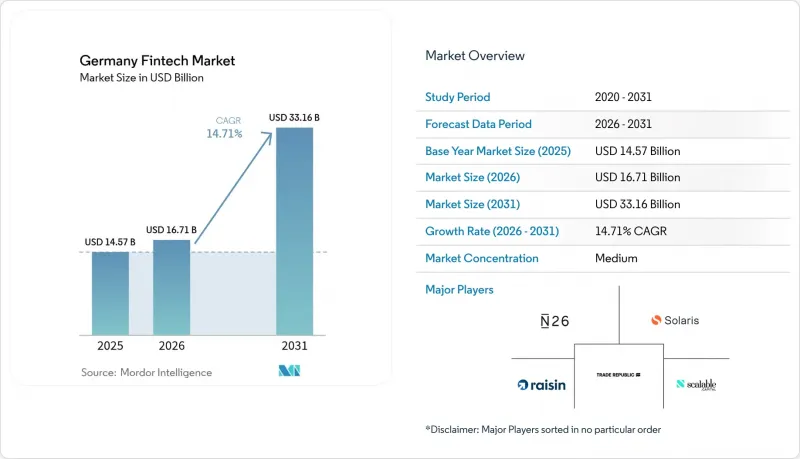
本報告按服務領域(數位支付、數位借貸和資金籌措、數位投資、保險科技、新型銀行)、終端用戶(個人和企業)以及用戶介面(行動應用、網頁/瀏覽器、POS/物聯網設備)進行分類。市場預測以美元計價。
德國金融科技市場的趨勢與洞察
以PSD2為驅動力的開放銀行正在加速API創新。
PSD2 強制引入的 API 閘道促使德國銀行業從最初的抵觸態度轉向了獲利模式。德國聯邦金融監理局 (BaFin) 對安全 API 的強制性要求,使得 2024 年註冊的第三方 API 提供者數量達到 187 家,年增 23%。如今,金融機構正在開發者體驗 (DevOps) 領域競爭。德意志銀行的「XS2A」沙盒支援帳戶整合,而儲蓄銀行集團則為電子商務支付流程提供即時支付發起功能。曾經被視為推廣障礙的強客戶身份驗證,如今卻透過降低詐欺風險和標準化安全性,幫助金融科技公司無需進行專有整合開發即可擴展業務規模。從合規性轉向商業 API 組合,使得開放銀行成為推動德國金融科技市場持續成長的驅動力。
都市區Z世代和千禧世代的行動優先銀行模式正在發生人口結構變化
35歲以下的消費者很少光顧分店,他們期望透過智慧型手機即時開戶、驗證帳戶資訊並進行投資操作。在都市區,普及率不僅反映下載量,也反映實際使用情況。活躍的行動銀行用戶每月登入15-20次,是2022年的兩倍。這種行動化趨勢也延伸到了投資領域,在首次投資者中,零碎股票交易平台的表現優於傳統理財顧問。那些能夠兼顧卓越用戶體驗和存款保障的供應商正在擴大市場佔有率,而行動遲緩的老牌企業則面臨品牌影響力下降的風險。
德國老年人更偏愛現金。
現金交易仍佔據相當大的比例,其中大部分交易者是65歲及以上的老年人。本地零售商透過提供現金支付折扣來強化這個習慣。金融科技公司則以混合支付方式來因應。例如,Paysafe和德意志銀行正在共同開發郵局的現金存取服務,而G+D正在試行一種功能類似線下紙幣的央行數位貨幣(CBDC)。然而,同時管理數位註冊和店內培訓的需求增加了獲客成本,從而限制了完全無現金社會提案的獲利能力。
細分市場分析
數位支付在德國金融科技市場佔據37.65%的佔有率。隨著商家採用非接觸式POS機、QR碼和嵌入式結帳API,支付服務成為主要的收入來源。相較之下,保險科技目前市佔率較小,但預計將以17.98%的複合年成長率成長,這主要得益於參數型作物保險、基於使用量的汽車保險和人工智慧驅動的理賠處理。支付專家透過忠誠度附加元件維持市場佔有率,而保險新興企業則將承保、銷售和保單管理整合到雲端平台上。
新銀行、貸款和財富科技構成了中層市場。貸款領域正從消費分期付款轉向基於即時ERP數據評估的營運資金貸款。財富科技普及了ETF和零碎資產投資,但費用壓力迫使各平台提升銷售加密貨幣託管、ESG篩選和稅務最佳化等服務。因此,德國金融科技市場正從橫向的「金融超級應用」轉向深度實現單一收入來源獲利的垂直領域領導企業。
其他好處:
- Excel格式的市場預測(ME)表
- 3個月的分析師支持
目錄
第1章:引言
- 研究假設和市場定義
- 調查範圍
第2章:調查方法
第3章執行摘要
第4章 市場狀況
- 市場概覽
- 市場促進因素
- PSD2支援的開放銀行的引入正在加速德國基於API的創新。
- 都市區Z 世代和千禧世代的銀行消費習慣正向「行動優先」轉變。
- 德國電子商務交易量的激增正在推動嵌入式支付解決方案的擴張。
- 數位財資現代化正在擴大對B2B金融科技的需求。
- 即時支付正在加速即時支付的普及。
- 歐盟的綠色金融政策正在推動永續金融科技產品的發展。
- 市場限制因素
- 德國老年消費者對現金的偏好仍然存在
- 德國聯邦金融監理局 (BaFin) 嚴格的許可核准流程導致產品上市時間延長。
- B輪及以後階段創業投資(VC)資金籌措的減少限制了規模擴張。
- 現有銀行傳統IT系統的碎片化阻礙了金融科技的整合。
- 價值供應鏈分析
- 監理展望
- 技術展望
- 波特五力模型
- 投資和資金籌措分析
第5章 市場規模與成長預測
- 服務方案
- 數位支付
- 數位借貸和金融
- 數位投資
- 保險科技
- 新銀行
- 最終用戶
- 零售
- 公司
- 透過使用者介面
- 行動應用
- 網頁/瀏覽器
- POS/物聯網設備
第6章 競爭情勢
- 市場集中度
- 策略趨勢
- 市佔率分析
- 公司簡介
- N26 GmbH
- Solaris SE
- Trade Republic Bank GmbH
- Raisin DS GmbH
- Penta Bank GmbH(Qonto Group)
- Scalable Capital GmbH
- Clark Germany GmbH
- Getsafe Digital GmbH
- Wefox Germany GmbH
- Fidor Bank AG
- Unzer GmbH
- Payone GmbH
- RatePAY GmbH
- Billie GmbH
- Mambu GmbH
- Deposit Solutions GmbH
- Vivid Money GmbH
- Tomorrow Bank GmbH
- Auxmoney GmbH
- Moonfare GmbH
第7章 市場機會與未來展望
According to Mordor Intelligence, Germany fintech market size in 2026 is estimated at USD 16.71 billion, growing from 2025 value of USD 14.57 billion with 2031 projections showing USD 33.16 billion, growing at 14.71% CAGR over 2026-2031.
This report is Segmented by Service Proposition (Digital Payments, Digital Lending and Financing, Digital Investments, Insurtech, and Neobanking), by End-User (Retail and Businesses), and by User Interface (Mobile Applications, Web / Browser, and POS / IoT Devices). The Market Forecasts are Provided in Terms of Value (USD).
Germany Fintech Market Trends and Insights
PSD2-driven open banking accelerates API innovation
Mandatory API gateways introduced under PSD2 have moved German banks from resistance to monetization. BaFin's secure-API mandate spawned 187 registered third-party providers in 2024, a 23% jump year-on-year. Institutions now compete on developer experience: Deutsche Bank's XS2A sandbox underpins account aggregation, and savings-bank groups package real-time payment initiation for e-commerce checkouts. Strong customer authentication, once viewed as friction, reduces fraud exposure and standardizes security, allowing fintechs to scale without bespoke integrations. The shift from compliance to commercial API portfolios positions open banking as a durable growth rail for the Germany fintech market.
Demographic shift toward mobile-first banking among urban Gen Z and millennials
Consumers under 35 rarely visit branches and expect instant onboarding, account insights, and investment execution on a smartphone. Urban adoption rates translate into usage rather than just downloads: active mobile-bank users log in 15-20 times a month, double 2022 levels. This mobile bias extends to investing, where fractional-share platforms eclipse traditional advisors for first-time investors. Providers that pair sleek UX with deposit protection win share, while slower incumbents risk brand relevance.
Persistent cash preference among older Germans
Cash still accounts for a significant portion of transactions, with the 65+ cohort driving most usage. Rural merchants reinforce habits by offering cash discounts. Fintechs respond with hybrid rails: Paysafe and Deutsche Bank co-develop cash-in/cash-out at post offices, while G+D pilots a CBDC that mimics banknotes offline. Yet acquisition costs rise when digital onboarding must coexist with in-store education, capping the upside for fully cashless propositions.
Other drivers and restraints analyzed in the detailed report include:
- Surge in German e-commerce volumes fuels embedded payment solutions
- Digital treasury modernization expands B2B fintech demand
- Stringent BaFin licensing extends time-to-market
For complete list of drivers and restraints, kindly check the Table Of Contents.
Segment Analysis
Digital payments held a 37.65% share of Germany fintech market. Merchant adoption of contactless POS, QR codes, and embedded checkout APIs has made payment services the default monetization rail. Insurtech, in contrast, captures a modest slice today yet is forecasted to grow at an 17.98% CAGR, reflecting parametric crop cover, usage-based auto policies, and AI-driven claims. Payment specialists defend share through loyalty add-ons, while insurance challengers bundle underwriting, distribution, and policy administration on cloud cores.
Neobanking, lending, and wealth-tech form the middle ranks. Lending moves from consumer instalments to working-capital lines scored on real-time ERP data. Wealth-tech democratizes ETFs and fractions, but fee pressure forces platforms to upsell crypto custody, ESG filters, and tax optimization. The Germany fintech market, therefore, tilts from horizontal "finance-super-apps" toward vertical leaders that monetize a single profit pool deeply.
Complete Report Scope:
- By Service Proposition
- Digital Payments
- Digital Lending and Financing
- Digital Investments
- Insurtech
- Neobanking
- By End-User
- Retail
- Businesses
- By User Interface
- Mobile Applications
- Web / Browser
- POS / IoT Devices
List of Companies Covered in this Report:
- N26 GmbH
- Solaris SE
- Trade Republic Bank GmbH
- Raisin DS GmbH
- Penta Bank GmbH (Qonto Group)
- Scalable Capital GmbH
- Clark Germany GmbH
- Getsafe Digital GmbH
- Wefox Germany GmbH
- Fidor Bank AG
- Unzer GmbH
- Payone GmbH
- RatePAY GmbH
- Billie GmbH
- Mambu GmbH
- Deposit Solutions GmbH
- Vivid Money GmbH
- Tomorrow Bank GmbH
- Auxmoney GmbH
- Moonfare GmbH
Additional Benefits:
- The market estimate (ME) sheet in Excel format
- 3 months of analyst support
TABLE OF CONTENTS
1 Introduction
- 1.1 Study Assumptions & Market Definition
- 1.2 Scope of the Study
2 Research Methodology
3 Executive Summary
4 Market Landscape
- 4.1 Market Overview
- 4.2 Market Drivers
- 4.2.1 PSD2-Driven Open Banking Adoption Accelerating API-Based Innovation in Germany
- 4.2.2 Demographic Shift Toward Mobile-First Banking Among Urban Gen Z & Millennials
- 4.2.3 Surge in German E-Commerce Volumes Fueling Embedded Payment Solutions
- 4.2.4 Digital Treasury Modernization Expanding B2B Fintech Demand
- 4.2.5 Instant Payment Settlement Enabling Real-Time Payment Proliferation
- 4.2.6 EU Green Finance Policies Steering Growth of Sustainable Fintech Products
- 4.3 Market Restraints
- 4.3.1 Persistent Cash Preference Among Older German Consumers
- 4.3.2 Stringent BaFin Licensing Process Extending Time-to-Market
- 4.3.3 VC Funding Contraction in Series B+ Stage Limiting Scale-ups
- 4.3.4 Legacy IT Fragmentation at Incumbent Banks Hindering Fintech Integrations
- 4.4 Value / Supply-Chain Analysis
- 4.5 Regulatory Outlook
- 4.6 Technological Outlook
- 4.7 Porter's Five Forces
- 4.7.1 Threat of New Entrants
- 4.7.2 Bargaining Power of Suppliers
- 4.7.3 Bargaining Power of Buyers
- 4.7.4 Threat of Substitutes
- 4.7.5 Competitive Rivalry
- 4.8 Investment & Funding Trend Analysis
5 Market Size & Growth Forecasts (Value)
- 5.1 By Service Proposition
- 5.1.1 Digital Payments
- 5.1.2 Digital Lending and Financing
- 5.1.3 Digital Investments
- 5.1.4 Insurtech
- 5.1.5 Neobanking
- 5.2 By End-User
- 5.2.1 Retail
- 5.2.2 Businesses
- 5.3 By User Interface
- 5.3.1 Mobile Applications
- 5.3.2 Web / Browser
- 5.3.3 POS / IoT Devices
6 Competitive Landscape
- 6.1 Market Concentration
- 6.2 Strategic Moves
- 6.3 Market Share Analysis
- 6.4 Company Profiles (includes Global level Overview, Market Level Overview, Core Segments, Financials as available, Strategic Information, Market Rank/Share for Key Companies, Products & Services, and Recent Developments)
- 6.4.1 N26 GmbH
- 6.4.2 Solaris SE
- 6.4.3 Trade Republic Bank GmbH
- 6.4.4 Raisin DS GmbH
- 6.4.5 Penta Bank GmbH (Qonto Group)
- 6.4.6 Scalable Capital GmbH
- 6.4.7 Clark Germany GmbH
- 6.4.8 Getsafe Digital GmbH
- 6.4.9 Wefox Germany GmbH
- 6.4.10 Fidor Bank AG
- 6.4.11 Unzer GmbH
- 6.4.12 Payone GmbH
- 6.4.13 RatePAY GmbH
- 6.4.14 Billie GmbH
- 6.4.15 Mambu GmbH
- 6.4.16 Deposit Solutions GmbH
- 6.4.17 Vivid Money GmbH
- 6.4.18 Tomorrow Bank GmbH
- 6.4.19 Auxmoney GmbH
- 6.4.20 Moonfare GmbH
7 Market Opportunities & Future Outlook
- 7.1 White-Space & Unmet-Need Assessment

 中東和北非金融科技:市場佔有率分析、行業趨勢和統計數據以及成長預測(2026-2031 年)亞太地區金融科技:市場佔有率分析、產業趨勢與統計及成長預測(2026-2031)北美金融科技:市佔率分析、產業趨勢與統計及成長預測(2026-2031)新加坡金融科技:市場佔有率分析、產業趨勢與統計及成長預測(2026-2031)歐洲金融科技:市場佔有率分析、產業趨勢與統計及成長預測(2026-2031)越南金融科技:市場佔有率分析、產業趨勢與統計及成長預測(2026-2031)馬來西亞金融科技:市場佔有率分析、產業趨勢與統計及成長預測(2026-2031)金融科技:市場佔有率分析、產業趨勢與統計、成長預測(2025-2030)印度金融科技:市場佔有率分析、產業趨勢與統計及成長預測(2026-2031)
 金融科技即服務 (FaaS) 市場 - 全球市場預測 2026-2032