


 |
市場調查報告書
商品編碼
2099054
伊斯蘭金融科技:市場佔有率分析、產業趨勢與統計及成長預測(2026-2031)Islamic Fintech - Market Share Analysis, Industry Trends & Statistics, Growth Forecasts (2026 - 2031) |
||||||

※ 本網頁內容可能與最新版本有所差異。詳細情況請與我們聯繫。
根據 Mordor Intelligence 預測,伊斯蘭金融科技市場規模預計將在 2025 年達到 1,863.2 億美元,2026 年達到 2,225.8 億美元,2031 年達到 5,150.6 億美元,2026 年至 2031 年的複合年成長率為 18.27%。
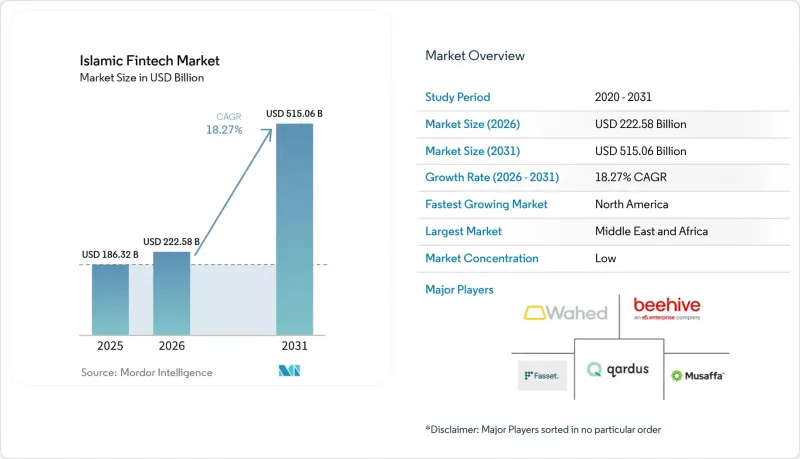
本報告按服務類型(數位支付、電子錢包和匯款、數位金融和借貸等)、部署方式(雲端、本地部署、混合部署)、最終用戶(個人、中小企業等)和地區(北美、南美等)進行細分。市場預測以美元計價。
全球伊斯蘭金融科技市場趨勢與洞察
對符合伊斯蘭教法的數位金融服務的需求日益成長
伊斯蘭金融科技市場的需求與長期的人口結構和行為變化密切相關,而非短期資金籌措週期。全球穆斯林人口超過18億,其中大多數是年輕一代,他們早已習慣使用行動優先的銀行服務。此外,透明度、抵押和風險共擔等伊斯蘭金融原則與監管框架內認可的更廣泛的倫理金融理念相契合,這意味著目標基本客群並不局限於宗教信仰的需求。在印尼,印尼央行將符合伊斯蘭教法的產品與2030年實現90%成人金融普惠的目標掛鉤,這表明消費者需求可以在政策支持下擴展到一定規模。在這樣的政策支持下,伊斯蘭金融科技市場正從利基市場轉向在主要穆斯林人口占多數的經濟體中扮演更核心的數位金融分銷角色。
清真經濟在支付、資產管理和資金籌措。
伊斯蘭金融科技市場也受益於清真經濟在支付、貸款和資產配置等領域的廣泛擴張。關鍵不僅在於交易量的成長,更在於符合伊斯蘭教法的支付關係如今已與貸款和投資產品直接關聯,為客戶帶來全新的體驗。 QFC發布的《2025/26年全球伊斯蘭金融科技報告》指出了這項不斷擴大的機遇,顯示企業正日益傾向於建立更廣泛的產品生態系統,而非僅僅開發單一功能的應用程式。這一趨勢在資產管理領域尤為顯著,企業正透過數位化管道為以往服務不足的客戶群提供符合伊斯蘭教法的投資機會。 2026年4月,Waheed Invest面向美國非合格零售投資者推出了一隻完全符合伊斯蘭教法的獨棟住宅房地產基金,這表明清真經濟正擴展到個人投資者(包括海外僑民)可觸及的資產管理產品領域。
不同司法管轄區對伊斯蘭教法的解釋有所不同。
不同司法管轄區對伊斯蘭教法的解讀存在差異,這仍然是限制伊斯蘭金融科技市場發展的最嚴重結構性障礙之一。在一個司法管轄區獲批准的產品結構,往往需要在另一個司法管轄區進行全面重新評估,這阻礙了尋求在多個市場獲得牌照的公司進行跨境業務擴張。 IFSB-31是現有文件中為提高監管一致性而做出的最系統性努力,它為監管機構和金融機構創建了一個更清晰的管治框架。然而,由於該標準並非對所有國家體係都具有約束力,因此在可預見的未來,不同司法管轄區對伊斯蘭教法(fiqf)的解讀以及當地監管實踐的差異仍將是實際存在的障礙。因此,能夠建構足夠靈活的治理架構以適應多個國家框架的管治,而非僅依賴單一的核准途徑,將維持持久的競爭優勢。
細分市場分析
到2025年,數位支付、電子錢包和匯款將佔伊斯蘭金融科技市場收入的54.8%,並繼續佔據核心地位。這是因為數位支付是交易基礎設施率先達到商業規模並獲得監管批准的領域。伊斯蘭金融科技市場仍依賴這一領域來獲取用戶,因為支付活動能夠建立最初的合規關係,從而為後續的貸款、投資和其他服務提供支援。預計到2031年,監管科技(RegTech)、伊斯蘭教法管治和合規工具將以24.6%的複合年成長率成長,成為伊斯蘭金融科技市場成長最快的服務類別。這一成長反映了合規實施方式的轉變,迭代式軟體邏輯正在取代臨時性的人工審核流程。隨著監管框架賦予金融機構更多理由將合規系統作為持續營運基礎設施而非偶爾的諮詢費用累計,預計這種轉變將進一步深化。
監管科技(RegTech)的重要性不僅在於其作為一項重要的收入來源,更在於它能夠改善所有其他依賴伊斯蘭教法核准、報告或審計流程的服務線的經濟效益。其影響在伊斯蘭資本市場尤為顯著,數位化技術驅動的發行和管治工具能夠縮短流程週期並擴大參與。 2026年4月,馬來西亞國庫控股(Khazanah Nacional)和馬來西亞證券委員會(Malaysian Securities Commission)根據Wakara bi Al Istismar協議,為馬來西亞首個代幣化伊斯蘭債券(Soukkuk)定價,發行規模為1億馬來西亞馬幣(約合2500萬美元)。馬來亞銀行(Maybank)擔任此次交易的聯席主承銷商、託管人和牽頭用戶。這項交易意義重大,因為它顯示數位化基礎設施能夠切實有效地支持政府擔保的伊斯蘭資本市場產品,同時也符合更廣泛的市場趨勢。預計到 2024 年,全球伊斯蘭債券發行量將達到 2,050 億美元,到 2025 年第三季度,伊斯蘭債券未償餘額預計將超過 1 兆美元,這證實了未來數位原生資本市場活動正在奠定堅實的基礎。
區域分析
中東和非洲地區在2025年貢獻了51.6%的收入,成為伊斯蘭金融科技市場最大的區域貢獻者。這反映的是該地區的結構性優勢,而非短期資金籌措週期。該地區受益於長期完善的伊斯蘭金融監管體系、普惠金融舉措以及支持符合伊斯蘭教法的數位金融的「耐心資本」。沙烏地阿拉伯和海灣合作理事會(GCC)成員國已超越基礎部署階段,目前正在建立可擴展的符合伊斯蘭教法的數位銀行、貸款和資本市場模式,這些模式可以推廣到其他地區。類似的區域優勢也體現在管治和基礎設施發展優先事項上,監管機構和金融機構支持能夠實現產品廣泛部署並同時保持更嚴格合規控制的解決方案。這解釋了為什麼儘管其他地區的成長機會不斷擴大,伊斯蘭金融科技市場仍然紮根於中東和非洲地區。
亞太地區的成長模式與其他地區有所不同,其特點是穆斯林人口大規模、資本市場基礎設施完善,以及積極的政策方向推動了該地區的規模擴張。馬來西亞在其中扮演核心角色,其伊斯蘭資本市場規模達2.7兆馬幣(約6,600億美元),佔該國資本市場總額的64%,並在ICD-LSEG伊斯蘭金融發展指數中連續13年位居榜首。馬來西亞也積極推動伊斯蘭金融科技市場向數位轉型,其《2026-2031年資本市場總體規劃》呼籲引入人工智慧驅動的數位伊斯蘭教法篩選系統,並在市場發展中更加注重「伊斯蘭教法目的」(Maksid al-Sharia)。 2026年4月,馬來西亞首個代幣化市集試點計畫正式啟動,為利用數位技術在伊斯蘭資本市場發行產品建立了一個切實可行的模式。印尼也是一個重要的市場。這是因為,由於該國的普惠金融策略,符合伊斯蘭教法的金融在擴大所有公民的金融取得管道方面發揮直接的政策作用。
預計到2031年,北美將以22.5%的複合年成長率成長,成為伊斯蘭金融科技市場成長最快的區域市場。這一成長反映了海外僑民市場尚未得到滿足的需求,因為當地獲得許可的符合伊斯蘭教法的數位金融產品有限。 2026年4月,Wahed在美國推出了一隻面向零售投資者的符合伊斯蘭教法的住宅房地產基金,這表明伊斯蘭資產管理產品正在從高淨值人群擴展到更廣泛的零售投資者群體。歐洲,尤其是英國,在伊斯蘭金融的穩固基礎上持續成長。南美洲雖然規模仍然較小,但由於其與清真經濟的聯繫以及海外僑民日益成長的需求,提供了一條長期的進入路徑。
其他好處:
- Excel格式的市場預測(ME)表
- 3個月的分析師支持
目錄
第1章:引言
- 研究假設和市場定義
- 調查範圍
第2章:調查方法
第3章執行摘要
第4章 市場狀況
- 市場概覽
- 市場促進因素
- 對符合伊斯蘭教法的數位金融服務的需求日益成長
- 清真經濟在支付、資產管理和資金籌措。
- 伊斯蘭銀行透過金融科技快速數位化和服務提供
- 為伊斯蘭金融科技新創公司提供創業融資和生態系統支持
- 利用嵌入式金融和應用程式介面提供符合伊斯蘭教法的產品。
- 天課的數位化和瓦克夫的現代化正在創造新的交易流。
- 市場限制因素
- 不同司法管轄區對伊斯蘭教法的解讀各不相同。
- 消費者對新型伊斯蘭金融產品的信心有限。
- 新成立的公司在合規和伊斯蘭教法管治的高成本
- 跨境授權和資料本地化方面的摩擦
- 價值鏈分析
- 監理情勢
- 技術展望
- 波特五力分析
第5章 市場規模與成長預測
- 按服務類型
- 數位支付、電子錢包、轉賬
- 數位金融和貸款
- 伊斯蘭債券和伊斯蘭資本市場
- 伊斯蘭保險與伊斯蘭保險科技
- 財富管理、智慧投顧、數位投資
- 監管科技、伊斯蘭教法管治與合規
- 其他(替代性融資、群眾集資等)
- 不同的發展
- 雲
- 現場
- 混合
- 最終用戶
- 個人
- 小型企業
- 大型企業和機構投資者
- 政府、公共部門和發展機構
- 按地區
- 北美洲
- 美國
- 加拿大
- 南美洲
- 巴西
- 其他南美國家
- 歐洲
- 德國
- 英國
- 法國
- 俄羅斯
- 其他歐洲國家
- 亞太地區
- 中國
- 印度
- 印尼
- 馬來西亞
- 日本
- 其他亞太國家
- 中東和非洲
- 沙烏地阿拉伯
- 阿拉伯聯合大公國
- 卡達
- 巴林
- 土耳其
- 南非
- 其他中東和非洲國家
- 北美洲
第6章 競爭情勢
- 市場集中度
- 策略趨勢
- 市佔率分析
- 公司簡介
- Wahed Invest Limited
- Fasset
- Qardus
- Beehive P2P Limited
- Musaffa
- NymCaro
- Raqamyah
- Codebase Technologies
- PayHalal
- ShariaPortfolio
- Tabby
- PayTabs
- Sarwa
- CoinMENA
- Rain
- Ruya Bank
- SmartCrowd
- Haball
- Mal
- NymCard
第7章 市場機會與未來展望
According to Mordor Intelligence, the islamic fintech market size is projected to be USD 186.32 billion in 2025, USD 222.58 billion in 2026, and reach USD 515.06 billion by 2031, growing at a CAGR of 18.27% from 2026 to 2031.
This report is Segmented by Service Type (Digital Payments, Wallets & Remittances, Digital Financing & Lending, and More), by Deployment (Cloud, On-Premise, Hybrid), by End-User (Individuals, Small and Medium Enterprises, and More), and by Geography (North America, South America, and More). The Market Forecasts are Provided in Terms of Value (USD).
Global Islamic Fintech Market Trends and Insights
Rising Demand for Shariah-Compliant Digital Financial Services
Demand in the Islamic fintech market is tied to long-term demographic and behavioral shifts rather than to short-term funding cycles. The global Muslim population exceeded 1.8 billion, and a large share of that population sits in younger age groups that treat mobile-first banking as a standard expectation. The addressable base also extends beyond faith-based demand because Islamic finance principles such as transparency, asset backing, and risk sharing overlap with broader ethical finance preferences recognized in supervisory frameworks. Indonesia shows how consumer demand can move into policy-backed volume, as Bank Indonesia links Shariah-compliant product penetration to a 90% adult financial inclusion target by 2030. That policy support is helping the Islamic fintech market move from a niche position to a more central role in digital financial distribution across major Muslim-majority economies.
Halal Economy Expansion Across Payments, Wealth, and Financing
The Islamic fintech market is also benefiting from the wider expansion of the halal economy across payments, financing, and asset allocation. What matters here is not only higher transaction volume, but also the fact that compliant payment relationships can now feed directly into financing and investment products inside the same customer journey. The QFC Global Islamic Fintech Report 2025/26 points to this broadening opportunity set and shows that firms are increasingly building broader product ecosystems rather than operating as single-function apps. That pattern is especially relevant in wealth management, where digital channels are opening Shariah-compliant investing to customer groups that were historically underserved. In April 2026, Wahed Invest launched a fully Shariah-compliant single-family residential real estate fund for non-accredited retail investors in the United States, showing that the halal economy is expanding into retail-accessible wealth products in diaspora markets as well.
Fragmented Shariah Interpretation Across Jurisdictions
Fragmented Shariah interpretation remains one of the deepest structural limits on scale in the Islamic fintech market. Product structures approved in one jurisdiction often require a full re-evaluation in another, which slows cross-border expansion for firms seeking multi-market licenses. IFSB-31 is the most systematic effort in the current material to improve supervisory consistency, and it creates a clearer governance framework for regulators and institutions. Still, the standard is not binding across all national systems, so differences in fiqh interpretation and local regulatory practice will remain a practical barrier in the near term. That leaves a durable advantage for platforms that can build governance architectures flexible enough to align with multiple national frameworks, rather than relying on a single approval path at a time.
Other drivers and restraints analyzed in the detailed report include:
- Rapid Digitization of Islamic Banking and Fintech Delivery
- Venture Funding and Ecosystem Support for Islamic Fintech Startups
- High Compliance and Shariah Governance Costs for Early-Stage Firms
For complete list of drivers and restraints, kindly check the Table Of Contents.
Segment Analysis
Digital payments, wallets, and remittances accounted for 54.8% of revenue in 2025, keeping this category at the center of the Islamic fintech market, as transaction infrastructure was the first area to reach commercial scale and regulatory acceptance. The Islamic fintech market still depends on this layer for user acquisition, because payment activity creates the first compliant relationship that can later support financing, investment, and other services. RegTech, Shariah governance, and compliance tools are projected to expand at a 24.6% CAGR through 2031, which makes this the fastest-growing service category in the Islamic fintech market. That growth reflects a change in how compliance is delivered, with recurring software logic replacing more ad hoc and manually intensive review processes. The shift is likely to deepen as supervisory frameworks give institutions a stronger reason to budget for compliance systems as ongoing operating infrastructure rather than occasional advisory spend.
RegTech is important not only as a revenue segment, but also because it improves the economics of every other service line that depends on Shariah approval, reporting, or audit workflows. The effect is especially visible in Islamic capital markets, where digitally enabled issuance and governance tools can shorten process cycles and widen participation. In April 2026, Khazanah Nasional and the Securities Commission Malaysia priced Malaysia's first tokenized sukuk at MYR 100 million (USD 25 million) under Wakalah bi al-Istithmar, with Maybank acting as joint lead manager, custodian, and primary subscriber. That transaction matters because it shows that digital infrastructure can support sovereign-backed Islamic capital market instruments at a practical scale. It also aligns with the broader market backdrop, where global sukuk issuance reached USD 205 billion in 2024, and outstanding sukuk crossed USD 1 trillion in Q3 2025, confirming a sizable base for future digitally native capital market activity.
Complete Report Scope:
- By Service Type
- Digital Payments, Wallets & Remittances
- Digital Financing & Lending
- Sukuk & Islamic Capital Markets
- Takaful & Islamic InsurTech
- Wealth Management, Robo-Advisory & Digital Investment
- RegTech, Shariah Governance & Compliance
- Others (Alternative Finance, Crowdfunding, etc.)
- By Deployment
- Cloud
- On-Premise
- Hybrid
- By End-User
- Individuals
- Small and Medium Enterprises
- Large Corporates & Institutional Investors
- Government, Public Sector & Development Institutions
- By Geography
- North America
- United States
- Canada
- South America
- Brazil
- Rest of South America
- Europe
- Germany
- United Kingdom
- France
- Russia
- Rest of Europe
- Asia-Pacific
- China
- India
- Indonesia
- Malaysia
- Japan
- Rest of Asia-Pacific
- Middle East and Africa
- Saudi Arabia
- United Arab Emirates
- Qatar
- Bahrain
- Turkey
- South Africa
- Rest of Middle East and Africa
- North America
Geography Analysis
The Middle East and Africa accounted for 51.6% of revenue in 2025, making it the largest regional contributor to the Islamic fintech market and reflecting structural strengths rather than a short-term funding cycle. The region benefits from long-developed Islamic finance regulation, financial inclusion mandates, and patient capital that supports Shariah-compliant digital finance. Saudi Arabia and the wider GCC have moved beyond basic adoption and are now shaping exportable models for compliant digital banking, lending, and capital markets. The same regional strength is evident in governance and infrastructure priorities, where regulators and institutions are backing solutions that can support wider product distribution while maintaining tighter compliance controls. This explains why the Islamic fintech market remains anchored in MEA even as growth opportunities broaden elsewhere.
Asia-Pacific offers a different growth profile, with scale coming from large Muslim populations, strong capital market infrastructure, and active policy direction. Malaysia remains central to that picture because its Islamic Capital Market was valued at MYR 2.7 trillion (USD 0.66 trillion), representing 64% of the country's total capital market, and the country also ranked first on the ICD-LSEG Islamic Finance Development Indicator for 13 consecutive years. Malaysia is also pushing the Islamic fintech market toward more advanced forms of digitalization, as its Capital Market Masterplan 2026-2031 calls for AI-powered digital Shariah screening and a stronger Maqasid al-Shariah orientation in market development. In April 2026, the country's first tokenized sukuk pilot added a practical template for digitally enabled Islamic capital market issuance. Indonesia also remains important because its inclusion strategy gives Shariah-compliant finance a direct policy role in expanding access across the population.
North America is projected to grow at a 22.5% CAGR through 2031, making it the fastest-growing regional segment in the Islamic fintech market. That growth reflects unmet demand in diaspora markets where locally licensed Shariah-compliant digital options have been limited. Wahed's April 2026 launch of a retail-accessible Shariah-compliant residential real estate fund in the United States showed how Islamic wealth products are moving beyond high-net-worth positioning into wider retail access. Europe continues to grow from its established Islamic finance base, especially in the United Kingdom. At the same time, South America remains small but offers a longer-term entry path where halal economy links and diaspora demand expand.
- Wahed Invest Limited
- Fasset
- Qardus
- Beehive P2P Limited
- Musaffa
- NymCaro
- Raqamyah
- Codebase Technologies
- PayHalal
- ShariaPortfolio
- Tabby
- PayTabs
- Sarwa
- CoinMENA
- Rain
- Ruya Bank
- SmartCrowd
- Haball
- Mal
- NymCard
Additional Benefits:
- The market estimate (ME) sheet in Excel format
- 3 months of analyst support
TABLE OF CONTENTS
1 INTRODUCTION
- 1.1 Study Assumptions and Market Definition
- 1.2 Scope of the Study
2 RESEARCH METHODOLOGY
3 EXECUTIVE SUMMARY
4 MARKET LANDSCAPE
- 4.1 Market Overview
- 4.2 Market Drivers
- 4.2.1 Rising Demand for Shariah-Compliant Digital Financial Services
- 4.2.2 Halal Economy Expansion Across Payments, Wealth, and Financing
- 4.2.3 Rapid Digitization of Islamic Banking and Fintech Delivery
- 4.2.4 Venture Funding and Ecosystem Support for Islamic Fintech Startups
- 4.2.5 Embedded Finance and API-Based Shariah-Compliant Product Distribution
- 4.2.6 Zakat Digitization and Waqf Modernization Creating New Transaction Flows
- 4.3 Market Restraints
- 4.3.1 Fragmented Shariah Interpretation Across Jurisdictions
- 4.3.2 Limited Consumer Trust in New-Format Islamic Financial Products
- 4.3.3 High Compliance and Shariah Governance Costs for Early-Stage Firms
- 4.3.4 Cross-Border Licensing and Data Localization Friction
- 4.4 Value Chain Analysis
- 4.5 Regulatory Landscape
- 4.6 Technological Outlook
- 4.7 Porter's Five Forces Analysis
- 4.7.1 Bargaining Power of Suppliers
- 4.7.2 Bargaining Power of Buyers
- 4.7.3 Threat of New Entrants
- 4.7.4 Threat of Substitutes
- 4.7.5 Competitive Rivalry
5 MARKET SIZE AND GROWTH FORECASTS
- 5.1 By Service Type
- 5.1.1 Digital Payments, Wallets & Remittances
- 5.1.2 Digital Financing & Lending
- 5.1.3 Sukuk & Islamic Capital Markets
- 5.1.4 Takaful & Islamic InsurTech
- 5.1.5 Wealth Management, Robo-Advisory & Digital Investment
- 5.1.6 RegTech, Shariah Governance & Compliance
- 5.1.7 Others (Alternative Finance, Crowdfunding, etc.)
- 5.2 By Deployment
- 5.2.1 Cloud
- 5.2.2 On-Premise
- 5.2.3 Hybrid
- 5.3 By End-User
- 5.3.1 Individuals
- 5.3.2 Small and Medium Enterprises
- 5.3.3 Large Corporates & Institutional Investors
- 5.3.4 Government, Public Sector & Development Institutions
- 5.4 By Geography
- 5.4.1 North America
- 5.4.1.1 United States
- 5.4.1.2 Canada
- 5.4.2 South America
- 5.4.2.1 Brazil
- 5.4.2.2 Rest of South America
- 5.4.3 Europe
- 5.4.3.1 Germany
- 5.4.3.2 United Kingdom
- 5.4.3.3 France
- 5.4.3.4 Russia
- 5.4.3.5 Rest of Europe
- 5.4.4 Asia-Pacific
- 5.4.4.1 China
- 5.4.4.2 India
- 5.4.4.3 Indonesia
- 5.4.4.4 Malaysia
- 5.4.4.5 Japan
- 5.4.4.6 Rest of Asia-Pacific
- 5.4.5 Middle East and Africa
- 5.4.5.1 Saudi Arabia
- 5.4.5.2 United Arab Emirates
- 5.4.5.3 Qatar
- 5.4.5.4 Bahrain
- 5.4.5.5 Turkey
- 5.4.5.6 South Africa
- 5.4.5.7 Rest of Middle East and Africa
- 5.4.1 North America
6 COMPETITIVE LANDSCAPE
- 6.1 Market Concentration
- 6.2 Strategic Moves
- 6.3 Market Share Analysis
- 6.4 Company Profiles (includes Global Level Overview, Market Level Overview, Core Segments, Financials as available, Strategic Information, Market Rank/Share, Products and Services, Recent Developments)
- 6.4.1 Wahed Invest Limited
- 6.4.2 Fasset
- 6.4.3 Qardus
- 6.4.4 Beehive P2P Limited
- 6.4.5 Musaffa
- 6.4.6 NymCaro
- 6.4.7 Raqamyah
- 6.4.8 Codebase Technologies
- 6.4.9 PayHalal
- 6.4.10 ShariaPortfolio
- 6.4.11 Tabby
- 6.4.12 PayTabs
- 6.4.13 Sarwa
- 6.4.14 CoinMENA
- 6.4.15 Rain
- 6.4.16 Ruya Bank
- 6.4.17 SmartCrowd
- 6.4.18 Haball
- 6.4.19 Mal
- 6.4.20 NymCard
7 MARKET OPPORTUNITIES AND FUTURE OUTLOOK
- 7.1 White-Space and Unmet-Need Assessment

 中東和北非金融科技:市場佔有率分析、行業趨勢和統計數據以及成長預測(2026-2031 年)亞太地區金融科技:市場佔有率分析、產業趨勢與統計及成長預測(2026-2031)北美金融科技:市佔率分析、產業趨勢與統計及成長預測(2026-2031)德國金融科技:市場佔有率分析、產業趨勢與統計及成長預測(2026-2031)新加坡金融科技:市場佔有率分析、產業趨勢與統計及成長預測(2026-2031)歐洲金融科技:市場佔有率分析、產業趨勢與統計及成長預測(2026-2031)越南金融科技:市場佔有率分析、產業趨勢與統計及成長預測(2026-2031)馬來西亞金融科技:市場佔有率分析、產業趨勢與統計及成長預測(2026-2031)金融科技:市場佔有率分析、產業趨勢與統計、成長預測(2025-2030)印度金融科技:市場佔有率分析、產業趨勢與統計及成長預測(2026-2031)