

 |
市場調查報告書
商品編碼
2098492
印度綠色IT軟體:市場佔有率分析、產業趨勢與統計及成長預測(2026-2031年)India Green IT Software - Market Share Analysis, Industry Trends & Statistics, Growth Forecasts (2026 - 2031) |
||||||

※ 本網頁內容可能與最新版本有所差異。詳細情況請與我們聯繫。
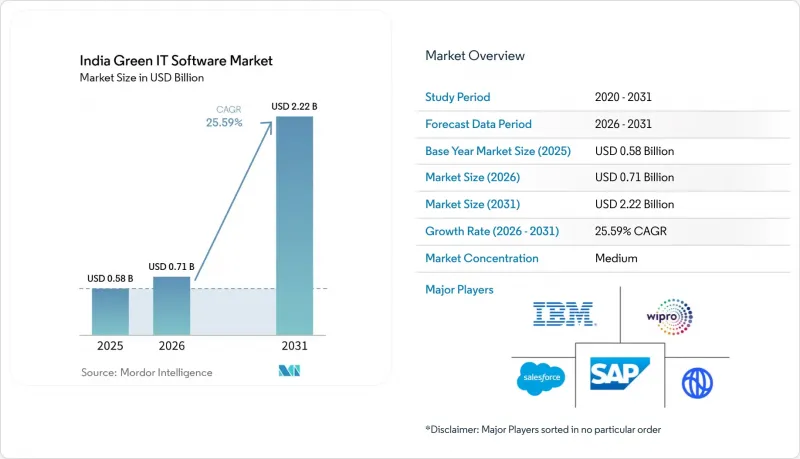
根據 Mordor Intelligence 預測,印度綠色 IT 軟體市場預計將從 2025 年的 5.8 億美元成長到 2026 年的 7.1 億美元,到 2031 年達到 22.2 億美元,2026 年至 2031 年的複合年成長率預計為 25.59%。
本報告按產品(軟體和服務)、部署模式(雲端、本地部署、混合部署)、組織規模(大型企業和中小企業)、最終用戶行業(IT和電信、銀行、金融服務和公共產業、製造業、能源和公用事業、零售和電子商務等)以及解決方案類型(碳管理和計算軟體等)進行細分。市場預測以美元計價。
印度綠色IT軟體市場趨勢與洞察
各公司正加大力度實現淨零排放
2024年至2025年間,印度設定淨零排放目標的公司數量從29家增加到34家,顯示大型企業的管治結構加強。這對印度的綠色IT軟體市場具有重大意義,因為每個目標都需要更正式的排放測量、內部控制和可重複揭露流程。從設定目標轉向保證報告的公司不能再無限期地依賴電子表格主導的流程,因為這些流程需要版本控制、審計追蹤和供應商資料的妥善處理。此外,隨著相關人員越來越期望已公開承諾的印度公司提供可比較且可靠的氣候數據,採購決策也正從自願決策轉向永續決策。因此,印度的綠色IT軟體市場目前正受益於與財務、合規、採購和董事會層級監督更加緊密結合的永續發展項目。
資料中心能源成本飆升
隨著印度超大規模資料中心的建設計畫,電力管理已成為一項核心營運挑戰,而不再只是次要問題。 AirTrunk承諾到2030年在印度投資300億美元建造5吉瓦的資料中心,凸顯了電力消耗和效率如今已達到影響基礎設施經濟效益的規模。谷歌決定在其計劃建造的維沙卡帕特南資料中心直接管理電力,表明能源採購和使用監控正成為印度運營商的戰略能力。這直接推動了印度綠色IT軟體市場的發展,因為買家需要能夠追蹤能源強度、比較設施性能並將使用數據與報告義務關聯起來的工具。隨著大規模運算能力運作,對軟體的需求正在從傳統的企業用戶擴展到包括超大規模資料中心超大規模資料中心業者、託管服務提供商以及與數位基礎設施相關的大規模房地產營運商。
與傳統企業系統整合的複雜性
許多印度公司仍在使用無法根據站點級營運數據產生碳計量結果的ERP系統。這阻礙了印度綠色IT軟體市場的成長,因為軟體部署通常需要中間件開發、客製化API和主資料整理,才能讓報告穩定運作。製造業、能源業和銀行、金融及保險業(BFSI)尤其如此,因為這些行業的作業系統、公用事業數據和供應商記錄分散在多個互不相連的平台上。這些產業的買家往往需要更長的引進週期,因為永續發展報告與更廣泛的資料架構問題密不可分。雖然供應商正在透過提供與主要企業系統的連接器來解決這個問題,但當需要工廠級或設施級的精細數據來了解排放量時,部署仍然需要時間。因此,銷售週期延長,對於那些同時投資核心系統現代化專案的買家而言,整體擁有成本(TCO)也隨之增加。
細分市場分析
到2025年,軟體將佔市場佔有率的81.43%,這表明在實施初期,買家更傾向於可擴展的平台,而非專案主導支援。印度綠色IT軟體市場的這一發展趨勢,主要源於上市公司對可審計、可更新且可在多個報告週期內重複使用的系統的迫切需求。大型組織對集中式工作流程、存取控制以及一致的排放測量方法的需求,也推動了軟體需求的成長。在監管嚴格且資訊揭露要求高的環境中,買家通常更傾向於選擇能夠建立更永續營運基礎的訂閱式工具,而非一次性的諮詢服務。這使得軟體成為實施過程中不可或缺的基礎類別,即便企業在初期階段仍會依賴外部專家。
服務業持續快速成長,預計到2031年將以29.74%的複合年成長率成長。這反映出市場對配置、整合和託管報告支援的需求日益成長。許多中型企業在沒有內部永續發展技術團隊的情況下進入印度綠色IT軟體產業,因此依賴實施合作夥伴來縮短部署時間。這提升了託管服務的價值,因為買家在平台運作後,需要協助回應供應商的資料請求、配置工作流程並產生定期報告。印度IT服務公司在這方面已佔據優勢地位,為許多大型企業管理ERP、雲端和合規環境。這種服務機會也有利於小規模軟體供應商,因為他們可以透過合作夥伴主導的交付模式接觸到企業客戶,而無需組建大規模的直接服務團隊。未來,軟體和服務之間的平衡預計將更加互補,平台收入將鞏固基本客群,而業務收益將推動更深入的應用和穩定的更新。
預計到2025年,雲端採用率將達到73.86%,這反映出大多數買家希望降低部署負擔並快速存取更新的報告邏輯。 「雲端優先」策略非常適合印度的綠色IT軟體市場,因為企業可以避免建立大規模的本地基礎設施,並依靠定期的產品更新。此舉也符合印度企業遷移到SaaS業務系統的更廣泛趨勢,尤其是在永續發展團隊小規模且依賴共用IT支援的企業中。集中存取和便利的升級使雲端系統成為需要與眾多內部相關人員進行定期資訊揭露的企業的理想選擇。這使得雲端能夠保持主導地位,即使買家在後台仍然依賴一些較舊的作業系統。
混合部署是成長最快的部署模式,預計到2031年將以31.28%的複合年成長率成長。這是因為許多大型企業需要將本地營運數據與基於雲端的運算和報表引擎整合。在此背景下,混合部署已成為印度綠色IT軟體市場最切實可行的折衷方案,它既能實現現代化的分析和工作流程編配,又能確保資料機密性。製造業、金融服務業以及複雜的多站點營運的大型企業通常無法以相同的速度將所有資料集遷移到純雲端環境。因此,採用混合模式使他們能夠利用雲端進行排放運算邏輯、儀表板和揭露文檔,同時在本地保留某些記錄和來源系統。雖然在高度重視在地化的環境中,本地部署仍然佔有一席之地,但隨著雲端安全性和本地託管選項的改進,其相對作用正在縮小。目前,真正的產品優勢在於那些能夠支援混合架構而無需買家重新設計其企業堆疊其他部分的供應商。
其他好處:
- Excel格式的市場預測(ME)表
- 3個月的分析師支持
目錄
第1章:引言
- 研究假設和市場定義
- 調查範圍
第2章:調查方法
第3章執行摘要
第4章 市場狀況
- 市場概覽
- 市場促進因素
- 各公司為實現淨零排放所做的努力正在不斷擴大。
- 資料中心能源成本飆升
- 促進排放披露法規的製定
- 印度超大規模和託管資料中心的擴張
- 以IT工作負載為導向的AI驅動型能源最佳化
- 印度領先公司採購綠色軟體
- 市場限制因素
- 與傳統企業系統整合具有高度複雜性
- 缺乏熟練的綠色IT和碳計量專業人員
- 追蹤範圍 3 和嵌入式排放的資料品質差距
- 買家對中型市場公司短期投資報酬率的猶豫
- 產業價值鏈分析
- 宏觀經濟因素對市場的影響
- 監理情勢
- 技術展望
- 波特五力分析
第5章 市場規模與成長預測
- 報價
- 軟體
- 服務
- 部署模式
- 雲
- 現場
- 混合
- 按組織規模
- 大公司
- SME
- 按最終用戶行業分類
- IT/通訊
- BFSI
- 製造業
- 能源公用事業
- 零售與電子商務
- 政府
- 衛生保健
- 建築和基礎設施
- 其他終端用戶產業
- 按解決方案類型
- 碳管理和運算軟體
- ESG報告和合規軟體
- 永續性資料管理平台
- 脫碳規劃軟體
- 能源和資源最佳化軟體
第6章 競爭情勢
- 市場集中度
- 策略趨勢
- 市佔率分析
- 公司簡介
- Persefoni AI, Inc.
- Watershed Technology Inc.
- IBM Corporation
- SAP SE
- Wipro Limited
- Tata Consultancy Services Limited
- Infosys Limited
- HCL Technologies Limited
- Cognizant Technology Solutions Corporation
- Capgemini SE
- Microsoft Corporation
- Schneider Electric SE
- Accenture PLC
- Sweep SAS
- Greenly SAS
- Normative AB
- Plan A Earth GmbH
- Emitwise Ltd.
- Climatiq GmbH
- SINAI Technologies, Inc.
- Cority Software Inc.
- Enablon SA
- Sphera Solutions, Inc.
第7章 市場機會與未來展望
According to Mordor Intelligence, the India green IT software market size is expected to increase from USD 0.58 billion in 2025 to USD 0.71 billion in 2026 and reach USD 2.22 billion by 2031, growing at a CAGR of 25.59% over 2026-2031.
This report is Segmented by Offering (Software, and Services), Deployment Mode (Cloud, On-Premises, and Hybrid), Organization Size (Large Enterprises, and SMEs), End-User Industry (IT and Telecom, BFSI, Manufacturing, Energy and Utilities, Retail and E-Commerce, and More), and Solution Type (Carbon Management and Accounting Software, and More). The Market Forecasts are Provided in Terms of Value (USD).
India Green IT Software Market Trends and Insights
Rising Corporate Net-Zero Commitments
India's corporate net-zero target base increased from 29 to 34 companies between 2024 and 2025, showing a stronger governance posture among large enterprises. This matters for the India green IT software market because each target requires a more formal process for emissions measurement, internal controls, and repeatable disclosure. Companies that move from target setting to assured reporting cannot rely on spreadsheet-led processes for long because they need version control, audit trails, and better supplier data handling. The buying decision is also becoming less voluntary because external stakeholders increasingly expect comparable and credible climate data from Indian companies with public commitments. As a result, the India green IT software market is benefiting from sustainability programs that now sit closer to finance, compliance, procurement, and board-level oversight.
Escalating Data Center Energy Costs
India's hyperscale data center pipeline is making electricity management a central operating issue rather than a secondary facility concern. AirTrunk committed USD 30 billion to build 5 GW of data center capacity in India by 2030, which highlights the scale at which power use and efficiency now shape infrastructure economics. Google's direct electricity management move for its planned Visakhapatnam facility showed that energy procurement and usage monitoring are becoming strategic capabilities for operators in the country. This directly supports the India green IT software market because buyers need tools that can track energy intensity, compare facility performance, and connect usage data with reporting obligations. As more large computing capacity comes online, software demand extends beyond traditional enterprise users to hyperscalers, colocation providers, and large property operators linked to digital infrastructure.
High Integration Complexity with Legacy Enterprise Systems
Many Indian enterprises still run on ERP landscapes that were not designed to produce carbon accounting outputs from site-level operating data. This slows the India green IT software market because software deployment often needs middleware work, custom APIs, and master data cleanup before reporting can stabilize. The problem is most visible in manufacturing, energy, and BFSI environments where operating systems, utility data, and supplier records sit across several disconnected platforms. Buyers in these sectors often face longer implementation cycles because sustainability reporting cannot be separated from broader data architecture issues. Vendors are responding with connectors for major enterprise systems, but deployments still stretch when emissions capture needs plant-level or facility-level granularity. That keeps sales cycles longer and raises the total cost of ownership for buyers who are also funding core modernization projects.
Other drivers and restraints analyzed in the detailed report include:
- Regulatory Push for Emissions Disclosure
- Expansion of Hyperscale and Colocation Data Centers in India
- Limited Availability of Skilled Green IT and Carbon Accounting Talent
For complete list of drivers and restraints, kindly check the Table Of Contents.
Segment Analysis
Software commanded 81.43% of the market in 2025, which shows how strongly buyers favored scalable platforms over project-led support in the early phase of adoption. The India green IT software market developed this way because listed enterprises needed systems that could be audited, updated, and reused across multiple reporting cycles. Software demand was also supported by the need for centralized workflows, permission controls, and consistent methods for emissions measurement across large organizations. Buyers in regulated or disclosure-heavy settings usually preferred subscription tools because they created a more durable operating layer than one-time advisory work. This helped software remain the base category for adoption even as companies continued to rely on outside experts during implementation.
Services are still gaining ground quickly and are projected to expand at a 29.74% CAGR through 2031, which reflects a wider need for configuration, integration, and managed reporting support. Many mid-sized companies are entering the India green IT software industry without internal sustainability technology teams, so they are turning to implementation partners to shorten deployment time. That raises the value of managed services because buyers want help with supplier data requests, workflow setup, and recurring report preparation after the platform goes live. Indian IT service firms are well-positioned in this layer because they already manage ERP, cloud, and compliance environments for many large enterprises. The services opportunity also helps smaller software vendors because they can reach enterprise customers through partner-led delivery models instead of building large direct service teams. Over time, the balance between software and services is likely to become more complementary, with platform revenue anchoring the account and service revenue driving adoption depth and renewal stability.
Cloud deployment accounted for 73.86% in 2025, which confirms that most buyers wanted lower setup friction and faster access to updated reporting logic. Cloud-first adoption suited the India green IT software market because companies could avoid heavy local infrastructure builds and rely on regular product updates. IT also matched the broader shift toward SaaS business systems across Indian enterprises, especially where sustainability teams are lean and depend on shared IT support. Centralized access and easier upgrades made cloud systems attractive for companies handling recurring disclosure cycles across many internal stakeholders. This kept cloud in the lead even where buyers still depended on several older operating systems in the background.
Hybrid deployment is the fastest-growing mode and is projected to advance at a 31.28% CAGR through 2031 because many large enterprises need to connect on-premises operational data with cloud-based calculation and reporting engines. In that context, hybrid captured the most practical middle ground for the India green IT software market because it respects data sensitivity while still allowing modern analytics and workflow orchestration. Large companies in manufacturing, financial services, and complex multi-site operations often cannot shift every dataset into a pure cloud setup at the same pace. Hybrid models, therefore, allow them to keep certain records and source systems local while using the cloud for emissions logic, dashboards, and disclosure preparation. On-premises deployments still retain some presence in environments with stronger localization preferences, but their relative role is narrowing as cloud security and domestic hosting choices improve. The real product advantage now sits with vendors that can support mixed architectures without making buyers redesign the rest of their enterprise stack.
Complete Report Scope:
- By Offering
- Software
- Services
- By Deployment Mode
- Cloud
- On-Premises
- Hybrid
- By Organization Size
- Large Enterprises
- SMEs
- By End-User Industry
- IT and Telecom
- BFSI
- Manufacturing
- Energy and Utilities
- Retail and E-Commerce
- Government
- Healthcare
- Construction and Infrastructure
- Other End-User Industries
- By Solution Type
- Carbon Management and Accounting Software
- ESG Reporting and Compliance Software
- Sustainability Data Management Platforms
- Decarbonization Planning Software
- Energy and Resource Optimization Software
List of Companies Covered in this Report:
- Persefoni AI, Inc.
- Watershed Technology Inc.
- IBM Corporation
- SAP SE
- Wipro Limited
- Tata Consultancy Services Limited
- Infosys Limited
- HCL Technologies Limited
- Cognizant Technology Solutions Corporation
- Capgemini SE
- Microsoft Corporation
- Schneider Electric SE
- Accenture PLC
- Sweep SAS
- Greenly SAS
- Normative AB
- Plan A Earth GmbH
- Emitwise Ltd.
- Climatiq GmbH
- SINAI Technologies, Inc.
- Cority Software Inc.
- Enablon SA
- Sphera Solutions, Inc.
Additional Benefits:
- The market estimate (ME) sheet in Excel format
- 3 months of analyst support
TABLE OF CONTENTS
1 INTRODUCTION
- 1.1 Study Assumptions and Market Definition
- 1.2 Scope of the Study
2 RESEARCH METHODOLOGY
3 EXECUTIVE SUMMARY
4 MARKET LANDSCAPE
- 4.1 Market Overview
- 4.2 Market Drivers
- 4.2.1 Rising Corporate Net-Zero Commitments
- 4.2.2 Escalating Data Center Energy Costs
- 4.2.3 Regulatory Push for Emissions Disclosure
- 4.2.4 Expansion of Hyperscale and Colocation Data Centers in India
- 4.2.5 AI-Based Energy Optimization in IT Workloads
- 4.2.6 Green Software Procurement by Large Indian Enterprises
- 4.3 Market Restraints
- 4.3.1 High Integration Complexity With Legacy Enterprise Systems
- 4.3.2 Limited Availability of Skilled Green IT and Carbon Accounting Talent
- 4.3.3 Data Quality Gaps in Scope 3 and Embedded Emissions Tracking
- 4.3.4 Buyer Hesitation Around Near-Term ROI in Mid-Market Firms
- 4.4 Industry Value Chain Analysis
- 4.5 Impact of Macroeconomic Factors on the Market
- 4.6 Regulatory Landscape
- 4.7 Technological Outlook
- 4.8 Porter's Five Forces Analysis
- 4.8.1 Threat of New Entrants
- 4.8.2 Bargaining Power of Suppliers
- 4.8.3 Bargaining Power of Buyers
- 4.8.4 Threat of Substitutes
- 4.8.5 Intensity of Competitive Rivalry
5 MARKET SIZE AND GROWTH FORECASTS (VALUE)
- 5.1 By Offering
- 5.1.1 Software
- 5.1.2 Services
- 5.2 By Deployment Mode
- 5.2.1 Cloud
- 5.2.2 On-Premises
- 5.2.3 Hybrid
- 5.3 By Organization Size
- 5.3.1 Large Enterprises
- 5.3.2 SMEs
- 5.4 By End-User Industry
- 5.4.1 IT and Telecom
- 5.4.2 BFSI
- 5.4.3 Manufacturing
- 5.4.4 Energy and Utilities
- 5.4.5 Retail and E-Commerce
- 5.4.6 Government
- 5.4.7 Healthcare
- 5.4.8 Construction and Infrastructure
- 5.4.9 Other End-User Industries
- 5.5 By Solution Type
- 5.5.1 Carbon Management and Accounting Software
- 5.5.2 ESG Reporting and Compliance Software
- 5.5.3 Sustainability Data Management Platforms
- 5.5.4 Decarbonization Planning Software
- 5.5.5 Energy and Resource Optimization Software
6 COMPETITIVE LANDSCAPE
- 6.1 Market Concentration
- 6.2 Strategic Moves
- 6.3 Market Share Analysis
- 6.4 Company Profiles (includes Global Level Overview, Market Level Overview, Core Segments, Financials as available, Strategic Information, Market Rank/Share, Products and Services, Recent Developments)
- 6.4.1 Persefoni AI, Inc.
- 6.4.2 Watershed Technology Inc.
- 6.4.3 IBM Corporation
- 6.4.4 SAP SE
- 6.4.5 Wipro Limited
- 6.4.6 Tata Consultancy Services Limited
- 6.4.7 Infosys Limited
- 6.4.8 HCL Technologies Limited
- 6.4.9 Cognizant Technology Solutions Corporation
- 6.4.10 Capgemini SE
- 6.4.11 Microsoft Corporation
- 6.4.12 Schneider Electric SE
- 6.4.13 Accenture PLC
- 6.4.14 Sweep SAS
- 6.4.15 Greenly SAS
- 6.4.16 Normative AB
- 6.4.17 Plan A Earth GmbH
- 6.4.18 Emitwise Ltd.
- 6.4.19 Climatiq GmbH
- 6.4.20 SINAI Technologies, Inc.
- 6.4.21 Cority Software Inc.
- 6.4.22 Enablon SA
- 6.4.23 Sphera Solutions, Inc.
7 MARKET OPPORTUNITIES AND FUTURE OUTLOOK
- 7.1 White-Space and Unmet-Need Assessment

 北美綠色IT軟體:市場佔有率分析、產業趨勢與統計及成長預測(2026-2031年)新加坡綠色IT軟體:市場佔有率分析、產業趨勢與統計及成長預測(2026-2031年)歐洲綠色IT軟體:市場佔有率分析、產業趨勢與統計及成長預測(2026-2031年)英國綠色IT軟體:市場佔有率分析、產業趨勢與統計及成長預測(2026-2031年)中國綠色IT軟體:市場佔有率分析、產業趨勢與統計及成長預測(2026-2031年)日本綠色IT軟體:市佔率分析、產業趨勢與統計及成長預測(2026-2031年)美國綠色IT軟體:市場佔有率分析、產業趨勢與統計及成長預測(2026-2031年)亞太地區綠色IT軟體:市佔率分析、產業趨勢與統計及成長預測(2026-2031年)印尼綠色IT軟體:市場佔有率分析、產業趨勢與統計及成長預測(2026-2031年)越南綠色IT軟體:市場佔有率分析、產業趨勢與統計及成長預測(2026-2031年)