

 |
市場調查報告書
商品編碼
2098487
新加坡綠色IT軟體:市場佔有率分析、產業趨勢與統計及成長預測(2026-2031年)Singapore Green IT Software - Market Share Analysis, Industry Trends & Statistics, Growth Forecasts (2026 - 2031) |
||||||

※ 本網頁內容可能與最新版本有所差異。詳細情況請與我們聯繫。
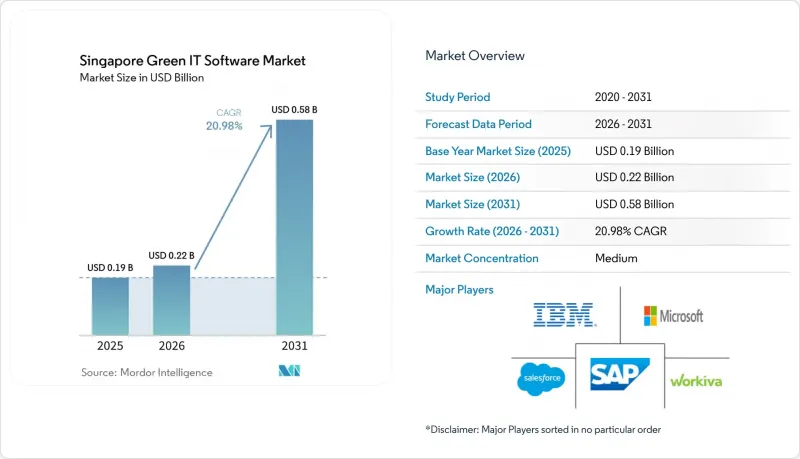
據 Mordor Intelligence 稱,新加坡綠色 IT 軟體市場在 2025 年的價值為 1.9 億美元,預計到 2031 年將達到 5.8 億美元,2026 年至 2031 年的複合年成長率為 20.98%。
本報告按產品/服務(軟體和服務)、部署模式(雲端、本地部署等)、組織規模(大型企業和中小企業)、最終用戶行業(IT和電信、銀行、金融服務和公共產業、製造業、能源和公用事業、零售和電子商務等)以及解決方案類型(碳管理和會計軟體等)進行細分。市場預測以美元計價。
新加坡綠色IT軟體市場趨勢與洞察
不斷提高的企業永續發展報告要求
新加坡綠色IT軟體市場正受益於一系列強制性報告框架的推動,這些框架對許多企業買家而言已不再是可選項。自2025會計年度起,所有在新加坡交易所上市的公司都必須依照國際財務報告準則S2(IFRS S2)報告範圍1和範圍2的碳排放,而海峽時報指數成分股公司則需自2026會計年度起報告範圍3的碳排放。這擴大了對包含資料收集和檢驗工作流程的軟體的需求,這些軟體需由供應商提供。藍圖也將從2030會計年度起把國際標準準則委員會(ISSB)的合規義務擴展到大規模私人企業,從而建立持續的合規流程,而非一次性的採購週期。這種結構至關重要,因為綠色報告工具的角色正在從單純的定期報告支援工具轉變為持續資料收集、管理和稽核合規的核心系統。此外,隨著大型企業越來越要求供應商以可整合到其報告系統中的格式提供可比的碳排放信息,IT採購的範圍也正在擴展到直接受監管的公司之外。因此,新加坡的綠色IT軟體市場正在成長,這不僅受到上市公司的需求所驅動,也受到支持它們的廣泛商業網路的需求所驅動。
公共和私營部門對低碳IT營運的需求
新加坡的綠色IT軟體市場也受惠於公共指導與企業營運需求之間難得的契合。新加坡資訊通訊媒體發展局(IMDA)宣布,新加坡成為首個加入綠色軟體基金會的政府機構,並且其參與開發的「軟體碳強度」規範已發佈為ISO標準。這使得買家能夠以更中立的方式討論軟體相關的碳排放問題。 IMDA與13家公司合作開展的綠色軟體試點計畫於2024年5月啟動,結果表明,參與公司能夠將碳排放量、能源消耗和成本降低至少20%,從而為企業更換營運軟體提供了更清晰的商業理由。新加坡數位發展與新聞部引用的2025年Pulse調查顯示,81%的非中小企業將至少實施一項數位化永續發展解決方案。這表明,受監管企業基礎設施的實際需求已經超過了試點案例。這些徵兆意義重大,因為軟體實施與能源效率、成本管理和管治息息相關,而不僅限於資訊揭露。這種組合使得新加坡的綠色IT軟體市場比許多其他永續發展軟體類別擁有更廣泛的用戶基礎。
與傳統企業系統整合的複雜性
新加坡綠色IT軟體市場面臨持續的實施障礙,尤其對於那些仍在使用過時ERP、資料庫和報表架構的公司而言更是如此。根據IMDA在草案中引用的2025年調查,38%尚未實施綠色IT軟體的公司表示缺乏相關知識是主要原因,而實際實施過程中的摩擦也持續推高專案成本並導致專案延長。當需要從最初並非為永續發展報告而設計的財務、營運、採購和設施管理系統中提取排放數據時,這項挑戰尤其突出。 IMDA的《永續發展數位技術手冊》試圖透過將數位工具與企業運作中用例結合來減輕這一負擔,從而使負責人能夠更清晰地定義整合流程。然而,負責人仍面臨重大的變更管理挑戰,因為軟體需要整合營運數據、框架邏輯和品質保證預期才能充分發揮其潛力。因此,即使公司已明確購買意向,實施風險依然很高。
細分市場分析
2025年新加坡綠色IT軟體市場中,軟體佔82.67%的佔有率,顯示買家強烈偏好能夠支援持續資料收集、計算和揭露工作流程的平台。軟體層在新加坡綠色IT軟體市場的高權重反映了企業對能夠跨越IFRS S1、IFRS S2、新加坡交易所(SGX)相關要求以及供應商協作流程映射資料的系統的實際需求,而無需依賴分散的手動工具。這個細分市場的地位也反映了受監管企業的採購行為,在這些企業中,版本控制、審計追蹤和可重複的報告邏輯比一次性的諮詢服務更為重要。因此,尤其是在上市公司的資訊揭露義務不斷擴大之後,對軟體的需求與結構化輸出、營運規格和持續報告系統的需求緊密相關。因此,在許多企業的採購週期中,平台功能已成為主要決定因素,而服務支援則作為軟體的補充而非替代方案。
預計到2031年,服務市場將以24.86%的複合年成長率成長,反映出隨著企業報告任務向範圍3和內部控制等更複雜的領域擴展,部署工作也不斷擴大。新加坡綠色IT軟體產業的服務成長源於這樣一個事實:許多買家在平台按預期運作之前,仍然需要配置支援、培訓、法規解讀和工作流程重新設計。 2026年5月, 銷售團隊宣布與Accenture、普華永道新加坡和Huron合作,在新加坡建立“數據和人工智慧卓越中心”,這反映了企業平台捆綁交付模式日益普遍。事實上,框架的變化、資料擴展和保障準備工作的推進也在重新運作服務需求,這意味著服務層在初始部署之後仍能持續提供價值。這一趨勢表明,服務產品結構將穩步擴展,軟體收入仍將佔據核心地位,而輔助服務在面向大型客戶的部署中的作用也將穩步提升。
到2025年,雲端運算將佔據72.94%的市場佔有率,這反映出集中式雲端環境能夠輕鬆支援跨多個營業單位的報告、可擴展的資料擷取以及持續的軟體更新。在新加坡的綠色IT軟體市場,雲端整合部署最為穩健,這得益於新加坡資訊通訊媒體發展局(IMDA)的碳排放運算工具和區域最佳化的排放因子,這些工具和因子使採購團隊能夠根據新加坡的特定假設,清楚地比較雲端架構和本地部署環境。新加坡強大的資料中心生態系統也促進了雲端運算的普及,使軟體買家能夠在營運柔軟性和更成熟的能源採購及設備效率方面的永續發展基礎設施之間取得平衡。這降低了希望透過通用技術平台在子公司、業務部門和區域運行永續發展報告工具的企業採用雲端的門檻。因此,雲端運算不僅成為許多買家的預設部署選項,也成為供應商最容易實現標準化和可擴展的格式。
預計到2031年,混合環境將以26.18%的複合年成長率成長。這反映出需要在可擴展性和對敏感資料更嚴格的內部控制之間取得平衡。在新加坡的綠色IT軟體市場,受監管客戶對混合環境的需求正在成長。這是因為一些公司希望在雲端進行分析和協作,同時將某些資料集和管治層保留在受控環境中。這一趨勢與新加坡廣泛的合規立場相符,在新加坡,資料架構決策通常不僅需要考慮成本,還需要考慮營運和風險管理問題。因此,雖然本地部署系統對於政府機構和嚴格管制的組織仍然很重要,但它們擴大被用作補充角色,而不是作為完全獨立的環境。混合部署越來越受歡迎,因為它為那些無法一次將其報告業務遷移到雲端的組織提供了一條切實可行的遷移路徑。
其他好處:
- Excel格式的市場預測(ME)表
- 3個月的分析師支持
目錄
第1章:引言
- 研究假設和市場定義
- 調查範圍
第2章:調查方法
第3章執行摘要
第4章 市場狀況
- 市場概覽
- 市場促進因素
- 企業永續發展報告的要求日益提高。
- 公共和私營部門對低碳IT營運的需求
- 透過雲端遷移和虛擬化提高效率
- 軟體和基礎設施的人工智慧驅動能源最佳化
- 企業和公共部門採購中的綠色採購標準。
- 新加坡作為亞太地區總部的區域合規中心
- 市場限制因素
- 與傳統企業系統整合具有高度複雜性
- 綠色軟體測量和調查方法缺乏標準化。
- 資料收集、審計和持續報告的相關高成本。
- 專業綠色軟體與永續發展分析師短缺
- 產業價值鏈分析
- 監理情勢
- 技術展望
- 宏觀經濟因素對市場的影響
- 波特五力分析
第5章 市場規模與成長預測
- 報價
- 軟體
- 服務
- 部署模式
- 雲
- 現場
- 混合
- 按組織規模
- 大公司
- SME
- 按最終用戶行業分類
- IT/通訊
- BFSI
- 製造業
- 能源公用事業
- 零售與電子商務
- 政府
- 衛生保健
- 建築和基礎設施
- 其他終端用戶產業
- 按解決方案類型
- 碳管理和運算軟體
- ESG報告和合規軟體
- 永續性資料管理平台
- 脫碳規劃軟體
- 能源和資源最佳化軟體
第6章 競爭情勢
- 市場集中度
- 策略趨勢
- 市佔率分析
- 公司簡介
- SAP SE
- Microsoft Corporation
- Salesforce, Inc.
- IBM Corporation
- Workiva Inc.
- Sphera Solutions, Inc.
- Wolters Kluwer NV
- Diligent Corporation
- Watershed Technology, Inc.
- Persefoni AI, Inc.
- Novisto Inc.
- Sweep SAS
- Greenly SAS
- EcoOnline Global AB
- Cority Software Inc.
- FigBytes Inc.
- Normative AB
- Position Green AB
- Benchmark Digital Partners LLC
- EnergyCAP, LLC
- SINAI Technologies, Inc.
- EcoVadis SAS
第7章 市場機會與未來展望
According to Mordor Intelligence, the Singapore green IT software market size was valued at USD 0.19 billion in 2025 and is forecast to reach USD 0.58 billion by 2031, growing at a CAGR of 20.98% during 2026-2031.
This report is Segmented by Offering (Software, and Services), Deployment Mode (Cloud, On-Premises, and More), Organization Size (Large Enterprises, and SMEs), End-User Industry (IT and Telecom, BFSI, Manufacturing, Energy and Utilities, Retail and E-Commerce, and More ), Solution Type (Carbon Management and Accounting Software, and More). The Market Forecasts are Provided in Terms of Value (USD).
Singapore Green IT Software Market Trends and Insights
Rising Corporate Sustainability Reporting Requirements
The Singapore green IT software market is being pushed forward by a reporting framework that has removed optionality for many enterprise buyers. From FY2025, all SGX-listed companies had to report Scope 1 and Scope 2 emissions in line with IFRS S2, and STI constituents must report Scope 3 emissions from FY2026, which widened software demand into supplier data collection and verification workflows. The same roadmap extends ISSB-aligned obligations to large non-listed companies from FY2030, which creates a rolling compliance pipeline rather than a one-time buying cycle. This structure matters because it shifts green reporting tools from periodic reporting aids into core systems for continuous data capture, control, and audit readiness. IT also expands procurement beyond directly regulated entities, since larger companies increasingly need suppliers to submit comparable carbon information in formats that can feed enterprise reporting systems. The result is a demand pattern in which the Singapore green IT software market grows not only from listed issuers, but also from the wider commercial network that supports them.
Public-Private Demand for Carbon-Aware IT Operations
The Singapore green IT software market is also benefiting from an unusual alignment between public guidance and enterprise operating needs. IMDA stated that Singapore became the first government organization to join the Green Software Foundation, and that the Software Carbon Intensity specification it contributed to has been published as an ISO standard, which gives buyers a more neutral basis for discussing software-related emissions. IMDA's green software trials, run with 13 companies since May 2024, showed that participating enterprises achieved at least 20% reductions in carbon emissions, energy usage, and costs, which gave enterprises a clearer business case for operational software changes. A 2025 pulse survey cited by Singapore's Ministry of Digital Development and Information found that 81% of non-SMEs had adopted at least 1 digital sustainability solution, which indicates that realized demand has already moved beyond pilot use cases in the regulated enterprise base. These signals matter because they connect software adoption to energy savings, cost discipline, and governance rather than to disclosure alone. That combination gives the Singapore green IT software market a broader operating rationale than many other sustainability software categories.
High Integration Complexity with Legacy Enterprise Systems
The Singapore green IT software market faces a persistent execution barrier in enterprises that still operate older ERP, database, and reporting architectures. The draft's cited 2025 IMDA survey found that 38% of non-adopting enterprises pointed to limited knowledge, while practical implementation friction also continued to raise project cost and extend deployment schedules. This challenge is especially relevant where emissions data must be extracted from finance, operations, procurement, and facility systems that were not originally designed for sustainability reporting. IMDA's Digital Technologies for Sustainability Playbook tried to reduce this burden by mapping digital tools to enterprise sustainability use cases, which should help buyers frame integration steps more clearly. Even so, buyers still face a significant change-management task because live operating data, framework logic, and assurance expectations all have to be connected before the software can deliver full value. That keeps implementation risk high even when the enterprise's intent to buy is already established.
Other drivers and restraints analyzed in the detailed report include:
- Cloud Migration and Virtualization Efficiency Gains
- AI-Driven Energy Optimization for Software and Infrastructure
- Limited Standardization in Green Software Measurement Methodologies
For complete list of drivers and restraints, kindly check the Table Of Contents.
Segment Analysis
Software held 82.67% of the Singapore green IT software market share in 2025, indicating that buyers strongly preferred platforms that could support recurring data collection, calculation, and disclosure workflows. In the Singapore green IT software market, the weight at the software layer reflected the practical need for systems that can map data across IFRS S1, IFRS S2, SGX-related requirements, and supplier engagement processes without relying on disconnected manual tools. The segment's position also reflects buying behavior in regulated enterprises, where version control, audit trails, and repeatable reporting logic carry more weight than one-time advisory work. Software demand has therefore been tied closely to the need for structured outputs, operating discipline, and continuous reporting readiness, especially after mandatory disclosures began to move through the listed company base. This made platform capability the first decision point in many enterprise buying cycles, with service support added around the software rather than replacing it.
Services are projected to grow at a 24.86% CAGR through 2031, which shows that implementation work is expanding as enterprise reporting moves into more complex areas such as Scope 3 and internal controls. The Singapore green IT software industry is seeing services growth because many buyers still need configuration support, training, regulatory interpretation, and workflow redesign before platforms can function as intended. Salesforce stated in May 2026 that it was establishing Data and AI Centers of Excellence with Accenture, PwC Singapore, and Huron in Singapore, which reflects the bundled delivery model increasingly used around enterprise platforms. In practice, service demand is also renewed by framework changes, data expansion, and assurance preparation, which means the service layer has recurring value even after the first deployment. That dynamic should keep the offering mix centered on software revenue while steadily increasing the role of attached service work across large-account implementations.
Cloud accounted for 72.94% of the market in 2025, and that position reflected the ease with which centralized cloud environments can support multi-entity reporting, scalable data ingestion, and ongoing software updates. The Singapore green IT software market size for cloud-linked deployment remained strongest because IMDA's carbon calculator and localized emission factors gave procurement teams a clearer way to compare cloud architectures with on-premises setups using Singapore-specific assumptions. The strength of Singapore's data center ecosystem also supported cloud adoption, because software buyers could align operational flexibility with a more maturing sustainability infrastructure around energy sourcing and equipment efficiency. These conditions reduced friction for enterprises that wanted sustainability reporting tools to work across subsidiaries, business units, and regional operations from a shared technology base. As a result, cloud was not only the default deployment choice for many buyers, it also became the easiest format for vendors to standardize and scale.
Hybrid is projected to expand at a 26.18% CAGR through 2031, which reflects the need to balance scalability with tighter internal controls over sensitive data. The Singapore green IT software market is seeing stronger hybrid demand in regulated accounts because some enterprises want analytics and collaboration in the cloud while keeping selected datasets or governance layers within controlled environments. This pattern is consistent with Singapore's broader compliance posture, where data architecture decisions often need to satisfy both operational and risk management concerns rather than cost alone. On-premises systems, therefore, remain relevant in agencies and highly controlled institutions, but they are increasingly being supplemented instead of serving as complete standalone environments. Hybrid deployment has gained ground because it offers a practical transition path for organizations that cannot move reporting operations fully into the cloud in a single step.
Complete Report Scope:
- By Offering
- Software
- Services
- By Deployment Mode
- Cloud
- On-Premises
- Hybrid
- By Organization Size
- Large Enterprises
- SMEs
- By End-User Industry
- IT and Telecom
- BFSI
- Manufacturing
- Energy and Utilities
- Retail and E-Commerce
- Government
- Healthcare
- Construction and Infrastructure
- Other End-User Industries
- By Solution Type
- Carbon Management and Accounting Software
- ESG Reporting and Compliance Software
- Sustainability Data Management Platforms
- Decarbonization Planning Software
- Energy and Resource Optimization Software
List of Companies Covered in this Report:
- SAP SE
- Microsoft Corporation
- Salesforce, Inc.
- IBM Corporation
- Workiva Inc.
- Sphera Solutions, Inc.
- Wolters Kluwer N.V.
- Diligent Corporation
- Watershed Technology, Inc.
- Persefoni AI, Inc.
- Novisto Inc.
- Sweep SAS
- Greenly SAS
- EcoOnline Global AB
- Cority Software Inc.
- FigBytes Inc.
- Normative AB
- Position Green AB
- Benchmark Digital Partners LLC
- EnergyCAP, LLC
- SINAI Technologies, Inc.
- EcoVadis SAS
Additional Benefits:
- The market estimate (ME) sheet in Excel format
- 3 months of analyst support
TABLE OF CONTENTS
1 INTRODUCTION
- 1.1 Study Assumptions and Market Definition
- 1.2 Scope of the Study
2 RESEARCH METHODOLOGY
3 EXECUTIVE SUMMARY
4 MARKET LANDSCAPE
- 4.1 Market Overview
- 4.2 Market Drivers
- 4.2.1 Rising Corporate Sustainability Reporting Requirements
- 4.2.2 Public-Private Demand for Carbon-Aware IT Operations
- 4.2.3 Cloud Migration and Virtualization Efficiency Gains
- 4.2.4 AI-Driven Energy Optimization for Software and Infrastructure
- 4.2.5 Green Procurement Standards in Enterprise and Public Sector Buying
- 4.2.6 Singapore as a Regional Compliance Hub for Asia-Pacific Headquarters
- 4.3 Market Restraints
- 4.3.1 High Integration Complexity With Legacy Enterprise Systems
- 4.3.2 Limited Standardization in Green Software Measurement Methodologies
- 4.3.3 High Cost of Data Collection, Auditability, and Continuous Reporting
- 4.3.4 Shortage of Specialized Green Software and Sustainability Analytics Talent
- 4.4 Industry Value Chain Analysis
- 4.5 Regulatory Landscape
- 4.6 Technological Outlook
- 4.7 Impact of Macroeconomic Factors on the Market
- 4.8 Porter's Five Forces Analysis
- 4.8.1 Bargaining Power of Buyers
- 4.8.2 Bargaining Power of Suppliers
- 4.8.3 Threat of New Entrants
- 4.8.4 Threat of Substitutes
- 4.8.5 Intensity of Competitive Rivalry
5 MARKET SIZE AND GROWTH FORECASTS (VALUE)
- 5.1 By Offering
- 5.1.1 Software
- 5.1.2 Services
- 5.2 By Deployment Mode
- 5.2.1 Cloud
- 5.2.2 On-Premises
- 5.2.3 Hybrid
- 5.3 By Organization Size
- 5.3.1 Large Enterprises
- 5.3.2 SMEs
- 5.4 By End-User Industry
- 5.4.1 IT and Telecom
- 5.4.2 BFSI
- 5.4.3 Manufacturing
- 5.4.4 Energy and Utilities
- 5.4.5 Retail and E-Commerce
- 5.4.6 Government
- 5.4.7 Healthcare
- 5.4.8 Construction and Infrastructure
- 5.4.9 Other End-User Industries
- 5.5 By Solution Type
- 5.5.1 Carbon Management and Accounting Software
- 5.5.2 ESG Reporting and Compliance Software
- 5.5.3 Sustainability Data Management Platforms
- 5.5.4 Decarbonization Planning Software
- 5.5.5 Energy and Resource Optimization Software
6 COMPETITIVE LANDSCAPE
- 6.1 Market Concentration
- 6.2 Strategic Moves
- 6.3 Market Share Analysis
- 6.4 Company Profiles (includes Global Level Overview, Market Level Overview, Core Segments, Financials as available, Strategic Information, Market Rank/Share, Products and Services, Recent Developments)
- 6.4.1 SAP SE
- 6.4.2 Microsoft Corporation
- 6.4.3 Salesforce, Inc.
- 6.4.4 IBM Corporation
- 6.4.5 Workiva Inc.
- 6.4.6 Sphera Solutions, Inc.
- 6.4.7 Wolters Kluwer N.V.
- 6.4.8 Diligent Corporation
- 6.4.9 Watershed Technology, Inc.
- 6.4.10 Persefoni AI, Inc.
- 6.4.11 Novisto Inc.
- 6.4.12 Sweep SAS
- 6.4.13 Greenly SAS
- 6.4.14 EcoOnline Global AB
- 6.4.15 Cority Software Inc.
- 6.4.16 FigBytes Inc.
- 6.4.17 Normative AB
- 6.4.18 Position Green AB
- 6.4.19 Benchmark Digital Partners LLC
- 6.4.20 EnergyCAP, LLC
- 6.4.21 SINAI Technologies, Inc.
- 6.4.22 EcoVadis SAS
7 MARKET OPPORTUNITIES AND FUTURE OUTLOOK
- 7.1 White-Space and Unmet-Need Assessment

 北美綠色IT軟體:市場佔有率分析、產業趨勢與統計及成長預測(2026-2031年)印度綠色IT軟體:市場佔有率分析、產業趨勢與統計及成長預測(2026-2031年)歐洲綠色IT軟體:市場佔有率分析、產業趨勢與統計及成長預測(2026-2031年)英國綠色IT軟體:市場佔有率分析、產業趨勢與統計及成長預測(2026-2031年)中國綠色IT軟體:市場佔有率分析、產業趨勢與統計及成長預測(2026-2031年)日本綠色IT軟體:市佔率分析、產業趨勢與統計及成長預測(2026-2031年)美國綠色IT軟體:市場佔有率分析、產業趨勢與統計及成長預測(2026-2031年)亞太地區綠色IT軟體:市佔率分析、產業趨勢與統計及成長預測(2026-2031年)印尼綠色IT軟體:市場佔有率分析、產業趨勢與統計及成長預測(2026-2031年)越南綠色IT軟體:市場佔有率分析、產業趨勢與統計及成長預測(2026-2031年)