


 |
市場調查報告書
商品編碼
2097414
中東和非洲資料中心GPU:市場佔有率分析、行業趨勢和統計數據以及成長預測(2026-2031年)Middle East and Africa Data Center GPU - Market Share Analysis, Industry Trends & Statistics, Growth Forecasts (2026 - 2031) |
||||||

※ 本網頁內容可能與最新版本有所差異。詳細情況請與我們聯繫。
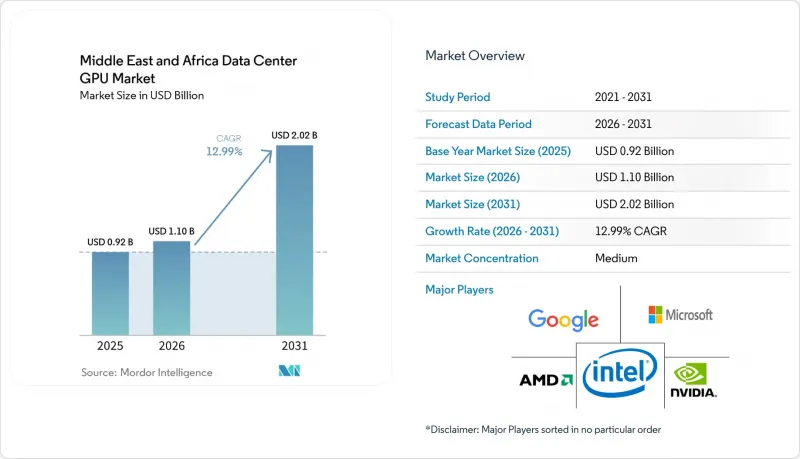
根據 Mordor Intelligence 預測,中東和非洲資料中心 GPU 市場規模將從 2025 年的 9.2 億美元和 2026 年的 11 億美元成長到 2031 年的 20.2 億美元,2026 年至 2031 年的年複合成長率(CAGR)為 12.9%。
本報告按部署類型(雲端資料中心、企業級等)、GPU 類型(訓練 GPU、推理 GPU)、互連方式(基於 PCIe 的 GPU、高頻寬互連 GPU)、工作負載類型(人工智慧和機器學習、高效能運算等)以及最終用戶(超大規模資料中心業者伺服器/雲端服務供應商、企業、政府機構和研究機構)進行細分。市場預測以美元計價。
中東及非洲資料中心GPU市場趨勢及洞察
加速海灣國家政府主導的舉措中生成式人工智慧和大規模語言模型的應用。
中東和非洲的資料中心GPU市場正受到政府主導的人工智慧專案的推動,這些專案已將部署週期從傳統的多年週期縮短至更短的部署週期。沙烏地阿拉伯的HUMAIN舉措於2026年1月與xAI合作,在利雅德和吉達部署Grok-3推理叢集,目標是在2026年第三季度處理5萬個並發的阿拉伯語查詢。在阿拉伯聯合大公國(阿拉伯聯合大公國),G42在Masdar城營運200兆瓦的人工智慧園區,配備了專為1.8兆參數模型設計的NVIDIA GB200 NVL72機架。這使得該設施的規模達到了先前只有美國超大規模資料中心業者才能達到的水平。摩洛哥也加入了這一趨勢,於2025年11月宣布與NVIDIA合作建造「Nexus AI Factory」。到 2028 年,我們計劃確保 500 兆瓦的 GPU 容量,這將對北非地區法語和阿拉伯語語言模型的部署起到至關重要的作用。這些項目之所以重要,是因為它們比企業用戶更快地消耗 GPU 資源,而企業用戶則需要經過季度預算核准和合規性審查。因此,硬體配置越來越專注於訓練和推理。這是因為區域性語言模型的部署需要基於區域特定的資料集、方言支援以及當地的法律和文化框架。
在主權財富基金的支持下,超大規模雲端運算迅速擴張。
中東和非洲的資料中心GPU市場也受惠於主權財富基金的資金投入。這使得超大規模資料中心業者資料中心營運商能夠比其他許多地區的競爭對手更快地獲得土地、電力和硬體資源。 2025年3月,微軟宣布與G42合作,在阿拉伯聯合大公國投資152億美元用於人工智慧基礎建設,其中包括計畫於2026年底前完成的200兆瓦擴建工程。在卡達,Brookfield和Qai的合資企業於2026年2月在杜哈破土動工興建一座100兆瓦的計算中心,這是其200億美元投資計畫的一部分。預計電力成本為每千瓦時0.06美元。 2026年1月,亞馬遜網路服務(AWS)透過新增三個可用區擴展了其在巴林的區域,並推出了基於NVIDIA H200 Tensor Core GPU的GPU最佳化型EC2 P5實例。這種資金籌措模式消除了通常會拖慢大規模雲端專案進度的資金籌措瓶頸。因此,中東和非洲地區的多個園區得以比全球建設計畫通常的長期進度更快進入運作階段。這種模式也擴大了中東和非洲資料中心GPU市場的潛在基本客群,不僅為政府主導的專案提供了容量,也為需要本地託管和AI加速的企業租戶提供了容量。
沙漠氣候下高功率和冷卻系統的運作成本
中東和非洲的資料中心GPU市場面臨直接的成本挑戰。在沙漠地區的資料中心,電力和冷卻成本可能超過每千瓦時0.12美元,而全球超大規模資料中心的平均成本約為每千瓦時0.06美元。在利雅德或阿布達比,10兆瓦的GPU叢集,如果運轉率達到90%,其年電力成本可能高達950萬美元,而北歐同等規模的資料中心則為470萬美元。此外,極端高溫迫使營運商部署比實際需要多30-40%的冷卻器,導致冷卻相關的資本支出飆升至每千瓦1,200美元,而氣候溫和地區的數字為每千瓦800美元。雖然液冷系統可以提高效率(如HPE和Khazna的合作案例所示),但此類設計需要專用冷卻液和耐腐蝕的基礎設施,從而推高了機架級部署成本。將廢氣轉化為電力的項目在某些油田地區行之有效,但由於選址、授權和建設方面的嚴格限制,並非適用於全部區域。對於單次查詢收益極低的推理應用而言,這種成本壓力尤其查詢,因此,營運商需要更優惠的電力合約、替代能源或更高價值的工作負載,才能在中東和非洲資料中心GPU市場維持獲利能力。
細分市場分析
2025年,雲端資料中心按部署類型分類的營收佔比達到57.39%,在中東和非洲資料中心GPU市場中佔據最大佔有率。這一地位反映了超大規模資料中心業者資料中心在沿岸地區主要園區的訓練工作負載、集中式計算和批量分析的優勢。預計從2026年到2031年,邊緣資料中心將繼續快速成長,因為在現場作業和都市區服務節點等響應迅速的應用場景中,本地處理的重要性日益凸顯。 2026年第一季,沙烏地阿美在Ghawar和Safaniya油田部署了12個邊緣GPU集群。每個集群配備了64個NVIDIA L40S推理GPU,用於即時地震波處理和鑽頭最佳化。這個例子說明了為什麼邊緣部署在能源產業正成為更實用的選擇,因為等待集中式雲端的回應會降低分析的價值。因此,中東和非洲的資料中心GPU市場正在從集中式園區擴展到支援更靠近資產的工業推理的分散式環境。
企業和私人資料中心仍然是第二大部署模式,因為受監管行業仍然傾向於直接控制資料放置和運算資源。 2025年8月,阿拉伯聯合大公國中央銀行發布指南,要求國內銀行在境內處理客戶交易資料。這迫使阿拉伯聯合大公國國民銀行(Emirates NBD)和阿布達比第一銀行(First Abu Dhabi Bank)等金融機構遷移到私人GPU系統。即使雲端服務在技術上可用,此類監管壓力也推動了本地部署的普及。此外,在邊緣站點,由於環境適應性機殼、冗餘電源和遠端連接要求等原因,系統安裝的複雜性增加了每個機架的資本成本。儘管如此,在即時決策能夠帶來明顯營運效益的領域,例如油氣天然氣田、智慧城市節點和交通走廊,營運商仍然繼續投資。集中式規模和快速本地應對力之間的這種平衡意味著,隨著中東和非洲資料中心GPU市場的持續擴張,這三種部署模式預計都將繼續發揮至關重要的作用。
2025年,推理GPU的銷售量佔GPU總銷量的59.86%,成為中東和非洲資料中心GPU市場的主要產品類型。此外,推理成本的下降改變了聊天機器人、語音系統、建議引擎和本地語言服務等商業規模部署的經濟模式,並預計推理GPU將保持最高的成長率直到2031年。推理成本從2024年初的0.02美元降至2025年底的0.0008美元,是提升公共和私有部署中即時阿拉伯語應用程式可用性的重要因素。 2025年,G42將Masdar城200兆瓦容量的70%分配給了推理工作負載,這表明市場需求正從訓練最先進的模型轉向專注於為用戶提供服務。這種需求模式在政府入口網站、翻譯服務、客戶支援和企業人工智慧工具等領域尤為突出,這些領域的擴展不僅取決於原始運算能力,還取決於交易成本。因此,在中東和非洲,資料中心GPU市場在許多部署場景中正從「先建置後擴展」階段轉向「規模化服務交付」階段。
儘管部署數量有所下降,但訓練用GPU仍然至關重要,因為政府主導的人工智慧專案仍需要基於區域法律、醫療和語言資料集訓練的本地模型。 NVIDIA指出,H200的推理成本遠高於L40S配置,因此訓練系統仍集中在政府支援的園區和超大規模資料中心業者資料中心實驗室,而不是部署到更廣泛的企業。沙烏地阿拉伯的「HUMAIN」舉措在其位於利雅德的設施中部署了超過1萬塊H200 GPU,用於阿拉伯語法律和醫療語言模型,該設施於2026年1月開始運作。訓練和推理之間的這種區別至關重要,因為它意味著收入成長並非僅依賴單一工作負載。推理驅動著更多用戶和地點的單價需求,而訓練則支援少數規模龐大、售價更高的項目。這種組合使得中東和非洲的資料中心GPU市場在GPU類型配置方面兼具廣度和深度。
其他好處:
- Excel格式的市場預測(ME)表
- 3個月的分析師支持
目錄
第1章:引言
- 研究假設和市場定義
- 調查範圍
第2章:調查方法
第3章執行摘要
第4章 市場狀況
- 市場概覽
- 市場促進因素
- 加速海灣國家政府主導的各項措施中生成式人工智慧和大規模語言模型的應用。
- 在主權財富基金的支持下,超大規模雲端運算迅速擴張。
- 高頻寬記憶體和多晶片模組GPU的硬體創新週期
- 全國GPU分配協議使供應出現偏差,有利於MEA項目。
- 在中東油田部署廢氣驅動資料中心
- 為沙漠地區校園的液冷基礎設施提供優先津貼
- 市場限制因素
- 沙漠氣候下高昂的電力和冷凍相關運作成本
- 半導體出口限制導致一些非洲國家無法取得高階GPU。
- 大規模 MEA GPU叢集中長期存在的 DAC/AOC 光纖前置作業時間瓶頸
- 該地區人工智慧基礎設施人員短缺,導致實施工作延誤。
- 產業價值鏈分析
- 監理情勢
- 技術展望
- 宏觀經濟因素對市場的影響
- 波特五力分析
第5章 市場規模與成長預測
- 依部署類型
- 雲端資料中心
- 企業/私人資料中心
- 邊緣資料中心
- 按GPU類型
- 訓練 GPU
- 用於推理的GPU
- 依類型互連
- 基於 PCIe 的 GPU
- 高頻寬互連GPU
- 依工作負載類型
- 人工智慧和機器學習
- 高效能運算(科學運算,不包括人工智慧)
- 資料分析(資料庫加速、查詢處理)
- 圖形和視覺化(VDI、渲染、數位孿生)
- 最終用戶
- 超大規模資料中心業者雲端服務供應商/雲端服務供應商
- 公司
- 政府和研究機構
- 按地區
- 中東
- 沙烏地阿拉伯
- 阿拉伯聯合大公國
- 卡達
- 其他中東國家
- 非洲
- 南非
- 奈及利亞
- 埃及
- 其他非洲國家
- 中東
第6章 競爭情勢
- 市場集中度
- 策略趨勢
- 市佔率分析
- 公司簡介
- NVIDIA Corporation
- Advanced Micro Devices, Inc.
- Intel Corporation
- Amazon Web Services, Inc.
- Microsoft Corporation
- Google LLC
- Huawei Technologies Co., Ltd.
- Dell Technologies Inc.
- Hewlett Packard Enterprise Company
- Super Micro Computer, Inc.
- Cisco Systems, Inc.
- Arista Networks, Inc.
- Broadcom Inc.
- Marvell Technology, Inc.
- Khazna Data Centers LLC
- Center3(stc Data Center Company)
- G42 Cloud Computing LLC
- Africa Data Centres(Cassava Technologies)
- Equinix, Inc.
- Digital Realty Trust, Inc.
第7章 市場機會與未來展望
According to Mordor Intelligence, the Middle East and Africa data center GPU market size is projected to expand from USD 0.92 billion in 2025 and USD 1.10 billion in 2026 to USD 2.02 billion by 2031, registering a CAGR of 12.99% between 2026 and 2031.
This report is Segmented by Deployment Type (Cloud Data Centers, Enterprise, and More), GPU Type (Training GPUs, and Inference GPUs), Interconnect (PCIe-Based GPUs, High-Bandwidth Interconnect GPUs), Workload Type (AI and ML, HPC, and More), and End-User (Hyperscalers/CSPs, Enterprises, Government and Research Institutions). Market Forecasts are Provided in Terms of Value (USD).
Middle East and Africa Data Center GPU Market Trends and Insights
Accelerated Adoption of Generative AI and Large Language Models in Gulf Sovereign Initiatives
The Middle East and Africa data center GPU market is being pushed forward by sovereign AI programs that moved adoption windows from traditional multi-year cycles into much shorter deployment schedules. Saudi Arabia's HUMAIN initiative partnered with xAI in January 2026 to deploy Grok-3 inference clusters across Riyadh and Jeddah, with a target of 50,000 concurrent Arabic-language queries by Q3 2026.In the UAE, G42 operated a 200-megawatt AI campus in Masdar City that housed NVIDIA GB200 NVL72 racks designed for models with 1.8 trillion parameters, which placed the facility at a scale previously associated with U.S. hyperscalers. Morocco also moved into this pattern when the Nexus AI factory was announced with NVIDIA in November 2025, with a plan for 500 megawatts of GPU capacity by 2028 and a North African role in French and Arabic language model deployment. These projects matter because they absorb GPU supply faster than enterprise buyers that still move through quarterly budget approvals and compliance reviews. The result is a hardware mix that shifts toward training as well as inference, because localized language models require regional datasets, dialect support, and deployment under local legal and cultural frameworks.
Rapid Hyperscale Cloud Expansion Backed by Sovereign Wealth Funds
The Middle East and Africa data center GPU market is also benefiting from sovereign wealth fund capital that lets hyperscalers secure land, power, and hardware earlier than peers in many other regions. Microsoft announced a USD 15.2 billion commitment to UAE AI infrastructure with G42 in March 2025, including a 200-megawatt expansion scheduled by the end of 2026. In Qatar, the Brookfield-Qai joint venture broke ground in February 2026 on a 100-megawatt compute center in Doha under a broader USD 20 billion commitment, with projected power costs of USD 0.06 per kilowatt-hour. Amazon Web Services expanded its Bahrain region with 3 additional availability zones in January 2026 and added GPU-optimized EC2 P5 instances based on NVIDIA H200 Tensor Core GPUs. This funding model removes the financing bottlenecks that often slow large cloud projects, which is why several MEA campuses moved toward operating status far faster than the longer timelines common in global builds. It also widened the addressable base of the Middle East and Africa data center GPU market, because capacity is being prepared not only for sovereign projects but also for enterprise tenants that need local hosting and AI acceleration.
High Power And Cooling OPEX In Desert Climates
The Middle East and Africa data center GPU market faces a direct cost challenge because desert facilities can operate at power and cooling costs above USD 0.12 per kilowatt-hour, while the global hyperscale average is near USD 0.06 per kilowatt-hour. A 10-megawatt GPU cluster running at 90% utilization in Riyadh or Abu Dhabi can incur annual electricity costs of USD 9.5 million, compared with USD 4.7 million for a comparable facility in Northern Europe. Extreme heat also forces operators to over-provision chillers by 30% to 40%, which pushes cooling capital expenditure to USD 1,200 per kilowatt against USD 800 per kilowatt in more temperate locations. Liquid-cooling systems can improve efficiency, but the HPE and Khazna partnership highlighted that these designs require specialized fluids and corrosion-resistant infrastructure that raise rack-level deployment costs. Waste-gas-to-power projects can help in selected oilfield locations, but they are not a region-wide answer because site selection, permitting, and construction are tightly constrained. This cost pressure is particularly severe for inference applications where revenue per query is very small, so operators need better power contracts, alternative energy arrangements, or higher-value workloads to protect margins in the Middle East and Africa data center GPU market.
Other drivers and restraints analyzed in the detailed report include:
- Hardware Innovation Cycle Toward High-Bandwidth Memory and Multi-Chip Module GPUs
- Sovereign GPU Allocation Agreements Skewing Supply in Favor of MEA Projects
- Semiconductor Export Restrictions Limiting High-End GPU Supply to Some African Countries
For complete list of drivers and restraints, kindly check the Table Of Contents.
Segment Analysis
Cloud data centers held 57.39% of deployment-type revenue in 2025, which gave them the largest share of the Middle East and Africa data center GPU market size within this segment set. That position reflected hyperscaler strength in training workloads, centralized compute, and batch analytics across major Gulf campuses. Edge data centers are still expected to grow faster through 2026-2031 because field operations and urban service nodes are prioritizing local processing for response-sensitive use cases. Saudi Aramco deployed 12 edge GPU pods across the Ghawar and Safaniya oilfields in Q1 2026, and each pod contained 64 NVIDIA L40S inference GPUs for real-time seismic processing and drill-bit optimization. That example shows why edge deployments are becoming more practical in energy operations, where waiting for a centralized cloud response can reduce the value of the analysis. The Middle East and Africa data center GPU market is therefore widening beyond centralized campuses and into distributed environments that support industrial inference close to assets.
Enterprise and private data centers remained the second-largest deployment type because regulated industries still prefer direct control over data placement and compute resources. The UAE Central Bank issued guidance in August 2025 that required domestic banks to process customer transaction data within national borders, which pushed institutions such as Emirates NBD and First Abu Dhabi Bank toward private GPU systems. This type of regulatory push supports on-premise deployment even when cloud offerings are technically available. Edge sites also face higher per-rack capital costs, because rugged enclosures, redundant power, and remote connectivity requirements make these systems more complex to install. Even so, operators continue to fund them where real-time decision making in oil and gas fields, smart-city nodes, and transport corridors produces a clear operational return. That balance between centralized scale and local responsiveness is likely to keep all 3 deployment types relevant as the Middle East and Africa data center GPU market continues to expand.
Inference GPUs held 59.86% of GPU-type revenue in 2025, which made them the leading product category in the Middle East and Africa data center GPU market. Their growth profile also remains the strongest through 2031 because lower inference costs changed the economics of deploying chatbots, voice systems, recommendation engines, and localized language services at commercial scale. The decline in per-token inference costs from USD 0.02 in early 2024 to USD 0.0008 by late 2025 was a major reason why real-time Arabic language applications became more viable across public and private deployments. G42 allocated 70% of its 200-megawatt Masdar City capacity to inference workloads in 2025, which shows that demand is now centered on serving users rather than only training frontier models. This demand pattern is especially visible in government portals, translation services, customer support, and enterprise AI tools, where scale depends on transaction cost, not only raw compute capability. The Middle East and Africa data center GPU market is therefore moving from a build-first phase into a serve-at-scale phase for many deployments.
Training GPUs remain essential even though they represent a smaller unit base, because sovereign AI programs still need local models trained on regional legal, medical, and language datasets. NVIDIA stated that H200 pricing sat well above inference-oriented L40S configurations, which keeps training systems concentrated in state-backed campuses and hyperscaler labs rather than broad enterprise rollouts. Saudi Arabia's HUMAIN initiative used 10,000-plus H200 GPUs in a Riyadh facility that went live in January 2026 for Arabic legal and medical language models. This split between training and inference is important because it means revenue growth does not depend on one workload alone. Inference expands unit demand across more users and locations, while training supports a smaller number of very large projects with higher selling prices. That combination gives the Middle East and Africa data center GPU market both breadth and depth across the GPU-type mix.
Complete Report Scope:
- By Deployment Type
- Cloud Data Centers
- Enterprise / Private Data Centers
- Edge Data Centers
- By GPU Type
- Training GPUs
- Inference GPUs
- By Interconnect
- PCIe-Based GPUs
- High-Bandwidth Interconnect GPUs
- By Workload Type
- Artificial Intelligence and Machine Learning
- High-Performance Computing (non-AI scientific computing)
- Data Analytics (database acceleration, query processing)
- Graphics and Visualization (VDI, rendering, digital twins)
- By End-User
- Hyperscalers / Cloud Service Providers
- Enterprises
- Government and Research Institutions
- By Geography
- Middle East
- Saudi Arabia
- United Arab Emirates
- Qatar
- Rest of Middle East
- Africa
- South Africa
- Nigeria
- Egypt
- Rest of Africa
- Middle East
List of Companies Covered in this Report:
- NVIDIA Corporation
- Advanced Micro Devices, Inc.
- Intel Corporation
- Amazon Web Services, Inc.
- Microsoft Corporation
- Google LLC
- Huawei Technologies Co., Ltd.
- Dell Technologies Inc.
- Hewlett Packard Enterprise Company
- Super Micro Computer, Inc.
- Cisco Systems, Inc.
- Arista Networks, Inc.
- Broadcom Inc.
- Marvell Technology, Inc.
- Khazna Data Centers LLC
- Center3 (stc Data Center Company)
- G42 Cloud Computing LLC
- Africa Data Centres (Cassava Technologies)
- Equinix, Inc.
- Digital Realty Trust, Inc.
Additional Benefits:
- The market estimate (ME) sheet in Excel format
- 3 months of analyst support
TABLE OF CONTENTS
1 INTRODUCTION
- 1.1 Study Assumptions and Market Definition
- 1.2 Scope of the Study
2 RESEARCH METHODOLOGY
3 EXECUTIVE SUMMARY
4 MARKET LANDSCAPE
- 4.1 Market Overview
- 4.2 Market Drivers
- 4.2.1 Accelerated Adoption of Generative AI and Large Language Models in Gulf Sovereign Initiatives
- 4.2.2 Rapid Hyperscale Cloud Expansion Backed by Sovereign Wealth Funds
- 4.2.3 Hardware Innovation Cycle Toward High-Bandwidth Memory and Multi-Chip Module GPUs
- 4.2.4 Sovereign GPU Allocation Agreements Skewing Supply in Favor of MEA Projects
- 4.2.5 Deployment of Waste-Gas-to-Power Data Centers in Middle East Oilfields
- 4.2.6 Preferential Liquid-Cooling Infrastructure Grants in Desert Campuses
- 4.3 Market Restraints
- 4.3.1 High Power and Cooling OPEX in Desert Climates
- 4.3.2 Semiconductor Export Restrictions Limiting High-End GPU Supply to Some African Countries
- 4.3.3 Chronic DAC/AOC Fiber Lead-Time Bottlenecks for Large MEA GPU Clusters
- 4.3.4 Scarcity of Local AI Infrastructure Talent Driving Deployment Delays
- 4.4 Industry Value Chain Analysis
- 4.5 Regulatory Landscape
- 4.6 Technological Outlook
- 4.7 Impact of Macroeconomic Factors on the Market
- 4.8 Porter's Five Forces Analysis
- 4.8.1 Threat of New Entrants
- 4.8.2 Bargaining Power of Suppliers
- 4.8.3 Bargaining Power of Buyers
- 4.8.4 Threat of Substitutes
- 4.8.5 Competitive Rivalry
5 MARKET SIZE AND GROWTH FORECASTS (VALUE)
- 5.1 By Deployment Type
- 5.1.1 Cloud Data Centers
- 5.1.2 Enterprise / Private Data Centers
- 5.1.3 Edge Data Centers
- 5.2 By GPU Type
- 5.2.1 Training GPUs
- 5.2.2 Inference GPUs
- 5.3 By Interconnect
- 5.3.1 PCIe-Based GPUs
- 5.3.2 High-Bandwidth Interconnect GPUs
- 5.4 By Workload Type
- 5.4.1 Artificial Intelligence and Machine Learning
- 5.4.2 High-Performance Computing (non-AI scientific computing)
- 5.4.3 Data Analytics (database acceleration, query processing)
- 5.4.4 Graphics and Visualization (VDI, rendering, digital twins)
- 5.5 By End-User
- 5.5.1 Hyperscalers / Cloud Service Providers
- 5.5.2 Enterprises
- 5.5.3 Government and Research Institutions
- 5.6 By Geography
- 5.6.1 Middle East
- 5.6.1.1 Saudi Arabia
- 5.6.1.2 United Arab Emirates
- 5.6.1.3 Qatar
- 5.6.1.4 Rest of Middle East
- 5.6.2 Africa
- 5.6.2.1 South Africa
- 5.6.2.2 Nigeria
- 5.6.2.3 Egypt
- 5.6.2.4 Rest of Africa
- 5.6.1 Middle East
6 COMPETITIVE LANDSCAPE
- 6.1 Market Concentration
- 6.2 Strategic Moves
- 6.3 Market Share Analysis
- 6.4 Company Profiles (includes Global Level Overview, Market Level Overview, Core Segments, Financials as available, Strategic Information, Market Rank/Share, Products and Services, Recent Developments)
- 6.4.1 NVIDIA Corporation
- 6.4.2 Advanced Micro Devices, Inc.
- 6.4.3 Intel Corporation
- 6.4.4 Amazon Web Services, Inc.
- 6.4.5 Microsoft Corporation
- 6.4.6 Google LLC
- 6.4.7 Huawei Technologies Co., Ltd.
- 6.4.8 Dell Technologies Inc.
- 6.4.9 Hewlett Packard Enterprise Company
- 6.4.10 Super Micro Computer, Inc.
- 6.4.11 Cisco Systems, Inc.
- 6.4.12 Arista Networks, Inc.
- 6.4.13 Broadcom Inc.
- 6.4.14 Marvell Technology, Inc.
- 6.4.15 Khazna Data Centers LLC
- 6.4.16 Center3 (stc Data Center Company)
- 6.4.17 G42 Cloud Computing LLC
- 6.4.18 Africa Data Centres (Cassava Technologies)
- 6.4.19 Equinix, Inc.
- 6.4.20 Digital Realty Trust, Inc.
7 MARKET OPPORTUNITIES AND FUTURE OUTLOOK
- 7.1 White-Space and Unmet-Need Assessment

 AI資料中心GPU市場報告:趨勢、預測與競爭分析(至2035年)
 東南亞資料中心GPU:市佔率分析、產業趨勢與統計及成長預測(2026-2031年)印度資料中心GPU:市場佔有率分析、產業趨勢與統計及成長預測(2026-2031年)新加坡資料中心GPU:市佔率分析、產業趨勢與統計及成長預測(2026-2031年)法國資料中心GPU:市佔率分析、產業趨勢與統計及成長預測(2026-2031年)中國資料中心GPU:市場佔有率分析、產業趨勢與統計及成長預測(2026-2031年)亞太地區資料中心GPU:市場佔有率分析、產業趨勢與統計及成長預測(2026-2031年)北美資料中心GPU:市佔率分析、產業趨勢與統計及成長預測(2026-2031年)德國資料中心GPU:市場佔有率分析、產業趨勢與統計及成長預測(2026-2031年)日本資料中心GPU市場:市佔率分析、產業趨勢與統計及成長預測(2026-2031年)