


 |
市場調查報告書
商品編碼
2097413
東南亞資料中心GPU:市佔率分析、產業趨勢與統計及成長預測(2026-2031年)Southeast Asia Data Center GPU - Market Share Analysis, Industry Trends & Statistics, Growth Forecasts (2026 - 2031) |
||||||

※ 本網頁內容可能與最新版本有所差異。詳細情況請與我們聯繫。
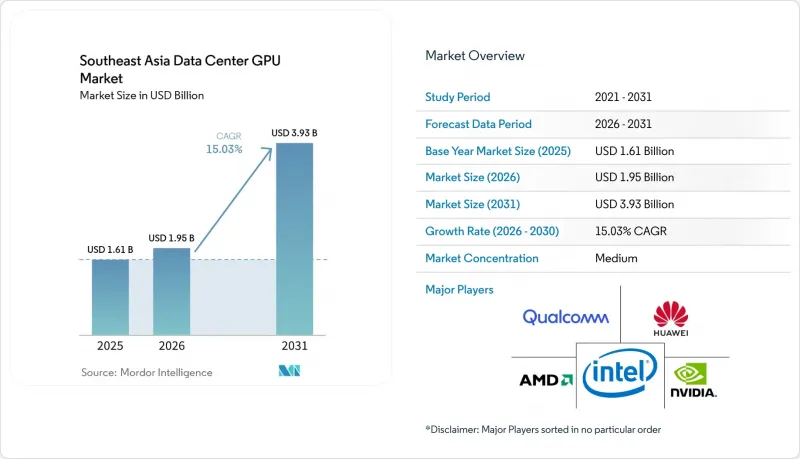
根據 Mordor Intelligence 預測,東南亞資料中心 GPU 市場規模預計將在 2025 年達到 16.1 億美元,2026 年達到 19.5 億美元,到 2031 年達到 39.3 億美元,2026 年至 2031 年的複合年成長率為 15.03%。
本報告按部署類型(雲端資料中心、企業/私有資料中心等)、GPU 類型(訓練 GPU、推理 GPU)、互連方式(基於 PCIe 的 GPU、高頻寬互連 GPU)、工作負載類型(人工智慧和機器學習、高效能運算等)以及最終用戶(超大規模資料中心業者/雲端服務供應商、企業等)進行細分。市場預測以美元計價。
東南亞資料中心GPU市場的趨勢與洞察
人工智慧最佳化超大規模設施的快速擴張
預計在2025年1月至2026年3月期間,超大規模資料中心業者將投資超過130億美元,其中微軟在新加坡投資55億美元,在泰國投資11億美元尤其引人注目。位於巴淡島和柔佛州的新園區將圍繞著功率超過80千瓦的高密度GPU機架進行設計,此配置將有助於液冷技術的應用,並引導廠商制定底盤級熱回收藍圖。接近性海底光纜登陸點將降低與亞洲主要都會地區的連接延遲,並允許將大型語言模型等工作負載限制在同一可用區內。然而,兆瓦級專案集中在少數幾個區域將迫使營運商面臨電網容量限制,這可能會延緩進一步的擴張。總體而言,未來幾年持續不斷的資本投資清晰地表明了市場需求,這將支撐下一波大規模GPU訂單。
5G邊緣節點的普及促進了低延遲人工智慧推理
到2025年,超過15,000個5G基地台將整合微型資料中心,這些資料中心將託管配備4至8個GPU的設備,用於影像分析、自動駕駛車輛遙測和工業IoT工作負載。新加坡電信的Paragon平台展示了亞毫秒級的效能,證明推理處理可以從集中式雲端遷移到本地,同時滿足服務品質(QoS)目標。通訊業者目前正在捆綁基礎設施即服務(IaaS)契約,將GPU資本投資分散到多年租賃協議中,從而縮短入門級加速器的銷售週期。然而,分散的部署位置帶來了營運複雜性,因為每個邊緣站點都需要現場維護人員、耐環境腐蝕的機殼和遠端編配堆疊。
電網長期不穩定和電力供應受限
柔佛州監管機構在2025年駁回了近三分之一的資料中心申請,原因是變電站無法應付兆瓦級負載。這導致營運商多年來一直等待容量升級。印尼依賴煤炭的電網運轉運轉率僅99.7%,低於Tier III認證所需的99.995%。因此,電壓波動頻繁,觸發GPU過熱保護機制。預計全部區域的電力需求將從2024年的9兆瓦飆升至2030年的68兆瓦時,遠超過已確認發電工程的供給能力。企業被迫租賃柴油發電機,將使營運成本增加高達20%,損害其淨零排放承諾,並造成永續性口號與日常應急計畫之間的差距。
細分市場分析
到2025年,雲端設施將佔全部區域出貨量的58.76%。這主要集中在新加坡和柔佛的園區,數萬個GPU透過NVLink和InfiniBand網路互連,用於訓練和服務擁有數兆個參數的模型。超大規模資料中心業者受益於可再生能源契約,這些合約將電源使用效率(PUE)控制在1.3以下,並且與出口收入掛鉤的稅收優惠也為其帶來了收益。邊緣設施雖然單一規模較小,但隨著5G網路密度的增加,對無線接取網路(RAN)推理處理的需求日益成長,其規模也迅速擴大。每個微站點都配備4到8張NVIDIA T4或A2顯示卡,以確保影片分析的回應時間低於10毫秒。與邊緣節點相關的資料中心GPU市場規模預計將以超過22%的複合年成長率快速成長,這主要得益於與通訊業者的合作,這些合作將資本支出(CAPEX)分攤到每月訂閱費用中。企業和私人資料中心完善了這一整體情況,主要服務於受監管的行業,這些行業需要在本地保留某些記錄,並在季節性高峰期將過多的負載轉移到公共雲端。
邊緣運算面積的不斷縮小,正推動基礎設施設計朝著模組化刀鋒伺服器的方向發展,採用單相浸沒式冷卻和遠端編配,這與部署在120千瓦雲端機架中的單體式冷卻器截然不同。儘管通訊業者目前正在協商聯合採購以獲得批量折扣,但異質部署標準仍然增加了整合成本。同時,雅加達和曼谷的託管服務供應商正在租賃協定中加入專用暗纖,以適應混合工作負載的需求:這些工作負載將敏感資料保留在本地,同時利用超大規模資料中心業者資料中心的GPU突發效能進行尖峰時段分析處理。這種分散式拓撲結構使資料中心GPU市場的收入來源多樣化,並對沖了位置風險,但同時也導致供應商關係分散,並使大規模韌體管理變得更加複雜。
預計到2025年,推理加速器的市佔率將達到57.52%,因為企業將優先考慮聊天機器人、建議引擎和詐欺偵測等可獲利服務,而非純粹基於研究的訓練。 Transformer變壓器的量化有望進一步擴大資料中心推理GPU的市場佔有率,因為它降低了記憶體需求,使得以前需要8個GPU才能處理的工作負載現在只需4個GPU即可完成。 NVIDIA的H100 NVL和L40S顯示卡是部署超大規模資料中心業者推理群集的核心,而AMD的MI300X在處理單元成本方面具有競爭力,尤其是在中小企業的訂閱方案中。 H200和MI325X等訓練GPU對於開發新的基礎模型仍然至關重要,但由於記憶體價格上漲和前置作業時間延長,它們的市場佔有率受到限制。
新加坡和泰國的國家超級計算中心是大多數訓練叢集的核心,它們目前正在考慮實施“分區調度”,將空閒的處理週期出租給大學和新創公司。相較之下,推理板的應用範圍非常廣泛,從渲染逼真場景的媒體工作室到毫秒更新風險評分的金融科技新創公司,都在使用推理板。轉向推理將使每張板的平均功耗從700瓦降低到300瓦,從而簡化機架整合,並允許分階段引入水冷系統,而無需進行徹底的機械維修。隨著模型壓縮技術的日益普及,能夠確保軟體在FP16、FP8和即將推出的FP4等不同精度等級之間可攜性的供應商將佔據主導地位。
其他好處:
- Excel格式的市場預測(ME)表
- 3個月的分析師支持
目錄
第1章:引言
- 研究假設和市場定義
- 調查範圍
第2章:調查方法
第3章執行摘要
第4章 市場狀況
- 市場概覽
- 市場促進因素
- 人工智慧最佳化超大規模設施的快速發展
- 金融科技領域GPU加速資料庫的普及應用日益廣泛
- 政府對綠色資料中心和排碳權的獎勵
- 智慧城市對即時數位孿生平台的需求日益成長
- 5G邊緣節點的普及促進了低延遲人工智慧推理
- 雲端遊戲服務在東南亞的擴張
- 市場限制因素
- 電網長期不穩定和電力供應受限
- 大都會圈四級資料中心房地產供不應求
- 對先進半導體元件徵收高額進口關稅
- 全球GPU供應鏈面臨的地緣政治風險日益增加
- 宏觀經濟因素對市場的影響
- 產業價值鏈分析
- 監理情勢
- 技術展望
- 波特五力分析
第5章 市場規模與成長預測
- 依部署類型
- 雲端資料中心
- 企業/私人資料中心
- 邊緣資料中心
- 按GPU類型
- 訓練 GPU
- 用於推理的GPU
- 依類型互連
- 基於 PCIe 的 GPU
- 高頻寬互連GPU
- 依工作負載類型
- 人工智慧(AI)和機器學習(ML)
- 高效能運算(HPC)(科學運算,不包括人工智慧)
- 資料分析(資料庫加速、查詢處理)
- 圖形和視覺化(VDI、渲染、數位孿生)
- 最終用戶
- 超大規模資料中心業者雲端服務供應商/雲端服務供應商
- 公司
- 政府和研究機構
- 按地區
- 印尼
- 馬來西亞
- 菲律賓
- 新加坡
- 泰國
- 越南
- 東南亞其他地區
第6章 競爭情勢
- 市場集中度
- 策略趨勢
- 市佔率分析
- 公司簡介
- NVIDIA Corporation
- Advanced Micro Devices, Inc.
- Intel Corporation
- Huawei Technologies Co., Ltd.
- Qualcomm Technologies, Inc.
- Graphcore Limited
- Baidu, Inc.
- Tencent Holdings Ltd.
- Alibaba Group Holding Limited
- Giga Computing Technology Co., Ltd.(Gigabyte)
- AsusTek Computer Inc.
- Lenovo Group Limited
- ASRock Rack Inc.
- Super Micro Computer, Inc.
- Dell Technologies Inc.
- Hewlett Packard Enterprise Company
- Inspur Group
- Acer Inc.
- Fujitsu Limited
- Amazon Web Services, Inc.(Annapurna Labs)
- Google LLC
- Samsung Electronics Co., Ltd.
- EVGA Corporation
- Xilinx, Inc.(AMD)
- Arm Ltd.
- Tyan Computer Corporation
- Synopsys, Inc.
第7章 市場機會與未來展望
According to Mordor Intelligence, the Southeast Asia data center GPU market size is projected to be USD 1.61 billion in 2025, USD 1.95 billion in 2026, and reach USD 3.93 billion by 2031, growing at a CAGR of 15.03% from 2026 to 2031.
This report is Segmented by Deployment Type (Cloud Data Centers, Enterprise/Private Data Centers, and More), GPU Type (Training GPUs, Inference GPUs), Interconnect (PCIe-Based GPUs, High-Bandwidth Interconnect GPUs), Workload Type (AI and ML, HPC, and More), and End-User (Hyperscalers/CSPs, Enterprises, and More). The Market Forecasts are Provided in Terms of Value (USD).
Southeast Asia Data Center GPU Market Trends and Insights
Rapid Build-Out of AI-Optimized Hyperscale Facilities
Hyperscaler capital commitments topped USD 13 billion between January 2025 and March 2026, highlighted by Microsoft's USD 5.5 billion plan for Singapore and USD 1.1 billion for Thailand. New campuses in Batam and Johor are designed around GPU-dense racks that exceed 80 kilowatts, a configuration that pushes liquid-cooling adoption and shapes vendor roadmaps toward chassis-level heat reuse.Proximity to subsea cable landings improves latency to major Asian metros, which keeps workloads such as large language model serving anchored in the same availability zones. However, clustering of megawatt-scale projects inside a few corridors exposes operators to grid caps that can slow additional build-outs. Overall, sustained multiyear capex pipelines provide a clear demand signal that underpins the next wave of GPU volume orders.
Proliferation of 5G-Enabled Edge Nodes for Low-Latency AI Inference
More than 15,000 5G base stations installed during 2025 embedded micro data centers that host 4- to 8-GPU appliances for video analytics, autonomous vehicle telemetry, and industrial IoT workloads. Singtel's Paragon platform showed sub-10-millisecond performance, proving that inference can shift away from centralized cloud while meeting quality-of-service targets.Telecommunications operators are now bundling infrastructure-as-a-service contracts that spread GPU capex across multiyear leases, which shortens sales cycles for entry-level accelerators. Yet fragmented site footprints create operational complexity because each edge location demands on-site maintenance skills, hardened enclosures, and remote orchestration stacks.
Chronic Grid Instability and Power-Supply Constraints
Johor regulators rejected nearly one-third of data center applications in 2025 because substations could not meet megawatt-scale loads, placing operators in multiyear queues for capacity upgrades. Indonesia's coal-dependent grid delivers only 99.7% uptime, short of the 99.995% needed for Tier III certification, leading to voltage swings that trip GPU thermal throttling safeguards. Power demand across the region is set to jump from 9 terawatt-hours in 2024 to 68 terawatt-hours by 2030, far outpacing confirmed generation projects. Enterprises are forced to lease diesel generators, which lift operating expenditure by up to 20% and undermine net-zero pledges, creating a wedge between sustainability rhetoric and day-to-day resiliency planning.
Other drivers and restraints analyzed in the detailed report include:
- Rising Adoption of GPU-Accelerated Databases for Fintech
- Government Incentives for Green Data Centers and Carbon Credits
- Escalating Geopolitical Risk to Global GPU Supply Chains
For complete list of drivers and restraints, kindly check the Table Of Contents.
Segment Analysis
Cloud installations delivered 58.76% of regional shipments in 2025, anchored in Singapore and Johor campuses that string tens of thousands of GPUs behind NVLink and InfiniBand fabrics to train and serve trillion-parameter models. Hyperscalers benefit from renewable power contracts that assure sub-1.3 power usage effectiveness as well as tax abatements linked to export revenue. Edge facilities, though smaller individually, are multiplying quickly because 5G densification demands inference at the radio access network; each micro site carries 4-8 NVIDIA T4 or A2 cards to guarantee sub-10-millisecond response for video analytics. The data center GPU market size tied to edge nodes is projected to surge at more than 22% CAGR, driven by telecom partnerships that spread capex across monthly subscriptions. Enterprise and private data centers round out the picture, mainly serving regulated industries that must retain certain records on-premises and burst excess loads to the public cloud when seasonal peaks hit.
Smaller footprints at the edge shift infrastructure design toward modular blades with single-phase immersion cooling and remote orchestration, a contrast to the monolithic chillers deployed in 120-kilowatt cloud racks. Telecommunication operators now negotiate joint procurement pools to unlock volume discounts, but heterogeneous deployment standards still inflate integration overhead. Meanwhile, colocation landlords in Jakarta and Bangkok bundle dedicated dark fiber into leases to capture hybrid workloads that pin sensitive data on premises while leaning on hyperscaler GPU bursts for peak analytics. This distributed topology diversifies revenue for the data center GPU market and hedges location risk, yet also fragments vendor relationships, complicating firmware management at scale.
Inference accelerators captured 57.52% share in 2025 as enterprises prioritized monetizable services like chatbots, recommendation engines, and fraud screening over pure research training. The data center GPU market share tied to inference is expected to widen as transformer quantization reduces memory requirements and allows four inference GPUs to serve workloads previously needing eight. NVIDIA H100 NVL and L40S boards headline deployments in hyperscaler inference farms, while AMD MI300X competes on cost per token processed, especially in subscription tiers engineered for small-to-mid-size enterprises. Training GPUs such as H200 and MI325X remain vital for new foundation model development, but their share is bound by high memory premiums and longer lead times.
National supercomputing centers in Singapore and Thailand anchor most training clusters, which are now exploring partitioned scheduling that leases idle cycles to universities and startups. Inference boards, by contrast, surface everywhere from media studios rendering photorealistic scenes to fintech start-ups that refresh risk scores in milliseconds. The pivot toward inference shrinks average card power from 700 watts to 300 watts, easing rack integration and enabling incremental adoption of liquid-cooling retrofits rather than wholesale mechanical overhauls. Vendors that bridge software portability across FP16, FP8, and upcoming FP4 precisions can capture outsized share as model compression techniques proliferate.
Complete Report Scope:
- By Deployment Type
- Cloud Data Centers
- Enterprise / Private Data Centers
- Edge Data Centers
- By GPU Type
- Training GPUs
- Inference GPUs
- By Interconnect
- PCIe-Based GPUs
- High-Bandwidth Interconnect GPUs
- By Workload Type
- Artificial Intelligence (AI) and Machine Learning (ML)
- High-Performance Computing (HPC) (non-AI scientific computing)
- Data Analytics (database acceleration, query processing)
- Graphics and Visualization (VDI, rendering, digital twins)
- By End-User
- Hyperscalers / Cloud Service Providers
- Enterprises
- Government and Research Institutions
- By Geography
- Indonesia
- Malaysia
- Philippines
- Singapore
- Thailand
- Vietnam
- Rest of Southeast Asia
List of Companies Covered in this Report:
- NVIDIA Corporation
- Advanced Micro Devices, Inc.
- Intel Corporation
- Huawei Technologies Co., Ltd.
- Qualcomm Technologies, Inc.
- Graphcore Limited
- Baidu, Inc.
- Tencent Holdings Ltd.
- Alibaba Group Holding Limited
- Giga Computing Technology Co., Ltd. (Gigabyte)
- AsusTek Computer Inc.
- Lenovo Group Limited
- ASRock Rack Inc.
- Super Micro Computer, Inc.
- Dell Technologies Inc.
- Hewlett Packard Enterprise Company
- Inspur Group
- Acer Inc.
- Fujitsu Limited
- Amazon Web Services, Inc. (Annapurna Labs)
- Google LLC
- Samsung Electronics Co., Ltd.
- EVGA Corporation
- Xilinx, Inc. (AMD)
- Arm Ltd.
- Tyan Computer Corporation
- Synopsys, Inc.
Additional Benefits:
- The market estimate (ME) sheet in Excel format
- 3 months of analyst support
TABLE OF CONTENTS
1 INTRODUCTION
- 1.1 Study Assumptions and Market Definition
- 1.2 Scope of the Study
2 RESEARCH METHODOLOGY
3 EXECUTIVE SUMMARY
4 MARKET LANDSCAPE
- 4.1 Market Overview
- 4.2 Market Drivers
- 4.2.1 Rapid Build-Out of AI-Optimized Hyperscale Facilities
- 4.2.2 Rising Adoption of GPU-Accelerated Databases for Fintech
- 4.2.3 Government Incentives for Green Data Centers and Carbon Credits
- 4.2.4 Growing Demand for Real-Time Digital Twin Platforms in Smart Cities
- 4.2.5 Proliferation of 5G-Enabled Edge Nodes for Low-Latency AI Inference
- 4.2.6 Expansion of Cloud Gaming Services Across Southeast Asia
- 4.3 Market Restraints
- 4.3.1 Chronic Grid Instability and Power-Supply Constraints
- 4.3.2 Limited Availability of Tier IV Data-Center Real Estate in Metro Hubs
- 4.3.3 High Import Tariffs on Advanced Semiconductor Components
- 4.3.4 Escalating Geopolitical Risk to Global GPU Supply Chains
- 4.4 Impact of Macroeconomic Factors on the Market
- 4.5 Industry Value Chain Analysis
- 4.6 Regulatory Landscape
- 4.7 Technological Outlook
- 4.8 Porter's Five Forces Analysis
- 4.8.1 Threat of New Entrants
- 4.8.2 Bargaining Power of Buyers
- 4.8.3 Bargaining Power of Suppliers
- 4.8.4 Threat of Substitute Products or Services
- 4.8.5 Competitive Rivalry
5 MARKET SIZE AND GROWTH FORECASTS (VALUE)
- 5.1 By Deployment Type
- 5.1.1 Cloud Data Centers
- 5.1.2 Enterprise / Private Data Centers
- 5.1.3 Edge Data Centers
- 5.2 By GPU Type
- 5.2.1 Training GPUs
- 5.2.2 Inference GPUs
- 5.3 By Interconnect
- 5.3.1 PCIe-Based GPUs
- 5.3.2 High-Bandwidth Interconnect GPUs
- 5.4 By Workload Type
- 5.4.1 Artificial Intelligence (AI) and Machine Learning (ML)
- 5.4.2 High-Performance Computing (HPC) (non-AI scientific computing)
- 5.4.3 Data Analytics (database acceleration, query processing)
- 5.4.4 Graphics and Visualization (VDI, rendering, digital twins)
- 5.5 By End-User
- 5.5.1 Hyperscalers / Cloud Service Providers
- 5.5.2 Enterprises
- 5.5.3 Government and Research Institutions
- 5.6 By Geography
- 5.6.1 Indonesia
- 5.6.2 Malaysia
- 5.6.3 Philippines
- 5.6.4 Singapore
- 5.6.5 Thailand
- 5.6.6 Vietnam
- 5.6.7 Rest of Southeast Asia
6 COMPETITIVE LANDSCAPE
- 6.1 Market Concentration
- 6.2 Strategic Moves
- 6.3 Market Share Analysis
- 6.4 Company Profiles (includes Global Level Overview, Market Level Overview, Core Segments, Financials as available, Strategic Information, Market Rank/Share, Products and Services, Recent Developments)
- 6.4.1 NVIDIA Corporation
- 6.4.2 Advanced Micro Devices, Inc.
- 6.4.3 Intel Corporation
- 6.4.4 Huawei Technologies Co., Ltd.
- 6.4.5 Qualcomm Technologies, Inc.
- 6.4.6 Graphcore Limited
- 6.4.7 Baidu, Inc.
- 6.4.8 Tencent Holdings Ltd.
- 6.4.9 Alibaba Group Holding Limited
- 6.4.10 Giga Computing Technology Co., Ltd. (Gigabyte)
- 6.4.11 AsusTek Computer Inc.
- 6.4.12 Lenovo Group Limited
- 6.4.13 ASRock Rack Inc.
- 6.4.14 Super Micro Computer, Inc.
- 6.4.15 Dell Technologies Inc.
- 6.4.16 Hewlett Packard Enterprise Company
- 6.4.17 Inspur Group
- 6.4.18 Acer Inc.
- 6.4.19 Fujitsu Limited
- 6.4.20 Amazon Web Services, Inc. (Annapurna Labs)
- 6.4.21 Google LLC
- 6.4.22 Samsung Electronics Co., Ltd.
- 6.4.23 EVGA Corporation
- 6.4.24 Xilinx, Inc. (AMD)
- 6.4.25 Arm Ltd.
- 6.4.26 Tyan Computer Corporation
- 6.4.27 Synopsys, Inc.
7 MARKET OPPORTUNITIES AND FUTURE OUTLOOK
- 7.1 White-Space and Unmet-Need Assessment

 AI資料中心GPU市場報告:趨勢、預測與競爭分析(至2035年)
 中東和非洲資料中心GPU:市場佔有率分析、行業趨勢和統計數據以及成長預測(2026-2031年)印度資料中心GPU:市場佔有率分析、產業趨勢與統計及成長預測(2026-2031年)新加坡資料中心GPU:市佔率分析、產業趨勢與統計及成長預測(2026-2031年)法國資料中心GPU:市佔率分析、產業趨勢與統計及成長預測(2026-2031年)中國資料中心GPU:市場佔有率分析、產業趨勢與統計及成長預測(2026-2031年)亞太地區資料中心GPU:市場佔有率分析、產業趨勢與統計及成長預測(2026-2031年)北美資料中心GPU:市佔率分析、產業趨勢與統計及成長預測(2026-2031年)德國資料中心GPU:市場佔有率分析、產業趨勢與統計及成長預測(2026-2031年)日本資料中心GPU市場:市佔率分析、產業趨勢與統計及成長預測(2026-2031年)