


 |
市場調查報告書
商品編碼
2073261
整合顯示卡:市場佔有率分析、產業趨勢與統計、成長預測(2026-2031)Integrated GPU - Market Share Analysis, Industry Trends & Statistics, Growth Forecasts (2026 - 2031) |
||||||

※ 本網頁內容可能與最新版本有所差異。詳細情況請與我們聯繫。
根據 Mordor Intelligence 預測,整合 GPU 市場預計將從 2025 年的 448.6 億美元成長到 2026 年的 509.2 億美元,到 2031 年達到 1,111.9 億美元,2026 年至 2031 年的複合年成長率為 16.91%。
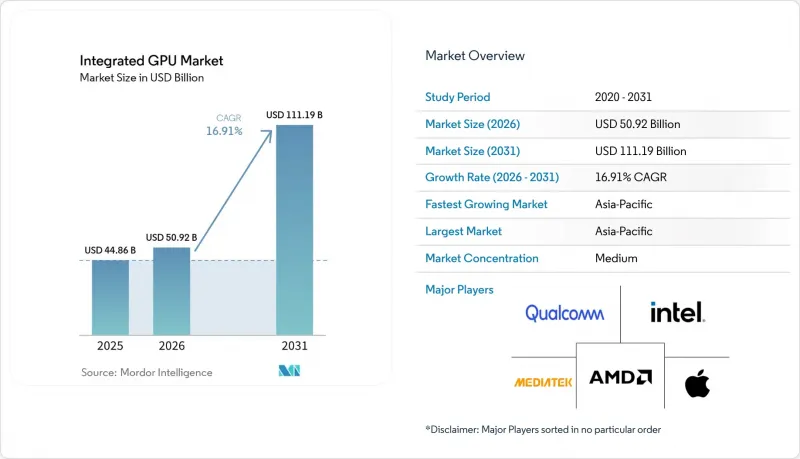
本報告按設備類型(桌上型電腦和筆記型電腦處理器、行動SoC、嵌入式和工業SoC以及具有整合式顯示卡的伺服器和資料中心處理器)、效能等級(入門級、主流級、效能級和高效能級)以及地區進行細分。市場預測以美元(USD)為單位。
全球整合GPU市場趨勢與洞察
AI PC更換週期和裝置端AI採用
整合GPU市場正受益於個人電腦朝向人工智慧(AI)賦能的廣泛轉變。在主流系統中,圖形模組現在支援影像增強、本地模型執行和媒體處理。廠商不再將整合GPU視為次要功能,因為它們現在與CPU和NPU協同工作,為企業和消費者用戶處理關鍵的共用工作負載。英特爾透過Core Ultra Series 3清楚地展示了這一轉變,該系列處理器在Intel 18A處理器的單一封裝中整合了多達12個Xe3 GPU核心和一個50 TOPS的NPU。此設計選擇透過提升基準,允許將較輕的AI任務卸載到NPU,而整合GPU則繼續處理視覺管線和持續的圖形處理。因此,整合GPU市場在企業更新周期和高階筆記型電腦的定位中扮演著越來越重要的角色。
擴展移動SoC中的圖形整合
在整合式圖形處理器 (GPU) 市場,行動 SoC 領域仍佔據最大的銷售佔有率。在這個領域,圖形模組的功能不再局限於簡單的幀渲染,而是涵蓋了更廣泛的運算能力和 AI 驅動的影像處理功能。聯發科憑藉“天璣 9500”擴展了其性能範圍。這款晶片整合了 Arm G1-Ultra GPU,並新增了“GPU 動態快取架構”,與上一代產品相比,峰值效能提升了 33%,能源效率提升了 42%。三星也憑藉其 2nm GAA 晶片「Exynos 2600」提高了人們對高階智慧型手機的期望。這款晶片將 Xclipse 960 GPU 與三星自主研發的溫度控管技術結合,實現了比上一代產品更高的射線追蹤效能。高通也憑藉其驍龍 X2 Elite 系列,在 PC 級移動半導體領域強化了類似的發展方向。此系列中的 Adreno X2-90 整合 GPU 支援 DirectX 12.2 Ultimate 和 Vulkan 1.4,在相近的功耗水準下提供更高的效能。這些變化對整合 GPU 市場意義重大,因為它們進一步拓展了 SoC 的效能極限,而 SoC 已在智慧型手機、平板電腦和常開 PC 等裝置中大量出貨。這些變化也表明,記憶體處理、快取設計和圖形效率不再只是輔助功能,而是整合 GPU 市場的核心產品差異化因素。
在AAA級遊戲與專業工作負載中,獨立顯示卡與效能差距明顯
整合顯示卡市場在需要長時間渲染、專業內容創作或高畫質遊戲等工作負載方面仍面臨明顯的限制。儘管架構有所進步,但整合式顯示卡仍共用系統記憶體和散熱設計的限制,而獨立顯示卡則擁有專用的記憶體池和獨立的功耗預算。英特爾目前的藍圖展示了整合式顯示卡的發展,但即使是其最新的客戶端平台,也並未將強大的整合式顯示卡定位為專業獨立顯示卡的完全替代品,而是將其作為更廣泛封裝設計的一部分。因此,整合式顯示卡市場未能充分掌握創作工作站、高階桌上型電腦和高要求3D製作環境等市場機會。軟體認證狀況也阻礙了替代方案的普及,因為專業買家通常仍然傾向於選擇在專業渲染和視覺化工作流程中擁有長期應用經驗的硬體。因此,儘管整合式顯示卡市場將繼續擴張,但在預測期內,其在要求最嚴苛的圖形領域的滲透率可能仍然有限。
細分市場分析
到2025年,行動SoC將佔據整合GPU市場49.32%的佔有率,該品類在全球出貨量中仍佔據核心地位。整合GPU市場的大部分佔有率來自智慧型手機和平板電腦,因為圖形IP直接整合到應用處理器中,而這些處理器的出貨量龐大,涵蓋了廣泛的消費價格區間。在整合GPU領域,廠商之間的競爭不僅體現在原始運算能力上,也體現在遊戲反應速度、影像品質、AI驅動的媒體功能以及能源效率等。聯發科憑藉其「天璣9500」強化了這一領域,該晶片在主流商用SoC中整合了Arm G1-Ultra GPU,實現了更高的峰值圖形性能、更佳的能效以及120fps的硬體射線追蹤。三星也憑藉其「Exynos 2600」增強了其高階行動圖形產品線。該產品採用 Xclipse 960 GPU 和 2nm GAA 工藝,為旗艦設備提供更強大的視覺性能。
預計到2031年,整合顯示卡的伺服器和資料中心處理器將以17.62%的複合年成長率成長,成為整合GPU市場中成長最快的設備類別。這一成長反映了市場對邊緣AI和緊湊型伺服器平台的需求,這些平台無需單獨的擴充卡即可實現輕量級推理和編配。桌面和筆記型電腦處理器仍然是收入第二大的設備類別,這主要得益於x86和Arm架構處理器在客戶端運算領域的持續高普及率,以及整合顯示卡效能的提升。英特爾酷睿Ultra系列3和酷睿系列3處理器憑藉其更強大的圖形模組和先進的AI應對力,展現了整合GPU市場在高階和入門級筆記型電腦產品線中的發展趨勢。嵌入式和工業SoC仍然是收入最小的細分市場,但隨著高效能SoC設計在視覺介面、邊緣視覺和互聯控制系統中的應用,整合GPU市場的潛在基本客群正在不斷擴大。
區域分析
預計到2025年,亞太地區將佔據整合GPU市場43.93%的佔有率,並在2031年之前維持17.89%的複合年成長率,成為該地區最高的成長點。該地區整合GPU市場的成長主要得益於組裝以及智慧型手機、筆記型電腦和家用電子電器等終端設備的巨大需求。中國憑藉其龐大的設備組裝規模和不斷提升的國內半導體能力,仍然是該地區最大的需求中心。區域廠商持續投資於高階整合式顯示卡技術。韓國透過開發先進的行動晶片創造附加價值,三星的「Exynos 2600」晶片也表明,該地區的主要廠商持續投資於高階整合式顯示卡技術。印度和東南亞也透過5G的普及、智慧型手機使用量的增加以及將GPU產品引入日常運算的設備存取計劃,不斷擴大其整合GPU市場。
北美是整合GPU市場第二大區域銷售基地,這主要得益於企業PC的更換、高階消費市場的需求以及人工智慧設備的日益普及。根據2026年1月生效的《232條款》對半導體徵收的關稅,改變了進口晶片的採購經濟格局,使得國內或免稅來源對部分買家更具吸引力。這個政策環境正在推動美國本土的設計和製造策略,尤其是在整合平台能夠降低材料清單(BOM)複雜性方面。加拿大和墨西哥則主要透過組裝、物流和分銷等環節,為整個北美供應鏈做出貢獻。
歐洲作為整合式圖形處理器 (GPU) 的需求中心和戰略製造投資中心,正持續發展壯大。該地區的需求主要來自依賴嵌入式圖形功能的商用 PC、工業系統和汽車電子產品。南美洲是整合 GPU 市場中規模較小但成長迅速的地區,其需求與中階智慧型手機和行動數據普及率的不斷提高密切相關。中東和非洲的市場規模也正在擴大,這主要得益於數位轉型計畫、小規模城市建設以及連網監控系統的普及,這些因素推動了對具備圖形功能的嵌入式和工業 SoC 的需求成長。在上述兩個地區,整合 GPU 市場仍深受進口設備的供應和價格影響,而非本地晶片生產。因此,需求容易受到外匯波動、貿易政策以及主要半導體製造地供應緊張等因素所導致的價格波動的影響。
其他好處:
- Excel格式的市場預測(ME)表
- 3個月的分析師支持
目錄
第1章:引言
- 研究假設和市場定義
- 調查範圍
第2章:調查方法
第3章執行摘要
第4章 市場狀況
- 市場概覽
- 市場促進因素
- 人工智慧PC更換週期及人工智慧在設備的應用
- 對節能、輕薄運算設備的需求
- 行動SoC圖形功能整合的進展
- 主流整合圖形的架構進步
- 統一的記憶體設計支援本地AI推理
- 由於關稅和記憶體價格上漲,入門級獨立顯示卡被取代。
- 市場限制因素
- 與獨立顯示卡相比,在AAA級遊戲和專業工作負載中效能差異顯著
- 持續負載下的熱限制和共用記憶體限制
- 先進節點和低功耗數位記憶體(LPDDR)的供應和分配受到限制
- AI PC規格過熱和實際記憶體/頻寬需求
- 宏觀經濟因素對市場的影響
- 產業價值鏈分析
- 供應鏈分析
- 監理情勢
- 技術展望
- 波特五力分析
第5章 市場規模與成長預測
- 透過裝置
- 桌上型電腦和筆記型電腦處理器
- 行動SoC(智慧型手機和平板電腦)
- 嵌入式和工業級SoC
- 伺服器和資料中心處理器,整合顯示卡
- 按績效水準
- 入門級(50 美元以下)
- 主流(50-150美元)
- 性能(150-300 美元)
- 高性能(超過 300 美元)
- 按地區
- 北美洲
- 美國
- 加拿大
- 墨西哥
- 歐洲
- 德國
- 英國
- 法國
- 義大利
- 其他歐洲國家
- 亞太地區
- 中國
- 日本
- 韓國
- 印度
- 東南亞
- 其他亞太國家
- 南美洲
- 中東和非洲
- 北美洲
第6章 競爭情勢
- 市場集中度
- 策略趨勢
- 市佔率分析
- 公司簡介
- Intel Corporation
- Advanced Micro Devices, Inc.
- Apple Inc.
- Qualcomm Incorporated
- MediaTek Inc.
- Samsung Electronics Co., Ltd.
- Arm Limited
- Imagination Technologies Group plc
- UNISOC Technologies Co., Ltd.
- NXP Semiconductors NV
- Renesas Electronics Corporation
- Texas Instruments Incorporated
- VeriSilicon Holdings Co., Ltd.
- HiSilicon Technologies Co., Ltd.
- Rockchip Electronics Co., Ltd.
- Allwinner Technology Co., Ltd.
- Loongson Technology Corporation Limited
- Shanghai Zhaoxin Semiconductor Co., Ltd.
- Google LLC
- VIA Technologies, Inc.
第7章 市場機會與未來展望
According to Mordor Intelligence, the integrated GPU market size is expected to increase from USD 44.86 billion in 2025 to USD 50.92 billion in 2026 and reach USD 111.19 billion by 2031, growing at a CAGR of 16.91% over 2026-2031.
This report is Segmented by Device Category (Desktop and Laptop Processors, Mobile SoCs, Embedded and Industrial SoCs, and Server and Data Center Processors With Integrated Graphics), Performance Tier (Entry-Level, Mainstream, Performance, and High-Performance), and Geography. The Market Forecasts are Provided in Terms of Value (USD).
Global Integrated GPU Market Trends and Insights
AI PC Refresh Cycle and On-Device AI Adoption
The integrated GPU market is benefiting from the broader move toward AI-capable personal computing, where graphics blocks now support image enhancement, local model execution, and media processing in mainstream systems. Platform vendors are no longer treating the integrated GPU as a secondary feature, because it now works alongside the CPU and NPU in shared workloads that matter to enterprise and consumer buyers. Intel clearly positioned this shift with the Core Ultra Series 3, which combines up to 12 Xe3 GPU cores and a 50 TOPS NPU in a single package on Intel 18A. That design choice supports the integrated GPU market by raising the baseline graphics capability in AI PCs without adding a separate graphics card. The same approach also improves system balance, as lighter AI tasks can be offloaded to the NPU while the integrated GPU continues to handle visual pipelines and sustained graphics activity. This is helping the integrated GPU market gain a stronger role in commercial refresh cycles and premium notebook positioning.
Rising Graphics Integration Across Mobile SoCs
The integrated graphics processing unit (GPU) market continues to draw its largest unit base from mobile SoCs, where graphics blocks are moving beyond frame rendering and into broader compute and AI-assisted imaging functions. MediaTek expanded that performance range with the Dimensity 9500, which integrates the Arm G1-Ultra GPU, adds a new GPU Dynamic Cache Architecture, delivers 33% higher peak performance, and improves power efficiency by 42% from the prior generation. Samsung also raised expectations in premium smartphones with the Exynos 2600, a 2nm GAA chip that pairs the Xclipse 960 GPU with in-house thermal management and higher ray-tracing capability than the prior model. Qualcomm reinforced the same direction in PC-class mobile silicon with the Snapdragon X2 Elite family, where the Adreno X2-90 integrated GPU supports DirectX 12.2 Ultimate, Vulkan 1.4, and higher performance at the same power level. These changes matter to the integrated GPU market because they widen the performance ceiling of SoCs that already ship at very high volume across phones, tablets, and always-connected PCs. They also show that memory handling, cache design, and graphics efficiency have become core product differentiators in the integrated GPU market rather than supporting features.
Performance Gap Versus Discrete GPUs in AAA and Professional Workloads
The integrated GPU market still faces a clear ceiling in workloads that need long-duration rendering, professional content creation, or advanced gaming at high settings. Even with architectural gains, integrated designs still share system memory and thermal limits, while discrete GPUs keep dedicated memory pools and separate power budgets. Intel's current roadmap shows how far integrated graphics have advanced, but even its newest client platforms position strong integrated graphics within broader package designs rather than as full substitutes for professional discrete hardware. This keeps the integrated GPU market from capturing the entire opportunity in creator workstations, high-end desktops, and heavy 3D production environments. Software certification patterns also slow substitution, because professional buyers often continue to specify hardware that has a longer history in specialist rendering and visualization workflows. As a result, the integrated GPU market will continue to expand, but it is likely to remain limited in the most demanding graphics segments over the forecast period.
Other drivers and restraints analyzed in the detailed report include:
- Unified-Memory Designs Enabling Local AI Inference
- Demand for Power-Efficient Thin-and-Light Computing
- Thermal and Shared-Memory Constraints in Sustained Loads
For complete list of drivers and restraints, kindly check the Table Of Contents.
Segment Analysis
Mobile SoCs held a 49.32% share of the integrated GPU market in 2025, keeping the category at the center of global shipment volume. The integrated GPU market draws much of its scale from smartphones and tablets because graphics IP is embedded directly into application processors that ship in very large numbers across consumer price bands. In this part of the integrated GPU industry, vendors compete on gaming response, imaging quality, AI-assisted media features, and power efficiency rather than on raw compute power alone. MediaTek strengthened this category with the Dimensity 9500, which added the Arm G1-Ultra GPU, higher peak graphics performance, better power efficiency, and 120 fps hardware ray tracing in a mainstream commercial SoC. Samsung also reinforced premium mobile graphics with the Exynos 2600, which features the Xclipse 960 GPU and a 2nm GAA process, supporting stronger visual performance in flagship devices.
Server and Data Center Processors with Integrated Graphics are projected to expand at a 17.62% CAGR through 2031, making them the fastest-growing device category in the integrated GPU market. This growth reflects demand for edge AI and compact server platforms where lightweight inference and orchestration can run without a separate add-in card. Desktop and Laptop Processors remain the second-largest device category by value, as client computing continues to absorb large volumes of x86 and Arm-based processors, with improving integrated graphics capabilities. Intel's Core Ultra Series 3 and Core Series 3 show how the integrated GPU market is moving across both premium and value notebook lines with stronger graphics blocks and higher AI readiness. Embedded and Industrial SoCs remain the smallest revenue segment, but they continue to widen the addressable base of the integrated GPU market as visual interfaces, edge vision, and connected control systems adopt more capable SoC designs.
Complete Report Scope:
- By Device Category
- Desktop and Laptop Processors
- Mobile SoCs (Smartphones and Tablets)
- Embedded and Industrial SoCs
- Server and Data Center Processors with Integrated Graphics
- By Performance Tier
- Entry-Level (< USD 50)
- Mainstream (USD 50 - USD 150)
- Performance (USD 150 - USD 300)
- High-Performance (> USD 300)
- By Geography
- North America
- United States
- Canada
- Mexico
- Europe
- Germany
- United Kingdom
- France
- Italy
- Rest of Europe
- Asia-Pacific
- China
- Japan
- South Korea
- India
- Southeast Asia
- Rest of Asia-Pacific
- South America
- Middle East and Africa
- North America
Geography Analysis
Asia-Pacific held 43.93% of the integrated GPU market share in 2025 and is expected to post the fastest regional CAGR of 17.89% through 2031. The region leads the integrated GPU market because it combines SoC manufacturing depth, high-volume electronics assembly, and very great end-device demand across smartphones, notebooks, and consumer electronics. China remains the largest regional demand center due to its scale in device assembly and its push to strengthen domestic semiconductor capabilities. Regional vendors continue to invest in premium integrated graphics capabilities. South Korea adds value through advanced mobile chip development, and Samsung's Exynos 2600 shows how leading vendors in the region continue to invest in premium integrated graphics capability. India and Southeast Asia are also expanding the integrated GPU market through wider 5G adoption, rising smartphone use, and device access programs that bring more GPU-equipped products into everyday computing.
North America represents the second-largest regional revenue base in the integrated GPU market, supported by enterprise PC replacement, premium consumer demand, and wider adoption of AI-ready devices. The January 2026 Section 232 semiconductor tariffs changed procurement economics for imported chips, increasing the appeal of domestic or tariff-exempt supply for some buyers. That policy backdrop favors US-based design and manufacturing strategies, especially when integrated platforms can help reduce bill-of-material complexity. Canada and Mexico contribute mainly through assembly, logistics, and distribution roles within the broader North American supply chain.
Europe continues to develop as both a demand center and a strategic manufacturing investment location for the integrated graphics processing unit (GPU) market. Regional demand is supported by commercial PCs, industrial systems, and automotive electronics that rely on embedded graphics capability. South America remains a smaller but growing part of the integrated GPU market, with demand tied closely to mid-range smartphones and broader mobile data adoption. The Middle East and Africa are also expanding from a smaller base as digital transformation programs, smart city deployments, and connected surveillance systems increase demand for embedded and industrial SoCs with graphics capability. Across both regions, the integrated GPU market is still shaped more by the availability and pricing of imported devices than by local chip production. This leaves demand sensitive to currency movements, trade policy, and pricing effects stemming from supply tightness in major semiconductor manufacturing hubs.
- Intel Corporation
- Advanced Micro Devices, Inc.
- Apple Inc.
- Qualcomm Incorporated
- MediaTek Inc.
- Samsung Electronics Co., Ltd.
- Arm Limited
- Imagination Technologies Group plc
- UNISOC Technologies Co., Ltd.
- NXP Semiconductors N.V.
- Renesas Electronics Corporation
- Texas Instruments Incorporated
- VeriSilicon Holdings Co., Ltd.
- HiSilicon Technologies Co., Ltd.
- Rockchip Electronics Co., Ltd.
- Allwinner Technology Co., Ltd.
- Loongson Technology Corporation Limited
- Shanghai Zhaoxin Semiconductor Co., Ltd.
- Google LLC
- VIA Technologies, Inc.
Additional Benefits:
- The market estimate (ME) sheet in Excel format
- 3 months of analyst support
TABLE OF CONTENTS
1 INTRODUCTION
- 1.1 Study Assumptions and Market Definition
- 1.2 Scope of the Study
2 RESEARCH METHODOLOGY
3 EXECUTIVE SUMMARY
4 MARKET LANDSCAPE
- 4.1 Market Overview
- 4.2 Market Drivers
- 4.2.1 AI PC Refresh Cycle and On-Device AI Adoption
- 4.2.2 Demand for Power-Efficient Thin-and-Light Computing
- 4.2.3 Rising Graphics Integration Across Mobile SoCs
- 4.2.4 Architectural Gains in Mainstream Integrated Graphics
- 4.2.5 Unified-Memory Designs Enabling Local AI Inference
- 4.2.6 Tariff- and Memory-Driven Substitution Away From Entry Discrete GPUs
- 4.3 Market Restraints
- 4.3.1 Performance Gap Versus Discrete GPUs in AAA and Professional Workloads
- 4.3.2 Thermal and Shared-Memory Constraints in Sustained Loads
- 4.3.3 Advanced-Node and LPDDR Supply Allocation Constraints
- 4.3.4 AI PC Spec Inflation Versus Real Memory-Bandwidth Needs
- 4.4 Impact of Macroeconomic Factors on the Market
- 4.5 Industry Value Chain Analysis
- 4.6 Supply Chain Analysis
- 4.7 Regulatory Landscape
- 4.8 Technological Outlook
- 4.9 Porter's Five Forces Analysis
- 4.9.1 Bargaining Power of Suppliers
- 4.9.2 Bargaining Power of Buyers
- 4.9.3 Threat of New Entrants
- 4.9.4 Threat of Substitutes
- 4.9.5 Intensity of Competitive Rivalry
5 MARKET SIZE AND GROWTH FORECASTS (VALUE)
- 5.1 By Device Category
- 5.1.1 Desktop and Laptop Processors
- 5.1.2 Mobile SoCs (Smartphones and Tablets)
- 5.1.3 Embedded and Industrial SoCs
- 5.1.4 Server and Data Center Processors with Integrated Graphics
- 5.2 By Performance Tier
- 5.2.1 Entry-Level (< USD 50)
- 5.2.2 Mainstream (USD 50 - USD 150)
- 5.2.3 Performance (USD 150 - USD 300)
- 5.2.4 High-Performance (> USD 300)
- 5.3 By Geography
- 5.3.1 North America
- 5.3.1.1 United States
- 5.3.1.2 Canada
- 5.3.1.3 Mexico
- 5.3.2 Europe
- 5.3.2.1 Germany
- 5.3.2.2 United Kingdom
- 5.3.2.3 France
- 5.3.2.4 Italy
- 5.3.2.5 Rest of Europe
- 5.3.3 Asia-Pacific
- 5.3.3.1 China
- 5.3.3.2 Japan
- 5.3.3.3 South Korea
- 5.3.3.4 India
- 5.3.3.5 Southeast Asia
- 5.3.3.6 Rest of Asia-Pacific
- 5.3.4 South America
- 5.3.5 Middle East and Africa
- 5.3.1 North America
6 COMPETITIVE LANDSCAPE
- 6.1 Market Concentration
- 6.2 Strategic Moves
- 6.3 Market Share Analysis
- 6.4 Company Profiles (includes Global Level Overview, Market Level Overview, Core Segments, Financials as available, Strategic Information, Market Rank/Share, Products and Services, Recent Developments)
- 6.4.1 Intel Corporation
- 6.4.2 Advanced Micro Devices, Inc.
- 6.4.3 Apple Inc.
- 6.4.4 Qualcomm Incorporated
- 6.4.5 MediaTek Inc.
- 6.4.6 Samsung Electronics Co., Ltd.
- 6.4.7 Arm Limited
- 6.4.8 Imagination Technologies Group plc
- 6.4.9 UNISOC Technologies Co., Ltd.
- 6.4.10 NXP Semiconductors N.V.
- 6.4.11 Renesas Electronics Corporation
- 6.4.12 Texas Instruments Incorporated
- 6.4.13 VeriSilicon Holdings Co., Ltd.
- 6.4.14 HiSilicon Technologies Co., Ltd.
- 6.4.15 Rockchip Electronics Co., Ltd.
- 6.4.16 Allwinner Technology Co., Ltd.
- 6.4.17 Loongson Technology Corporation Limited
- 6.4.18 Shanghai Zhaoxin Semiconductor Co., Ltd.
- 6.4.19 Google LLC
- 6.4.20 VIA Technologies, Inc.
7 MARKET OPPORTUNITIES AND FUTURE OUTLOOK
- 7.1 White-Space and Unmet-Need Assessment

 圖形處理器 (GPU) 市場預測至 2034 年——按 GPU 類型、部署模式、記憶體類型、裝置類型、功能、應用程式、最終用戶和地區分類的全球分析
 東南亞GPU市場:市場佔有率分析、產業趨勢與統計及成長預測(2026-2031年)超大規模資料中心GPU:市場佔有率分析、產業趨勢與統計及成長預測(2026-2031年)影像處理處理器(GPU):市場佔有率分析、行業趨勢和統計數據以及成長預測(2026-2031 年)亞太地區整合GPU:市場佔有率分析、產業趨勢與統計及成長預測(2026-2031年)歐洲整合顯示卡市場:市場佔有率分析、產業趨勢與統計及成長預測(2026-2031 年)北美整合顯示卡:市場佔有率分析、產業趨勢與統計及成長預測(2026-2031 年)行動GPU:市場佔有率分析、產業趨勢與統計及成長預測(2026-2031年)印度GPU市場:市場佔有率分析、產業趨勢與統計及成長預測(2026-2031年)德國GPU市場:市場佔有率分析、產業趨勢與統計及成長預測(2026-2031年)