

 |
市場調查報告書
商品編碼
2066729
綜合設施管理:市場佔有率分析、產業趨勢與統計、成長預測(2026-2031)Integrated Facility Management - Market Share Analysis, Industry Trends & Statistics, Growth Forecasts (2026 - 2031) |
||||||

※ 本網頁內容可能與最新版本有所差異。詳細情況請與我們聯繫。
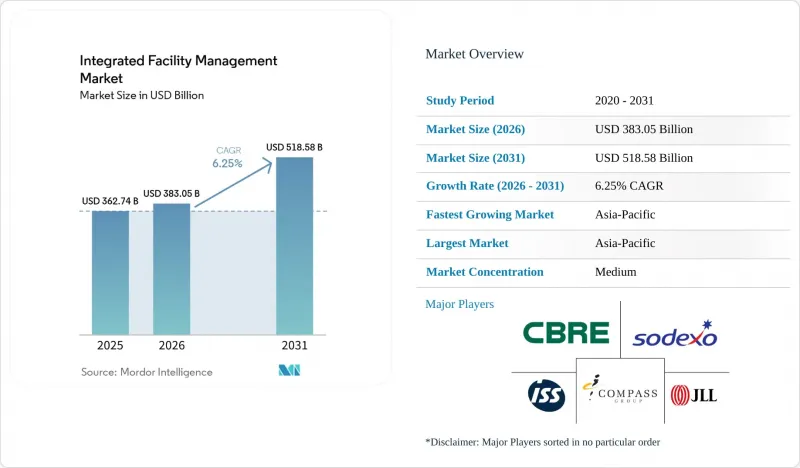
據 Mordor Intelligence 稱,2025 年綜合設施管理市場價值為 3,627.4 億美元,預計到 2031 年將達到 5,185.8 億美元,而 2026 年為 3,830.5 億美元,預測期內(2026-2031 年)的複合成長率為 6.25%。
本報告按服務類型(硬性設施管理[資產管理、機電和暖通空調服務等]、軟性設施管理[辦公室支援和安保、清潔服務、餐飲服務等])、最終用戶(商業、酒店、醫療保健、工業和流程行業等)以及地區進行細分。市場預測以價值(美元)表示。
全球整合性機構管理市場趨勢與洞察
智慧建築與預測性維護的實施:人工智慧決定採購標準
人工智慧驅動的監控和物聯網建築系統正在改變整合性機構管理的採購和交付方式。對於大型企業客戶而言,運轉率和能源績效正從單純的服務目標轉變為合約義務。Honeywell在2025年4月報告稱,60%的組織已經實施了人工智慧驅動的維護系統,84%的商業建築決策者計劃進一步擴展人工智慧的應用。世邦魏理仕(CBRE)報告稱,其設施管理部門在2025年實現了13%的成長,這得益於資料中心技術服務和與智慧基礎設施項目相關的區域設施管理部署。擁有長期合約的供應商正在建立新進入者難以企及的資產級性能標準,從而增加了客戶的轉換成本。西門子在2026年5月推出了Asset Performance Advanced,進一步推動了這個趨勢。 Asset Performance Advanced是一項託管建築服務,它將預測性維護故障分類與暖通空調(HVAC)和推出大樓自動化系統的自動化工作流程執行相結合。
非核心職場和物業管理外包:首次採用外包的公司正在擴大其目標市場。
隨著租戶越來越難以自行管理建築系統,綜合設施管理 (IFM) 市場正受益於不斷擴大的外包週期。機械、電氣、空氣品質、安防和控制系統如今需要高度協調,而許多租戶無法在內部維持這些系統。仲量聯行 (JLL) 報告稱,其物業管理服務部門在 2025 年第四季度的收入成長了 9%,這主要得益於辦公場所管理業務的擴張以及在以往依賴內部設施管理模式的領域中獲取了新客戶。世邦魏理仕 (CBRE) 也於 2024 年 2 月透過以 8 億美元收購 J&J Worldwide Services 擴大了其外包平台,將擁有長期固定價格合約和機構級服務需求的聯邦政府設施納入其營運範圍。隨著辦公室佈局的重新設計以適應混合辦公模式和服務柔軟性,中型租戶正在推動綜合設施管理市場的新需求。 IFMA 在 2025 年報告中指出,領先的公司越來越將設施管理視為直接影響財務、環境和人力資源結果的一種手段,這使得採購的重點從投資團隊轉移到了經營團隊。
各行各業技術人才短缺:人才缺口正成為策略風險。
綜合設施管理 (IFM) 市場面臨的不僅是招募週期縮短,而是結構性的勞動力問題。服務提供者所需的電工、暖通空調技術人員、控制專家和合規負責人數量遠遠超過現有訓練體系的供應能力。根據 SFG20 發布的《2026 年設施管理現況》報告,51% 的設施管理機構表示有人才短缺,42% 的機構表示有顯著的技能缺口,尤其是在合規、數位化能力和能源管理方面。仲量聯行 (JLL) 預測,到 2030 年,將有 210 萬個技術職位空缺,如果這一缺口持續下去,每年可能造成 1 兆美元的經濟損失。美國勞工統計局預測,到 2034 年,暖通空調技術人員的就業人數將增加 8.1%,電工的就業人數將增加 9.5%,均高於所有職業 3.1% 的平均成長率。因此,綜合設施管理市場對硬體維修設施管理的採用速度正在放緩,同時,供應商面臨著加強對遠距離診斷和預測性維護投資的壓力,以減少對現場勞動力的依賴。
細分市場分析
截至2025年,軟性設施管理(FM)在綜合設施管理(IFM)市佔率中佔比高達61.73%。這一主導地位反映了商業、公共和酒店設施組合中清潔、保全、餐飲、接待和辦公室支援等服務長期以來外包的趨勢。這些服務通常是客戶組織最先外包的部分,因為它們易於在多個地點標準化。在軟性設施管理領域,辦公室支援和保全仍然佔據最大佔有率,但清潔服務正經歷技術升級的周期,機器人工具和基於使用量的調度方式的應用日益普及。 Compass 指南針公佈的2025會計年度營收為461億美元,新業務成長4-5%,凸顯了機構餐飲在IFM市場的強勁表現。
預計到2031年,硬體維修)將以6.83%的複合年成長率成長,成為綜合設施管理(IFM)市場中成長最快的服務類別。這一成長主要得益於資料中心關鍵系統管理、能源系統維修以及技術先進環境中的機電管道(MEP)維護服務。資產管理、MEP服務和暖通空調(HVAC)維護仍然是硬體維修領域最大的工作重點,因為基礎設施老化和合規週期使得相關工作無法推遲。這種轉變表明,在綜合設施管理行業中,定價權正在增強,因為與運作、能源消耗和碳排放等結果掛鉤的硬體維修合約比任務式的服務計劃更有價值。 2026年5月,Mitie與Astra Zeneca位於麥克爾斯菲爾德的製藥園區簽署了一份價值2600萬英鎊(3300萬美元)的機電(M&E)維護和能源管理契約,進一步鞏固了其市場地位。
區域分析
預計到2025年,亞太地區將佔據全球綜合設施管理市場40.76%的佔有率,並在2031年之前以7.24%的複合年成長率成長。該地區既包括日本、澳洲和新加坡等成熟的外包市場,也包括中國、印度和東南亞等高成長地區。尤其值得一提的是,日本市場發展勢頭強勁,綜合設施管理合約有助於租戶企業應對勞動力短缺、日益嚴格的管治要求以及不斷成長的ESG(環境、社會和治理)報告期望。 2024年,Azbil在日本的設施中推廣了其人工智慧驅動的設施管理平台,同年,NTT Facilities也推廣了基於物聯網的監控技術。此外,新加坡和印度商業房地產的成長、智慧城市計畫以及資料中心建設計畫的推進,也帶動了亞太地區綜合設施管理市場的新建設需求。
北美和歐洲仍然是綜合設施管理 (IFM) 市場中最具獲利潛力的區域市場。歐洲的需求主要源於對經檢驗的設施數據的需求、對碳排放課責的日益重視,以及希望在大規模的項目中減少供應商數量的明確願望。在英國,ISS 透過與關鍵政府部門簽訂年度 IFM 契約,鞏固了其在該地區公共部門外包領域的地位,這些合約將於 2026 年第二季生效。德國仍然是該地區價值最高的單一國家市場,Apreona 已將其與德意志銀行的 IFM 合約延長至 2029 年 12 月,該合約涵蓋德國和盧森堡的 825 處物業,總面積達 190 萬平方公尺。在北美,諸如紐約市第 97 號地方法律和加州第 24 號法規等建築性能法規正在重塑採購格局,使能夠實現項目組合層面排放課責的供應商更具優勢。
中東是綜合設施管理(IFM)市場變化最快的次區域之一,這主要得益於沙烏地阿拉伯的專案儲備、阿拉伯聯合大公國的智慧城市投資以及旅遊業主導的酒店業需求。 Farneck報告稱,在2026年第一季,該公司為Equinix在阿拉伯聯合大公國的資料中心和教育機構獲得了價值5800萬迪拉姆(約合1580萬美元)的設施管理契約,這表明波灣合作理事會(GCC)成員國目前的需求十分廣泛。非洲仍處於發展初期,南非、奈及利亞和埃及走在前面。隨著商業房地產的成長,儘管面臨技術人才短缺的限制,機構投資者仍在增加外包需求。以巴西和阿根廷為中心的南美洲,跨國租戶要求在其不斷擴大的商業房地產組合中實現更一致的服務標準。
其他好處:
- Excel格式的市場預測(ME)表
- 3個月的分析師支持
目錄
第1章:引言
- 研究假設和市場定義
- 調查範圍
第2章:調查方法
第3章執行摘要
第4章 市場狀況
- 市場概覽
- 市場促進因素
- 除核心業務和房地產管理營運以外的其他職場營運外包。
- 引入智慧建築和預測性維護
- ESG 和建築性能合規要求
- 對跨多個地點的單一問責制度的需求。
- 資料中心和生命科學設施擴建
- 與碳排放和運轉率。
- 市場限制因素
- 多技能工人短缺
- 互聯建築堆疊所帶來的網路安全責任
- 由於FM合約通膨重置延遲,導致利潤率縮小。
- 暖通空調和控制設備供應的關稅和前置作業時間發生變化。
- 產業價值鏈分析
- 技術分析
- 監理情勢
- 宏觀經濟因素對市場的影響
- 波特五力分析
第5章 市場規模與成長預測
- 按服務類型
- 硬設施管理
- 資產管理
- 機電及暖通空調服務
- 消防系統和安全措施
- 其他硬設施管理服務
- 軟設施管理
- 辦公室支援和安全
- 清潔服務
- 餐飲服務
- 其他軟性設施管理服務
- 硬設施管理
- 按最終用戶行業分類
- 商業的
- 飯店業
- 機構和公共基礎設施
- 衛生保健
- 工業和流程部門
- 其他終端用戶產業
- 按地區
- 北美洲
- 美國
- 加拿大
- 墨西哥
- 南美洲
- 巴西
- 阿根廷
- 其他南美國家
- 歐洲
- 德國
- 英國
- 法國
- 義大利
- 西班牙
- 俄羅斯
- 其他歐洲國家
- 亞太地區
- 中國
- 日本
- 印度
- 韓國
- 澳洲
- 東南亞
- 其他亞太國家
- 中東
- 沙烏地阿拉伯
- 阿拉伯聯合大公國
- 土耳其
- 其他中東國家
- 非洲
- 南非
- 埃及
- 奈及利亞
- 其他非洲國家
- 北美洲
第6章 競爭情勢
- 市場集中度
- 策略趨勢
- 市佔率分析
- 公司簡介
- ISS A/S
- CBRE Group, Inc.
- Jones Lang LaSalle Incorporated
- Sodexo SA
- Compass Group PLC
- Cushman & Wakefield plc
- Mitie Group plc
- Aramark
- ABM Industries Incorporated
- Apleona GmbH
- ATALIAN Holding Development and Strategy
- BGIS Global Integrated Solutions Canada LP
- Dussmann Group
- ENGIE
- EMCOR Group, Inc.
- OCS Group Holdings Limited
- GDI Integrated Facility Services Inc.
- VINCI Facilities
- Coor Service Management Holding AB
- Facilicom Group NV
- BVG India Limited
- AEON DELIGHT CO., LTD.
第7章 市場機會與未來展望
According to Mordor Intelligence, the integrated facility management market size was valued at USD 362.74 billion in 2025 and is estimated to grow from USD 383.05 billion in 2026 to reach USD 518.58 billion by 2031, at a CAGR of 6.25% during the forecast period (2026-2031).
This report is Segmented by Service Type (Hard Facility Management [Asset Management, MEP and HVAC Services, and More], and Soft Facility Management [Office Support and Security, Cleaning Services, Catering Services, and More]), End User (Commercial, Hospitality, Healthcare, Industrial and Process Sector, and More), and Geography. The Market Forecasts are Provided in Terms of Value (USD).
Global Integrated Facility Management Market Trends and Insights
Smart Building and Predictive Maintenance Adoption: AI Now Sets the Procurement Floor
AI-enabled monitoring and IoT building systems are changing how integrated facility management is procured and delivered. Uptime and energy performance are now moving from service aspirations into contract obligations in large enterprise accounts. Honeywell reported in April 2025 that 60% of organizations had integrated AI-driven maintenance systems, while 84% of commercial building decision-makers planned to expand AI further. CBRE reported 13% growth in its facility management segment in 2025, supported by data center technical services and local FM deployments linked to smart infrastructure programs. Providers with long-tenure contracts are building asset-level performance baselines that new entrants cannot easily match, which raises switching costs for clients. Siemens expanded this shift in May 2026, launching Asset Performance Advanced, a managed building service that combines predictive failure classification with automated workflow execution for HVAC and building automation systems.
Outsourcing Of Non-Core Workplace and Estate Operations: First-Time Outsourcers Expand the Addressable Market
The integrated facility management (IFM) market is gaining from a broader outsourcing cycle as building systems become harder for occupiers to manage in-house. Mechanical, electrical, air-quality, security, and control systems now require a level of coordination that many occupiers do not maintain internally. JLL reported 9% revenue growth in its Real Estate Management Services segment in the fourth quarter of 2025, supported by workplace management expansion and new client wins in sectors that had relied on self-operated FM models. CBRE also extended its outsourcing platform through the USD 800 million acquisition of J&J Worldwide Services in February 2024, adding federal facilities with long-term fixed-price contracts and institutional-grade service requirements. Mid-market occupiers are adding fresh demand to the integrated facility management market as office footprints are redesigned around hybrid attendance patterns and service flexibility. IFMA reported in 2025 that leading organizations increasingly treat FM as a direct lever for financial, environmental, and workforce outcomes, which is moving procurement attention from operations teams to executive leadership.
Shortage Of Multi-Trade Technical Labor: Supply Gaps Are Becoming Strategic Risks
The integrated facility management (IFM) market is facing a structural labour problem rather than a short hiring cycle. Providers need more electricians, HVAC technicians, control specialists, and compliance staff than current training pipelines can supply. The SFG20 State of Facilities Management 2026 report found that 51% of FM organizations reported staff shortages and 42% reported a significant skills gap, especially in compliance, digital capability, and energy management. JLL projected 2.1 million unfilled skilled trades positions by 2030, with potential economic losses of USD 1 trillion per year if the gap persists. The U.S. Bureau of Labor Statistics projected HVAC technician employment to grow 8.1% and electrician roles to grow 9.5% through 2034, both above the 3.1% average for all occupations. This slows hard FM mobilization in the integrated facility management market while also pushing providers to invest more aggressively in remote diagnostics and predictive maintenance to reduce site-level labour dependence.
Other drivers and restraints analyzed in the detailed report include:
- ESG And Building-Performance Compliance Mandates: Penalties Are Driving Procurement Decisions
- Data Center and Life Sciences Capacity Expansion: Specialized FM Becomes a Barrier to Entry
- Cybersecurity Liability from Connected Building Stacks: OT-IT Convergence Introduces Systemic Risk
For complete list of drivers and restraints, kindly check the Table Of Contents.
Segment Analysis
Soft facility management (FM) held 61.73% of the integrated facility management (IFM) market share in 2025. Its lead reflects the long-standing outsourcing of cleaning, security, catering, reception, and office support across commercial, institutional, and hospitality portfolios. These services are usually the first to move outside the client organization because they are easier to standardize across multiple sites. Office support and security continue to carry the largest weight within soft FM, while cleaning is moving through a technology upgrade cycle with greater use of robotic tools and occupancy-based scheduling. Compass Group reported FY2025 revenue of USD 46.1 billion and net new business growth of 4-5% for the fourth straight year, which supports the durability of institutional catering within the IFM market.
Hard FM is projected to expand at a 6.83% CAGR through 2031, making it the fastest-growing service category in the IFM market. Growth is being driven by data center critical-systems management, energy-system retrofits, and mechanical, electrical, and plumbing servicing in technically demanding environments. Asset management, MEP services, and HVAC maintenance remain the largest hard FM activities because aging infrastructure and compliance cycles leave limited room for deferred work. This shift shows where pricing power is building in the integrated facility management industry, since performance-linked hard FM contracts tied to uptime, energy use, and carbon outcomes carry more value than task-based service schedules. Mitie strengthened that position in May 2026 through a GBP 26 million (USD 33 million) M&E maintenance and energy management contract with AstraZeneca at its Macclesfield pharmaceutical campus.
Geography Analysis
Asia-Pacific held 40.76% of the integrated facility management market share in 2025 and is projected to grow at a 7.24% CAGR through 2031. The region combines mature outsourcing markets such as Japan, Australia, and Singapore with high-growth corridors in China, India, and Southeast Asia. Japan is showing especially strong momentum because integrated FM contracts are helping occupiers handle labour pressure, tighter governance needs, and growing ESG reporting expectations. Azbil expanded the use of AI-enabled FM platforms across Japanese facilities in 2024, while NTT Facilities also advanced IoT-based monitoring deployments in the same year. The integrated facility management market in Asia-Pacific is also benefiting from new-build demand tied to commercial real estate growth, smart-city programs, and data center pipelines in Singapore and India.
North America and Europe remain the highest-margin regional blocks in the integrated facility management (IFM) market. European demand is being supported by the need for verified facilities data, stronger carbon accountability, and a clear preference for fewer suppliers across large portfolios. In the United Kingdom, ISS secured an annual IFM contract with a major government department that starts in the second quarter of 2026, reinforcing the role of public-sector outsourcing in regional demand. Germany remains the region's highest-value single-country market, and Apleona extended its Deutsche Bank IFM agreement through December 2029 across 825 properties and 1.9 million sqm in Germany and Luxembourg. In North America, procurement is being reshaped by building-performance rules such as Local Law 97 in New York City and Title 24 in California, which favour providers that can deliver portfolio-level emissions accountability.
The Middle East is one of the fastest-moving sub-regions in the IFM market because of Saudi Arabia's project pipeline, UAE smart-city investment, and tourism-led hospitality demand. Farnek reported AED 58 million (USD 15.8 million) in first-quarter 2026 FM contract wins covering Equinix data centers and UAE education institutions, which shows the breadth of current demand in the Gulf Cooperation Council. Africa remains at an earlier stage, with South Africa, Nigeria, and Egypt leading activity as commercial property growth increases institutional outsourcing demand despite technical labour constraints. South America is centered on Brazil and Argentina, where multinational occupiers are looking for more consistent service standards across expanding commercial real estate portfolios.
- ISS A/S
- CBRE Group, Inc.
- Jones Lang LaSalle Incorporated
- Sodexo S.A.
- Compass Group PLC
- Cushman & Wakefield plc
- Mitie Group plc
- Aramark
- ABM Industries Incorporated
- Apleona GmbH
- ATALIAN Holding Development and Strategy
- BGIS Global Integrated Solutions Canada LP
- Dussmann Group
- ENGIE
- EMCOR Group, Inc.
- OCS Group Holdings Limited
- GDI Integrated Facility Services Inc.
- VINCI Facilities
- Coor Service Management Holding AB
- Facilicom Group N.V.
- BVG India Limited
- AEON DELIGHT CO., LTD.
Additional Benefits:
- The market estimate (ME) sheet in Excel format
- 3 months of analyst support
TABLE OF CONTENTS
1 INTRODUCTION
- 1.1 Study Assumptions and Market Definition
- 1.2 Scope of the Study
2 RESEARCH METHODOLOGY
3 EXECUTIVE SUMMARY
4 MARKET LANDSCAPE
- 4.1 Market Overview
- 4.2 Market Drivers
- 4.2.1 Outsourcing of Non-core Workplace and Estate Operations
- 4.2.2 Smart Building and Predictive Maintenance Adoption
- 4.2.3 ESG and Building-Performance Compliance Mandates
- 4.2.4 Demand for Single Accountability Across Multi-site Portfolios
- 4.2.5 Data Center and Life Sciences Capacity Expansion
- 4.2.6 Outcome-based FM Contracts Linked to Carbon and Uptime KPIs
- 4.3 Market Restraints
- 4.3.1 Shortage of Multi-trade Technical Labor
- 4.3.2 Cybersecurity Liability from Connected Building Stacks
- 4.3.3 Margin Compression from Inflation Reset Lag in FM Contracts
- 4.3.4 Tariff and Lead-time Volatility in HVAC and Controls Supply
- 4.4 Industry Value Chain Analysis
- 4.5 Technology Analysis
- 4.6 Regulatory Landscape
- 4.7 Impact of Macroeconomic Factors on the Market
- 4.8 Porter's Five Forces Analysis
- 4.8.1 Bargaining Power of Suppliers
- 4.8.2 Bargaining Power of Buyers
- 4.8.3 Threat of New Entrants
- 4.8.4 Threat of Substitutes
- 4.8.5 Intensity of Competitive Rivalry
5 MARKET SIZE AND GROWTH FORECASTS (VALUE)
- 5.1 By Service Type
- 5.1.1 Hard Facility Management
- 5.1.1.1 Asset Management
- 5.1.1.2 MEP and HVAC Services
- 5.1.1.3 Fire Systems and Safety
- 5.1.1.4 Other Hard Facility Management Services
- 5.1.2 Soft Facility Management
- 5.1.2.1 Office Support and Security
- 5.1.2.2 Cleaning Services
- 5.1.2.3 Catering Services
- 5.1.2.4 Other Soft Facility Management Services
- 5.1.1 Hard Facility Management
- 5.2 By End-user Industry
- 5.2.1 Commercial
- 5.2.2 Hospitality
- 5.2.3 Institutional and Public Infrastructure
- 5.2.4 Healthcare
- 5.2.5 Industrial and Process Sector
- 5.2.6 Other End-user Industries
- 5.3 By Geography
- 5.3.1 North America
- 5.3.1.1 United States
- 5.3.1.2 Canada
- 5.3.1.3 Mexico
- 5.3.2 South America
- 5.3.2.1 Brazil
- 5.3.2.2 Argentina
- 5.3.2.3 Rest of South America
- 5.3.3 Europe
- 5.3.3.1 Germany
- 5.3.3.2 United Kingdom
- 5.3.3.3 France
- 5.3.3.4 Italy
- 5.3.3.5 Spain
- 5.3.3.6 Russia
- 5.3.3.7 Rest of Europe
- 5.3.4 Asia-Pacific
- 5.3.4.1 China
- 5.3.4.2 Japan
- 5.3.4.3 India
- 5.3.4.4 South Korea
- 5.3.4.5 Australia
- 5.3.4.6 Southeast Asia
- 5.3.4.7 Rest of Asia-Pacific
- 5.3.5 Middle East
- 5.3.5.1 Saudi Arabia
- 5.3.5.2 United Arab Emirates
- 5.3.5.3 Turkey
- 5.3.5.4 Rest of Middle East
- 5.3.6 Africa
- 5.3.6.1 South Africa
- 5.3.6.2 Egypt
- 5.3.6.3 Nigeria
- 5.3.6.4 Rest of Africa
- 5.3.1 North America
6 COMPETITIVE LANDSCAPE
- 6.1 Market Concentration
- 6.2 Strategic Moves
- 6.3 Market Share Analysis
- 6.4 Company Profiles (includes Global Level Overview, Market Level Overview, Core Segments, Financials as available, Strategic Information, Market Rank/Share, Products and Services, Recent Developments)
- 6.4.1 ISS A/S
- 6.4.2 CBRE Group, Inc.
- 6.4.3 Jones Lang LaSalle Incorporated
- 6.4.4 Sodexo S.A.
- 6.4.5 Compass Group PLC
- 6.4.6 Cushman & Wakefield plc
- 6.4.7 Mitie Group plc
- 6.4.8 Aramark
- 6.4.9 ABM Industries Incorporated
- 6.4.10 Apleona GmbH
- 6.4.11 ATALIAN Holding Development and Strategy
- 6.4.12 BGIS Global Integrated Solutions Canada LP
- 6.4.13 Dussmann Group
- 6.4.14 ENGIE
- 6.4.15 EMCOR Group, Inc.
- 6.4.16 OCS Group Holdings Limited
- 6.4.17 GDI Integrated Facility Services Inc.
- 6.4.18 VINCI Facilities
- 6.4.19 Coor Service Management Holding AB
- 6.4.20 Facilicom Group N.V.
- 6.4.21 BVG India Limited
- 6.4.22 AEON DELIGHT CO., LTD.
7 MARKET OPPORTUNITIES AND FUTURE OUTLOOK
- 7.1 White-space and Unmet-need Assessment

 全球設施管理服務市場:機會與策略展望(至2035年)
 日本綜合設施管理:市場佔有率分析、產業趨勢與統計、成長預測(2026-2031)義大利綜合設施管理:市場佔有率分析、產業趨勢與統計、成長預測(2026-2031)馬來西亞綜合設施管理:市場佔有率分析、產業趨勢與統計、成長預測(2026-2031)中國綜合設施管理:市場佔有率分析、產業趨勢與統計、成長預測(2026-2031)印度綜合設施管理:市場佔有率分析、產業趨勢與統計、成長預測(2026-2031)泰國綜合設施管理:市場佔有率分析、產業趨勢與統計、成長預測(2026-2031)印尼綜合設施管理:市場佔有率分析、產業趨勢與統計、成長預測(2026-2031)新加坡綜合設施管理:市場佔有率分析、產業趨勢與統計、成長預測(2026-2031)越南綜合設施管理:市場佔有率分析、產業趨勢與統計、成長預測(2026-2031)