

 |
市場調查報告書
商品編碼
2064415
印尼綜合設施管理:市場佔有率分析、產業趨勢與統計、成長預測(2026-2031)Indonesia Integrated Facility Management - Market Share Analysis, Industry Trends & Statistics, Growth Forecasts (2026 - 2031) |
||||||

※ 本網頁內容可能與最新版本有所差異。詳細情況請與我們聯繫。
根據 Mordor Intelligence 預測,印尼綜合設施管理市場規模將從 2025 年的 28.4 億美元成長到 2026 年的 29.9 億美元,到 2031 年將達到 36.5 億美元,2026 年至 2031 年的複合年成長率為 4.07%。
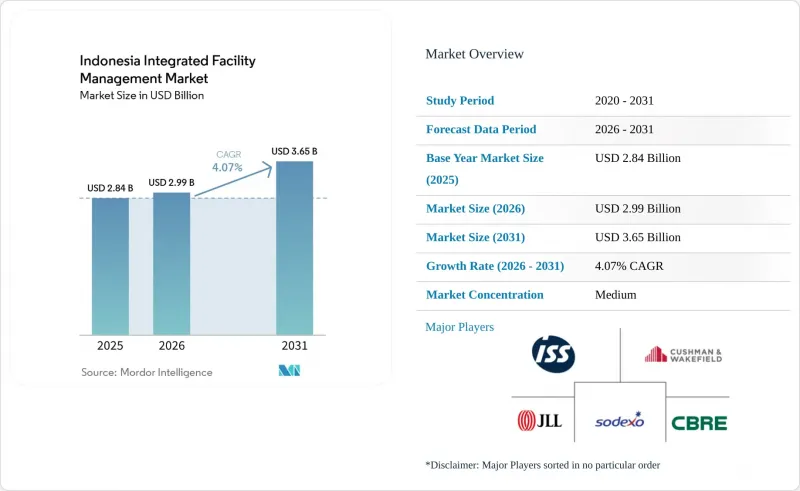
本報告按服務類型(硬性設施管理[資產管理、機電/暖通空調服務等]、軟性設施管理[辦公室支援/安保、清潔服務、餐飲服務等])和最終用戶行業(商業、旅館、公共設施/公共基礎設施等)進行分類。市場預測以美元計價。
印尼綜合設施管理市場趨勢與分析
城市中心商業地產的快速擴張
印尼綜合設施管理市場受惠於主要都市區辦公空間供應緊張的現狀。 2024年第四季度,雅加達中央商務區(CBD)甲級辦公室的運轉率超過75%,且過去兩年沒有新建甲級辦公大樓竣工。這種情況迫使業主不僅要在占地面積上競爭,還要在建築性能、租戶服務品質和營運可靠性方面展開競爭。類似的趨勢也出現在一些新興資產類別。 INA和DayOne共同開發的巴淡島資料中心平台,容量達72.4兆瓦,已被全球超大規模資料中心業者資料中心營運商全部租用10年,顯示市場對電力、冷凍、安全和安保管理的需求穩定。就短期辦公大樓供應而言,僅有兩座新的甲級辦公大樓-「蘇迪曼二號」(Two Sudirman)和「印尼一號」(Indonesia One)-計畫分別於2027年和2028年竣工,這顯示現有物業對高水準服務的需求依然存在。因此,印尼的綜合設施管理 (IFM) 市場不僅與建築物數量的增加密切相關,而且與主要大都市地區資產品質的競爭密切相關。
擴大外包規模以專注於核心業務營運的趨勢。
在印尼的綜合設施管理市場,以往自行管理建築的機構對外包服務的需求日益成長,尤其是在交通、醫療保健和活動基礎設施領域。 ISS Indonesia續簽了雅加達國際會議中心的契約,隨後又獲得了全長231公里的TransJakarta快速公交網路的契約,這表明大規模公共資產越來越傾向於採用針對運營規模量身定做的系統化服務契約。這項需求至關重要,因為TransJakarta網路每天運送超過一百萬名乘客,其清潔、維護和支援服務必須按照可重複的流程和清晰的服務管理進行。 JLL獲得巴厘島國際醫院的合約是另一個例證,表明這家高度複雜的醫療機構如何在開業後不久就轉型為國際化的建築管理模式。隨著外包服務從私人商業建築擴展到公共和準公共資產,印尼綜合設施管理市場長期、多地點合約的基礎正在進一步擴大。
缺乏能夠管理先進系統的熟練工程師
印尼綜合設施管理 (IFM) 市場仍面臨著建築自動化、暖通空調最佳化、消防系統以及其他先進技術服務技能短缺的瓶頸,而這些服務在新建築法規下正變得日益重要。在數位化營運領域,這一差距尤其突出,因為2025年印尼國際展覽會(ITB) 上提出的暖通空調數位雙胞胎計畫需要能夠管理物聯網感測器、即時數據流和系統調優的工程師。此類技能人才主要集中在爪哇島以外的地區,導致全國各地高水準服務分佈不均。印尼的島國地位進一步加劇了這一限制,因為將專家團隊部署到離島的工業和能源設施會對差旅、住宿和反應時間造成壓力。 UEM Edgenta 強調在2025年實現多技能培養、基於能力的培訓和跨領域配置,這表明人才發展不僅僅是一個短期的人員配備問題,而是整個行業的運作必需。
細分市場分析
到2025年,軟性設施管理(FM)將佔印尼綜合設施管理(IFM)市場規模的61.6%,這反映了該國勞力密集的營運模式,涵蓋清潔、保全、辦公室支援、餐飲及相關職場服務。在印尼的綜合設施管理市場,軟性服務長期以來備受青睞,許多業主在轉向更複雜的技術外包之前,就已將日常營運外包出去。在許多設施中,清潔品質、人員可靠性和現場支援對使用者體驗的影響比先進的工程系統更為直接,因此這種趨勢仍在繼續。醫療保健和酒店業對衛生要求的提高也推動了對軟性服務的需求,因為這些行業的運營商正在尋求更正式的合規管理和服務追蹤。在安保領域,市場正朝著更整合的服務交付模式轉變。正如OCS印尼公司與印尼國家警察(Baharkam Polri)於2025年5月建立的合作關係所表明的那樣,機構客戶正在尋求能夠將管治和營運監督相結合的擴充性模式。
在印尼綜合設施管理(IFM)產業中,硬性設施硬體維修)是成長最快的細分市場,預計到2031年將以5.1%的複合年成長率成長。自動化、暖通空調(HVAC)性能、消防安全和機電(MEP)可靠性已成為不可延遲的合規要求。智慧建築法規和更嚴格的暖通空調能源效率標準正促使業主對現有高層建築進行維修、試運行和性能監控。江森自控在Tamrin Nine的完工項目,將先進的冷卻器機組設計與建築自動化相結合,實現了30%的節能,為印尼IFM市場樹立了明確的標竿。雖然餐飲服務仍然比清潔和保全服務更加分散,但在偏遠地區的工業和能源項目中,由於必須在條件艱苦的位置中維持供應連續性和員工服務能力,因此綜合營地管理合約越來越受歡迎。因此,儘管軟性設施管理(Soft FM)目前仍保持著利潤優勢,但隨著合規性和能源性能對資產管理變得越來越重要,硬體維修管理也不斷崛起。
其他好處:
- Excel格式的市場預測(ME)表
- 3個月的分析師支持
目錄
第1章:引言
- 市場分析與定義的前提條件
- 分析範圍
第2章 分析方法
第3章執行摘要
第4章 市場狀況
- 市場概覽
- 市場促進因素
- 城市中心商業地產的快速擴張
- 外包業務不斷擴張,以專注於核心能力的趨勢。
- 政府對綠建築和智慧建築的獎勵
- 主權基金委託的ESG相關資產管理規模擴大
- 在預測性維護中引入數位雙胞胎技術
- 已退役油氣設施的設備整合
- 市場限制因素
- 缺乏能夠管理先進系統的熟練工程師
- 供應商分散化推高了採購成本。
- 小規模設施所有者對技術的接受度較低
- 勞動法的不確定性和契約的僵化
- 產業價值鏈分析
- 監理情勢
- 技術展望
- 波特五力分析
- 宏觀經濟因素對市場的影響
第5章:預測市場規模與成長率
- 按服務類型
- 硬體設施管理
- 資產管理
- 機電/暖通空調服務
- 消防系統和安全
- 其他硬體維修服務
- 軟設施管理
- 辦公室支援和安全
- 清潔服務
- 餐飲服務
- 其他軟調頻服務
- 硬體設施管理
- 按最終用戶行業分類
- 商業
- 飯店業
- 公共設施和公共基礎設施
- 醫療保健
- 工業和流程部門
- 其他終端用戶產業
第6章 競爭情勢
- 市場集中度
- 策略趨勢
- 市佔率分析
- 公司簡介
- PT CBRE Indonesia
- PT Jones Lang LaSalle Indonesia
- Cushman & Wakefield plc
- Sodexo SA
- PT Shield-On Service Tbk.
- PT Samudera Indonesia Properti Manajemen
- Colliers International Group Inc.
- PT Global Facility Management
- PT ISS Ciptamitra Facility Services
- PT Angkasa Pura Solusi
- PT PP Properti Tbk.
- PT Wijaya Karya Realty
- PT Telkom Property Indonesia
第7章 市場機會與未來展望
According to Mordor Intelligence, the indonesia integrated facility management market size is expected to grow from USD 2.84 billion in 2025 to USD 2.99 billion in 2026 and is forecast to reach USD 3.65 billion by 2031 at 4.07% CAGR over 2026-2031.
This report is Segmented by Service Type (Hard Facility Management [Asset Management, MEP and HVAC Services, and More], and Soft Facility Management [Office Support and Security, Cleaning Services, Catering Services, and More]), and End User (Commercial, Hospitality, Institutional and Public Infrastructure, and More). The Market Forecasts are Provided in Terms of Value (USD).
Indonesia Integrated Facility Management Market Trends and Insights
Rapid Expansion of Commercial Real Estate in Urban Hubs
The Indonesia integrated facility management market is benefiting from tighter office supply in premium urban districts, where Jakarta's CBD Grade A occupancy stayed above 75% in Q4 2024, and no new Grade A buildings were completed during the prior two years. That setting is pushing landlords to compete more on building performance, tenant service quality, and operating reliability than on the simple expansion of floor space. The same pattern is visible in newer asset categories, since INA and DayOne established a Batam data center platform with 72.4 MW capacity that was fully contracted by a global hyperscaler for ten years, which points to steady demand for power, cooling, safety, and security management. In near-term office supply, only two new Grade A towers, Two Sudirman and Indonesia One, are scheduled for completion in 2027 and 2028, which supports continued demand for strong service standards in existing stock. This keeps the Indonesia integrated facility management (IFM) market closely tied to asset-quality competition in major urban hubs rather than to growth in building count alone.
Growing Outsourcing Trend to Focus on Core Competencies
The Indonesia integrated facility management market is seeing stronger outsourcing demand from institutions that previously kept building operations in-house, especially in transport, healthcare, and event infrastructure. ISS Indonesia's reappointment at the Jakarta International Convention Center and its appointment across TransJakarta's 231 km BRT network show that large public-facing assets are now using structured service contracts at an operating scale. That demand matters because the TransJakarta network serves more than one million passenger trips a day, so cleaning, maintenance, and support services must be delivered with repeatable processes and clear service control. JLL's appointment at Bali International Hospital adds another example, since a high-complexity healthcare asset moved into an internationally managed building operations model soon after inauguration. As outsourcing broadens from private commercial buildings to public and quasi-public assets, the Indonesia IFM market gains a larger base of multi-site and longer-duration contracts.
Shortage of Skilled Technicians for Advanced Systems
The Indonesia integrated facility management market still faces a skill bottleneck in building automation, HVAC optimization, fire systems, and other advanced technical services that are becoming more important under newer building rules. The gap is visible in digital operations because the 2025 ITB work on HVAC digital twins assumed technicians who could manage IoT sensors, live data flows, and system tuning. That skill profile is limited outside the main Java corridor, which makes high-standard service deployment uneven across the country. Indonesia's island geography makes the constraint harder to solve because moving specialist teams to outer-island industrial and energy sites adds travel, housing, and response-time pressure. UEM Edgenta's FY2025 emphasis on multi-skilling, competency-based training, and cross-deployment shows that workforce development is a sector-wide operating need rather than a short-term staffing issue.
Other drivers and restraints analyzed in the detailed report include:
- Government Incentives for Green and Smart Buildings
- Rising ESG-Linked Asset Management Mandates by Sovereign Funds
- Fragmented Supplier Base Inflating Procurement Costs
For complete list of drivers and restraints, kindly check the Table Of Contents.
Segment Analysis
Soft facility management (FM) retained 61.6% of the Indonesia integrated facility management (IFM) market size in 2025, which reflected the country's labor-intensive operating model across cleaning, security, office support, catering, and related workplace services. The Indonesia integrated facility management market has long favored soft services because many owners first outsourced visible day-to-day operations before moving into deeper technical outsourcing. That pattern still holds in many facilities where cleaning quality, manpower reliability, and front-line support shape user experience more directly than advanced engineering systems. Soft-service demand is also being strengthened by stricter hygiene expectations in healthcare and hospitality, where operators want more formal compliance controls and service tracking. In security, the market is moving toward more integrated delivery, as OCS Indonesia's May 2025 partnership with Baharkam Polri showed that institutional clients are looking for scalable models that combine governance and operational oversight.
Hard FM is the faster-moving part of the Indonesia IFM industry, and it is forecast to rise at a 5.1% CAGR through 2031 as automation, HVAC performance, fire safety, and MEP reliability become compliance requirements that are harder to postpone. The smart building rules and tighter AC efficiency standards are moving owners toward retrofit, commissioning, and performance-monitoring work across existing high-rise stock. Johnson Controls' completed work at Thamrin Nine gave the Indonesia IFM market a visible benchmark because the project paired advanced chiller plant design with building automation and delivered a 30% energy reduction. Catering remains more fragmented than cleaning or security, yet remote industrial and energy projects are increasingly favouring integrated camp management contracts where supply continuity and workforce servicing must be maintained across difficult locations. This keeps Soft FM dominant by current revenue, while Hard FM gains ground as compliance and energy performance become more central to asset operations.
List of Companies Covered in this Report:
- PT CBRE Indonesia
- PT Jones Lang LaSalle Indonesia
- Cushman & Wakefield plc
- Sodexo S.A.
- PT Shield-On Service Tbk.
- PT Samudera Indonesia Properti Manajemen
- Colliers International Group Inc.
- PT Global Facility Management
- PT ISS Ciptamitra Facility Services
- PT Angkasa Pura Solusi
- PT PP Properti Tbk.
- PT Wijaya Karya Realty
- PT Telkom Property Indonesia
Additional Benefits:
- The market estimate (ME) sheet in Excel format
- 3 months of analyst support
TABLE OF CONTENTS
1 INTRODUCTION
- 1.1 Study Assumptions and Market Definition
- 1.2 Scope of the Study
2 RESEARCH METHODOLOGY
3 EXECUTIVE SUMMARY
4 MARKET LANDSCAPE
- 4.1 Market Overview
- 4.2 Market Drivers
- 4.2.1 Rapid Expansion of Commercial Real Estate in Urban Hubs
- 4.2.2 Growing Outsourcing Trend to Focus on Core Competencies
- 4.2.3 Government Incentives for Green and Smart Buildings
- 4.2.4 Rising ESG-Linked Asset Management Mandates by Sovereign Funds
- 4.2.5 Digital Twin Adoption for Predictive Maintenance
- 4.2.6 Facility Consolidation in Decommissioned Oil and Gas Sites
- 4.3 Market Restraints
- 4.3.1 Shortage of Skilled Technicians for Advanced Systems
- 4.3.2 Fragmented Supplier Base Inflating Procurement Costs
- 4.3.3 Low Technology Adoption Among Small Facility Owners
- 4.3.4 Labour Law Uncertainties and Contractual Rigidities
- 4.4 Industry Value Chain Analysis
- 4.5 Regulatory Landscape
- 4.6 Technological Outlook
- 4.7 Porter's Five Forces Analysis
- 4.7.1 Threat of New Entrants
- 4.7.2 Bargaining Power of Suppliers
- 4.7.3 Bargaining Power of Buyers
- 4.7.4 Threat of Substitutes
- 4.7.5 Competitive Rivalry
- 4.8 Impact of Macroeconomic Factors on the Market
5 MARKET SIZE AND GROWTH FORECASTS (VALUE)
- 5.1 By Service Type
- 5.1.1 Hard Facility Management
- 5.1.1.1 Asset Management
- 5.1.1.2 MEP and HVAC Services
- 5.1.1.3 Fire Systems and Safety
- 5.1.1.4 Other Hard FM Services
- 5.1.2 Soft Facility Management
- 5.1.2.1 Office Support and Security
- 5.1.2.2 Cleaning Services
- 5.1.2.3 Catering Services
- 5.1.2.4 Other Soft FM Services
- 5.1.1 Hard Facility Management
- 5.2 By End User Industry
- 5.2.1 Commercial
- 5.2.2 Hospitality
- 5.2.3 Institutional and Public Infrastructure
- 5.2.4 Healthcare
- 5.2.5 Industrial and Process Sector
- 5.2.6 Other End-User Industries
6 COMPETITIVE LANDSCAPE
- 6.1 Market Concentration
- 6.2 Strategic Moves
- 6.3 Market Share Analysis
- 6.4 Company Profiles (includes Global Level Overview, Market Level Overview, Core Segments, Financials as available, Strategic Information, Market Rank/Share, Products and Services, Recent Developments)
- 6.4.1 PT CBRE Indonesia
- 6.4.2 PT Jones Lang LaSalle Indonesia
- 6.4.3 Cushman & Wakefield plc
- 6.4.4 Sodexo S.A.
- 6.4.5 PT Shield-On Service Tbk.
- 6.4.6 PT Samudera Indonesia Properti Manajemen
- 6.4.7 Colliers International Group Inc.
- 6.4.8 PT Global Facility Management
- 6.4.9 PT ISS Ciptamitra Facility Services
- 6.4.10 PT Angkasa Pura Solusi
- 6.4.11 PT PP Properti Tbk.
- 6.4.12 PT Wijaya Karya Realty
- 6.4.13 PT Telkom Property Indonesia
7 MARKET OPPORTUNITIES AND FUTURE OUTLOOK
- 7.1 White-Space and Unmet-Need Assessment

 全球設施管理服務市場:機會與策略展望(至2035年)
 日本綜合設施管理:市場佔有率分析、產業趨勢與統計、成長預測(2026-2031)義大利綜合設施管理:市場佔有率分析、產業趨勢與統計、成長預測(2026-2031)馬來西亞綜合設施管理:市場佔有率分析、產業趨勢與統計、成長預測(2026-2031)中國綜合設施管理:市場佔有率分析、產業趨勢與統計、成長預測(2026-2031)綜合設施管理:市場佔有率分析、產業趨勢與統計、成長預測(2026-2031)印度綜合設施管理:市場佔有率分析、產業趨勢與統計、成長預測(2026-2031)泰國綜合設施管理:市場佔有率分析、產業趨勢與統計、成長預測(2026-2031)新加坡綜合設施管理:市場佔有率分析、產業趨勢與統計、成長預測(2026-2031)越南綜合設施管理:市場佔有率分析、產業趨勢與統計、成長預測(2026-2031)