

 |
市場調查報告書
商品編碼
2064488
中國綜合設施管理:市場佔有率分析、產業趨勢與統計、成長預測(2026-2031)China Integrated Facility Management - Market Share Analysis, Industry Trends & Statistics, Growth Forecasts (2026 - 2031) |
||||||

※ 本網頁內容可能與最新版本有所差異。詳細情況請與我們聯繫。
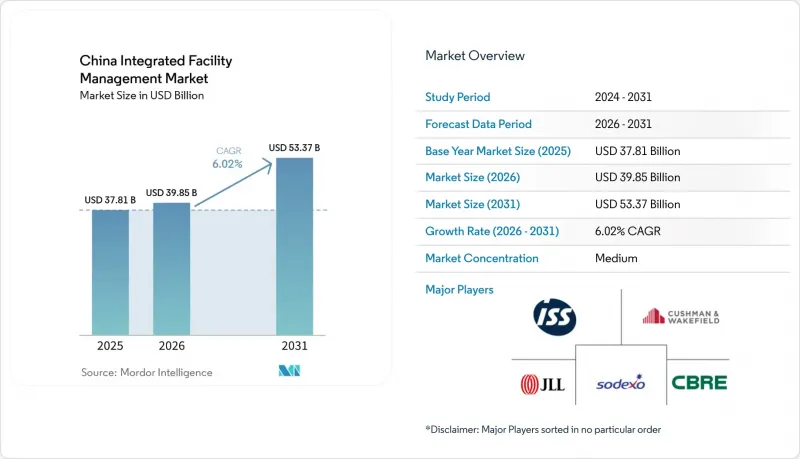
根據 Mordor Intelligence 的數據顯示,2025 年中國綜合設施管理市場規模為 378.1 億美元,預計到 2031 年將從 2026 年的 398.5 億美元成長至 533.7 億美元,預測期(2026-2031 年)複合年成長率為 6.02%。
本報告按服務類型(硬體整合管理[資產管理、機電和暖通空調服務等]、軟體整合管理[辦公室支援和保全、清潔服務、餐飲服務等])和最終用戶(商業、飯店、機構和公共基礎設施、醫療保健及其他)進行細分。市場預測以美元計價。
中國綜合管理市場趨勢及洞察
房地產、辦公大樓和資料中心產業的快速成長
由於資料中心需要不間斷的工程支援、更短的回應時限和更嚴格的效能檢驗,因此在中國的綜合設施管理(IFM)市場中產生了獨特的需求。這與傳統的辦公設施不同,後者雖然提供多種服務組合,但工程難度相對較低。 「資料中心綠色發展行動計畫」提出了提高能源效率和增加可再生能源利用的要求,這推動了硬體維修服務中對能源管理、冷卻最佳化和電氣系統監控的需求。辦公園區和企業園區進一步擴大了這個需求管道,尤其是在科技、智慧製造和新能源相關企業,這些領域需要穩定且全面的支援服務。因此,能夠提供專業檢查、冷卻、合規和客戶管理等服務的供應商在中國的綜合設施管理(IFM)市場中佔據了更有利的地位。
中國第三方設施管理服務外包業務的擴張
隨著租戶對更清晰的責任分類和更優質的整合服務的需求日益成長,中國的綜合設施管理(IFM)市場也正受益於向第三方交付模式的逐步轉變。這種轉變在大型企業的資產組合中尤其明顯,要求供應商將辦公室服務、維護、數位化工具和績效報告整合到單一的營運模式中。近期推出的產品和合約表明,外包模式正從簡單的勞動力替代轉向基於平台的營運模式。數位雙胞胎監控技術也被用於支援清潔、維護、園藝和衛生管理,並將其整合到單一的服務架構中。隨著越來越多的租戶要求全面執行而非分散採購,能夠將現場服務交付、數位化視覺化和全國客戶管理相結合的供應商,預計將在中國IFM市場中佔據競爭優勢。
定價、參考標準和合約缺乏標準化
缺乏標準化的定價和合約結構持續限制中國綜合設施管理(IFM)市場的成長。這是因為許多競標被迫以最低價格為目標。這種做法使得買方難以區分單純的勞動力供應和真正具有技術深度的綜合服務交付。當採購過度依賴價格時,即使擁有卓越工程和數位化能力的供應商,即便服務品質優異,也可能難以維持獲利。此外,如果合約缺乏明確的品質標準,客戶可能會遇到服務品質不穩定的情況,從而削弱合約續約的動力。在合約範本、服務定義和績效標準更加統一之前,中國綜合設施管理市場在基於價值的採購方面仍可能面臨許多挑戰。
細分市場分析
2025年,軟性綜合管理(FM)在中國綜合管理(IFM)市場佔有55.78%的佔有率,持續維持其在商業、公共和園區環境中最大的服務類別地位。清潔、餐飲和辦公室支援仍然是外包最廣泛的任務,因為這些任務具有可見性和重複性,且租戶可以輕鬆地將其集中管理在單一供應商的管理之下。中國IFM市場的這一細分領域也受益於大規模企業園區的擴張,因為雇主需要在更複雜的場所獲得一致的支援服務。隨著合約範圍的擴大,客戶越來越傾向於將前台支援、清潔、辦公場所服務和特定合規任務打包成一個整體服務包,而不是單獨採購。這種轉變支撐了對軟性FM的穩定需求,即使服務配置變得更加數據驅動和流程主導。
硬性設施硬體維修)是成長最快的服務類別,預計2026年至2031年中國綜合設施管理市場將以6.73%的複合年成長率成長。這一成長主要由資產管理、機電(MEP)服務、暖通冷暖氣空調(HVAC)監控、運作、安全以及其他與能源管理相關的工程密集營運所驅動。資料中心法規也推動了這項需求,因為營運商需要在正式的效率目標下更嚴格地監控冷卻系統、電氣系統和性能追蹤。隨著客戶要求在關鍵任務場所提供有記錄的維護、審計追蹤和更好的故障回應,消防系統和安全服務也變得更加專業化。在中國綜合設施管理產業,這使得硬體維修在新的綜合合約中佔據有利地位,因為技術保障和日常服務交付都至關重要。
其他福利
- Excel格式的市場預測(ME)表
- 3個月的分析師支持
目錄
第1章:引言
- 研究假設和市場定義
- 調查範圍
第2章:調查方法
第3章執行摘要
第4章 市場狀況
- 市場概覽
- 市場促進因素
- 加快主要城市的智慧建築計劃
- 公共設施強制性能源效率目標
- 國營企業非核心業務外包增加
- 中國西部工業園區的擴張
- 醫療園區對綜合合約的需求日益成長
- 推出相容 5G 的預測性維護平台
- 市場限制因素
- 專業硬體維修服務人員短缺
- 政府採購中繼續沿用以價格為導向的競標。
- 中小企業對IFM的採用率較低
- 與公私合營模式相關的監理不確定性
- 產業價值鏈分析
- 監理情勢
- 技術展望
- 宏觀經濟因素對市場的影響
- 波特五力分析
第5章 市場規模與成長預測
- 按服務類型
- 硬體整合管理
- 資產管理
- 機電及暖通空調服務
- 消防系統和安全
- 其他硬體整合管理服務
- 軟體整合管理
- 辦公室支援和安全
- 清潔服務
- 餐飲服務
- 其他軟體整合管理服務
- 硬體整合管理
- 按最終用戶行業分類
- 商業
- 飯店業
- 機構和公共基礎設施
- 醫療保健
- 工業流程部
- 其他
第6章 競爭情勢
- 市場集中度
- 策略趨勢
- 市佔率分析
- 公司簡介
- CBRE Group Inc.
- Jones Lang LaSalle Incorporated
- Cushman & Wakefield plc
- ISS A/S
- Sodexo SA
- Savills plc
- Colliers International Group Inc.
- GDI Integrated Facility Services Inc.
- China Overseas Property Holdings Limited
- Poly Property Services Co. Ltd.
- Shanghai Xincheng Facility Management Ltd.
- Sichuan Huaming Property Management Co. Ltd.
- Shenzhen Capital Property Management Co. Ltd.
- Guangzhou Guangwu Property Management Ltd.
- Beijing Winn Property Management Co. Ltd.
- Secom Co. Ltd.
- Diebold Nixdorf Inc.
- Sangfor Technologies Inc.
- Qingdao Hisense Facility Management Co. Ltd.
- Greentown Service Group Co. Ltd.
第7章 市場機會與未來展望
According to Mordor Intelligence, the china integrated facility management market size was valued at USD 37.81 billion in 2025 and is estimated to grow from USD 39.85 billion in 2026 to reach USD 53.37 billion by 2031, at a CAGR of 6.02% during the forecast period (2026-2031).
This report is Segmented by Service Type (Hard Facility Management [Asset Management, MEP and HVAC Services, and More], and Soft Facility Management [Office Support and Security, Cleaning Services, Catering Services, and More]), and End User (Commercial, Hospitality, Institutional and Public Infrastructure, Healthcare, and More). The Market Forecasts are Provided in Terms of Value (USD).
China Integrated Facility Management Market Trends and Insights
Rapid Growth of Real Estate, Office, And Data Centre Industries
Data centers are creating a distinct stream of demand in the China integrated facility management market because they need uninterrupted engineering support, tighter response windows, and stronger performance validation. This is different from conventional office facilities, where the service mix is broader, but the engineering threshold is often lower. The Data Center Green Development Action Plan set requirements around lower power usage effectiveness and rising renewable energy use, which has increased the need for energy management, cooling optimization, and electrical system oversight within hard FM services. Office parks and corporate campuses continue to add to this demand channel, especially where technology, intelligent manufacturing, and new energy firms need stable and bundled support services. Providers that can handle specialized testing, cooling, compliance, and account management are therefore gaining stronger contract positions in the China integrated facility management (IFM) market.
Rising Outsourcing of Third-Party FM Services in China
The China integrated facility management market is also benefiting from a gradual shift toward third-party delivery, as occupiers seek clearer accountability and better service integration. This shift is visible in large enterprise portfolios, where providers are being asked to combine workplace services, maintenance, digital tools, and performance reporting within a single operating model. Recent product and contract launches show how outsourcing is moving beyond labour substitution and toward a platform-based operating approach. Digital twin monitoring is also being used to support cleaning, maintenance, landscaping, and hygiene under one service structure. As more occupiers seek bundled execution instead of fragmented procurement, the China IFM market is likely to reward vendors that can combine site delivery, digital visibility, and national account management.
Lack Of Standardization in Pricing, Referencing, And Contracts
A lack of standard pricing and contract structures still slows the China integrated facility management (IFM) market because it keeps many tenders focused on lowest-cost selection. That approach makes it harder for buyers to distinguish between basic labour supply and genuinely integrated delivery with technical depth. When procurement leans too heavily on price, providers with stronger engineering or digital capability can struggle to defend margins even when their service quality is higher. This also creates weaker renewal dynamics, because clients may see inconsistent outcomes when contracts are awarded without clear quality benchmarks. Until contract templates, service definitions, and performance baselines become more consistent, the China integrated facility management market will continue to face friction in value-based procurement.
Other drivers and restraints analyzed in the detailed report include:
- Mandate of Energy Efficiency and Focus on Sustainable Solutions
- Acceleration Of Urbanization and Growth of Real Estate Sector in China
- Complex Legal Requirements from National and State-Level Regulations
For complete list of drivers and restraints, kindly check the Table Of Contents.
Segment Analysis
Soft Facility Management (FM) held 55.78% of China integrated facility management (IFM) market share in 2025, which kept it as the largest service group across commercial, institutional, and campus environments. Cleaning, catering, and office support remained the most widely outsourced activities because they are visible, repetitive, and easier for occupiers to centralize under one vendor. This part of the China IFM market also benefits from the spread of larger enterprise campuses, where employers need consistent support services across more complex sites. As contracts become broader, clients are increasingly bundling front-of-house support, cleaning, workplace services, and selected compliance tasks into one package rather than sourcing them separately. That shift supports stable demand for Soft FM even as the service mix becomes more data-aware and process-driven.
Hard FM is the fastest-growing service category, with the China integrated facility management market size for this segment advancing at a 6.73% CAGR from 2026 to 2031. The growth is being driven by asset management, MEP services, HVAC oversight, and other engineering-intensive work tied to uptime, safety, and energy control. Data center policy has added to this demand because operators need tighter oversight of cooling, electrical systems, and performance tracking under formal efficiency targets. Fire systems and safety services are also becoming more specialized as clients look for documented maintenance, audit trails, and better fault response across mission-critical sites. Within the China integrated facility management industry, this leaves hard FM well placed to capture a larger share of new integrated contracts where technical assurance matters as much as routine service coverage.
List of Companies Covered in this Report:
- CBRE Group Inc.
- Jones Lang LaSalle Incorporated
- Cushman & Wakefield plc
- ISS A/S
- Sodexo SA
- Savills plc
- Colliers International Group Inc.
- GDI Integrated Facility Services Inc.
- China Overseas Property Holdings Limited
- Poly Property Services Co. Ltd.
- Shanghai Xincheng Facility Management Ltd.
- Sichuan Huaming Property Management Co. Ltd.
- Shenzhen Capital Property Management Co. Ltd.
- Guangzhou Guangwu Property Management Ltd.
- Beijing Winn Property Management Co. Ltd.
- Secom Co. Ltd.
- Diebold Nixdorf Inc.
- Sangfor Technologies Inc.
- Qingdao Hisense Facility Management Co. Ltd.
- Greentown Service Group Co. Ltd.
Additional Benefits:
- The market estimate (ME) sheet in Excel format
- 3 months of analyst support
TABLE OF CONTENTS
1 INTRODUCTION
- 1.1 Study Assumptions and Market Definition
- 1.2 Scope of the Study
2 RESEARCH METHODOLOGY
3 EXECUTIVE SUMMARY
4 MARKET LANDSCAPE
- 4.1 Market Overview
- 4.2 Market Drivers
- 4.2.1 Acceleration of Smart Building Initiatives in Tier-1 Cities
- 4.2.2 Mandated Energy-Efficiency Targets for Public Facilities
- 4.2.3 Rising Outsourcing of Non-Core Operations by SOEs
- 4.2.4 Expansion of Industrial Parks in Western China
- 4.2.5 Growing Demand for Integrated Contracts in Healthcare Campuses
- 4.2.6 Deployment of 5G-Enabled Predictive Maintenance Platforms
- 4.3 Market Restraints
- 4.3.1 Talent Shortages in Specialized Hard FM Services
- 4.3.2 Persistent Price-Based Bidding in Government Tenders
- 4.3.3 Low Penetration of IFM in Small and Medium Enterprises
- 4.3.4 Regulatory Uncertainty Around Private-Public Partnership Models
- 4.4 Industry Value Chain Analysis
- 4.5 Regulatory Landscape
- 4.6 Technological Outlook
- 4.7 Impact of Macroeconomic Factors on the Market
- 4.8 Porter's Five Forces Analysis
- 4.8.1 Threat of New Entrants
- 4.8.2 Bargaining Power of Suppliers
- 4.8.3 Bargaining Power of Buyers
- 4.8.4 Threat of Substitutes
- 4.8.5 Competitive Rivalry
5 MARKET SIZE AND GROWTH FORECASTS (VALUE)
- 5.1 By Service Type
- 5.1.1 Hard Facility Management
- 5.1.1.1 Asset Management
- 5.1.1.2 MEP and HVAC Services
- 5.1.1.3 Fire Systems and Safety
- 5.1.1.4 Other Hard Facility Management Services
- 5.1.2 Soft Facility Management
- 5.1.2.1 Office Support and Security
- 5.1.2.2 Cleaning Services
- 5.1.2.3 Catering Services
- 5.1.2.4 Other Soft Facility Management Services
- 5.1.1 Hard Facility Management
- 5.2 By End-User Industry
- 5.2.1 Commercial
- 5.2.2 Hospitality
- 5.2.3 Institutional and Public Infrastructure
- 5.2.4 Healthcare
- 5.2.5 Industrial and Process Sector
- 5.2.6 Other End-User Industries
6 COMPETITIVE LANDSCAPE
- 6.1 Market Concentration
- 6.2 Strategic Moves
- 6.3 Market Share Analysis
- 6.4 Company Profiles (includes Global Level Overview, Market Level Overview, Core Segments, Financials as available, Strategic Information, Market Rank/Share, Products and Services, Recent Developments)
- 6.4.1 CBRE Group Inc.
- 6.4.2 Jones Lang LaSalle Incorporated
- 6.4.3 Cushman & Wakefield plc
- 6.4.4 ISS A/S
- 6.4.5 Sodexo SA
- 6.4.6 Savills plc
- 6.4.7 Colliers International Group Inc.
- 6.4.8 GDI Integrated Facility Services Inc.
- 6.4.9 China Overseas Property Holdings Limited
- 6.4.10 Poly Property Services Co. Ltd.
- 6.4.11 Shanghai Xincheng Facility Management Ltd.
- 6.4.12 Sichuan Huaming Property Management Co. Ltd.
- 6.4.13 Shenzhen Capital Property Management Co. Ltd.
- 6.4.14 Guangzhou Guangwu Property Management Ltd.
- 6.4.15 Beijing Winn Property Management Co. Ltd.
- 6.4.16 Secom Co. Ltd.
- 6.4.17 Diebold Nixdorf Inc.
- 6.4.18 Sangfor Technologies Inc.
- 6.4.19 Qingdao Hisense Facility Management Co. Ltd.
- 6.4.20 Greentown Service Group Co. Ltd.
7 MARKET OPPORTUNITIES AND FUTURE OUTLOOK
- 7.1 White-Space and Unmet-Need Assessment

 全球設施管理服務市場:機會與策略展望(至2035年)
 日本綜合設施管理:市場佔有率分析、產業趨勢與統計、成長預測(2026-2031)義大利綜合設施管理:市場佔有率分析、產業趨勢與統計、成長預測(2026-2031)馬來西亞綜合設施管理:市場佔有率分析、產業趨勢與統計、成長預測(2026-2031)綜合設施管理:市場佔有率分析、產業趨勢與統計、成長預測(2026-2031)印度綜合設施管理:市場佔有率分析、產業趨勢與統計、成長預測(2026-2031)泰國綜合設施管理:市場佔有率分析、產業趨勢與統計、成長預測(2026-2031)印尼綜合設施管理:市場佔有率分析、產業趨勢與統計、成長預測(2026-2031)新加坡綜合設施管理:市場佔有率分析、產業趨勢與統計、成長預測(2026-2031)越南綜合設施管理:市場佔有率分析、產業趨勢與統計、成長預測(2026-2031)