


 |
市場調查報告書
商品編碼
2065513
馬來西亞綜合設施管理:市場佔有率分析、產業趨勢與統計、成長預測(2026-2031)Malaysia Integrated Facility Management - Market Share Analysis, Industry Trends & Statistics, Growth Forecasts (2026 - 2031) |
||||||

※ 本網頁內容可能與最新版本有所差異。詳細情況請與我們聯繫。
根據 Mordor Intelligence 預測,馬來西亞綜合設施管理市場規模將從 2025 年的 18.9 億美元成長到 2026 年的 19.7 億美元,然後在 2031 年達到 24.4 億美元,2026 年至 2031 年的複合年成長率為 4.37%。
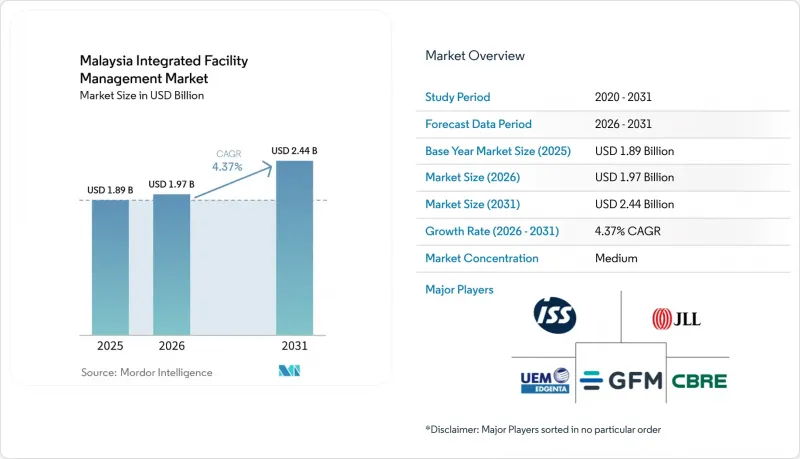
本報告按服務類型(硬性設施管理[資產管理、機電和暖通空調服務等]、軟性設施管理[辦公室支援和安保、清潔服務、餐飲服務等])和最終用戶(商業、飯店、醫療保健、公共機構和公共基礎設施等)進行細分。市場預測以美元計價。
馬來西亞整合性機構管理市場趨勢與洞察
擴大智慧技術在設施管理的應用
馬來西亞的整合性機構管理市場正向數位化營運模式轉型。這是因為業主希望提高資產可視性、縮短回應時間並更嚴格地控制維護成本。自2025年7月1日起,馬來西亞將強制要求所有超過1,000萬馬幣(約225萬美元)的公共和私人建設項目採用建築資訊模型(BIM),同時,數位化交付標準也日益提高,因此,在新建築投入營運過程中,結構化資產數據的重要性進一步凸顯。符合PeDATA和SKATA標準的資產資訊有助於改善3D視覺化、計畫維護和生命週期規劃,從而加強馬來西亞綜合設施管理市場中專案竣工與持續服務交付之間的聯繫。這一點意義重大,因為擁有整合BIM的CMMS平台的供應商能夠以非整合營運商難以實現的方式傳輸資產歷史記錄和維護規則。根據草案中引用的一項研究,在獲得GBI認證的建築物中,數位雙胞胎和暖通空調-建築管理系統(HVAC-BMS)整合的採用率達到28%,而未認證建築的採用率僅為7%。這表明,高階建築在設施管理(FM)實踐方面的進步速度遠遠超過普通建築。因此,在馬來西亞的綜合設施管理市場中,能夠將軟體、建築控制系統和現場執行整合到單一服務模式中的營運商更受青睞,而不是僅僅將技術視為一項獨立的附加功能。
城市中心商業房地產和工業資產的快速擴張
隨著商業、工業、物流和綜合用途物業存量的成長,馬來西亞的綜合設施管理市場正在擴張,尤其是在柔佛州和巴生谷地區。 2025年前九個月,獲批投資金額達2,852億馬幣(約641.2億美元),其中柔佛州佔了911億馬幣(約204.7億美元)。這推動了新建建築和工業用地對系統化服務的長期需求不斷成長。位於新山、佔地125萬平方英尺的加冕廣場購物中心(Coronation Square Mall)正在建設中,由凱德集團(CapitaLand Investments)和科隆納德地產(Colonnade Properties)合作開發,是大型商業地產需要在其整個運營週期內提供涵蓋維護、清潔、安保、景觀和能源管理等綜合服務的又一顯著案例。工業地產也呈現類似的趨勢,物流和製造業資產組合的擴張推動了高入住率設施對持續服務的需求成長,這些設施對正常運作和合規性的要求也更加嚴格。馬來西亞的綜合設施管理市場也正在經歷品質方面的轉變。資料中心需要全天候運作管理、精準冷卻、電力持續供應和先進的消防系統,這使得資料中心的合約比傳統辦公室或零售設施的合約更為複雜。這種差異意味著,能夠管理關鍵環境(而不僅僅是普通建築營運)的供應商有望獲得更強勁的成長。
市場結構分散,面臨合規和認證的挑戰。
儘管馬來西亞的綜合設施管理市場需求強勁,但由於大多數供應商仍在區域性競標市場中以小規模運營,服務品質參差不齊。根據草案中引用的2024年文獻綜述,該行業面臨的主要挑戰是供應商之間缺乏標準化的維護流程,這導致服務品質差異較大,並降低了合約續約的可能性。此外,供應商還必須應對涉及馬來西亞建築業發展局 (CIDB)、財政部、公共工程局 (JKR) 相關公共服務機構以及醫療保健特定法規的重疊註冊和核准要求,這對於合規負責人有限的中型公司而言可能是一個挑戰。因此,儘管馬來西亞的綜合設施管理市場整體上較為擁擠,但相當一部分政府相關工作仍集中在少數幾家獲得認證的供應商手中。這種分散化也使得客戶難以根據標準化標準比較供應商,因為績效評估標準尚未在不同合約之間實現標準化。只要認證等級和營運紀律有差異,馬來西亞的綜合設施管理市場就會繼續呈現兩極化的局面,一方是資質優良的特許經營經營商,另一方是價格主導的中型企業。
細分市場分析
2025年,軟性設施管理(FM)在馬來西亞綜合設施管理(IFM)市場規模中佔61.6%。這表明,該市場仍然高度依賴公共、商業和機構建築中週期性、勞動密集型服務。清潔、保全、蟲害控制、園林綠化、廢棄物管理、餐飲和接待服務仍佔據主導地位,因為這些服務需求頻繁,且覆蓋範圍廣泛,這與機械設備維護(其維護週期更為規律)截然不同。在馬來西亞的IFM產業中,由於清潔和保全合約的轉換成本仍然較低,這些軟性服務領域面臨著最激烈的價格競爭。因此,營運商高度依賴人員管理、路線規劃、考勤管理和更嚴格的排班來維持高業務量但低利潤率合約的獲利能力。 2025年2月最低工資提高至每月1700馬來西亞馬幣(約382美元)將進一步加劇此領域的壓力。這是因為人事費用仍然是大多數軟性服務合約中最大的成本項目。
預計到2031年,硬體維修)將以5.1%的複合年成長率成長,成為馬來西亞綜合設施管理(IFM)市場中成長最快的服務類別。這一細分市場的成長主要由技術複雜的建築驅動,這些建築需要專門的維護工作,例如電子機械系統、暖通空調(HVAC)、消防安全和關鍵基礎設施。雖然軟性設施管理(Soft 硬體維修 )目前仍主導馬來西亞IFM市場佔有率的主導地位,但隨著每份合約的技術範圍不斷擴大以及運作要求日益嚴格,硬性設施管理在以金額為準方面正在縮小差距。柔佛州資料中心的發展是關鍵促進因素,因為需要低PUE(電源使用效率)和全天候服務的設施需要精準的冷卻、持續的電力供應以及超出傳統商業維護範圍的持續最佳化。江森自控在雙威集團多個物業項目中的應用表明,單一建築技術的應用可以如何惠及開發商的整個投資組合,並在其性能得到驗證後,持續增強硬體維修服務的收入。在馬來西亞的綜合設施管理(IFM)產業,將於2025年7月實施的BIM要求也推動了硬體維修的發展。這是因為數位化交接使得從建築物投入運作的第一天起,就更容易建立資產維護系統。
其他好處:
- Excel格式的市場預測(ME)表
- 3個月的分析師支持
目錄
第1章:引言
- 研究假設和市場定義
- 調查範圍
第2章:調查方法
第3章執行摘要
第4章 市場狀況
- 市場概覽
- 市場促進因素
- 擴大智慧技術在設施管理的應用
- 城市中心商業房地產和工業資產的快速擴張
- 政府對綠建築和ESG法規的獎勵措施
- 政府設施管理中官民合作關係的興起
- 強制實施BIM和在設施管理領域採用數位雙胞胎技術
- 企業越來越關注職場的健康、福祉和室內環境品質。
- 市場限制因素
- 市場結構分散,面臨合規和認證的挑戰。
- 技術實施和系統整合需要較高的初始投資
- 具備技術技能的設施管理專業人員短缺,且離職率率高
- 國際企業面臨的監管與競爭壁壘
- 產業價值鏈分析
- 宏觀經濟因素對市場的影響
- 監理情勢
- 技術展望
- 波特五力分析
第5章 市場規模與成長預測
- 按服務類型
- 硬設施管理
- 資產管理
- 機電及暖通空調服務
- 消防系統和安全措施
- 其他硬設施管理服務
- 軟設施管理
- 辦公室支援和安全
- 清潔服務
- 餐飲服務
- 其他軟性設施管理服務
- 硬設施管理
- 按最終用戶行業分類
- 商業
- 飯店業
- 機構和公共基礎設施
- 衛生保健
- 工業和流程部門
- 其他終端用戶產業
第6章 競爭情勢
- 市場集中度
- 策略趨勢
- 市佔率分析
- 公司簡介
- UEM Edgenta Berhad
- GFM Services Berhad
- ISS A/S
- CBRE Group, Inc.
- JLL Malaysia Sdn Bhd
- Cushman and Wakefield plc
- Knight Frank Malaysia Sdn Bhd
- Colliers International Group Inc.
- KFM Holdings Sdn Bhd
- AWC Berhad
- Sime Darby Property Berhad
- Sodexo SA
- OCS Group Limited
- Allied Universal
- G4S Limited
- Johnson Controls International plc
- Honeywell International Inc.
- Tenaga Nasional Berhad
第7章 市場機會與未來展望
According to Mordor Intelligence, the malaysia integrated facility management market size is expected to grow from USD 1.89 billion in 2025 to USD 1.97 billion in 2026 and is forecast to reach USD 2.44 billion by 2031 at 4.37% CAGR over 2026-2031.
This report is Segmented by Service Type (Hard Facility Management [Asset Management, MEP and HVAC Service, and More], and Soft Facility Management [Office Support and Security, Cleaning Services, Catering Services, and More]), and End User (Commercial, Hospitality, Healthcare, Institutional and Public Infrastructure, and More). The Market Forecasts are Provided in Terms of Value (USD).
Malaysia Integrated Facility Management Market Trends and Insights
Growing Adoption of Smart Technologies in Facility Management
The Malaysia integrated facility management market is moving toward a more digital operating model as building owners expect better asset visibility, faster response times, and tighter control of maintenance spending. The July 1, 2025, BIM mandate for public and private construction projects valued at MYR 10 million (USD 2.25 million), or more raised the baseline for digital handover and made structured asset data more important when new buildings enter service. Asset information aligned with PeDATA and SKATA standards improves 3D visualization, scheduled maintenance, and lifecycle planning, which gives the Malaysia integrated facility management market a stronger link between project completion and ongoing service delivery. This matters because providers with BIM-linked CMMS platforms can carry forward asset histories and maintenance rules in ways that disconnected operators cannot easily match. Research cited in the draft also showed that GBI-certified buildings had a 28% adoption rate for digital twin and HVAC-BMS integration, compared with 7% in non-certified stock, which shows how premium buildings are advancing FM practices faster than the wider building base. As a result, the Malaysia integrated facility management market is rewarding operators that can combine software, building controls, and field execution into one service model rather than treating technology as a stand-alone add-on.
Rapid Expansion of Commercial Real Estate and Industrial Assets In Urban Centers
The Malaysia integrated facility management market is expanding with the country's rising stock of commercial, industrial, logistics, and mixed-use assets, especially in Johor and the Klang Valley. Approved investments reached MYR 285.2 billion (USD 64.12 billion), in the first nine months of 2025, and Johor alone drew MYR 91.1 billion (USD 20.47 billion), which increased the long-term need for structured services across new buildings and industrial sites. CapitaLand Investment's partnership with Coronade Properties on the 1.25 million sq ft Coronation Square Mall in Johor Bahru added another visible example of a large-format commercial asset that will require bundled maintenance, cleaning, security, landscaping, and energy management throughout its operating life. The same pattern is visible in industrial property, where portfolio expansion in logistics and manufacturing assets is creating more recurring service demand across high-use facilities with stricter uptime and compliance requirements. The Malaysia integrated facility management market is also seeing a quality shift because data centers require 24-hour uptime management, precision cooling, power continuity, and advanced fire suppression, which makes those contracts more complex than conventional office or retail work. That difference supports a stronger growth profile for providers that can manage critical environments rather than only general building operations.
Fragmented Market Structure with Compliance and Certification Challenges
The Malaysian integrated facility management market has a healthy demand base, but service quality remains uneven because a large share of providers still operate at a small scale across local tender markets. A 2024 literature review cited in the draft found that the sector's main challenge was the lack of standardized maintenance processes across operators, which leads to inconsistent delivery quality and weaker contract renewal potential. Providers also need to manage overlapping registration and approval requirements across CIDB, the Ministry of Finance, JKR-linked public works structures, and healthcare-specific rules, which can be difficult for mid-sized firms with limited compliance staff. This keeps a meaningful share of government-linked work within a relatively small certified pool, even when the broader Malaysia integrated facility management market remains crowded. The same fragmentation also makes it harder for clients to compare providers on a standard basis because performance measures are not yet uniform across contracts. As long as certification depth and operating discipline remain uneven, the Malaysia integrated facility management market will continue to show a split between well-qualified concessionaires and a more price-led middle tier.
Other drivers and restraints analyzed in the detailed report include:
- Government Green Building Incentives and ESG Mandates
- Rise Of Public-Private Partnerships for Government Building Management
- High Initial Capital Requirements for Technology Adoption and System Integration
For complete list of drivers and restraints, kindly check the Table Of Contents.
Segment Analysis
Soft Facility Management (FM) accounted for 61.6% of the Malaysia integrated facility management (IFM) market size in 2025, which shows how strongly the market still depends on recurring labour-based services across public, commercial, and institutional buildings. Cleaning, security, pest control, landscaping, waste management, catering, and reception services stayed dominant because they are needed frequently and across a broad building base, unlike mechanical maintenance, which follows a more periodic schedule. In the Malaysia IFM industry, those soft service categories also face the most intense price competition because switching costs remain low in cleaning and guarding contracts. Providers therefore rely heavily on workforce control, route planning, attendance tracking, and tighter scheduling to protect margins in contracts that are large by volume but thinner in profitability. The February 2025 minimum wage increase to MYR 1,700 (USD 382) per month placed extra pressure on this segment because labour cost is still the largest cost item in most soft service contracts.
Hard FM is forecast to grow at a 5.1% CAGR through 2031, making it the fastest-growing service category within the Malaysia IFM market. This part of the market is being lifted by more technically demanding buildings that need specialized work across electromechanical systems, HVAC, fire safety, and mission-critical infrastructure. The Malaysia IFM market share is still led by Soft FM, but Hard FM is closing the gap in value terms because each contract now carries more technical scope and tighter uptime requirements. Data center development in Johor is an important reason, since facilities operating at low PUE levels and under 24-hour service expectations need precision cooling, power continuity, and constant optimization that go beyond conventional commercial maintenance. Johnson Controls' work across multiple Sunway Group properties also shows how one building technology deployment can spread across a developer's wider portfolio, which strengthens repeat hard-service revenue once performance is proven. In the Malaysia IFM industry, the July 2025 BIM requirement also supports Hard FM because digital handover makes it easier to structure asset maintenance from the first day a building enters operation.
List of Companies Covered in this Report:
- UEM Edgenta Berhad
- GFM Services Berhad
- ISS A/S
- CBRE Group, Inc.
- JLL Malaysia Sdn Bhd
- Cushman and Wakefield plc
- Knight Frank Malaysia Sdn Bhd
- Colliers International Group Inc.
- KFM Holdings Sdn Bhd
- AWC Berhad
- Sime Darby Property Berhad
- Sodexo S.A.
- OCS Group Limited
- Allied Universal
- G4S Limited
- Johnson Controls International plc
- Honeywell International Inc.
- Tenaga Nasional Berhad
Additional Benefits:
- The market estimate (ME) sheet in Excel format
- 3 months of analyst support
TABLE OF CONTENTS
1 INTRODUCTION
- 1.1 Study Assumptions and Market Definition
- 1.2 Scope of the Study
2 RESEARCH METHODOLOGY
3 EXECUTIVE SUMMARY
4 MARKET LANDSCAPE
- 4.1 Market Overview
- 4.2 Market Drivers
- 4.2.1 Growing Adoption of Smart Technologies In Facility Management
- 4.2.2 Rapid Expansion Of Commercial Real Estate And Industrial Assets In Urban Centers
- 4.2.3 Government Green Building Incentives And ESG Mandates
- 4.2.4 Rise Of Public-Private Partnerships For Government Building Management
- 4.2.5 Mandatory BIM Integration And Digital Twin Adoption In FM
- 4.2.6 Increasing Corporate Focus On Workplace Health, Wellness, And Indoor Environmental Quality
- 4.3 Market Restraints
- 4.3.1 Fragmented Market Structure With Compliance And Certification Challenges
- 4.3.2 High Initial Capital Requirements For Technology Adoption And System Integration
- 4.3.3 Shortage Of Technically Skilled FM Professionals And High Workforce Turnover
- 4.3.4 Regulatory And Competitive Barriers For International Operators
- 4.4 Industry Value Chain Analysis
- 4.5 Impact of Macroeconomic Factors on the Market
- 4.6 Regulatory Landscape
- 4.7 Technological Outlook
- 4.8 Porter's Five Forces Analysis
- 4.8.1 Threat of New Entrants
- 4.8.2 Bargaining Power of Buyers
- 4.8.3 Bargaining Power of Suppliers
- 4.8.4 Threat of Substitute Products or Services
- 4.8.5 Intensity of Competitive Rivalry
5 MARKET SIZE AND GROWTH FORECASTS (VALUE)
- 5.1 By Service Type
- 5.1.1 Hard Facility Management
- 5.1.1.1 Asset Management
- 5.1.1.2 MEP and HVAC Services
- 5.1.1.3 Fire Systems and Safety
- 5.1.1.4 Other Hard Facility Management Services
- 5.1.2 Soft Facility Management
- 5.1.2.1 Office Support and Security
- 5.1.2.2 Cleaning Services
- 5.1.2.3 Catering Services
- 5.1.2.4 Other Soft Facility Management Services
- 5.1.1 Hard Facility Management
- 5.2 By End User Industry
- 5.2.1 Commercial
- 5.2.2 Hospitality
- 5.2.3 Institutional and Public Infrastructure
- 5.2.4 Healthcare
- 5.2.5 Industrial and Process Sector
- 5.2.6 Other End-User Industries
6 COMPETITIVE LANDSCAPE
- 6.1 Market Concentration
- 6.2 Strategic Moves
- 6.3 Market Share Analysis
- 6.4 Company Profiles (includes Global Level Overview, Market Level Overview, Core Segments, Financials as available, Strategic Information, Market Rank/Share, Products and Services, Recent Developments)
- 6.4.1 UEM Edgenta Berhad
- 6.4.2 GFM Services Berhad
- 6.4.3 ISS A/S
- 6.4.4 CBRE Group, Inc.
- 6.4.5 JLL Malaysia Sdn Bhd
- 6.4.6 Cushman and Wakefield plc
- 6.4.7 Knight Frank Malaysia Sdn Bhd
- 6.4.8 Colliers International Group Inc.
- 6.4.9 KFM Holdings Sdn Bhd
- 6.4.10 AWC Berhad
- 6.4.11 Sime Darby Property Berhad
- 6.4.12 Sodexo S.A.
- 6.4.13 OCS Group Limited
- 6.4.14 Allied Universal
- 6.4.15 G4S Limited
- 6.4.16 Johnson Controls International plc
- 6.4.17 Honeywell International Inc.
- 6.4.18 Tenaga Nasional Berhad
7 MARKET OPPORTUNITIES AND FUTURE OUTLOOK
- 7.1 White-space and Unmet-need Assessment

 全球設施管理服務市場:機會與策略展望(至2035年)
 日本綜合設施管理:市場佔有率分析、產業趨勢與統計、成長預測(2026-2031)義大利綜合設施管理:市場佔有率分析、產業趨勢與統計、成長預測(2026-2031)中國綜合設施管理:市場佔有率分析、產業趨勢與統計、成長預測(2026-2031)綜合設施管理:市場佔有率分析、產業趨勢與統計、成長預測(2026-2031)印度綜合設施管理:市場佔有率分析、產業趨勢與統計、成長預測(2026-2031)泰國綜合設施管理:市場佔有率分析、產業趨勢與統計、成長預測(2026-2031)印尼綜合設施管理:市場佔有率分析、產業趨勢與統計、成長預測(2026-2031)新加坡綜合設施管理:市場佔有率分析、產業趨勢與統計、成長預測(2026-2031)越南綜合設施管理:市場佔有率分析、產業趨勢與統計、成長預測(2026-2031)