


 |
市場調查報告書
商品編碼
2063934
美國綜合設施管理:市場佔有率分析、產業趨勢與統計及成長預測(2026-2031 年)United States Integrated Facility Management - Market Share Analysis, Industry Trends & Statistics, Growth Forecasts (2026 - 2031) |
||||||

※ 本網頁內容可能與最新版本有所差異。詳細情況請與我們聯繫。
據 Mordor Intelligence 稱,2025 年美國綜合設施管理 (FM) 市場價值為 961.9 億美元,預計到 2031 年將達到 1494.2 億美元,而 2026 年為 1150.3 億美元,2026 年至 2031 年預測期內的複合年成長率為 5.37%。
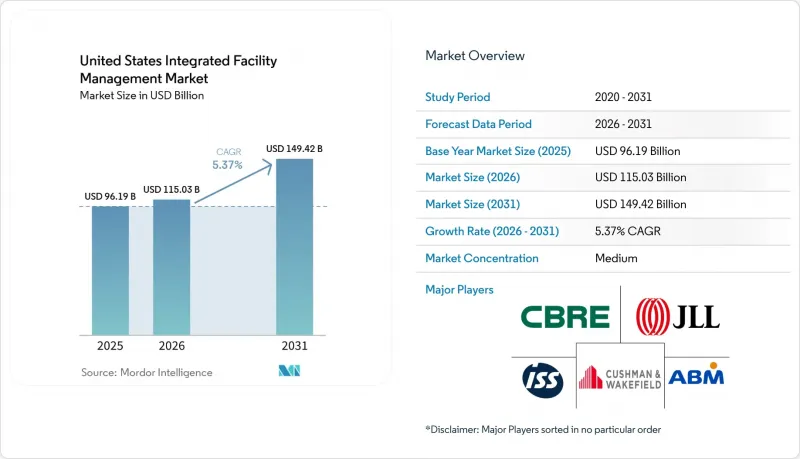
本報告按服務類型(硬性設施管理[資產管理、機電和暖通空調服務等]、軟性設施管理[辦公室支援和安保、清潔服務等])和最終用戶(商業、飯店、公共及公共基礎設施、醫療保健及其他)進行細分。市場預測以美元計價。
美國綜合設施管理市場的趨勢與見解。
對智慧互聯建築的需求日益成長
智慧建築基礎設施不再只是一項獨立的技術升級,它正逐漸成為美國綜合設施管理市場的核心營運層。預計到2026年,智慧建築節點數量將達到1.15億,這意味著越來越多的設施正在將即時營運數據融入日常服務流程中。這些數據如今支援即時暖通空調最佳化、基於入住率的能源控制以及透過預測性維護進行故障檢測,從而減少了對大規模人工巡檢團隊的需求。因此,許多合約的重點正從保證工作時間轉向運轉率、舒適度和能源績效目標,這往往有利於擁有強大數位化平台的大型供應商。根據仲量聯行(JLL)的報告,到2025年,28%的設施管理(FM)機構將在其營運中應用人工智慧(AI),而對於擁有數十萬或以上員工的公司,這一比例將達到46%,另有92%的公司已在其房地產或設施管理營運中測試和運行人工智慧工具。 2026年4月,江森自控收購南騰人工智慧,進一步加速了這一趨勢,旨在增強其自主式暖通空調控制系統。該公司預計每棟建築的能源消耗將降低10%以上。
增加外包的使用以降低營運成本
成本壓力是促使買家加速進入美國綜合設施管理(IFM)市場的最明顯原因之一。根據仲量聯行(JLL)2025年的一項調查,84%的商業地產和設施管理(CRE/FM)領導者表示,成本上升和預算限制是他們最大的擔憂,81%的領導者將成本效益列為來年的首要任務。這種成本壓力在首次外包時最為顯著,企業紛紛從內部解決方案轉向打包或完全整合的契約,從而創造了新的需求。根據國際設施管理協會(IFMA)2025年第四季發布的《設施管理市場脈動》報告,外包擴張的趨勢淨成長了19個百分點,其中公共產業、醫療保健和專業服務領域的成長尤為強勁。此外,買家在選擇供應商時也變得更加挑剔,仲量聯行的數據顯示,78%的企業表示,對業務的深入了解而非最低價格是他們選擇供應商的首要標準。這一趨勢正在推動長期合約關係的發展,因為一旦服務模式建立起來,了解營運、合規性和入住模式的供應商就很難被取代。
供應商格局的分散化阻礙了標準化。
在美國綜合設施管理市場,分散化仍然是一個結構性障礙,因為多個供應商、系統和地區之間存在重疊的實踐,使得服務交付的標準化變得困難。在大規模專案中,這個問題尤其突出,因為清潔、保全、工程、餐飲和工作場所系統仍然各自獨立採購或管理。每增加一個介面,就會增加日誌不一致、工單延遲、資料傳輸不完整以及服務等級合規性可見性降低的風險。國際設施管理協會 (IFMA) 也強調了在現代設施管理營運中整合關鍵績效指標 (KPI) 可見性和審計可追溯性的重要性,尤其是在監管和內部報告要求日益嚴格的背景下。因此,分散化不再只是一個管理難題,而是直接影響大規模企業客戶的成本控制、營運績效追蹤和審計應對力。
細分市場分析
至2025年,軟性設施管理(IFM)細分市場將占美國綜合設施管理(IFM)市場的56.28%,成為收入最高的服務類別。其在美國IFM行業的領先地位反映了辦公室支援、保全、清潔、餐飲和工作場所體驗服務在整體外包合約中的廣泛作用。這些活動如今不再被視為輔助支持,而是租戶價值的核心組成部分,尤其是在使用者體驗日益重要的商業和公共設施中。硬性設施管理(Hard FM)細分市場涵蓋資產管理、機電和暖通空調服務、消防安全系統以及其他技術職能,預計到2031年將以5.83%的複合年成長率成長。美國IFM市場技術服務規模的快速擴張主要受能源法規、老舊機械設備以及建築互聯控制系統的推動,所有這些因素都增加了非自由支配維護預算的工作量。
這種細分解釋了為什麼軟性服務持續推動交易量成長,而硬性服務通常能獲得更穩健的合約條款和更高的利潤率。在硬體維修)領域,機電(MEP)和暖通空調(HVAC)仍然是產能最緊張的領域,因為技術人員短缺限制了供應商實際能夠滿足的需求。在軟性設施管理領域,安防領域正經歷著一場技術主導的升級週期,人工智慧驅動的門禁控制、遠端監控和整合訪客管理系統正在取代許多建築中傳統的以保全人員為中心的模式。這種升級透過數位化層面改善監控和標準化,從而改變了設施的經濟效益,而無需依賴傳統合約中使用的人員配置。江森自控於2026年4月收購Nantum AI,體現了分析、建築控制和硬性服務交付融合,朝向更加差異化的技術提案發展的更廣泛趨勢。
其他好處
- Excel格式的市場預測(ME)表
- 3個月的分析師支持
目錄
第1章:引言
- 研究假設和市場定義
- 調查範圍
第2章:調查方法
第3章執行摘要
第4章 市場狀況
- 市場概覽
- 市場促進因素
- 對智慧互聯建築的需求日益成長
- 增加外包的使用以降低營運成本
- 人們越來越關注節能運營
- 疫情後加速推廣混合辦公模式
- 聯邦政府推廣碳中和政府設施
- 資料驅動型預測性維護的興起
- 市場限制因素
- 供應商格局分散阻礙了標準化。
- 熟練的機電和暖通空調技術人員短缺
- 物聯網賦能的設施管理平檯面臨較高的網路安全風險
- 通貨膨脹導致合約成本波動
- 產業價值鏈分析
- 監理情勢
- 技術展望
- 宏觀經濟因素對市場的影響
- 波特五力分析
第5章 市場規模與成長預測
- 按服務類型
- 硬體設施管理
- 資產管理
- 機電及暖通空調服務
- 消防系統和安全
- 其他硬體設施管理服務
- 軟設施管理
- 辦公室支援和安全
- 清潔服務
- 餐飲服務
- 其他軟性設施管理服務
- 硬體設施管理
- 最終用戶
- 商業
- 飯店業
- 公共和公共基礎設施
- 醫療保健
- 工業流程部
- 其他
第6章 競爭情勢
- 市場集中度
- 策略趨勢
- 市佔率分析
- 公司簡介
- CBRE Group, Inc.
- Jones Lang LaSalle Incorporated(JLL)
- Cushman & Wakefield plc
- ABM Industries Inc.
- ISS A/S
- Sodexo SA
- Aramark Corporation
- EMCOR Group, Inc.
- Compass Group plc
- Honeywell International Inc.
- Veolia Environnement SA
- Brookfield Global Integrated Solutions(BGIS)
- GDI Integrated Facility Services Inc.
- ServiceMaster Global Holdings, Inc.
- Johnson Controls International plc
- Allied Universal
- Cushman Facility Services, Inc.
- CBM Managed Services
- Trane Technologies plc
- Siemens AG
第7章 市場機會與未來展望
According to Mordor Intelligence, the united states integrated facility management market size was valued at USD 96.19 billion in 2025 and estimated to grow from USD 115.03 billion in 2026 to reach USD 149.42 billion by 2031, at a CAGR of 5.37% during the forecast period 2026-2031.
This report is Segmented by Service Type (Hard Facility Management [Asset Management, MEP and HVAC Services, and More], and Soft Facility Management [Office Support and Security, Cleaning Services, and More]), and End User (Commercial, Hospitality, Institutional and Public Infrastructure, Healthcare, and More). The Market Forecasts are Provided in Terms of Value (USD).
United States Integrated Facility Management Market Trends and Insights
Growing Demand for Smart, Connected Buildings
Smart building infrastructure is becoming a core operating layer in the United States integrated facility management market, rather than a separate technology upgrade. Smart-building node installations are projected to reach 115 million in 2026, which means more facilities are sending live operating data into day-to-day service workflows. That data now supports real-time HVAC optimization, occupancy-linked energy control, and predictive fault detection, which reduces the need for large manual inspection teams. As a result, many contracts are shifting away from labor-hour commitments and toward uptime, comfort, and energy-performance targets, which tends to favor larger vendors with stronger digital platforms. JLL reported that 28% of FM organizations embedded AI in operations in 2025, while the figure reached 46% among enterprises with more than 100,000 employees, and 92% had already piloted AI tools in real estate or FM functions. Johnson Controls reinforced that direction in April 2026 when it acquired Nantum AI to strengthen autonomous HVAC control, with the company pointing to energy savings above 10% per building.
Rising Outsourcing to Control Operating Expenditure
Cost pressure has become one of the clearest reasons buyers are moving deeper into the United States IFM market. JLL found in 2025 that 84% of CRE and FM leaders identified escalating costs and budget constraints as a top concern, while 81% said cost efficiency was a leading priority for the following year. That pressure matters most in first-time outsourcing, where organizations are moving from in-house delivery into bundled or fully integrated contracts and creating new addressable demand. IFMA reported a net 19% point shift toward greater outsourcing in its Q4 2025 FM Market Pulse, with utilities, healthcare, and professional services showing especially strong movement. Buyers are also becoming more selective in how they choose vendors, and JLL said 78% of organizations ranked deep business understanding as the top selection factor rather than the lowest unit rate. That preference supports longer contract relationships because providers that understand operations, compliance, and occupancy patterns are harder to replace once the service model is embedded.
Fragmented Vendor Landscape Limiting Standardization
Fragmentation remains a structural drag on the United States integrated facility management market because service delivery becomes harder to standardize when multiple vendors, systems, and local practices overlap. The problem becomes more severe in large portfolios where cleaning, security, engineering, catering, and workplace systems are still procured or tracked separately. Each additional interface increases the risk of inconsistent logs, delayed work orders, incomplete data transfers, and limited visibility into service-level compliance. International Facility Management Association has also emphasized the importance of integrated KPI visibility and audit traceability in modern FM operations, particularly as regulatory and internal reporting requirements continue to increase. As a result, fragmentation is no longer just an administrative challenge because it directly impacts cost control, operational performance tracking, and audit defensibility across large enterprise accounts.
Other drivers and restraints analyzed in the detailed report include:
- Increasing Emphasis on Energy-Efficient Operations
- Accelerated Post-Pandemic Hybrid Workplace Adoption
- Shortage Of Skilled MEP And HVAC Technicians
For complete list of drivers and restraints, kindly check the Table Of Contents.
Segment Analysis
Soft facility management segment held 56.28% of the United States integrated facility management market share in 2025, which made it the largest service category by revenue. In the United States IFM industry, that lead reflects the broad role of office support, security, cleaning, catering, and workplace experience services across outsourced contracts. These activities are now treated as a core part of occupier value rather than a peripheral support layer, especially in commercial and institutional settings where user experience matters more. Hard facility management segment, which covers asset management, MEP and HVAC services, fire systems and safety, and other technical functions, is projected to expand at a 5.83% CAGR through 2031. The US IFM market size for technical services is rising faster because energy rules, aging mechanical systems, and connected building controls are all pushing more work into non-discretionary maintenance budgets.
That split shows why soft services still drive volume while hard services often drive stickier contract economics and stronger margins. Within Hard FM, MEP and HVAC remain the most capacity-constrained areas because technician shortages are limiting how much of the available demand providers can actually serve. Within Soft FM, security is moving through a technology-led upgrade cycle as AI-enabled access control, remote monitoring, and integrated visitor systems replace older guard-heavy models in many buildings. That upgrade changes site economics because digital layers can improve oversight and standardization without relying on the same staffing mix used in legacy contracts. Johnson Controls' acquisition of Nantum AI in April 2026 captured the broader direction of travel, where analytics, building controls, and hard-services delivery are converging into a more differentiated technical offer.
List of Companies Covered in this Report:
- CBRE Group, Inc.
- Jones Lang LaSalle Incorporated (JLL)
- Cushman & Wakefield plc
- ABM Industries Inc.
- ISS A/S
- Sodexo S.A.
- Aramark Corporation
- EMCOR Group, Inc.
- Compass Group plc
- Honeywell International Inc.
- Veolia Environnement S.A.
- Brookfield Global Integrated Solutions (BGIS)
- GDI Integrated Facility Services Inc.
- ServiceMaster Global Holdings, Inc.
- Johnson Controls International plc
- Allied Universal
- Cushman Facility Services, Inc.
- CBM Managed Services
- Trane Technologies plc
- Siemens AG
Additional Benefits:
- The market estimate (ME) sheet in Excel format
- 3 months of analyst support
TABLE OF CONTENTS
1 INTRODUCTION
- 1.1 Study Assumptions and Market Definition
- 1.2 Scope of the Study
2 RESEARCH METHODOLOGY
3 EXECUTIVE SUMMARY
4 MARKET LANDSCAPE
- 4.1 Market Overview
- 4.2 Market Drivers
- 4.2.1 Growing Demand for Smart, Connected Buildings
- 4.2.2 Rising Outsourcing to Control Operating Expenditure
- 4.2.3 Increasing Emphasis on Energy-Efficient Operations
- 4.2.4 Accelerated Post-Pandemic Hybrid Workplace Adoption
- 4.2.5 Federal Push for Carbon-Neutral Government Facilities
- 4.2.6 Emergence of Data-Driven Predictive Maintenance
- 4.3 Market Restraints
- 4.3.1 Fragmented Vendor Landscape Limiting Standardization
- 4.3.2 Shortage of Skilled MEP and HVAC Technicians
- 4.3.3 High Cybersecurity Risk in IoT-Enabled FM Platforms
- 4.3.4 Inflation-Driven Contract Cost Volatility
- 4.4 Industry Value Chain Analysis
- 4.5 Regulatory Landscape
- 4.6 Technological Outlook
- 4.7 Impact of Macroeconomic Factors on the Market
- 4.8 Porter's Five Forces Analysis
- 4.8.1 Threat of New Entrants
- 4.8.2 Bargaining Power of Suppliers
- 4.8.3 Bargaining Power of Buyers
- 4.8.4 Threat of Substitutes
- 4.8.5 Competitive Rivalry
5 MARKET SIZE AND GROWTH FORECASTS (VALUE)
- 5.1 By Service Type
- 5.1.1 Hard Facility Management
- 5.1.1.1 Asset Management
- 5.1.1.2 MEP and HVAC Services
- 5.1.1.3 Fire Systems and Safety
- 5.1.1.4 Other Hard Facility Management Services
- 5.1.2 Soft FM
- 5.1.2.1 Office Support and Security
- 5.1.2.2 Cleaning Services
- 5.1.2.3 Catering Services
- 5.1.2.4 Other Soft Facility Management Services
- 5.1.1 Hard Facility Management
- 5.2 By End User
- 5.2.1 Commercial
- 5.2.2 Hospitality
- 5.2.3 Institutional and Public Infrastructure
- 5.2.4 Healthcare
- 5.2.5 Industrial and Process Sector
- 5.2.6 Other End-User Industries
6 COMPETITIVE LANDSCAPE
- 6.1 Market Concentration
- 6.2 Strategic Moves
- 6.3 Market Share Analysis
- 6.4 Company Profiles (includes Global Level Overview, Market Level Overview, Core Segments, Financials as available, Strategic Information, Market Rank/Share, Products and Services, Recent Developments)
- 6.4.1 CBRE Group, Inc.
- 6.4.2 Jones Lang LaSalle Incorporated (JLL)
- 6.4.3 Cushman & Wakefield plc
- 6.4.4 ABM Industries Inc.
- 6.4.5 ISS A/S
- 6.4.6 Sodexo S.A.
- 6.4.7 Aramark Corporation
- 6.4.8 EMCOR Group, Inc.
- 6.4.9 Compass Group plc
- 6.4.10 Honeywell International Inc.
- 6.4.11 Veolia Environnement S.A.
- 6.4.12 Brookfield Global Integrated Solutions (BGIS)
- 6.4.13 GDI Integrated Facility Services Inc.
- 6.4.14 ServiceMaster Global Holdings, Inc.
- 6.4.15 Johnson Controls International plc
- 6.4.16 Allied Universal
- 6.4.17 Cushman Facility Services, Inc.
- 6.4.18 CBM Managed Services
- 6.4.19 Trane Technologies plc
- 6.4.20 Siemens AG
7 MARKET OPPORTUNITIES AND FUTURE OUTLOOK
- 7.1 White-Space and Unmet-Need Assessment

 全球設施管理市場:依產品、產業及地區分類-預測至2032年
 設施管理市場:2026-2032年全球市場預測(依產品、產品模式、部署類型、公司規模及最終用途分類)
 2026年全球共消化設施市場報告
 中東設施管理:市場佔有率分析、產業趨勢與統計及成長預測(2026-2031 年)北美硬設施管理:市場佔有率分析、產業趨勢與統計及成長預測(2026-2031 年)越南設施管理:市場佔有率分析、產業趨勢與統計、成長預測(2026-2031)全球設施管理服務市場:機會與策略展望(至2035年)西班牙綜合設施管理:市場佔有率分析、產業趨勢與統計、成長預測(2026-2031)日本綜合設施管理:市場佔有率分析、產業趨勢與統計、成長預測(2026-2031)義大利綜合設施管理:市場佔有率分析、產業趨勢與統計、成長預測(2026-2031)