

 |
市場調查報告書
商品編碼
2101980
金融科技即服務市場機會、成長要素、產業趨勢分析及 2026-2035 年預測。Fintech as a Service Market Opportunity, Growth Drivers, Industry Trend Analysis, and Forecast 2026 - 2035 |
||||||

全球金融科技即服務市場預計到 2025 年將達到 4,229 億美元,年複合成長率為 16.1%,到 2035 年將達到 1.87 兆美元。
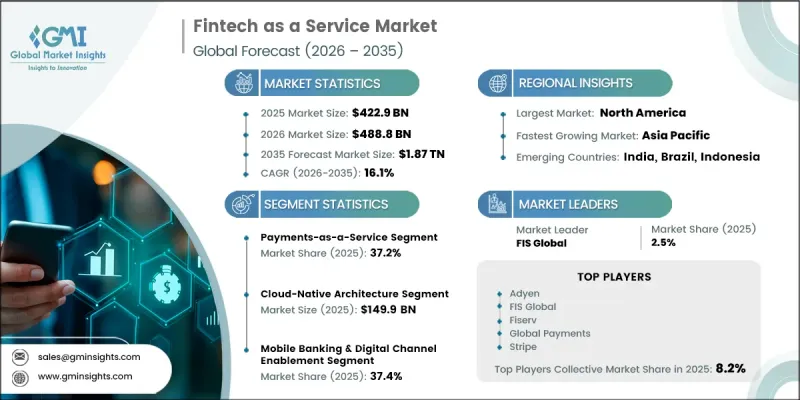
隨著金融機構加速數位轉型,並尋求更有效率的金融服務現代化方式,金融科技即服務(FaaS)市場正經歷快速成長。傳統銀行和信用社正不斷升級其遺留基礎設施,採用雲端技術,並整合先進的應用程式介面(API),以改善客戶體驗並降低營運成本。面對數位化優先型金融機構日益激烈的競爭,各機構正透過第三方平台推動靈活且擴充性的金融解決方案的普及。隨著企業需要便捷地獲取支付處理、合規監管和客戶參與等領域的功能,而無需自行開發系統,金融科技即服務(FaaS)供應商的重要性日益凸顯。 「嵌入式金融」的興起——即非金融公司將金融功能整合到現有的數位生態系統中——進一步推動了對FaaS平台的需求。這種轉變使企業能夠提供支付、貸款解決方案和保險等服務,同時提升客戶便利性並擴大商機。數位銀行、雲端技術應用以及對整合金融解決方案的需求共同推動市場持續擴張。
| 市場範圍 | |
|---|---|
| 開始年份 | 2025 |
| 預測期 | 2026-2035 |
| 初始市場規模 | 4229億美元 |
| 預測金額 | 1.87兆美元 |
| 複合年成長率 | 16.1% |
雲端原生架構目前佔據35.5%的市場佔有率,預計到2025年市場規模將達到1,499億美元。雲端原生解決方案正成為金融即服務(FaaS)生態系統的基礎要素,為金融機構提供可擴展、靈活且經濟高效的基礎設施。這些架構能夠實現金融產品的快速部署、提升營運敏捷性並增強服務交付能力,使金融機構能夠更有效地應對不斷變化的客戶需求和市場波動。
行動銀行和數位通路細分市場佔37.4%的市場佔有率,預計到2025年市場規模將達到1584億美元。該細分市場持續成長的原因在於行動裝置在全球範圍內的普及、數位銀行的日益廣泛應用以及消費者對透過線上平台進行金融交易的偏好不斷增強。金融機構正大力投資於行動應用程式、數位開戶解決方案、電子支付系統和多通路互動平台,以提高服務的可及性並提供無縫的客戶體驗。數位金融服務的持續創新有望進一步加速該細分市場的成長。
預計到2025年,北美金融科技即服務(Fintech as a Service)市場規模將達到1,728億美元,並在2026年至2035年間以14.8%的複合年成長率成長。該地區強大的市場地位得益於成熟的金融機構、先進的數位支付生態系統、廣泛的雲端技術應用,以及銀行即服務(Banking-as-a-Service)和嵌入式金融解決方案的日益普及。促進數位金融服務發展的法律規範,以及對API主導銀行技術的持續投資,預計將在整個預測期內維持北美市場的成長。
全球金融科技即服務 (Fintech-as-a-Service) 市場的主要參與者包括 Stripe、Adyen、Finastra、FIS Global、Fiserv、Global Payments 和 Nuvei。進入金融科技即服務市場的公司正透過持續創新、策略夥伴關係、平台擴展以及對先進金融技術的投資來鞏固其市場地位。市場參與企業專注於開發擴充性的雲端解決方案、增強 API 功能並擴展嵌入式金融服務,以滿足金融和非金融實體日益成長的需求。他們也積極尋求合作、收購和區域擴張策略,以擴大基本客群並提升服務能力。投資於網路安全、監管科技 (RegTech)、自動化和個人化金融解決方案有助於企業實現服務差異化。
目錄
第1章:調查方法
第2章執行摘要
第3章 行業洞察
- 產業生態系分析
- 供應商情況
- 利潤率
- 成本結構
- 每個階段增加的價值
- 影響價值鏈的因素
- 中斷
- 影響產業的因素
- 促進因素
- 開放銀行和API標準化的興起
- 加速傳統金融機構的數位轉型
- 非金融公司對嵌入式融資的需求激增
- 即時支付基礎設施的全球擴張
- 產業潛在風險與挑戰
- 與傳統核心銀行系統整合的複雜性
- 監管合規要求因司法管轄區而異,並有細分。
- 市場機遇
- 在銀行服務尚未普及的新興市場,拓展金融即服務(FaaS)。
- 一個面向中小企業的 FaaS 平台,旨在彌合經濟實惠的金融基礎設施方面的差距。
- 人工智慧和自動化正在推動成本降低,為 FaaS 開闢新的收入模式。
- 促進因素
- 技術與創新展望
- 最新科技趨勢
- 利用API和開放銀行API的銀行業務運營
- 數位付款閘道和支付編配
- 新興技術
- 金融服務領域的生成式人工智慧
- 基於代理的人工智慧在自主金融營運的應用
- 最新科技趨勢
- 成長潛力分析
- 價格分析
- 對過去價格趨勢的分析
- 依球員類型分類的定價策略(高級球員、超值球員、成本加成球員)
- 監理情勢
- 北美洲
- 美國證券交易委員會(SEC)
- 美國消費者金融保護局(CFPB)
- 歐洲
- 英國金融行為監理局(FCA)
- 歐盟 - 歐洲銀行監理局 (EBA)
- 亞太地區
- 印度 - 印度證券交易委員會 (SEBI)
- 日本 - 金融服務廳 (FSA)
- LATAM
- 巴西證券交易委員會(CVM)
- 墨西哥 - 墨西哥國家銀行和證券委員會 (CNBV)
- 中東和非洲
- 阿拉伯聯合大公國 - 杜拜金融服務管理局 (DFSA)
- 南非 - 金融部門行為監理局 (FSCA)
- 北美洲
- 波特的分析
- PESTLE分析
- 專利分析
- 人工智慧和生成式人工智慧對市場的影響
- 利用人工智慧改造現有經營模式
- 按細分市場分類的生成式人工智慧用例和部署藍圖
- 風險、限制和監管考量
- FaaS 中零信任架構採用趨勢
- FaaS 許可系統
- 預測假設和情境分析
- 基本案例:驅動複合年成長率的關鍵宏觀經濟與產業變量
- 樂觀情境:宏觀經濟與產業的順風
- 悲觀情景:宏觀經濟放緩或產業逆風
第4章 競爭情勢
- 介紹
- 企業市佔率分析
- 北美洲
- 歐洲
- 亞太地區
- LATAM
- 中東和非洲
- 主要市場公司的競爭分析
- 競爭定位矩陣
- 主要進展
- 併購
- 夥伴關係和聯盟
- 新產品發布
- 業務拓展計劃及資金籌措
- 按公司規模進行基準測試
- 排名分類標準與遴選標準
- 按銷售額、地區和創新能力分類的層級定位矩陣。
第5章 市場估計與預測:依服務業分類,2022-2035年
- Payments-as-a-Service
- Banking-as-a-Service(BaaS)
- Lending-as-a-Service
- 保險即服務(保險科技)
- Wealth Management-as-a-Service
- RegTech-as-a-Service
- 數位資產和加密資產服務
第6章 市場估計與預測:依技術分類,2022-2035年
- 人工智慧和機器學習
- 區塊鏈和分散式帳本技術(DLT)
- 機器人流程自動化 (RPA)
- 雲端原生架構
- 巨量資料和進階分析
- 其他
第7章 市場估計與預測:依應用領域分類,2022-2035年
- 利用行動銀行和數位管道
- P2P借貸與市場金融
- 監理合規和報告
- 風險管理和詐欺偵測
- 其他
第8章 市場估算與預測:依組織規模分類,2022-2035年
- 大公司
- 小型企業
第9章 市場估算與預測:依部署模式分類,2022-2035年
- 基於雲端的
- 公共雲端
- 私有雲端
- 混合
- 現場
第10章 市場估價與預測:依最終用途分類,2022-2035年
- 金融機構
- 銀行及傳統金融機構
- 非銀行金融公司(NBFC)
- 保險公司
- 投資和資產管理公司
- 非金融機構
- 零售和電子商務企業
- 電信和科技公司
- 醫療保健和生命科學公司
- 政府和監管機構
第11章 市場估價與預測:按地區分類,2022-2035年
- 北美洲
- 美國
- 加拿大
- 歐洲
- 德國
- 英國
- 法國
- 義大利
- 西班牙
- 瑞典
- 荷蘭
- 瑞士
- 愛爾蘭
- 亞太地區
- 中國
- 印度
- 日本
- 韓國
- 澳洲
- 印尼
- 馬來西亞
- 越南
- 拉丁美洲
- 巴西
- 墨西哥
- 阿根廷
- 智利
- 中東和非洲
- 南非
- 沙烏地阿拉伯
- UAE
第12章:公司簡介
- 世界公司
- FIS Global
- Fiserv
- Temenos
- Finastra
- Mambu
- Backbase
- Stripe
- Adyen
- Checkout.com
- Global Payments
- Nuvei
- Rapyd
- 本地公司
- Solarisbank
- Cross River Bank
- Equals
- LoanPro
- ChargeAfter
- 新興企業
- Unit
- Synctera
- Swan
The Global Fintech as a Service Market was valued at USD 422.9 billion in 2025 and is estimated to grow at a CAGR of 16.1% to reach USD 1.87 trillion by 2035.
The fintech as a service market is experiencing rapid growth as financial institutions accelerate their digital transformation initiatives and seek more efficient ways to modernize financial service delivery. Traditional banks and credit unions are increasingly upgrading legacy infrastructure, adopting cloud-based technologies, and integrating advanced application programming interfaces (APIs) to improve customer experiences while lowering operational expenses. Rising competition from digital-first financial providers is encouraging organizations to adopt flexible and scalable financial solutions through third-party platforms. Financial-as-a-service providers are becoming increasingly important as businesses look for ready-to-use capabilities in areas such as payment processing, regulatory compliance, and customer engagement without developing these systems internally. The expansion of embedded finance is further strengthening demand for FaaS platforms as non-financial companies integrate financial features into their existing digital ecosystems. This shift allows businesses to offer services such as payments, lending solutions, and insurance capabilities while improving customer convenience and expanding revenue opportunities. The combination of digital banking growth, cloud adoption, and demand for integrated financial solutions is expected to drive sustained market expansion.
| Market Scope | |
|---|---|
| Start Year | 2025 |
| Forecast Year | 2026-2035 |
| Start Value | $422.9 Billion |
| Forecast Value | $1.87 Trillion |
| CAGR | 16.1% |
The cloud-native architecture segment held 35.5% share, generating USD 149.9 billion in 2025. Cloud-native solutions have become a fundamental component of the FaaS ecosystem due to their ability to provide financial organizations with scalable, flexible, and cost-efficient infrastructure. These architectures enable faster deployment of financial products, improved operational agility, and enhanced service delivery capabilities, allowing institutions to respond more effectively to changing customer requirements and evolving market conditions.
The mobile banking and digital channel segment held 37.4% share, generating USD 158.4 billion in 2025. The segment continues to expand due to the increasing global adoption of mobile devices, rising digital banking usage, and growing consumer preference for conducting financial activities through online platforms. Financial institutions are investing significantly in mobile applications, digital account onboarding solutions, electronic payment systems, and multi-channel engagement platforms to improve accessibility and deliver seamless customer experiences. Continued innovation in digital financial services is expected to further strengthen the growth of this segment.
North America Fintech as a Service Market reached USD 172.8 billion in 2025 and is expected to grow at a CAGR of 14.8% from 2026 to 2035. The region's strong market position is supported by the presence of established financial institutions, advanced digital payment ecosystems, widespread cloud adoption, and increasing implementation of banking-as-a-service and embedded finance solutions. Supportive regulatory frameworks for digital financial services, combined with continuous investments in API-driven banking technologies, are expected to sustain market growth across North America throughout the forecast period.
The leading companies operating in the global fintech as a service market include Stripe, Adyen, Finastra, FIS Global, Fiserv, Global Payments, and Nuvei. Companies operating in the fintech as a service market are strengthening their market position through continuous innovation, strategic partnerships, platform expansion, and investments in advanced financial technologies. Market participants are focusing on developing scalable cloud-based solutions, enhancing API capabilities, and expanding embedded finance offerings to address increasing demand from financial institutions and non-financial businesses. Companies are also pursuing collaborations, acquisitions, and geographic expansion strategies to increase their customer base and improve service capabilities. Investments in cybersecurity, regulatory technology, automation, and personalized financial solutions are helping organizations differentiate their offerings.
Table of Contents
Chapter 1 Methodology
- 1.1 Research approach
- 1.2 Quality Commitments
- 1.2.1 GMI AI policy & data integrity commitment
- 1.3 Research Trail & Confidence Scoring
- 1.3.1 Research Trail Components
- 1.3.2 Scoring Components
- 1.4 Data Collection
- 1.5 Data mining sources
- 1.5.1 Paid sources
- 1.6 Base estimates and calculations
- 1.6.1 Base year calculation
- 1.7 Forecast model
- 1.7.1 Quantified market impact analysis
- 1.8 Research transparency addendum
- 1.8.1 Source attribution framework
- 1.8.2 Quality assurance metrics
- 1.8.3 Our commitment to trust
Chapter 2 Executive Summary
- 2.1 Industry 360° synopsis
- 2.2 Key market trends
- 2.2.1 Regional
- 2.2.2 Service
- 2.2.3 Technology
- 2.2.4 Application
- 2.2.5 Organization Size
- 2.2.6 Deployment Model
- 2.2.7 End Use
- 2.3 TAM analysis, 2026-2035
- 2.4 CXO perspectives: Strategic imperatives
Chapter 3 Industry Insights
- 3.1 Industry ecosystem analysis
- 3.1.1 Supplier landscape
- 3.1.2 Profit margin
- 3.1.3 Cost structure
- 3.1.4 Value addition at each stage
- 3.1.5 Factor affecting the value chain
- 3.1.6 Disruptions
- 3.2 Industry impact forces
- 3.2.1 Growth drivers
- 3.2.1.1 Rise of Open Banking & API Standardization
- 3.2.1.2 Accelerating Digital Transformation in Traditional Financial Institutions
- 3.2.1.3 Surging Demand for Embedded Finance by Non-Financial Enterprises
- 3.2.1.4 Growing Adoption of Real-Time Payment Infrastructure Globally
- 3.2.2 Industry pitfalls and challenges
- 3.2.2.1 Integration Complexity with Legacy Core Banking Systems
- 3.2.2.2 Evolving & Fragmented Regulatory Compliance Requirements Across Jurisdictions
- 3.2.3 Market opportunities
- 3.2.3.1 FaaS Expansion in Underbanked Emerging Markets
- 3.2.3.2 SME-Focused FaaS Platforms Addressing Affordable Financial Infrastructure Gap
- 3.2.3.3 AI & Automation-Driven Cost Reduction Unlocking New FaaS Revenue Models
- 3.2.1 Growth drivers
- 3.3 Technology and innovation landscape
- 3.3.1 Current technological trends
- 3.3.1.1 API-Based Banking & Open Banking APIs
- 3.3.1.2 Digital Payment Gateways & Payment Orchestration
- 3.3.2 Emerging technologies
- 3.3.2.1 Generative AI for Financial Services
- 3.3.2.2 Agentic AI for Autonomous Financial Operations
- 3.3.1 Current technological trends
- 3.4 Growth potential analysis
- 3.5 Pricing Analysis (Driven by Primary Research)
- 3.5.1 Historical Price Trend Analysis
- 3.5.2 Pricing Strategy by Player Type (Premium / Value / Cost-plus)
- 3.6 Regulatory landscape
- 3.6.1 North America
- 3.6.1.1 US - Securities and Exchange Commission (SEC)
- 3.6.1.2 US - Consumer Financial Protection Bureau (CFPB)
- 3.6.2 Europe
- 3.6.2.1 UK - Financial Conduct Authority (FCA)
- 3.6.2.2 EU - European Banking Authority (EBA)
- 3.6.3 Asia Pacific
- 3.6.3.1 India - Securities and Exchange Board of India (SEBI)
- 3.6.3.2 Japan - Financial Services Agency (FSA)
- 3.6.4 LATAM
- 3.6.4.1 Brazil - Comissao de Valores Mobiliarios (CVM)
- 3.6.4.2 Mexico - Comision Nacional Bancaria y de Valores (CNBV)
- 3.6.5 MEA
- 3.6.5.1 UAE - Dubai Financial Services Authority (DFSA)
- 3.6.5.2 South Africa - Financial Sector Conduct Authority (FSCA)
- 3.6.1 North America
- 3.7 Porter's analysis
- 3.8 PESTEL analysis
- 3.9 Patent analysis (Driven by Primary Research)
- 3.10 Impact of AI & generative AI on the market
- 3.10.1 AI-driven disruption of existing business models
- 3.10.2 GenAI use cases & adoption roadmap by segment
- 3.10.3 Risks, limitations & regulatory considerations
- 3.11 Zero-Trust Architecture Adoption Trends in FaaS
- 3.12 FaaS Licensing Structures
- 3.13 Forecast assumptions & scenario analysis (Driven by Primary Research)
- 3.13.1 Base Case- Key Macro & Industry Variables Driving CAGR
- 3.13.2 Optimistic Scenarios- Favorable macro and industry tailwinds
- 3.13.3 Pessimistic Scenario - Macroeconomic slowdown or industry headwinds
Chapter 4 Competitive Landscape, 2025
- 4.1 Introduction
- 4.2 Company market share analysis
- 4.2.1 North America
- 4.2.2 Europe
- 4.2.3 Asia Pacific
- 4.2.4 LATAM
- 4.2.5 MEA
- 4.3 Competitive analysis of major market players
- 4.4 Competitive positioning matrix
- 4.5 Key developments
- 4.5.1 Mergers & acquisitions
- 4.5.2 Partnerships & collaborations
- 4.5.3 New product launches
- 4.5.4 Expansion plans and funding
- 4.6 Company tier benchmarking
- 4.6.1 Tier classification criteria & qualifying thresholds
- 4.6.2 Tier positioning matrix by revenue, geography & innovation
Chapter 5 Market Estimates and Forecast, By Service, 2022 - 2035 ($ Mn)
- 5.1 Key trends
- 5.2 Payments-as-a-Service
- 5.3 Banking-as-a-Service (BaaS)
- 5.4 Lending-as-a-Service
- 5.5 Insurance-as-a-Service (Insurtech)
- 5.6 Wealth Management-as-a-Service
- 5.7 RegTech-as-a-Service
- 5.8 Digital Assets & Cryptocurrency Services
Chapter 6 Market Estimates and Forecast, By Technology, 2022 - 2035 ($ Mn)
- 6.1 Key trends
- 6.2 Artificial Intelligence & Machine Learning
- 6.3 Blockchain & Distributed Ledger Technology (DLT)
- 6.4 Robotic Process Automation (RPA)
- 6.5 Cloud-Native Architecture
- 6.6 Big Data & Advanced Analytics
- 6.7 Others
Chapter 7 Market Estimates and Forecast, By Application, 2022 - 2035 ($ Mn)
- 7.1 Key trends
- 7.2 Mobile Banking & Digital Channel Enablement
- 7.3 P2P Lending & Marketplace Finance
- 7.4 Regulatory Compliance & Reporting
- 7.5 Risk Management & Fraud Detection
- 7.6 Others
Chapter 8 Market Estimates and Forecast, By Organization Size, 2022 - 2035 ($ Mn)
- 8.1 Key trends
- 8.2 Large Enterprises
- 8.3 SMEs
Chapter 9 Market Estimates and Forecast, By Deployment Model, 2022 - 2035 ($ Mn)
- 9.1 Key trends
- 9.2 Cloud-Based
- 9.2.1 Public Cloud
- 9.2.2 Private Cloud
- 9.3 Hybrid
- 9.4 On-Premises
Chapter 10 Market Estimates and Forecast, By End Use, 2022 - 2035 ($ Mn)
- 10.1 Key trends
- 10.2 Financial Institutions
- 10.2.1 Banks & Traditional Financial Institutions
- 10.2.2 Non-Banking Financial Companies (NBFCs)
- 10.2.3 Insurance Companies
- 10.2.4 Investment & Wealth Management Firms
- 10.3 Non-Financial Institutions
- 10.3.1 Retail & E-commerce Companies
- 10.3.2 Telecom & Technology Companies
- 10.3.3 Healthcare & Life Sciences Companies
- 10.3.4 Government & Regulatory Bodies
Chapter 11 Market Estimates & Forecast, By Region, 2022 - 2035 ($ Mn)
- 11.1 Key trends
- 11.2 North America
- 11.2.1 US
- 11.2.2 Canada
- 11.3 Europe
- 11.3.1 Germany
- 11.3.2 UK
- 11.3.3 France
- 11.3.4 Italy
- 11.3.5 Spain
- 11.3.6 Sweden
- 11.3.7 Netherlands
- 11.3.8 Switzerland
- 11.3.9 Ireland
- 11.4 Asia Pacific
- 11.4.1 China
- 11.4.2 India
- 11.4.3 Japan
- 11.4.4 South Korea
- 11.4.5 Australia
- 11.4.6 Indonesia
- 11.4.7 Malaysia
- 11.4.8 Vietnam
- 11.5 Latin America
- 11.5.1 Brazil
- 11.5.2 Mexico
- 11.5.3 Argentina
- 11.5.4 Chile
- 11.6 MEA
- 11.6.1 South Africa
- 11.6.2 Saudi Arabia
- 11.6.3 UAE
Chapter 12 Company Profiles
- 12.1 Global players
- 12.1.1 FIS Global
- 12.1.2 Fiserv
- 12.1.3 Temenos
- 12.1.4 Finastra
- 12.1.5 Mambu
- 12.1.6 Backbase
- 12.1.7 Stripe
- 12.1.8 Adyen
- 12.1.9 Checkout.com
- 12.1.10 Global Payments
- 12.1.11 Nuvei
- 12.1.12 Rapyd
- 12.2 Regional players
- 12.2.1 Solarisbank
- 12.2.2 Cross River Bank
- 12.2.3 Equals
- 12.2.4 LoanPro
- 12.2.5 ChargeAfter
- 12.3 Emerging players
- 12.3.1 Unit
- 12.3.2 Synctera
- 12.3.3 Swan

 中東和北非金融科技:市場佔有率分析、行業趨勢和統計數據以及成長預測(2026-2031 年)亞太地區金融科技:市場佔有率分析、產業趨勢與統計及成長預測(2026-2031)北美金融科技:市佔率分析、產業趨勢與統計及成長預測(2026-2031)德國金融科技:市場佔有率分析、產業趨勢與統計及成長預測(2026-2031)新加坡金融科技:市場佔有率分析、產業趨勢與統計及成長預測(2026-2031)歐洲金融科技:市場佔有率分析、產業趨勢與統計及成長預測(2026-2031)越南金融科技:市場佔有率分析、產業趨勢與統計及成長預測(2026-2031)馬來西亞金融科技:市場佔有率分析、產業趨勢與統計及成長預測(2026-2031)金融科技:市場佔有率分析、產業趨勢與統計、成長預測(2025-2030)印度金融科技:市場佔有率分析、產業趨勢與統計及成長預測(2026-2031)