


 |
市場調查報告書
商品編碼
1885826
有機蛋白水解物市場機會、成長促進因素、產業趨勢分析及預測(2025-2034年)Organic Protein Hydrolysates Market Opportunity, Growth Drivers, Industry Trend Analysis, and Forecast 2025 - 2034 |
||||||

2024 年全球有機蛋白水解物市場價值為 14 億美元,預計到 2034 年將以 8.2% 的複合年成長率成長至 31 億美元。
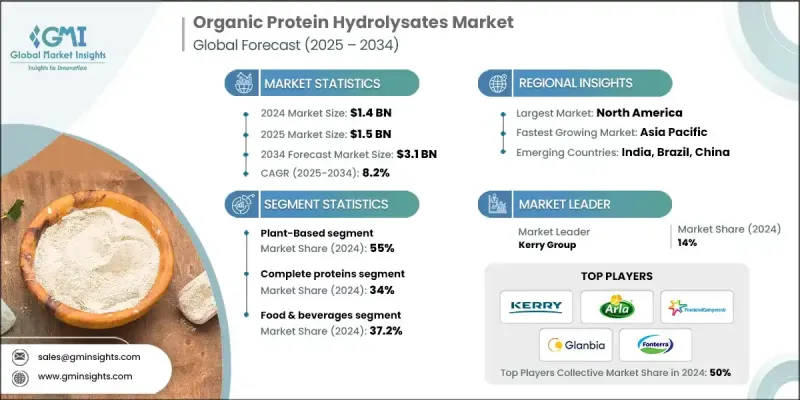
隨著有機營養、高蛋白飲食趨勢和個人化營養的融合,市場對水解有機蛋白的需求正在加速成長,這推動了多個消費和工業領域對水解有機蛋白的需求。水解有機蛋白的生物活性、較低的致敏性和更高的吸收率持續推動產品開發,並支撐其高階定價。隨著全球市場向更濃縮、更專業的蛋白質形式轉變,預計功能性食品和加工食品中對水解有機蛋白的應用將更加廣泛。人們對健康日益成長的興趣、有機生物基原料使用量的增加以及運動、醫療和生活方式營養的成長,都增強了水解蛋白的吸引力。有機農業監管的支持,加上酵素加工技術的進步,正在擴大生產能力。由於對較溫和、較易消化的蛋白質來源的需求,水解有機蛋白在嬰幼兒營養和特殊醫學營養領域的滲透率也不斷提高。這些因素共同鞏固了全球有機蛋白水解物的長期發展動能。
| 市場範圍 | |
|---|---|
| 起始年份 | 2024 |
| 預測年份 | 2025-2034 |
| 起始值 | 14億美元 |
| 預測值 | 31億美元 |
| 複合年成長率 | 8.2% |
2024年,植物性原料市佔率達到55%,預計到2034年將以8%的複合年成長率成長。隨著製造商不斷拓展原料組合,涵蓋新的植物和海洋來源,以實現客製化的胺基酸組成和功能特性,該品類將持續成長。在北美和歐洲市場,對永續性的關注、非基因定位以及消費者對負責任採購的偏好仍然十分強勁。
2024年,完整蛋白質市佔率達到34%,預計到2034年將以8.6%的複合年成長率成長。對完整氨基酸譜和先進功能特性的需求正在推動蛋白質類型的差異化。乳製品來源的蛋白質在臨床和運動營養領域仍然佔據主導地位,而膠原蛋白成分在注重運動和美容的領域保持強勁勢頭。市場正逐步轉向更專業的胜肽配方,旨在實現精準的健康定位和基於智慧財產權的產品宣稱。
2024年北美有機蛋白水解物市場規模為4.28億美元,預計2034年將達到9.52億美元。該地區受益於成熟的有機營養文化、運動和寵物產品領域的強勁需求,以及願意為高品質、清潔標籤蛋白買單的消費者群體。美國以其在健康和營養領域的快速創新而聞名,並持續擴大有機蛋白水解物在各類產品中的商業化應用,尤其是在高性能和臨床應用領域。
有機蛋白水解物市場的主要活躍企業包括:Arla Foods Ingredients、Kerry Group、FrieslandCampina Ingredients、Glanbia Nutritionals、Hilmar Ingredients、Fonterra Co-operative Group、Lactalis Ingredients、A. Costantino & CSptea、Essen Protein Solutions、VITA. Lyle、ADM (Archer Daniels Midland)、Cargill、Ingredion Incorporated、Roquette Freres、Symrise、Gelita AG 和 Weishardt Group。全球有機蛋白水解物市場的企業正透過有針對性的創新、策略性的產品組合拓展和加工能力的提升來增強其競爭優勢。許多企業正在投資先進的酵素技術,以開發針對特定健康和性能需求的差異化胜肽譜。此外,各企業也拓展原料來源,納入更廣泛的植物和動物蛋白,以滿足不同的應用和監管要求。與配方師和營養品牌進行策略合作有助於加快產品上市進程,並支持專業產品的開發。
目錄
第1章:方法論與範圍
第2章:執行概要
第3章:行業洞察
- 產業生態系分析
- 供應商格局
- 利潤率
- 每個階段的價值增加
- 影響價值鏈的因素
- 中斷
- 產業影響因素
- 成長促進因素
- 對清潔標籤、有機蛋白質的需求不斷成長
- 運動、嬰幼兒、臨床營養方面的成長
- 酵素加工技術的進步
- 產業陷阱與挑戰
- 與傳統蛋白質相比,生產成本高昂
- 原料供應有限,需進行認證
- 市場機遇
- 拓展至有機生物促效劑及農業營養領域
- 植物性和無過敏原配方趨勢
- 成長促進因素
- 成長潛力分析
- 監管環境
- 北美洲
- 歐洲
- 亞太地區
- 拉丁美洲
- 中東和非洲
- 波特的分析
- PESTEL 分析
- 價格趨勢
- 按地區
- 按來源
- 未來市場趨勢
- 技術與創新格局
- 當前技術趨勢
- 新興技術
- 專利格局
- 貿易統計(HS編碼)
(註:貿易統計僅針對重點國家提供)
- 主要進口國
- 主要出口國
- 永續性和環境方面
- 永續實踐
- 減少廢棄物策略
- 生產中的能源效率
- 環保舉措
- 碳足跡考量
第4章:競爭格局
- 介紹
- 公司市佔率分析
- 按地區
- 北美洲
- 歐洲
- 亞太地區
- 拉丁美洲
- MEA
- 按地區
- 公司矩陣分析
- 主要市場參與者的競爭分析
- 競爭定位矩陣
- 關鍵進展
- 併購
- 合作夥伴關係與合作
- 新產品發布
- 擴張計劃
第5章:市場估算與預測:依來源分類,2021-2034年
- 主要趨勢
- 植物性
- 大豆
- 小麥
- 豌豆
- 米
- 玉米
- 油籽(例如,葵花籽、菜籽)
- 其他植物來源
- 動物性
- 牛奶(酪蛋白、乳清蛋白)
- 蛋
- 肉類和家禽
- 魚類和海洋
- 膠原蛋白和明膠
- 其他來源
第6章:市場估算與預測:依蛋白質類型分類,2021-2034年
- 主要趨勢
- 完全蛋白質(包含所有必需胺基酸)
- 不完全蛋白質
- 膠原蛋白和明膠蛋白
- 酪蛋白和乳清蛋白
- 特種/功能性蛋白質(生物活性胜肽、客製化混合物)
第7章:市場估計與預測:依應用領域分類,2021-2034年
- 主要趨勢
- 食品和飲料
- 功能性食品
- 運動營養與性能產品
- 嬰幼兒及臨床營養
- 烘焙和糖果
- 乳製品及乳製品替代品
- 肉類替代品和肉製品
- 飲料(即飲飲料、粉狀飲料、冰沙)
- 零食和簡便食品
- 動物營養
- 寵物食品(狗糧、貓糧及其他)
- 水產飼料(魚、蝦及其他)
- 牲畜飼料(家禽、豬、反芻動物)
- 特種飼料和高性能飼料
- 農業與作物營養
- 生物促效劑和植物生長促進劑
- 葉面噴灑
- 土壤改良劑
- 種子處理
- 化妝品及個人護理
- 保養
- 護髮
- 營養美容/由內而外的美麗
- 藥品和營養保健品
- 膳食補充劑
- 醫學與臨床營養
- 藥物傳輸與特殊製劑
- 工業及其他應用
第8章:市場估算與預測:依地區分類,2021-2034年
- 主要趨勢
- 北美洲
- 美國
- 加拿大
- 歐洲
- 德國
- 英國
- 法國
- 西班牙
- 義大利
- 歐洲其他地區
- 亞太地區
- 中國
- 印度
- 日本
- 澳洲
- 韓國
- 亞太其他地區
- 拉丁美洲
- 巴西
- 墨西哥
- 阿根廷
- 拉丁美洲其他地區
- 中東和非洲
- 沙烏地阿拉伯
- 南非
- 阿拉伯聯合大公國
- 中東和非洲其他地區
第9章:公司簡介
- Arla Foods Ingredients
- Kerry Group
- FrieslandCampina Ingredients
- Glanbia Nutritionals
- Hilmar Ingredients
- Fonterra Co-operative Group
- Lactalis Ingredients
- A. Costantino & CSpA
- Essentia Protein Solutions
- VITAMINAS, SA (Bioiberica Group)
- Armor Proteines
- AMCO Proteins
- Tate & Lyle
- ADM (Archer Daniels Midland)
- Cargill
- Ingredion Incorporated
- Roquette Freres
- Symrise
- Gelita AG
- Weishardt Group
The Global Organic Protein Hydrolysates Market was valued at USD 1.4 billion in 2024 and is estimated to grow at a CAGR of 8.2% to reach USD 3.1 billion by 2034.
Demand is accelerating as organic nutrition, high-protein dietary trends, and personalized nutrition converge, increasing the need for hydrolyzed organic proteins across multiple consumer and industrial segments. Their bioactive characteristics, reduced allergenic potential, and improved absorption rates continue to drive product development and support premium pricing. Broader adoption within functional and processed foods is expected as the global market shifts toward more concentrated and specialized protein formats. Rising interest in wellness, increased use of organic bio-based inputs, and growth in sports, medical, and lifestyle nutrition have strengthened the appeal of hydrolysates. Regulatory backing for organic agriculture, combined with advancements in enzymatic processing, is expanding production capabilities. Penetration is also rising in infant, pediatric, and medical nutrition due to the need for gentler and easier-to-digest protein sources. These factors collectively reinforce long-term momentum for organic protein hydrolysates worldwide.
| Market Scope | |
|---|---|
| Start Year | 2024 |
| Forecast Year | 2025-2034 |
| Start Value | $1.4 Billion |
| Forecast Value | $3.1 Billion |
| CAGR | 8.2% |
The plant-based sources segment held a 55% share in 2024 and will grow at an 8% CAGR through 2034. The category continues to grow as manufacturers broaden their raw material portfolios across new botanical and marine sources to achieve customized amino acid compositions and functional characteristics. Sustainability concerns, non-GMO positioning, and consumer preference for responsible sourcing remain particularly strong across North American and European markets.
The complete proteins segment held a 34% share in 2024 and is expected to grow at an 8.6% CAGR through 2034. Demand for full amino acid profiles and advanced functional attributes is shaping protein-type differentiation. Dairy-derived proteins remain dominant in clinical and performance nutrition, while collagen-based ingredients maintain strong traction in mobility and beauty-focused segments. The market is gradually shifting toward more specialized peptide formulations aimed at targeted health positioning and intellectual property-based product claims.
North America Organic Protein Hydrolysates Market generated USD 428 million in 2024 to reach USD 952 million by 2034. The region benefits from a mature organic nutrition culture, strong adoption in sports and pet products, and a consumer base willing to pay for high-quality, clean-label proteins. The United States, known for rapid innovation in health and nutrition, continues to expand the commercialization of organic protein hydrolysates across diverse product categories, especially in advanced performance and clinical applications.
Key companies active in the Organic Protein Hydrolysates Market include Arla Foods Ingredients, Kerry Group, FrieslandCampina Ingredients, Glanbia Nutritionals, Hilmar Ingredients, Fonterra Co-operative Group, Lactalis Ingredients, A. Costantino & C. S.p.A., Essentia Protein Solutions, VITAMINAS, S.A. (Bioiberica Group), Armor Proteines, AMCO Proteins, Tate & Lyle, ADM (Archer Daniels Midland), Cargill, Ingredion Incorporated, Roquette Freres, Symrise, Gelita AG, and Weishardt Group. Companies in the Global Organic Protein Hydrolysates Market are strengthening their competitive positioning through targeted innovation, strategic portfolio expansion, and improved processing capabilities. Many are investing in advanced enzymatic technologies to create differentiated peptide profiles tailored for specific health and performance needs. Firms are also expanding raw material sourcing to include a broader mix of plant and animal proteins to serve diverse applications and regulatory preferences. Strategic collaborations with formulators and nutrition brands help accelerate go-to-market pathways and support specialized product development.
Table of Contents
Chapter 1 Methodology & Scope
- 1.1 Market scope and definition
- 1.2 Research design
- 1.2.1 Research approach
- 1.2.2 Data collection methods
- 1.3 Data mining sources
- 1.3.1 Global
- 1.3.2 Regional/Country
- 1.4 Base estimates and calculations
- 1.4.1 Base year calculation
- 1.4.2 Key trends for market estimation
- 1.5 Primary research and validation
- 1.5.1 Primary sources
- 1.6 Forecast model
- 1.7 Research assumptions and limitations
Chapter 2 Executive Summary
- 2.1 Industry 360° synopsis
- 2.2 Key market trends
- 2.2.1 Regional
- 2.2.2 Source
- 2.2.3 Protein Type
- 2.2.4 Application
- 2.3 TAM Analysis, 2025-2034
- 2.4 CXO perspectives: Strategic imperatives
- 2.4.1 Executive decision points
- 2.4.2 Critical success factors
- 2.5 Future Outlook and Strategic Recommendations
Chapter 3 Industry Insights
- 3.1 Industry ecosystem analysis
- 3.1.1 Supplier landscape
- 3.1.2 Profit margin
- 3.1.3 Value addition at each stage
- 3.1.4 Factor affecting the value chain
- 3.1.5 Disruptions
- 3.2 Industry impact forces
- 3.2.1 Growth drivers
- 3.2.1.1 Rising demand for clean-label, organic proteins
- 3.2.1.2 Growth in sports, infant, clinical nutrition
- 3.2.1.3 Advances in enzymatic processing technologies
- 3.2.2 Industry pitfalls and challenges
- 3.2.2.1 High production costs versus conventional proteins
- 3.2.2.2 Limited raw material availability and certification
- 3.2.3 Market opportunities
- 3.2.3.1 Expansion into organic biostimulants and agrinutrition
- 3.2.3.2 Plant-based and allergen-free formulation trends
- 3.2.1 Growth drivers
- 3.3 Growth potential analysis
- 3.4 Regulatory landscape
- 3.4.1 North America
- 3.4.2 Europe
- 3.4.3 Asia Pacific
- 3.4.4 Latin America
- 3.4.5 Middle East & Africa
- 3.5 Porter's analysis
- 3.6 PESTEL analysis
- 3.7 Price trends
- 3.7.1 By region
- 3.7.2 By Source
- 3.8 Future market trends
- 3.9 Technology and Innovation landscape
- 3.9.1 Current technological trends
- 3.9.2 Emerging technologies
- 3.10 Patent Landscape
- 3.11 Trade statistics (HS code)
( Note: the trade statistics will be provided for key countries only)
- 3.11.1 Major importing countries
- 3.11.2 Major exporting countries
- 3.12 Sustainability and environmental aspects
- 3.12.1 Sustainable practices
- 3.12.2 Waste reduction strategies
- 3.12.3 Energy efficiency in production
- 3.12.4 Eco-friendly initiatives
- 3.13 Carbon footprint consideration
Chapter 4 Competitive Landscape, 2024
- 4.1 Introduction
- 4.2 Company market share analysis
- 4.2.1 By region
- 4.2.1.1 North America
- 4.2.1.2 Europe
- 4.2.1.3 Asia Pacific
- 4.2.1.4 LATAM
- 4.2.1.5 MEA
- 4.2.1 By region
- 4.3 Company matrix analysis
- 4.4 Competitive analysis of major market players
- 4.5 Competitive positioning matrix
- 4.6 Key developments
- 4.6.1 Mergers & acquisitions
- 4.6.2 Partnerships & collaborations
- 4.6.3 New Product Launches
- 4.6.4 Expansion Plans
Chapter 5 Market Estimates and Forecast, By Source, 2021-2034 (USD Billion) (Kilo Tons)
- 5.1 Key trends
- 5.2 Plant-Based
- 5.2.1 Soy
- 5.2.2 Wheat
- 5.2.3 Pea
- 5.2.4 Rice
- 5.2.5 Corn
- 5.2.6 Oilseeds (e.g., sunflower, rapeseed)
- 5.2.7 Other plant sources
- 5.3 Animal-Based
- 5.3.1 Milk (casein, whey)
- 5.3.2 Egg
- 5.3.3 Meat & Poultry
- 5.3.4 Fish & Marine
- 5.3.5 Collagen & Gelatin
- 5.4 Other sources
Chapter 6 Market Estimates and Forecast, By Protein Type, 2021-2034 (USD Billion) (Kilo Tons)
- 6.1 Key trends
- 6.2 Complete Proteins (all essential amino acids)
- 6.3 Incomplete Proteins
- 6.4 Collagen & Gelatin Proteins
- 6.5 Casein & Whey Proteins
- 6.6 Specialty / Functional Proteins (bioactive peptides, tailored blends)
Chapter 7 Market Estimates and Forecast, By Application, 2021-2034 (USD Billion) (Kilo Tons)
- 7.1 Key trends
- 7.2 Food & Beverages
- 7.2.1 Functional Foods
- 7.2.2 Sports Nutrition & Performance Products
- 7.2.3 Infant & Clinical Nutrition
- 7.2.4 Bakery & Confectionery
- 7.2.5 Dairy & Dairy Alternatives
- 7.2.6 Meat Analogs & Meat Products
- 7.2.7 Beverages (RTD, powdered drinks, smoothies)
- 7.2.8 Snacks & Convenience Foods
- 7.3 Animal Nutrition
- 7.3.1 Pet Food (dogs, cats, others)
- 7.3.2 Aquafeed (fish, shrimp, others)
- 7.3.3 Livestock Feed (poultry, swine, ruminants)
- 7.3.4 Specialty & Performance Feeds
- 7.4 Agriculture & Crop Nutrition
- 7.4.1 Biostimulants & Plant Growth Promoters
- 7.4.2 Foliar Sprays
- 7.4.3 Soil Amendments
- 7.4.4 Seed Treatments
- 7.5 Cosmetics & Personal Care
- 7.5.1 Skin Care
- 7.5.2 Hair Care
- 7.5.3 Nutricosmetics / Beauty-from-within
- 7.6 Pharmaceuticals & Nutraceuticals
- 7.6.1 Dietary Supplements
- 7.6.2 Medical & Clinical Nutrition
- 7.6.3 Drug Delivery & Specialty Formulations
- 7.7 Industrial & Other Applications
Chapter 8 Market Estimates and Forecast, By Region, 2021-2034 (USD Billion) (Kilo Tons)
- 8.1 Key trends
- 8.2 North America
- 8.2.1 U.S.
- 8.2.2 Canada
- 8.3 Europe
- 8.3.1 Germany
- 8.3.2 UK
- 8.3.3 France
- 8.3.4 Spain
- 8.3.5 Italy
- 8.3.6 Rest of Europe
- 8.4 Asia Pacific
- 8.4.1 China
- 8.4.2 India
- 8.4.3 Japan
- 8.4.4 Australia
- 8.4.5 South Korea
- 8.4.6 Rest of Asia Pacific
- 8.5 Latin America
- 8.5.1 Brazil
- 8.5.2 Mexico
- 8.5.3 Argentina
- 8.5.4 Rest of Latin America
- 8.6 Middle East and Africa
- 8.6.1 Saudi Arabia
- 8.6.2 South Africa
- 8.6.3 UAE
- 8.6.4 Rest of Middle East and Africa
Chapter 9 Company Profiles
- 9.1 Arla Foods Ingredients
- 9.2 Kerry Group
- 9.3 FrieslandCampina Ingredients
- 9.4 Glanbia Nutritionals
- 9.5 Hilmar Ingredients
- 9.6 Fonterra Co-operative Group
- 9.7 Lactalis Ingredients
- 9.8 A. Costantino & C. S.p.A.
- 9.9 Essentia Protein Solutions
- 9.10 VITAMINAS, S.A. (Bioiberica Group)
- 9.11 Armor Proteines
- 9.12 AMCO Proteins
- 9.13 Tate & Lyle
- 9.14 ADM (Archer Daniels Midland)
- 9.15 Cargill
- 9.16 Ingredion Incorporated
- 9.17 Roquette Freres
- 9.18 Symrise
- 9.19 Gelita AG
- 9.20 Weishardt Group

 蛋白質水解物市場規模、佔有率及成長分析(依產品類型、形態類型、應用類型及地區分類)-2026-2033年產業預測
 全球蛋白質水解物市場規模、佔有率、趨勢和成長分析報告(2026-2034)
 單細胞蛋白水解物市場機會、成長促進因素、產業趨勢分析及預測(2025-2034年)精準發酵法製備蛋白水解物市場機會、成長促進因素、產業趨勢分析及預測(2025-2034年)老年營養蛋白水解物市場機會、成長促進因素、產業趨勢分析及預測(2025-2034年)下一代蛋白質水解物市場機會、成長促進因素、產業趨勢分析及預測(2025-2034)
 蛋白質水解物市場-全球產業規模、佔有率、趨勢、機會和預測,按類型、來源、形態、製程、應用、地區和競爭格局分類,2020-2030年預測非基因改造蛋白水解物市場機會、成長促進因素、產業趨勢分析及預測(2025-2034年)食品廢棄物衍生蛋白水解物市場機會、成長促進因素、產業趨勢分析及預測(2025-2034年)噴霧乾燥蛋白水解物市場機會、成長促進因素、產業趨勢分析及預測(2025-2034年)