


 |
市場調查報告書
商品編碼
1885815
單細胞蛋白水解物市場機會、成長促進因素、產業趨勢分析及預測(2025-2034年)Single-Cell Protein Hydrolysates Market Opportunity, Growth Drivers, Industry Trend Analysis, and Forecast 2025 - 2034 |
||||||

2024 年全球單細胞蛋白水解物市值為 2.884 億美元,預計到 2034 年將以 9.5% 的複合年成長率成長至 7.21 億美元。
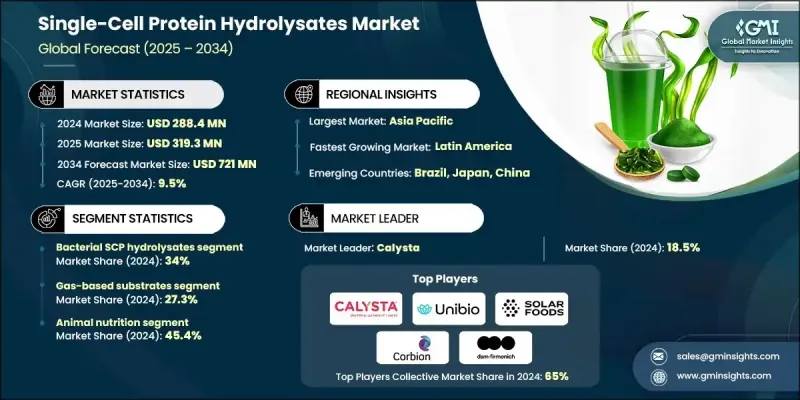
單細胞蛋白(SCP)水解物正成為永續蛋白質經濟的關鍵組成部分,這得益於其優異的消化率、豐富的氨基酸來源以及源自細菌、酵母、真菌和微藻等微生物的功能特性。 SCP的生產環境足跡小,通常利用廢棄物或氣基原料,使其在動物營養、人類食品和營養保健品領域極具吸引力。隨著全球蛋白質需求的成長和環境壓力的加劇,SCP水解物在水產養殖飼料、臨床營養和循環生物經濟策略中日益受到重視。 SCP水解物與循環系統的契合,特別是利用工業廢氣、有機殘渣和生質能衍生底物,有助於解決土地資源限制、減少排放和保障糧食安全等問題。這些因素正推動SCP水解物從新興技術走向廣泛應用的商業解決方案。
| 市場範圍 | |
|---|---|
| 起始年份 | 2024 |
| 預測年份 | 2025-2034 |
| 起始值 | 2.884億美元 |
| 預測值 | 7.21億美元 |
| 複合年成長率 | 9.5% |
2024年,細菌來源的單細胞蛋白水解物市佔率佔比達34%,預計到2034年將以8.9%的複合年成長率成長。由於生質能生成速度快、可擴展性強以及與氣基底物相容,細菌和酵母平台生產的水解物市場持續成長。它們被用於改善腸道功能,而酵母來源的水解物,特別是來自釀酒酵母屬的水解物,在寵物食品和風味增強劑領域也越來越常見。
動物營養領域在2024年佔據45.4%的市場佔有率,預計到2034年將以9.3%的複合年成長率成長。水產養殖業是成長的主要驅動力,這得益於單細胞蛋白(SCP)原料的穩定性和易消化性,為傳統的海洋蛋白提供了一種永續的替代方案。微生物蛋白供應商正在為不同物種量身定做解決方案,寵物食品行業的製造商正在添加酵母和細菌水解物以改善適口性和促進消化健康。畜牧業也在採用單細胞蛋白水解物來降低飼料成本並減少對傳統添加劑的依賴。
2024年美國單細胞蛋白水解物市場規模達7,030萬美元,預計2025年至2034年將以9.5%的複合年成長率成長。隨著許多創新者利用天然氣和工業副產品擴大單細胞蛋白水解物的生產,美國仍是飼料和營養應用領域規模化和技術進步的關鍵驅動力。
全球單細胞蛋白水解物市場的主要參與者包括Calysta、Unibio、Solar Foods、KnipBio、Quorn Foods、Arbiom、Corbion、DSM-Firmenich、Novozymes(現為Novonesis的一部分)、Angel Yeast、Lesaffre、Alltech、Nutreco和AlgaeCytes。這些企業正透過大規模發酵擴張、成本最佳化的生物加工以及先進的菌株工程來提升蛋白質產量和改善營養成分,從而鞏固其市場地位。許多公司正與飼料生產商和食品公司建立供應合作夥伴關係,以確保長期合約,同時根據特定物種的營養需求客製化水解物成分。永續發展承諾,包括使用廢棄物衍生原料和氣體驅動原料,正幫助企業脫穎而出,成為環保供應商。產品多元化、合規策略以及對臨床營養和功能性配方等高價值應用領域的投資,進一步鞏固了企業在全球市場的領先地位。
目錄
第1章:方法論與範圍
第2章:執行概要
第3章:行業洞察
- 產業生態系分析
- 供應商格局
- 利潤率
- 每個階段的價值增加
- 影響價值鏈的因素
- 中斷
- 產業影響因素
- 成長促進因素
- 對永續蛋白質的需求不斷成長
- 水產飼料應用領域的拓展
- 利用廢棄生質能進行循環生產
- 產業陷阱與挑戰
- 複雜的下游加工成本
- 新型成分的監理核准
- 市場機遇
- 二氧化碳發酵與電力製蛋白技術
- 運動和臨床營養領域的成長
- 成長促進因素
- 成長潛力分析
- 監管環境
- 北美洲
- 歐洲
- 亞太地區
- 拉丁美洲
- 中東和非洲
- 波特的分析
- PESTEL 分析
- 價格趨勢
- 按地區
- 依產品類型
- 未來市場趨勢
- 技術與創新格局
- 當前技術趨勢
- 新興技術
- 專利格局
- 貿易統計(HS編碼)(註:僅提供重點國家的貿易統計資料)
- 主要進口國
- 主要出口國
- 永續性和環境方面
- 永續實踐
- 減少廢棄物策略
- 生產中的能源效率
- 環保舉措
- 碳足跡考量
第4章:競爭格局
- 介紹
- 公司市佔率分析
- 按地區
- 北美洲
- 歐洲
- 亞太地區
- 拉丁美洲
- MEA
- 按地區
- 公司矩陣分析
- 主要市場參與者的競爭分析
- 競爭定位矩陣
- 關鍵進展
- 併購
- 合作夥伴關係與合作
- 新產品發布
- 擴張計劃
第5章:市場估算與預測:依來源/生物類型分類,2021-2034年
- 主要趨勢
- 細菌單細胞蛋白質水解物
- 甲烷氧化菌(例如,莢膜甲基球菌)
- 氫氧化細菌(例如 Cupriavidus necator)
- 自養菌(例如,產乙醇梭菌)
- 其他細菌(芽孢桿菌屬、乳酸桿菌屬、紫桿菌屬非硫桿菌屬)
- 酵母單細胞蛋白水解物
- 常規酵母(釀酒酵母、產朊假絲酵母)
- 甲基營養型酵母(畢赤酵母、解脂耶氏酵母)
- 其他酵母菌(克魯維酵母菌、紅酵母菌)
- 真菌單細胞蛋白質水解物
- 絲狀真菌(鐮刀菌、麴菌、根黴菌)
- 其他真菌(粗糙脈孢菌屬、木黴屬)
- 微藻和藍藻單細胞蛋白水解物
- 藍綠藻(螺旋藻屬)
- 綠藻(小球藻、柵藻)
- 其他微藻(擬球藻、眼蟲)
- 其他
第6章:市場估算與預測:依生產底物/原料分類,2021-2034年
- 主要趨勢
- 氣基基底
- 甲烷、甲醇、二氧化碳、氫氣
- 工業廢氣、生物瓦斯
- 碳水化合物底物
- 糖蜜、葡萄糖、澱粉水解物
- 食品加工廢料(乳清、果皮、釀酒廢料)
- 木質纖維素生質能和農業廢棄物
- 秸稈、甘蔗渣、木屑
- 廢亞硫酸鹽液
- 動物及工業副產品
- 魚禽糞便、糞肥
- 粗甘油,市政污水
- 其他
第7章:市場估計與預測:依應用領域分類,2021-2034年
- 主要趨勢
- 動物營養
- 水產飼料(魚、蝦)
- 牲畜飼料(家禽、豬、反芻動物)
- 寵物食品(狗糧、貓糧)
- 人類食品與營養保健品
- 蛋白質補充劑(運動、臨床、老年人)
- 功能性食品(飲料、能量棒、點心)
- 肉類和乳製品替代品
- 醫藥/營養保健品應用
- 生物活性胜肽(抗氧化劑、降血壓劑)
- 免疫與代謝健康
- 化妝品及工業用途
- 皮膚和頭髮護理活性成分
- 生物塑膠發酵、培養基
- 其他
第8章:市場估算與預測:依地區分類,2021-2034年
- 主要趨勢
- 北美洲
- 美國
- 加拿大
- 歐洲
- 德國
- 英國
- 法國
- 西班牙
- 義大利
- 歐洲其他地區
- 亞太地區
- 中國
- 印度
- 日本
- 澳洲
- 韓國
- 亞太其他地區
- 拉丁美洲
- 巴西
- 墨西哥
- 阿根廷
- 拉丁美洲其他地區
- 中東和非洲
- 沙烏地阿拉伯
- 南非
- 阿拉伯聯合大公國
- 中東和非洲其他地區
第9章:公司簡介
- Calysta
- Unibio
- Solar Foods
- KnipBio
- Quorn Foods
- Arbiom
- Corbion
- DSM-Firmenich
- Novozymes (Now part of Novonesis)
- Angel Yeast
- Lesaffre
- Alltech
- Nutreco
- AlgaeCytes
The Global Single-Cell Protein Hydrolysates Market was valued at USD 288.4 million in 2024 and is estimated to grow at a CAGR of 9.5% to reach USD 721 million by 2034.
Single-cell protein (SCP) hydrolysates are becoming a crucial component of the sustainable protein economy, supported by their strong digestibility, amino acid availability, and functional attributes derived from microbial sources such as bacteria, yeast, fungi, and microalgae. Their production is associated with a low environmental footprint, often relying on waste streams or gas-based feedstocks, which enhances their appeal across animal nutrition, human food applications, and nutraceuticals. As global protein requirements increase and environmental pressures intensify, SCP hydrolysates are gaining prominence in aquaculture diets, clinical nutrition, and circular bioeconomy strategies. Their alignment with circular systems, especially using industrial off-gases, organic residues, and biomass-derived substrates, helps address land constraints, emission reduction efforts, and food security priorities. These factors are moving SCP hydrolysates from emerging technologies into widely adopted commercial solutions.
| Market Scope | |
|---|---|
| Start Year | 2024 |
| Forecast Year | 2025-2034 |
| Start Value | $288.4 Million |
| Forecast Value | $721 Million |
| CAGR | 9.5% |
The bacterial SCP hydrolysates segment accounted for 34% in 2024 and is expected to grow at a CAGR of 8.9% by 2034. Hydrolysates produced from bacterial and yeast platforms continue to expand due to rapid biomass generation, strong scalability, and compatibility with gas-based substrates. They are used to enhance gut performance, while yeast-derived hydrolysates, particularly from Saccharomyces species, are becoming more common in pet food and flavor-enhancing applications.
The animal nutrition segment held a 45.4% share in 2024 and is projected to grow at a CAGR of 9.3% through 2034. Growth is led by aquaculture, driven by the stability and digestibility of SCP ingredients, offering a sustainable alternative to conventional marine-based proteins. Providers of microbial proteins are customizing solutions for various species, and manufacturers in the pet food sector are incorporating yeast and bacterial hydrolysates to improve palatability and digestive health. Livestock operations are also adopting SCP hydrolysates to lower feed expenses and reduce dependency on traditional additives.
U.S. Single-Cell Protein Hydrolysates Market reached USD 70.3 million in 2024 and is anticipated to register a CAGR of 9.5% from 2025 to 2034. With multiple innovators expanding SCP hydrolysate production using natural gas and industrial co-products, the United States remains a key driver of scale-up and technological advancement across feed and nutrition applications.
Major companies participating in the Global Single-Cell Protein Hydrolysates Market include Calysta, Unibio, Solar Foods, KnipBio, Quorn Foods, Arbiom, Corbion, DSM-Firmenich, Novozymes (now part of Novonesis), Angel Yeast, Lesaffre, Alltech, Nutreco, and AlgaeCytes. Companies competing in this market are strengthening their positions through large-scale fermentation expansion, cost-optimized bioprocessing, and advanced strain engineering to boost protein yields and enhance nutrient profiles. Many firms are forming supply partnerships with feed manufacturers and food companies to secure long-term contracts while tailoring hydrolysate compositions for species-specific nutritional needs. Sustainability commitments, including the use of waste-derived and gas-fed feedstocks, are helping companies stand out as environmentally aligned suppliers. Product diversification, regulatory compliance strategies, and investments in high-value applications such as clinical nutrition and functional formulations are further supporting stronger global market footholds.
Table of Contents
Chapter 1 Methodology & Scope
- 1.1 Market scope and definition
- 1.2 Research design
- 1.2.1 Research approach
- 1.2.2 Data collection methods
- 1.3 Data mining sources
- 1.3.1 Global
- 1.3.2 Regional/Country
- 1.4 Base estimates and calculations
- 1.4.1 Base year calculation
- 1.4.2 Key trends for market estimation
- 1.5 Primary research and validation
- 1.5.1 Primary sources
- 1.6 Forecast model
- 1.7 Research assumptions and limitations
Chapter 2 Executive Summary
- 2.1 Industry 3600 synopsis
- 2.2 Key market trends
- 2.2.1 Regional
- 2.2.2 Source / Organism Type
- 2.2.3 Production Substrate / Feedstock
- 2.2.4 Application
- 2.3 TAM Analysis, 2025-2034
- 2.4 CXO perspectives: Strategic imperatives
- 2.4.1 Executive decision points
- 2.4.2 Critical success factors
- 2.5 Future Outlook and Strategic Recommendations
Chapter 3 Industry Insights
- 3.1 Industry ecosystem analysis
- 3.1.1 Supplier landscape
- 3.1.2 Profit margin
- 3.1.3 Value addition at each stage
- 3.1.4 Factor affecting the value chain
- 3.1.5 Disruptions
- 3.2 Industry impact forces
- 3.2.1 Growth drivers
- 3.2.1.1 Rising demand for sustainable proteins
- 3.2.1.2 Expansion in aquafeed applications
- 3.2.1.3 Circular production using waste biomass
- 3.2.2 Industry pitfalls and challenges
- 3.2.2.1 Complex downstream processing costs
- 3.2.2.2 Regulatory approvals for novel ingredients
- 3.2.3 Market opportunities
- 3.2.3.1 CO2 fermentation and power-to-protein tech
- 3.2.3.2 Growth in sports and clinical nutrition
- 3.2.1 Growth drivers
- 3.3 Growth potential analysis
- 3.4 Regulatory landscape
- 3.4.1 North America
- 3.4.2 Europe
- 3.4.3 Asia Pacific
- 3.4.4 Latin America
- 3.4.5 Middle East & Africa
- 3.5 Porter's analysis
- 3.6 PESTEL analysis
- 3.7 Price trends
- 3.7.1 By region
- 3.7.2 By Product type
- 3.8 Future market trends
- 3.9 Technology and Innovation landscape
- 3.9.1 Current technological trends
- 3.9.2 Emerging technologies
- 3.10 Patent Landscape
- 3.11 Trade statistics (HS code) ( Note: the trade statistics will be provided for key countries only)
- 3.11.1 Major importing countries
- 3.11.2 Major exporting countries
- 3.12 Sustainability and environmental aspects
- 3.12.1 Sustainable practices
- 3.12.2 Waste reduction strategies
- 3.12.3 Energy efficiency in production
- 3.12.4 Eco-friendly initiatives
- 3.13 Carbon footprint consideration
Chapter 4 Competitive Landscape, 2024
- 4.1 Introduction
- 4.2 Company market share analysis
- 4.2.1 By region
- 4.2.1.1 North America
- 4.2.1.2 Europe
- 4.2.1.3 Asia Pacific
- 4.2.1.4 LATAM
- 4.2.1.5 MEA
- 4.2.1 By region
- 4.3 Company matrix analysis
- 4.4 Competitive analysis of major market players
- 4.5 Competitive positioning matrix
- 4.6 Key developments
- 4.6.1 Mergers & acquisitions
- 4.6.2 Partnerships & collaborations
- 4.6.3 New Product Launches
- 4.6.4 Expansion Plans
Chapter 5 Market Estimates and Forecast, By Source / Organism Type, 2021-2034 (USD Million) (Kilo Tons)
- 5.1 Key trends
- 5.2 Bacterial SCP Hydrolysates
- 5.2.1 Methanotrophs (e.g., Methylococcus capsulatus)
- 5.2.2 Hydrogen-Oxidizing Bacteria (e.g., Cupriavidus necator)
- 5.2.3 Autotrophic Bacteria (e.g., Clostridium autoethanogenum)
- 5.2.4 Other Bacteria (Bacillus, Lactobacillus, Purple Non-Sulfur)
- 5.3 Yeast SCP Hydrolysates
- 5.3.1 Conventional Yeasts (Saccharomyces cerevisiae, Candida utilis)
- 5.3.2 Methylotrophic Yeasts (Pichia pastoris, Yarrowia lipolytica)
- 5.3.3 Other Yeasts (Kluyveromyces, Rhodotorula)
- 5.4 Fungal SCP Hydrolysates
- 5.4.1 Filamentous Fungi (Fusarium, Aspergillus, Rhizopus)
- 5.4.2 Other Fungi (Neurospora, Trichoderma)
- 5.5 Microalgae & Cyanobacteria SCP Hydrolysates
- 5.5.1 Cyanobacteria (Spirulina species)
- 5.5.2 Green Microalgae (Chlorella, Scenedesmus)
- 5.5.3 Other Microalgae (Nannochloropsis, Euglena)
- 5.6 Others
Chapter 6 Market Estimates and Forecast, By Production Substrate / Feedstock, 2021-2034 (USD Million) (Kilo Tons)
- 6.1 Key trends
- 6.2 Gas-Based Substrates
- 6.2.1 Methane, Methanol, CO2, H2
- 6.2.2 Industrial off-gas, Biogas
- 6.3 Carbohydrate-Based Substrates
- 6.3.1 Molasses, Glucose, Starch Hydrolysates
- 6.3.2 Food Processing Waste (whey, peels, brewery waste)
- 6.4 Lignocellulosic Biomass & Agricultural Waste
- 6.4.1 Straw, Bagasse, Wood Residues
- 6.4.2 Spent Sulphite Liquor
- 6.5 Animal & Industrial Byproducts
- 6.5.1 Fish/Poultry Waste, Manure
- 6.5.2 Crude Glycerol, Municipal Wastewater
- 6.6 Others
Chapter 7 Market Estimates and Forecast, By Application, 2021-2034 (USD Million) (Kilo Tons)
- 7.1 Key trends
- 7.2 Animal Nutrition
- 7.2.1 Aquafeed (fish, shrimp)
- 7.2.2 Livestock Feed (poultry, swine, ruminants)
- 7.2.3 Pet Food (dogs, cats)
- 7.3 Human Food & Nutraceuticals
- 7.3.1 Protein Supplements (sports, clinical, elderly)
- 7.3.2 Functional Foods (beverages, bars, snacks)
- 7.3.3 Meat & Dairy Alternatives
- 7.4 Pharmaceutical/Nutraceutical Applications
- 7.4.1 Bioactive Peptides (antioxidant, antihypertensive)
- 7.4.2 Immune & Metabolic Health
- 7.5 Cosmetic & Industrial Uses
- 7.5.1 Skin & Hair Care Bioactives
- 7.5.2 Bioplastic Fermentation, Culture Media
- 7.6 Others
Chapter 8 Market Estimates and Forecast, By Region, 2021-2034 (USD Million) (Kilo Tons)
- 8.1 Key trends
- 8.2 North America
- 8.2.1 U.S.
- 8.2.2 Canada
- 8.3 Europe
- 8.3.1 Germany
- 8.3.2 UK
- 8.3.3 France
- 8.3.4 Spain
- 8.3.5 Italy
- 8.3.6 Rest of Europe
- 8.4 Asia Pacific
- 8.4.1 China
- 8.4.2 India
- 8.4.3 Japan
- 8.4.4 Australia
- 8.4.5 South Korea
- 8.4.6 Rest of Asia Pacific
- 8.5 Latin America
- 8.5.1 Brazil
- 8.5.2 Mexico
- 8.5.3 Argentina
- 8.5.4 Rest of Latin America
- 8.6 Middle East and Africa
- 8.6.1 Saudi Arabia
- 8.6.2 South Africa
- 8.6.3 UAE
- 8.6.4 Rest of Middle East and Africa
Chapter 9 Company Profiles
- 9.1 Calysta
- 9.2 Unibio
- 9.3 Solar Foods
- 9.4 KnipBio
- 9.5 Quorn Foods
- 9.6 Arbiom
- 9.7 Corbion
- 9.8 DSM-Firmenich
- 9.9 Novozymes (Now part of Novonesis)
- 9.10 Angel Yeast
- 9.11 Lesaffre
- 9.12 Alltech
- 9.13 Nutreco
- 9.14 AlgaeCytes

 蛋白質水解物市場規模、佔有率及成長分析(依產品類型、形態類型、應用類型及地區分類)-2026-2033年產業預測
 全球蛋白質水解物市場規模、佔有率、趨勢和成長分析報告(2026-2034)
 有機蛋白水解物市場機會、成長促進因素、產業趨勢分析及預測(2025-2034年)精準發酵法製備蛋白水解物市場機會、成長促進因素、產業趨勢分析及預測(2025-2034年)老年營養蛋白水解物市場機會、成長促進因素、產業趨勢分析及預測(2025-2034年)下一代蛋白質水解物市場機會、成長促進因素、產業趨勢分析及預測(2025-2034)
 蛋白質水解物市場-全球產業規模、佔有率、趨勢、機會和預測,按類型、來源、形態、製程、應用、地區和競爭格局分類,2020-2030年預測非基因改造蛋白水解物市場機會、成長促進因素、產業趨勢分析及預測(2025-2034年)食品廢棄物衍生蛋白水解物市場機會、成長促進因素、產業趨勢分析及預測(2025-2034年)噴霧乾燥蛋白水解物市場機會、成長促進因素、產業趨勢分析及預測(2025-2034年)