


 |
市場調查報告書
商品編碼
1885813
腎臟飲食蛋白水解物市場機會、成長促進因素、產業趨勢分析及預測(2025-2034年)Renal Diet Protein Hydrolysates Market Opportunity, Growth Drivers, Industry Trend Analysis, and Forecast 2025 - 2034 |
||||||

2024 年全球腎臟飲食蛋白水解物市場價值為 72 億美元,預計到 2034 年將以 7.5% 的複合年成長率成長至 149 億美元。
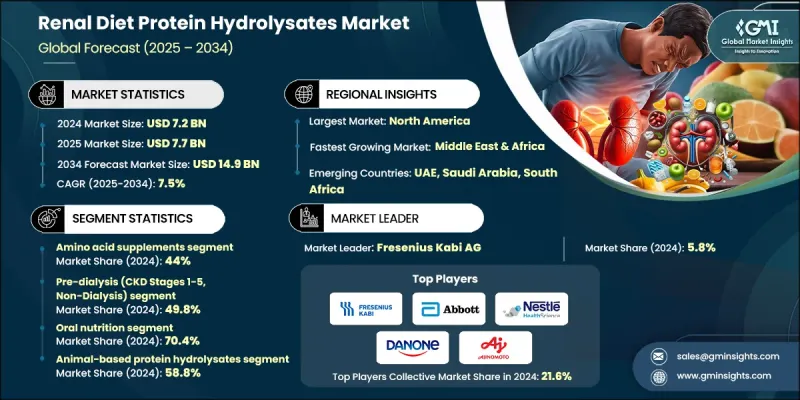
這一成長主要受全球慢性腎臟病負擔加重以及人們對腎臟護理中特殊營養重要性認知不斷提高的推動。醫療保健系統越來越重視蛋白質管理以支持腎功能,從而推動了對水解蛋白解決方案的需求,這類解決方案更易於加工,並能以更小的腎臟負擔輸送必需營養素。全球人口老化也顯著促進了這一成長,因為與年齡相關的腎臟疾病日益普遍。研究不斷強調蛋白質水解物在為腎功能受損患者提供標靶營養方面的臨床益處。隨著早期檢測和個人化飲食干預的普及,預計對這些特殊配方的需求將進一步增強。酵素水解技術的改進提高了產品的一致性和生產效率,從而增加了全球供應量。不斷成長的醫療保健支出以及對經濟有效的營養療法以幫助延緩疾病進展的需求,進一步鞏固了市場的長期前景。
| 市場範圍 | |
|---|---|
| 起始年份 | 2024 |
| 預測年份 | 2025-2034 |
| 起始值 | 72億美元 |
| 預測值 | 149億美元 |
| 複合年成長率 | 7.5% |
胺基酸補充劑市場在2024年佔據44%的市場佔有率,預計到2034年將以7.5%的複合年成長率成長。這些補充劑在滿足慢性腎臟病患者的營養需求方面發揮關鍵作用,同時最大限度地減少與攝取完整蛋白質相關的併發症。客製化的胺基酸配方對於遵循低蛋白飲食的患者至關重要,而配方科學的不斷進步有望提高吸收率和精準輸送營養。
透析前族群(涵蓋慢性腎臟病1-5期,即非透析患者)在2024年佔據了49.8%的市場佔有率,預計2025年至2034年將以7.4%的複合年成長率成長。此細分市場規模最大,主要原因是大量患者在進入透析階段前需要早期營養介入。隨著指南不斷強調控制蛋白質攝取以延緩腎功能惡化,對特製水解蛋白產品的需求預計將保持強勁。
2024年,北美腎臟營養蛋白水解物市佔率達到35.3%。該地區受益於先進的醫療保健體系、完善的醫療保險報銷機制以及較高的慢性腎臟病發病率。醫療營養產品的廣泛應用和健全的膳食管理臨床框架是其在該領域保持領先地位的重要因素。
腎臟營養蛋白水解物市場的主要企業包括費森尤斯卡比股份公司 (Fresenius Kabi AG)、雅培實驗室 (Abbott Laboratories)、雀巢健康科學 (Nestle Health Science)、達能紐迪希亞 (Danone Nutricia)、味之素株式會社 (Ajino B., Bjinomoto Co.)、貝特朗迪醫療 (B. Braunfolgen)、Gunfolgen SAs、G. (Baxter/Vantive)、阿旃陀製藥有限公司 (Ajanta Pharma Limited) 和曼金製藥有限公司 (Mankind Pharma Ltd.)。這些企業採取多種策略來增強其競爭優勢。許多企業致力於開發生物利用度更高的配方,採用先進的酵素工藝,以提高營養吸收率並最大限度地減少腎臟的代謝負荷。拓展針對不同慢性腎臟病 (CKD) 階段的產品組合,有助於品牌接觸到更廣泛的患者群。對臨床研究的投資支持實證營養解決方案的開發,並改善醫生的推薦建議。企業與醫療保健提供者和營養師合作,以提高醫用營養產品的普及率。透過合作、分銷網路和本地化生產進行地域擴張,增強了市場可及性。
目錄
第1章:方法論與範圍
第1章:執行概要
第2章:行業洞察
- 產業生態系分析
- 供應商格局
- 利潤率
- 每個階段的價值增加
- 影響價值鏈的因素
- 中斷
- 產業影響因素
- 成長促進因素
- 慢性腎臟病盛行率上升和人口老化
- 支持植物性蛋白質水解物的臨床證據
- 酶水解技術進步
- 產業陷阱與挑戰
- 生產成本高且監管複雜
- 特定水解物的臨床證據有限
- 市場機遇
- 個人化營養與精準醫療
- 植物性創新與永續性
- 成長促進因素
- 成長潛力分析
- 監管環境
- 北美洲
- 歐洲
- 亞太地區
- 拉丁美洲
- 中東和非洲
- 波特的分析
- PESTEL 分析
- 價格趨勢
- 按地區
- 依產品類型
- 未來市場趨勢
- 技術與創新格局
- 當前技術趨勢
- 新興技術
- 專利格局
- 貿易統計(HS編碼)(註:僅提供重點國家的貿易統計資料)
- 主要進口國
- 主要出口國
- 永續性和環境方面
- 永續實踐
- 減少廢棄物策略
- 生產中的能源效率
- 環保舉措
- 碳足跡考量
第3章:競爭格局
- 介紹
- 公司市佔率分析
- 按地區
- 北美洲
- 歐洲
- 亞太地區
- 拉丁美洲
- MEA
- 按地區
- 公司矩陣分析
- 主要市場參與者的競爭分析
- 競爭定位矩陣
- 關鍵進展
- 併購
- 合作夥伴關係與合作
- 新產品發布
- 擴張計劃
第4章:市場估算與預測:依產品類型分類,2021-2034年
- 主要趨勢
- 胺基酸補充劑
- α-酮類似物
- 支鏈胺基酸(BCAAs)
- 完全蛋白質水解物
- 維生素和礦物質補充劑
- 水溶性維生素
- 維生素D類似物
- 受控礦物配方
- 礦物質補充劑
- 鐵補充劑
- 鈣基產品
- 限磷配方
- 益生菌
- 單菌株配方
- 多菌株組合
- 益生菌產品
第5章:市場估算與預測:依CKD階段分類,2021-2034年
- 主要趨勢
- 透析前(CKD 1-5期,非透析)
- 早期慢性腎臟病(1-2期)
- 中度慢性腎病(3期)
- 晚期慢性腎臟病(4-5期)
- 血液透析患者
- 傳統血液透析
- 高通量血液透析
- 血液透析濾過
- 腹膜透析患者
- 持續性非臥床腹膜透析(CAPD)
- 自動腹膜透析(APD)
- 末期腎病(ESRD)
- 移植前患者
- 保守管理
- 急性腎損傷(AKI)恢復
第6章:市場估算與預測:依管理模式分類,2021-2034年
- 主要趨勢
- 口服營養
- 即飲配方
- 粉狀補充劑
- 固體劑型
- 腸內營養
- 管飼配方
- 口服營養補充品(ONS)
- 模組化產品
- 腸外營養
- 全腸外營養(TPN)
- 周邊腸外營養(PPN)
第7章:市場估算與預測:依蛋白質來源分類,2021-2034年
- 主要趨勢
- 動物性蛋白質水解物
- 乳清蛋白水解物
- 酪蛋白水解物
- 蛋清蛋白水解物
- 魚蛋白水解物
- 植物性蛋白質水解物
- 豌豆蛋白水解物
- 大豆蛋白水解物
- 米蛋白水解物
- 大麻蛋白水解物
第8章:市場估算與預測:依地區分類,2021-2034年
- 主要趨勢
- 北美洲
- 美國
- 加拿大
- 歐洲
- 德國
- 英國
- 法國
- 西班牙
- 義大利
- 歐洲其他地區
- 亞太地區
- 中國
- 印度
- 日本
- 澳洲
- 韓國
- 亞太其他地區
- 拉丁美洲
- 巴西
- 墨西哥
- 阿根廷
- 拉丁美洲其他地區
- 中東和非洲
- 沙烏地阿拉伯
- 南非
- 阿拉伯聯合大公國
- 中東和非洲其他地區
第9章:公司簡介
- Fresenius Kabi AG
- Abbott Laboratories
- Nestle Health Science
- Danone Nutricia
- Ajinomoto Co.
- B. Braun Melsungen
- Grifols SA
- Baxter/Vantive
- Ajanta Pharma Limited
- Mankind Pharma Ltd.
The Global Renal Diet Protein Hydrolysates Market was valued at USD 7.2 billion in 2024 and is estimated to grow at a CAGR of 7.5% to reach USD 14.9 billion by 2034.
This growth is driven by the increasing global burden of chronic kidney disease and rising awareness of the importance of specialized nutrition in kidney care. Healthcare systems are placing greater emphasis on protein management to support kidney function, pushing demand for hydrolyzed protein solutions that are easier to process and deliver essential nutrients with reduced strain on the kidneys. An aging global population has also contributed significantly, as age-related kidney conditions become more widespread. Research continues to highlight the clinical benefits of protein hydrolysates in providing targeted nutrition for kidney-impaired individuals. With early detection and personalized dietary interventions gaining traction, demand for these specialized formulations is expected to intensify. Improvements in enzymatic hydrolysis technologies have enhanced product consistency and production efficiency, increasing availability worldwide. Rising healthcare expenditures and the need for cost-effective nutritional therapies to help slow disease progression further reinforce the market's long-term outlook.
| Market Scope | |
|---|---|
| Start Year | 2024 |
| Forecast Year | 2025-2034 |
| Start Value | $7.2 Billion |
| Forecast Value | $14.9 Billion |
| CAGR | 7.5% |
The amino acid supplements segment held a 44% share in 2024 and is projected to grow at a CAGR of 7.5% through 2034. These supplements play a key role in meeting nutrient requirements for individuals with chronic kidney disease while minimizing the complications associated with intact protein intake. Tailored amino acid formulations are essential for patients following protein-limited diets, and ongoing progress in formulation science is expected to support better absorption and precise nutrient delivery.
The pre-dialysis category, covering CKD Stages 1-5 (non-dialysis), accounted for a 49.8% share in 2024 and is anticipated to grow at a CAGR of 7.4% from 2025 to 2034. This segment is the largest due to the substantial number of patients who require early nutritional intervention before reaching dialysis. As guidelines continue to emphasize controlled protein intake to slow kidney deterioration, demand for specialized hydrolysate-based products is expected to remain strong.
North America Renal Diet Protein Hydrolysates Market held a 35.3% share in 2024. The region benefits from advanced healthcare systems, established reimbursement structures, and a high incidence of chronic kidney disease. Widespread adoption of medical nutrition products and strong clinical frameworks for dietary management contribute significantly to regional leadership.
Key companies in the Renal Diet Protein Hydrolysates Market include Fresenius Kabi AG, Abbott Laboratories, Nestle Health Science, Danone Nutricia, Ajinomoto Co., B. Braun Melsungen, Grifols S.A., Baxter/Vantive, Ajanta Pharma Limited, and Mankind Pharma Ltd. Companies operating in the Renal Diet Protein Hydrolysates Market follow several strategies to strengthen their competitive position. Many focus on developing more bioavailable formulations using advanced enzymatic processes that improve nutrient absorption and minimize metabolic load on the kidneys. Expanding product portfolios tailored to different CKD stages helps brands reach a broader patient base. Investments in clinical research support evidence-backed nutritional solutions and improve physician recommendations. Firms collaborate with healthcare providers and dietitians to increase the adoption of medical nutrition products. Geographic expansion through partnerships, distribution networks, and localized manufacturing enhances market accessibility.
Table of Contents
Chapter 1 Methodology & Scope
- 1.1 Market scope and definition
- 1.2 Research design
- 1.2.1 Research approach
- 1.2.2 Data collection methods
- 1.3 Data mining sources
- 1.3.1 Global
- 1.3.2 Regional/Country
- 1.4 Base estimates and calculations
- 1.4.1 Base year calculation
- 1.4.2 Key trends for market estimation
- 1.5 Primary research and validation
- 1.5.1 Primary sources
- 1.6 Forecast model
- 1.7 Research assumptions and limitations
Chapter 1 Executive Summary
- 2.1 Industry 3600 synopsis
- 2.2 Key market trends
- 2.2.1 Regional trends
- 2.2.2 Product type trends
- 2.2.3 CKD stage trends
- 2.2.4 Administration mode trends
- 2.2.5 Protein source trends
- 2.3 TAM Analysis, 2025-2034
- 2.4 CXO perspectives: Strategic imperatives
- 2.4.1 Executive decision points
- 2.4.2 Critical success factors
- 2.5 Future Outlook and Strategic Recommendations
Chapter 2 Industry Insights
- 3.1 Industry ecosystem analysis
- 3.1.1 Supplier landscape
- 3.1.2 Profit margin
- 3.1.3 Value addition at each stage
- 3.1.4 Factor affecting the value chain
- 3.1.5 Disruptions
- 3.2 Industry impact forces
- 3.2.1 Growth drivers
- 3.2.1.1 Rising CKD prevalence & aging demographics
- 3.2.1.2 Clinical evidence supporting plant-based protein hydrolysates
- 3.2.1.3 Technological advances in enzymatic hydrolysis
- 3.2.2 Industry pitfalls and challenges
- 3.2.2.1 High production costs & regulatory complexity
- 3.2.2.2 Limited clinical evidence for specific hydrolysates
- 3.2.3 Market opportunities
- 3.2.3.1 Personalized nutrition & precision medicine
- 3.2.3.2 Plant-based innovation & sustainability
- 3.2.1 Growth drivers
- 3.3 Growth potential analysis
- 3.4 Regulatory landscape
- 3.4.1 North America
- 3.4.2 Europe
- 3.4.3 Asia Pacific
- 3.4.4 Latin America
- 3.4.5 Middle East & Africa
- 3.5 Porter's analysis
- 3.6 PESTEL analysis
- 3.7 Price trends
- 3.7.1 By region
- 3.7.2 By product type
- 3.8 Future market trends
- 3.9 Technology and Innovation landscape
- 3.9.1 Current technological trends
- 3.9.2 Emerging technologies
- 3.10 Patent Landscape
- 3.11 Trade statistics (HS code) (Note: the trade statistics will be provided for key countries only)
- 3.11.1 Major importing countries
- 3.11.2 Major exporting countries
- 3.12 Sustainability and environmental aspects
- 3.12.1 Sustainable practices
- 3.12.2 Waste reduction strategies
- 3.12.3 Energy efficiency in production
- 3.12.4 Eco-friendly initiatives
- 3.13 Carbon footprint consideration
Chapter 3 Competitive Landscape, 2024
- 4.1 Introduction
- 4.2 Company market share analysis
- 4.2.1 By region
- 4.2.1.1 North America
- 4.2.1.2 Europe
- 4.2.1.3 Asia Pacific
- 4.2.1.4 LATAM
- 4.2.1.5 MEA
- 4.2.1 By region
- 4.3 Company matrix analysis
- 4.4 Competitive analysis of major market players
- 4.5 Competitive positioning matrix
- 4.6 Key developments
- 4.6.1 Mergers & acquisitions
- 4.6.2 Partnerships & collaborations
- 4.6.3 New Product Launches
- 4.6.4 Expansion Plans
Chapter 4 Market Estimates and Forecast, By Product Type, 2021-2034 (USD Billion) (Kilo Tons)
- 5.1 Key trends
- 5.2 Amino acid supplements
- 5.2.1 Alpha-ketoanalogues
- 5.2.2 Branched-chain amino acids (BCAAS)
- 5.2.3 Complete protein hydrolysates
- 5.3 Vitamin & mineral supplements
- 5.3.1 Water-soluble vitamins
- 5.3.2 Vitamin D analogues
- 5.3.3 Controlled mineral formulations
- 5.4 Mineral supplements
- 5.4.1 Iron supplements
- 5.4.2 Calcium-based products
- 5.4.3 Phosphorus-restricted formulations
- 5.5 Probiotics
- 5.5.1 Single-strain formulations
- 5.5.2 Multi-strain combinations
- 5.5.3 Synbiotic products
Chapter 5 Market Estimates and Forecast, By CKD Stage, 2021-2034 (USD Billion) (Kilo Tons)
- 6.1 Key trends
- 6.2 Pre-dialysis (CKD stages 1-5, non-dialysis)
- 6.2.1 Early-stage CKD (stages 1-2)
- 6.2.2 Moderate CKD (stage 3)
- 6.2.3 Advanced CKD (stages 4-5)
- 6.3 Hemodialysis patients
- 6.3.1 Conventional hemodialysis
- 6.3.2 High-flux hemodialysis
- 6.3.3 Hemodiafiltration
- 6.4 Peritoneal dialysis patients
- 6.4.1 Continuous ambulatory peritoneal dialysis (CAPD)
- 6.4.2 Automated peritoneal dialysis (APD)
- 6.5 End-stage renal disease (ESRD)
- 6.5.1 Pre-transplant patients
- 6.5.2 Conservative management
- 6.5.3 Acute kidney injury (AKI) recovery
Chapter 6 Market Estimates and Forecast, By Administration Mode, 2021-2034 (USD Billion) (Kilo Tons)
- 7.1 Key trends
- 7.2 Oral nutrition
- 7.2.1 Ready-to-drink formulations
- 7.2.2 Powder supplements
- 7.2.3 Solid dosage forms
- 7.3 Enteral nutrition
- 7.3.1 Tube feeding formulations
- 7.3.2 Oral nutritional supplements (ONS)
- 7.3.3 Modular products
- 7.4 Parenteral nutrition
- 7.4.1 Total parenteral nutrition (TPN)
- 7.4.2 Peripheral parenteral nutrition (PPN)
Chapter 7 Market Estimates and Forecast, By Protein Source, 2021-2034 (USD Billion) (Kilo Tons)
- 8.1 Key trends
- 8.2 Animal-based protein hydrolysates
- 8.2.1 Whey protein hydrolysates
- 8.2.2 Casein hydrolysates
- 8.2.3 Egg white protein hydrolysates
- 8.2.4 Fish protein hydrolysates
- 8.3 Plant-based protein hydrolysates
- 8.3.1 Pea protein hydrolysates
- 8.3.2 Soy protein hydrolysates
- 8.3.3 Rice protein hydrolysates
- 8.3.4 Hemp protein hydrolysates
Chapter 8 Market Estimates and Forecast, By Region, 2021-2034 (USD Billion) (Kilo Tons)
- 9.1 Key trends
- 9.2 North America
- 9.2.1 U.S.
- 9.2.2 Canada
- 9.3 Europe
- 9.3.1 Germany
- 9.3.2 UK
- 9.3.3 France
- 9.3.4 Spain
- 9.3.5 Italy
- 9.3.6 Rest of Europe
- 9.4 Asia Pacific
- 9.4.1 China
- 9.4.2 India
- 9.4.3 Japan
- 9.4.4 Australia
- 9.4.5 South Korea
- 9.4.6 Rest of Asia Pacific
- 9.5 Latin America
- 9.5.1 Brazil
- 9.5.2 Mexico
- 9.5.3 Argentina
- 9.5.4 Rest of Latin America
- 9.6 Middle East and Africa
- 9.6.1 Saudi Arabia
- 9.6.2 South Africa
- 9.6.3 UAE
- 9.6.4 Rest of Middle East and Africa
Chapter 9 Company Profiles
- 10.1 Fresenius Kabi AG
- 10.2 Abbott Laboratories
- 10.3 Nestle Health Science
- 10.4 Danone Nutricia
- 10.5 Ajinomoto Co.
- 10.6 B. Braun Melsungen
- 10.7 Grifols S.A.
- 10.8 Baxter/Vantive
- 10.9 Ajanta Pharma Limited
- 10.10 Mankind Pharma Ltd.

 有機蛋白水解物市場機會、成長促進因素、產業趨勢分析及預測(2025-2034年)單細胞蛋白水解物市場機會、成長促進因素、產業趨勢分析及預測(2025-2034年)精準發酵法製備蛋白水解物市場機會、成長促進因素、產業趨勢分析及預測(2025-2034年)老年營養蛋白水解物市場機會、成長促進因素、產業趨勢分析及預測(2025-2034年)下一代蛋白質水解物市場機會、成長促進因素、產業趨勢分析及預測(2025-2034)
 蛋白質水解物市場-全球產業規模、佔有率、趨勢、機會和預測,按類型、來源、形態、製程、應用、地區和競爭格局分類,2020-2030年預測非基因改造蛋白水解物市場機會、成長促進因素、產業趨勢分析及預測(2025-2034年)食品廢棄物衍生蛋白水解物市場機會、成長促進因素、產業趨勢分析及預測(2025-2034年)噴霧乾燥蛋白水解物市場機會、成長促進因素、產業趨勢分析及預測(2025-2034年)發酵蛋白水解物市場機會、成長促進因素、產業趨勢分析及預測(2025-2034年)