


 |
市場調查報告書
商品編碼
2154268
美國礦業機械:市場佔有率分析、產業趨勢與統計、成長預測(2026-2031)United States Mining Equipment - Market Share Analysis, Industry Trends & Statistics, Growth Forecasts (2026 - 2031) |
||||||

※ 本網頁內容可能與最新版本有所差異。詳細情況請與我們聯繫。
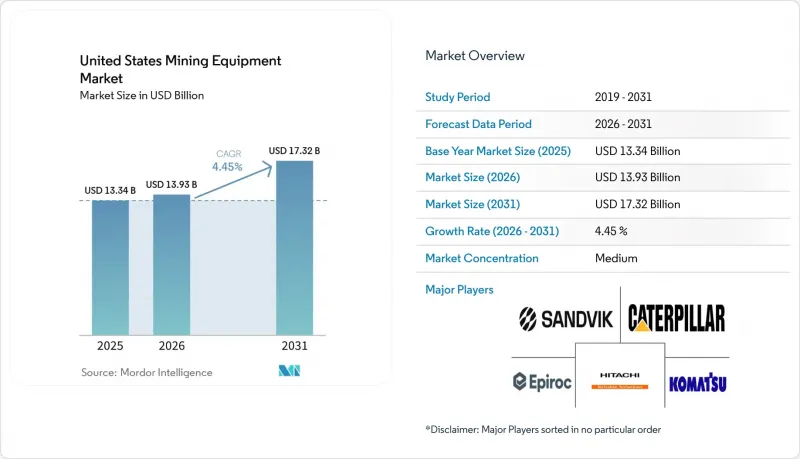
根據 Mordor Intelligence 的數據顯示,2025 年美國採礦設備市值為 133.4 億美元,預計 2026 年將達到 139.3 億美元。預計從 2026 年到 2031 年,該市場將以 4.45% 的複合年成長率成長,到 2031 年將達到 173.2 億美元。
美國礦業機械市場趨勢與洞察
重要礦產項目激增
預計未來幾年,Lithium Americas的「Sucker Pass」、Ionia的「Ryolite Ridge」以及USA Rare Earth的「Round Top」專案將獲得大規模設備訂單。由於內華達州擁有大量已開發的鋰礦床,Caterpillar和日本小松公司都在Elco和Reno策略性地維持了庫存。美國能源局(DOE)的大規模煤炭廢棄物回收計畫正在推動移動式破碎機和分離器的應用,以提高低品位原料的價值。山特維克在South32項目部署電池驅動的鑽探和運輸設備,凸顯了其在新隧道建設中實現零排放的承諾。雖然區域集群為經銷商的產能帶來了挑戰,但也提高了OEM製造商的售後市場收入密度。
老舊車隊的穩定更新換代
2025年,露天礦用卡車的平均使用壽命達到關鍵節點,維護成本超過了其殘值。粉河盆地的煤炭業者正根據預計的產量下降情況,用更小、更節能的車型替換超大型卡車。在亞利桑那州,金屬礦商正在逐步淘汰柴油挖土機,取而代之的是符合45X條款稅額扣抵的電動挖土機。小松公司計劃於2026年推出的D61PXi-25推土機配備了內建坡度控制系統,可大幅減少返工。在熟練操作員稀缺的市場中,這是一項至關重要的優勢。 2020年代初期被推遲的訂單現在正轉化為大規模採購,從而推動了美國礦業設備市場的蓬勃發展。
金屬價格波動週期
世界銀行預測,到2026年工業金屬價格將大幅上漲,但歷史趨勢表明,此類價格波動,尤其是短期波動,很少能帶來持續的設備擴張。例如,銅價暴跌會延長設備貸款的償還期限,從而有效抑制非強制性訂單。與此同時,融資緊張的中小型礦業公司正在推遲設備升級。這種情況迫使原始設備製造商(OEM)適應庫存波動。雖然大型公司可以透過目的地計畫來減輕影響,但這些計畫對在推動小型鑽機需求方面發揮關鍵作用的中小型探勘公司幾乎沒有幫助。因此,美國礦業設備市場呈現鋸齒狀的波動,而非平穩的走勢。
細分市場分析
2025年,露天銅礦、金礦和煤礦的露天鑽機將占美國礦業設備市場佔有率的45.23%。同時,由電力驅動的鑽機和破碎機以及用於降低通風負荷的自主鑽機預計到2031年將實現5.48%的複合年成長率。山特維克與South32公司簽訂的價值7.5億瑞典克朗(約7,860萬美元)的合約是美國歷史上最大的地下電池電動車(BEV)交易,這表明人們對零排放裝載機的信心日益增強。用於處理煤炭廢棄物的移動式破碎機和分類機正獲得美國能源局(DOE)的支持,這進一步擴大了這一細分市場的成長潛力。
原始設備製造商預計混合動力設備及相關裝置的需求將持續成長。日本小松公司的D175AX-10推土機配備了坡度控制系統,可在勞動力短缺的情況下減少返工。日立的EH4000AC-5卡車在超大型礦場中對Caterpillar的797卡車構成挑戰,加劇了價格競爭,同時也拓展了市場選擇。因此,美國礦業設備市場在現有露天礦設備和機械電氣化驅動的快速成長之間保持平衡。
到2025年,內燃機驅動的挖土機將佔總銷售量的67.71%,這反映了柴油液壓車隊的普及和更短的加油週期。然而,電動挖土機的年複合成長率(CAGR)為5.47%,通風成本的降低將在五年內抵消價格差異。 Epiroc的ST10 G裝載機可在3.5小時內充滿電,無需備用設備。日本小松公司的WX04B配備可在10分鐘內更換的電池組,緩解了續航里程的擔憂,其拖車輔助功能可將電池重量減輕40%。
第 45X 條款稅額扣抵直接津貼動力傳動系統升級,使電動車在法律上更具優勢。Caterpillar的 793 XE 柴油-電動混合動力汽車可將油耗降低 15-20%,填補了純電動車普及停滯不前的空白。隨著內華達州和亞利桑那州收緊現場排放氣體法規,中型礦業公司正轉向低排放氣體車輛,這將使美國礦業設備市場受益於車輛結構的穩定轉型。
其他好處:
- Excel格式的市場預測(ME)表
- 3個月的分析師支持
目錄
第1章:引言
- 研究假設和市場定義
- 調查範圍
第2章:調查方法
第3章執行摘要
第4章 市場狀況
- 市場概覽
- 市場促進因素
- 涉及重要礦產(鋰、稀土元素)的項目激增
- 老舊車輛的穩定更換週期
- 聯邦政府基礎建設支出激增
- 向電池供電的行動裝置過渡
- 深部礦井強制自動化
- 低排放機械的新稅收優惠
- 市場限制因素
- 金屬價格的波動週期
- 美國新礦山授權流程延誤
- 電氣化設備需要較高的初始資本支出(CAPEX)。
- AHS和數位技術領域技術純熟勞工短缺
- 價值供應鏈分析
- 監理情勢
- 技術展望
- 波特五力分析
第5章 市場規模與成長預測
- 依設備類型
- 露天鑽井設備
- 破碎、研磨及分類設備
- 鑽頭和破碎機
- 其他
- 透過電源
- 內燃機
- 電的
- 依輸出類型
- 低於500馬力
- 500~2000 HP
- 2000馬力或以上
- 透過使用
- 金屬礦開採
- 非金屬採礦
- 採煤
第6章 競爭情勢
- 市場集中度
- 策略趨勢
- 市佔率分析
- 公司簡介
- Caterpillar Inc.
- Komatsu Ltd.
- Hitachi Construction Machinery Co. Ltd.
- CNH Industrial America LLC
- Deere and Company
- Doosan Corporation
- Hyundai Construction Equipment Co. Ltd.
- JC Bamford Excavators Ltd.
- KUBOTA Corporation
- LIEBHERR Corporation
- MANITOU Group
- SANY Group
- Terex Corporation
- AB Volvo
- Wacker Neuson SE
- XCMG Group
- Zoomlion Heavy Industry Science and Technology Co. Ltd.
- Epiroc AB
- Sandvik AB
- Astec Industries Inc.
- The Weir Group PLC
第7章 市場機會與未來展望
According to Mordor Intelligence, the United States mining equipment market size was valued at USD 13.34 billion in 2025, is estimated at USD 13.93 billion in 2026, and is projected to reach USD 17.32 billion by 2031 at a 4.45% CAGR over 2026-2031.
United States Mining Equipment Market Trends and Insights
Surge in Critical-Minerals Projects
Over the next few years, significant equipment orders are anticipated from Lithium Americas' Thacker Pass, Ioneer's Rhyolite Ridge, and USA Rare Earth's Round Top. With Nevada hosting the majority of advanced-stage lithium prospects, both Caterpillar and Komatsu have strategically stocked inventories in Elko and Reno. The DOE's substantial program, aimed at coal-waste recovery, backs mobile crushers and separators to enhance the value of low-grade feedstock. Sandvik's deployment of battery-electric drilling and haulage packages at South32 underscores a commitment to zero-emission blueprints for new shafts. While regional clustering challenges dealer capacity, it simultaneously boosts aftermarket revenue density for OEMs.
Robust Replacement Cycle for Aging Fleets
In 2025, the average age of surface trucks reached a significant milestone, pushing maintenance costs beyond their residual values. Coal operators in the Powder River Basin are replacing ultra-class trucks with smaller, fuel-efficient models to align with a dimmer volume forecast. In Arizona, metal miners are phasing out diesel excavators, opting instead for electric models that are eligible for Section 45X credits. Komatsu's D61PXi-25 dozer, set for release in 2026, boasts built-in grade control, ensuring significantly less re-work - a vital advantage amid a shortage of skilled operators. Orders that were deferred during the early 2020s have now culminated in substantial lump-sum purchases, resulting in a notable boost for the US mining equipment market.
Volatile Metal-Price Cycles
Despite the World Bank's forecast of a significant rise in industrial-metal prices by 2026, historical trends show that such fluctuations, especially within short-term windows, rarely lead to sustained fleet expansions. For instance, a substantial drop in copper prices can extend the amortization period of equipment loans, effectively halting discretionary orders. Meanwhile, smaller miners grappling with tight cash flows are delaying equipment replacements. This situation compels original equipment manufacturers (OEMs) to navigate the highs and lows of their inventory. While major players benefit from hedging programs that cushion the impact, junior explorers-who are pivotal in driving demand for compact rigs-find little relief. As a result, the United States mining equipment market exhibits a jagged, saw-tooth pattern instead of a smooth trajectory.
Other drivers and restraints analyzed in the detailed report include:
- Federal Infrastructure-Spending Boom
- Shift to Battery-Electric Mobile Equipment
- Permitting Delays on Green-Field Mines
For complete list of drivers and restraints, kindly check the Table Of Contents.
Segment Analysis
Surface rigs retained 45.23% of the United States mining equipment market share in 2025, underpinned by open-pit copper, gold, and coal fleets. Drills and Breakers, however, log a 5.48% CAGR to 2031, propelled by electric equipment units and autonomous drill rigs to ease ventilation loads. Sandvik's SEK 750 million (USD 78.6 million) contract with South32 became the largest underground BEV deal in US history, signaling confidence in zero-emission payloads. Mobile crushers and screens that handle coal-waste reclamation attract DOE backing, adding niche upside.
OEMs see sustained demand for hybrid and ancillary assets. Komatsu's D175AX-10 dozer bundles grade control to cut rework amid a tight labor pool. Hitachi's EH4000AC-5 truck challenges Caterpillar's 797 in ultra-class pits, compressing pricing but broadening choice. The United States mining equipment market, therefore, balances incumbency in surface fleets with breakout growth in equipment electrification.
Internal combustion engine-powered rigs still commanded 67.71% of 2025 revenues, reflecting entrenched diesel-hydraulic fleets and faster refuel cycles. Yet electric units expand at 5.47% CAGR, leveraging ventilation savings that offset premiums within five years. Epiroc's ST10 G loader recharges in 3.5 hours, erasing the need for standby assets. Komatsu's WX04B uses 10-minute swappable packs to quell range anxiety, while trolley assist pares battery mass by 40%.
Section 45X credits directly subsidize powertrain upgrades, giving electrics a statutory edge. Caterpillar's 793 XE diesel-electric hybrid lowers fuel by 15-20%, bridging the gap where full battery adoption stalls. As Nevada and Arizona enforce tougher site emissions, mid-tier miners migrate to low-emission fleets, ensuring the United States mining equipment market benefits from a steady mix shift.
Complete Report Scope:
- By Equipment Type
- Surface Mining Equipment
- Crushing, Pulverizing and Screening Equipment
- Drills and Breakers
- Others
- By Power Source
- Internal Combustion Engine
- Electric
- By Power Output
- Below 500 HP
- 500 to 2000 HP
- Above 2000 HP
- By Application
- Metal Mining
- Non-metal Mining
- Coal Mining
List of Companies Covered in this Report:
- Caterpillar Inc.
- Komatsu Ltd.
- Hitachi Construction Machinery Co. Ltd.
- CNH Industrial America LLC
- Deere and Company
- Doosan Corporation
- Hyundai Construction Equipment Co. Ltd.
- J C Bamford Excavators Ltd.
- KUBOTA Corporation
- LIEBHERR Corporation
- MANITOU Group
- SANY Group
- Terex Corporation
- AB Volvo
- Wacker Neuson SE
- XCMG Group
- Zoomlion Heavy Industry Science and Technology Co. Ltd.
- Epiroc AB
- Sandvik AB
- Astec Industries Inc.
- The Weir Group PLC
Additional Benefits:
- The market estimate (ME) sheet in Excel format
- 3 months of analyst support
TABLE OF CONTENTS
1 Introduction
- 1.1 Study Assumptions and Market Definition
- 1.2 Scope of the Study
2 Research Methodology
3 Executive Summary
4 Market Landscape
- 4.1 Market Overview
- 4.2 Market Drivers
- 4.2.1 Surge In Critical-Minerals Projects (Lithium, REE)
- 4.2.2 Robust Replacement Cycle for Ageing Fleets
- 4.2.3 Federal Infrastructure-Spending Boom
- 4.2.4 Shift To Battery-Electric Mobile Equipment
- 4.2.5 Automation Mandates at Deep-Underground Mines
- 4.2.6 New Tax Incentives for Low-Emission Machinery
- 4.3 Market Restraints
- 4.3.1 Volatile Metal-Price Cycles
- 4.3.2 Permitting Delays on Green-Field U.S. Mines
- 4.3.3 High Upfront CAPEX For Electrified Equipment
- 4.3.4 Skilled-Labor Shortages for AHS And Digital Tech
- 4.4 Value / Supply-Chain Analysis
- 4.5 Regulatory Landscape
- 4.6 Technological Outlook
- 4.7 Porter's Five Forces Analysis
- 4.7.1 Threat of New Entrants
- 4.7.2 Bargaining Power of Suppliers
- 4.7.3 Bargaining Power of Buyers
- 4.7.4 Threat of Substitutes
- 4.7.5 Competitive Rivalry
5 Market Size and Growth Forecasts (Value (USD))
- 5.1 By Equipment Type
- 5.1.1 Surface Mining Equipment
- 5.1.2 Crushing, Pulverizing and Screening Equipment
- 5.1.3 Drills and Breakers
- 5.1.4 Others
- 5.2 By Power Source
- 5.2.1 Internal Combustion Engine
- 5.2.2 Electric
- 5.3 By Power Output
- 5.3.1 Below 500 HP
- 5.3.2 500 to 2000 HP
- 5.3.3 Above 2000 HP
- 5.4 By Application
- 5.4.1 Metal Mining
- 5.4.2 Non-metal Mining
- 5.4.3 Coal Mining
6 Competitive Landscape
- 6.1 Market Concentration
- 6.2 Strategic Moves
- 6.3 Market Share Analysis
- 6.4 Company Profiles (Includes Global Level Overview, Market Level Overview, Core Segments, Financials as Available, Strategic Information, Market Rank/Share for Key Companies, Products and Services, SWOT Analysis, and Recent Developments)
- 6.4.1 Caterpillar Inc.
- 6.4.2 Komatsu Ltd.
- 6.4.3 Hitachi Construction Machinery Co. Ltd.
- 6.4.4 CNH Industrial America LLC
- 6.4.5 Deere and Company
- 6.4.6 Doosan Corporation
- 6.4.7 Hyundai Construction Equipment Co. Ltd.
- 6.4.8 J C Bamford Excavators Ltd.
- 6.4.9 KUBOTA Corporation
- 6.4.10 LIEBHERR Corporation
- 6.4.11 MANITOU Group
- 6.4.12 SANY Group
- 6.4.13 Terex Corporation
- 6.4.14 AB Volvo
- 6.4.15 Wacker Neuson SE
- 6.4.16 XCMG Group
- 6.4.17 Zoomlion Heavy Industry Science and Technology Co. Ltd.
- 6.4.18 Epiroc AB
- 6.4.19 Sandvik AB
- 6.4.20 Astec Industries Inc.
- 6.4.21 The Weir Group PLC
7 Market Opportunities and Future Outlook
- 7.1 White-space and Unmet-Need Assessment

 全球深海採礦設備市場規模、佔有率、趨勢和成長分析報告(2026-2034年)
 礦業水力旋流器市場:全球市場預測,2026-2032年
 泰國礦業機械:市場佔有率分析、產業趨勢與統計及成長預測(2026-2031)中國礦山機械:市場佔有率分析、產業趨勢與統計、成長預測(2026-2031年)印度礦業機械:市場佔有率分析、產業趨勢與統計、成長預測(2026-2031)德國礦業機械:市場佔有率分析、產業趨勢與統計、成長預測(2026-2031)非洲礦業機械:市場佔有率分析、產業趨勢與統計、成長預測(2026-2031 年)馬來西亞礦業機械:市場佔有率分析、產業趨勢與統計、成長預測(2026-2031)日本礦業機械:市場佔有率分析、產業趨勢及統計、成長預測(2026-2031)法國礦業機械:市場佔有率分析、產業趨勢與統計、成長預測(2026-2031)