


 |
市場調查報告書
商品編碼
2117381
非洲礦業機械:市場佔有率分析、產業趨勢與統計、成長預測(2026-2031 年)Africa Mining Equipment - Market Share Analysis, Industry Trends & Statistics, Growth Forecasts (2026 - 2031) |
||||||

※ 本網頁內容可能與最新版本有所差異。詳細情況請與我們聯繫。
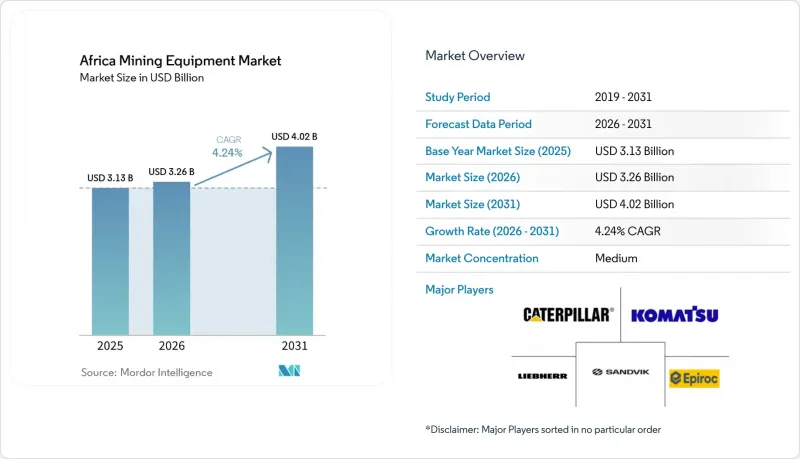
據 Mordor Intelligence 稱,2025 年非洲礦業機械市場價值為 31.3 億美元,預計將從 2026 年的 32.6 億美元成長到 2031 年的 40.2 億美元,2026 年至 2031 年的年複合成長率(CAGR)為 4.24%。
本報告按機器類型(露天鑽孔機、地下鑽孔機等)、自動化程度(手動機器、半自動機器等)、動力傳動系統類型(內燃機車輛、電池式電動車等)、功率輸出、應用領域和國家/地區進行細分。市場預測以貨幣價值(美元)和數量(台)兩種形式呈現。
非洲礦業機械市場趨勢與洞察
非洲露天採礦計畫迅速擴張
幾內亞的西芒杜鐵礦石綜合體和剛果民主共和國(剛果(金))價值289億美元的MIFOR開發項目等大型露天大型企劃項目,正在推動對超重型運輸卡車、大容量繩索挖掘機和破碎設備的訂單成長。 2025年2月,日本小松公司宣布了一項向西芒杜項目交付五台PC5500-11挖掘機的重大契約,這表明400噸級重型機械將如何降低運輸成本並提高生產效率。此外,像Tractafric Equipment在摩洛哥的工廠這樣的本地翻新中心,正在翻新關鍵部件,以縮短前置作業時間並加強售後服務。因此,露天採礦機械構成了更換需求的基礎,預計到2031年,它將繼續支撐非洲近一半的採礦機械市場。
政府主導的基礎設施開發項目正在提振對鐵礦石和骨材的需求。
為全長1300公里的洛比托走廊計畫提供的多邊融資降低了銅礦和鐵礦石的運輸成本,從而促進了鐵路裝卸料斗和移動破碎機的採購。同樣,幾內亞計劃在2028年前建造一條670公里的鐵路,這需要用於鋪軌和骨材加工的機械設備。南非國家發展計畫將近五分之一的基礎設施預算用於發展與採礦相關的物流基礎設施,從而支撐了對平土機和攤舖機的需求。因此,儘管大宗商品價格波動,公共部門的基礎設施規劃仍保證了設備訂單的穩定性。
商品價格波動會影響資本投資週期。
近期銅價暴跌,迫使剛果民主共和國和尚比亞等地區的生產商推遲原定的擴建計劃並減少機械訂單。這一趨勢反映了整體大宗商品市場的低迷,鐵礦石、煤炭和非鐵金屬等關鍵材料也面臨價格壓力。這些波動要求原始設備製造商 (OEM) 保持靈活性,調整生產計劃,並確保關鍵備件的庫存,以保證服務交付和合約履行不間斷。
細分市場分析
2025年,露天採礦機械佔非洲採礦機械市場的46.65%。 400噸級繩索挖掘機和220噸級運輸卡車的引入,正在增強鐵礦石和銅礦開採的規模經濟效益。該領域受益於有利於零排放裝載機的稅收優惠政策,並正在加速鉑金礦中電池驅動電動裝載機的試點部署。同時,預計到2031年,裝載機和運輸卡車的年複合成長率將達到5.17%。由於南非深層金礦蘊藏量枯竭,對地下採礦機械的需求停滯不前。然而,電動裝載機透過降低熱負荷和提高通風效率,正在緩解這一下滑趨勢。
破碎、分選和礦物加工生產線對露天採礦和基礎設施建設都至關重要,採石場生產的骨材用於鐵路和公路建設。奈及利亞和阿爾及利亞強制推行的本地選礦政策推動了浮選精礦和精礦的採購,使採購趨勢轉向加工環節。鑽孔機和破碎機受益於稀土元素探勘。同時,裝載機和運輸卡車正被高容量、低排放車輛所取代,引領非洲礦業機械市場的發展。
截至2025年,人工操作的機械設備佔非洲礦業機械市場的66.73%。這主要是由於人事費用相對較低以及通訊基礎設施持續存在差距。然而,隨著礦業公司將安全放在深層礦場的首要位置,預計到2031年,全自動系統的複合年成長率將達到18.38%。此外,對現有車輛進行改造的需求也在不斷成長,因為改造可以讓現有車輛在享受防碰撞和提高生產效率等優勢的同時,攤銷改造成本。中國原始設備製造商(OEM)正透過提供價格低於西方競爭對手的低成本自動駕駛套件,拓展其在中型礦業營運商市場的佔有率。
半自動化解決方案,包括遠端操控鑽機,正在彌補通訊環境不穩定但衛星服務正在改善的領域中的作業缺口。雖然風險評估現已成為法律規範的強制性要求,但隨著監管機構確認先導計畫的事故率下降,核准程序正在加快。這些政策進展支持整個非洲礦業設備市場向自動化長期轉型。
其他好處:
- Excel格式的市場預測(ME)表
- 3個月的分析師支持
目錄
第1章:引言
- 市場分析與定義的前提條件
- 分析範圍
第2章 分析方法
第3章執行摘要
第4章 市場狀況
- 市場概覽
- 市場促進因素
- 非洲露天採礦計畫迅速擴張
- 政府主導的基礎設施開發項目正在提振對鐵礦石和骨材的需求。
- 加大對電池驅動礦用卡車的投資
- 稀土元素探勘的擴大正在推動對專業鑽井的需求。
- 引入利用衛星通訊的預測性維護
- 在非洲各地建立OEM組裝和再製造中心。
- 市場限制因素
- 商品價格波動會影響資本投資週期。
- 自動和電動機械的初始成本較高
- 關鍵部件供應鏈持續中斷
- 假冒零件的氾濫正在削弱人們對汽車製造商的信任。
- 價值鍊和供應鏈分析
- 監理情勢
- 技術展望
- 波特五力分析
第5章:預測市場規模與成長率
- 按機器類型
- 露天鑽井機械
- 地下採礦機械
- 礦物加工設備
- 鑽孔機(挖掘機)/破碎機(破碎機)
- 破碎、研磨與分類機
- 裝載機/運輸卡車
- 按自動化級別
- 手動機器
- 半自動機器
- 全自動機器
- 依動力傳動系統類型
- 內燃機
- 電池供電
- 混合
- 依輸出類型
- 低於500馬力
- 500~1,000 HP
- 1000馬力或以上
- 透過使用
- 金屬礦開採
- 礦產開採
- 採煤
- 國家
- 南非
- 奈及利亞
- 阿爾及利亞
- 剛果民主共和國(DRC)
- 利比亞
- 其他非洲國家
第6章 競爭情勢
- 市場集中度
- 策略趨勢
- 市佔率分析
- 公司簡介
- Caterpillar Inc.
- Komatsu Ltd.
- Liebherr-International AG
- Sandvik AB
- Epiroc AB
- Hitachi Construction Machinery Co., Ltd.
- Volvo Construction Equipment
- Doosan Infracore
- XCMG Group
- Sany Group
- Bell Equipment
- Manitou Group
- Wirtgen Group
- Terex Corporation
- JCB
- Metso Outotec
- FLSmidth
- Astec Industries
- Hyundai Construction Equipment
第7章 市場機會與未來展望
According to Mordor Intelligence, the Africa mining equipment market size was valued at USD 3.13 billion in 2025 and is projected to expand from USD 3.26 billion in 2026 to USD 4.02 billion by 2031, registering a CAGR of 4.24% between 2026 and 2031.
This report is Segmented by Equipment Type (Surface Mining Equipment, Underground Mining Equipment, and More), Automation Level (Manual Equipment, Semi-Autonomous Equipment, and More), Powertrain Type (Internal-Combustion Engine Vehicles, Battery-Electric Vehicles, and More), Power Output, Application, and Country. The Market Forecasts are Provided in Terms of Value (USD) and Volume (Units).
Africa Mining Equipment Market Trends and Insights
Rapid Expansion of Surface Mining Projects in Africa
Open-pit mega-projects such as Guinea's Simandou iron ore complex and the DRC's USD 28.9 billion MIFOR development are fueling orders for ultra-class haul trucks, high-capacity rope shovels, and crushing circuits . Komatsu announced a major contract to deliver five PC5500-11 excavators to Simandou in February 2025, illustrating how 400-tonne-class machinery lowers haulage costs and boosts productivity. Local rebuild hubs, for example, Tractafric Equipment's facility in Morocco, now refurbish key components to shorten lead times and strengthen after-sales offerings. Surface fleets, therefore, anchor replacement demand and underpin nearly half of the African mining equipment market through 2031.
Government-Led Infrastructure Programs Boosting Iron-Ore and Aggregates Demand
Multilateral financing of the 1,300 km Lobito Corridor compresses transport costs for copper and iron ore, stimulating procurement of rail-loading hoppers and mobile crushers. Guinea's commitment to complete a 670 km rail line by 2028 likewise requires track-laying and aggregate-processing machinery. South Africa's National Development Plan allocates nearly one-fifth of its infrastructure budget to mining-linked logistics upgrades, sustaining demand for graders and pavers. Public-sector infrastructure agendas, therefore, reinforce steady equipment orders despite commodity-price cycles.
Commodity-Price Volatility Affecting CAPEX Cycles
In recent times, copper prices have declined sharply, prompting producers in regions such as the DRC and Zambia to delay planned expansions and scale back equipment orders. This trend reflects a broader downturn in the commodity market, with key materials such as iron ore, coal, and base metals also facing price pressures. These fluctuations force OEMs to remain agile, adjusting production schedules and maintaining inventories of critical spare parts to ensure uninterrupted service delivery and contract fulfillment.
Other drivers and restraints analyzed in the detailed report include:
- Rising Investments in Battery-Electric Mining Trucks
- Growth in Rare-Earth Exploration Driving Specialized Drilling Demand
- High Upfront Cost of Autonomous and Electric Equipment
For complete list of drivers and restraints, kindly check the Table Of Contents.
Segment Analysis
Surface machinery accounted for 46.65% of the African mining equipment market in 2025. The adoption of 400-tonne rope shovels and 220-tonne haul trucks enhances economies of scale in iron ore and copper operations. The segment benefits from tax incentives that favor zero-emission loaders, spurring pilot deployments of battery-electric units at platinum sites. At the same time, loaders and haul trucks are forecasted to expand at a 5.17% CAGR through 2031. Underground equipment trails as reserves in deep-level South African gold mines deplete, yet electrified loaders reduce heat load and improve ventilation efficiency, moderating the decline in demand.
Crushing, screening, and mineral-processing lines serve both open-pit and infrastructure pipelines, where quarry aggregates underpin rail and road corridors. Local beneficiation mandates in Nigeria and Algeria stimulate purchases of flotation cells and thickeners, reshaping procurement toward processing circuits. Drills and breakers benefit from rare-earth exploration. At the same time, loaders and haul trucks lead the substitution cycle toward higher-capacity, lower-emission fleets, driving the African mining equipment market forward.
Manual fleets accounted for 66.73% of the African mining equipment market in 2025, as labor costs remain comparatively low and connectivity gaps persist. Nevertheless, fully autonomous systems are projected to post a 18.38% CAGR to 2031 as mines prioritize safety in deep-level stopes. Retrofits are gaining popularity, allowing operators to amortize the cost of existing trucks while capturing collision-avoidance and productivity benefits. Chinese OEMs undercut Western rivals with lower-priced autonomy kits, widening access for mid-tier miners.
Semi-autonomous solutions, including tele-operated drills, bridge capability gaps in operations where connectivity is intermittent but improving through satellite services. Regulatory frameworks now require risk assessments, yet approvals are accelerating as authorities observe lower accident rates in pilot projects. This policy evolution supports the long-term transition toward autonomy across the African mining equipment market.
Complete Report Scope:
- By Equipment Type
- Surface Mining Equipment
- Underground Mining Equipment
- Mineral Processing Equipment
- Drills and Breakers
- Crushing, Pulverizing and Screening
- Loaders and Haul Trucks
- By Automation Level
- Manual Equipment
- Semi-Autonomous Equipment
- Fully Autonomous Equipment
- By Powertrain Type
- Internal-Combustion Engine Vehicles
- Battery-Electric Vehicles
- Hybrid Vehicles
- By Power Output
- Less than 500 HP
- 500 - 1,000 HP
- Above 1,000 HP
- By Application
- Metal Mining
- Mineral Mining
- Coal Mining
- By Country
- South Africa
- Nigeria
- Algeria
- Democratic Republic of Congo (DRC)
- Libya
- Rest of Africa
List of Companies Covered in this Report:
- Caterpillar Inc.
- Komatsu Ltd.
- Liebherr-International AG
- Sandvik AB
- Epiroc AB
- Hitachi Construction Machinery Co., Ltd.
- Volvo Construction Equipment
- Doosan Infracore
- XCMG Group
- Sany Group
- Bell Equipment
- Manitou Group
- Wirtgen Group
- Terex Corporation
- JCB
- Metso Outotec
- FLSmidth
- Astec Industries
- Hyundai Construction Equipment
Additional Benefits:
- The market estimate (ME) sheet in Excel format
- 3 months of analyst support
TABLE OF CONTENTS
1 Introduction
- 1.1 Study Assumptions & Market Definition
- 1.2 Scope of the Study
2 Research Methodology
3 Executive Summary
4 Market Landscape
- 4.1 Market Overview
- 4.2 Market Drivers
- 4.2.1 Rapid Expansion of Surface Mining Projects in Africa
- 4.2.2 Government-Led Infrastructure Programs Boosting Iron-Ore and Aggregates Demand
- 4.2.3 Rising Investments in Battery-Electric Mining Trucks
- 4.2.4 Growth in Rare-Earth Exploration Driving Specialized Drilling Demand
- 4.2.5 Uptake of Predictive Maintenance via Satellite Connectivity
- 4.2.6 Localization of OEM Assembly and Rebuild Centers Across Africa
- 4.3 Market Restraints
- 4.3.1 Commodity-Price Volatility Affecting CAPEX Cycles
- 4.3.2 High Upfront Cost of Autonomous and Electric Equipment
- 4.3.3 Persistent Supply-Chain Disruptions for Critical Components
- 4.3.4 Counterfeit Spare-Parts Proliferation Eroding OEM Trust
- 4.4 Value / Supply-Chain Analysis
- 4.5 Regulatory Landscape
- 4.6 Technological Outlook
- 4.7 Porter's Five Forces
- 4.7.1 Threat of New Entrants
- 4.7.2 Bargaining Power of Suppliers
- 4.7.3 Bargaining Power of Buyers
- 4.7.4 Threat of Substitutes
- 4.7.5 Industry Rivalry
5 Market Size & Growth Forecasts (Value (USD) & Volume (Units))
- 5.1 By Equipment Type
- 5.1.1 Surface Mining Equipment
- 5.1.2 Underground Mining Equipment
- 5.1.3 Mineral Processing Equipment
- 5.1.4 Drills and Breakers
- 5.1.5 Crushing, Pulverizing and Screening
- 5.1.6 Loaders and Haul Trucks
- 5.2 By Automation Level
- 5.2.1 Manual Equipment
- 5.2.2 Semi-Autonomous Equipment
- 5.2.3 Fully Autonomous Equipment
- 5.3 By Powertrain Type
- 5.3.1 Internal-Combustion Engine Vehicles
- 5.3.2 Battery-Electric Vehicles
- 5.3.3 Hybrid Vehicles
- 5.4 By Power Output
- 5.4.1 Less than 500 HP
- 5.4.2 500 - 1,000 HP
- 5.4.3 Above 1,000 HP
- 5.5 By Application
- 5.5.1 Metal Mining
- 5.5.2 Mineral Mining
- 5.5.3 Coal Mining
- 5.6 By Country
- 5.6.1 South Africa
- 5.6.2 Nigeria
- 5.6.3 Algeria
- 5.6.4 Democratic Republic of Congo (DRC)
- 5.6.5 Libya
- 5.6.6 Rest of Africa
6 Competitive Landscape
- 6.1 Market Concentration
- 6.2 Strategic Moves
- 6.3 Market Share Analysis
- 6.4 Company Profiles (Includes Global Level Overview, Market Level Overview, Core Segments, Financials as Available, Strategic Information, Market Rank/Share for Key Companies, Products and Services, SWOT Analysis, and Recent Developments)
- 6.4.1 Caterpillar Inc.
- 6.4.2 Komatsu Ltd.
- 6.4.3 Liebherr-International AG
- 6.4.4 Sandvik AB
- 6.4.5 Epiroc AB
- 6.4.6 Hitachi Construction Machinery Co., Ltd.
- 6.4.7 Volvo Construction Equipment
- 6.4.8 Doosan Infracore
- 6.4.9 XCMG Group
- 6.4.10 Sany Group
- 6.4.11 Bell Equipment
- 6.4.12 Manitou Group
- 6.4.13 Wirtgen Group
- 6.4.14 Terex Corporation
- 6.4.15 JCB
- 6.4.16 Metso Outotec
- 6.4.17 FLSmidth
- 6.4.18 Astec Industries
- 6.4.19 Hyundai Construction Equipment
7 Market Opportunities & Future Outlook
- 7.1 White-space & Unmet-Need Assessment

 中國礦山機械:市場佔有率分析、產業趨勢與統計、成長預測(2026-2031年)印度礦業機械:市場佔有率分析、產業趨勢與統計、成長預測(2026-2031)德國礦業機械:市場佔有率分析、產業趨勢與統計、成長預測(2026-2031)馬來西亞礦業機械:市場佔有率分析、產業趨勢與統計、成長預測(2026-2031)日本礦業機械:市場佔有率分析、產業趨勢及統計、成長預測(2026-2031)法國礦業機械:市場佔有率分析、產業趨勢與統計、成長預測(2026-2031)英國礦業機械:市場佔有率分析、產業趨勢與統計、成長預測(2026-2031)西班牙礦業機械:市場佔有率分析、產業趨勢與統計、成長預測(2026-2031)
 礦業機械市場報告:趨勢、預測與競爭分析(至2035年)
 自主採礦機械市場規模、佔有率、成長、全球產業分析、區域趨勢及2026-2034年預測。