


 |
市場調查報告書
商品編碼
2117389
馬來西亞礦業機械:市場佔有率分析、產業趨勢與統計、成長預測(2026-2031)Malaysia Mining Equipment - Market Share Analysis, Industry Trends & Statistics, Growth Forecasts (2026 - 2031) |
||||||

※ 本網頁內容可能與最新版本有所差異。詳細情況請與我們聯繫。
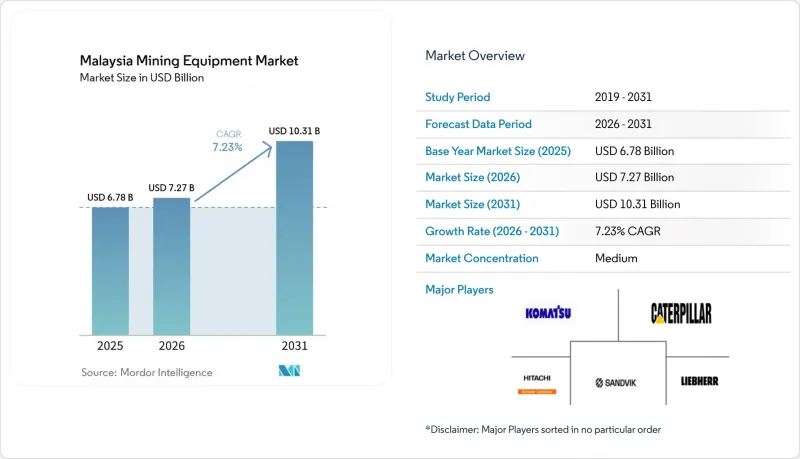
據 Mordor Intelligence 稱,馬來西亞礦業機械市場在 2025 年的價值為 67.8 億美元,預計到 2031 年將達到 103.1 億美元,而 2026 年為 72.7 億美元,預測期內(2026-2031 年)的複合成長率預計為 7.23%。
本報告按機器類型(例如,露天採礦機械)、自動化程度(例如,手動)、動力傳動系統類型(例如,內燃機)、功率輸出(例如,小於500馬力)、應用領域(例如,金屬)和地區進行細分。市場預測以貨幣價值(美元)和數量(台)兩種形式呈現。
馬來西亞礦業機械市場趨勢與洞察
電動車供應鏈對關鍵礦物的需求激增
馬來西亞在電池材料領域的努力遠不止於礬土和錫礦。 Linus公司計畫在2025年上半年出貨4,600噸釹镨氧化物,較去年同期成長12%,進而支撐全球磁鐵供應。 Fortress Minerals公司將於2025年為其位於武吉貝西(Bukit Besi)和孟加布爾(Mengapur)的礦場訂購美卓(Metso)破碎機,以擴大其鐵礦石、銅精礦和金精礦的加工能力。 Botanickel公司在沙巴州進行的植物採礦試驗,利用超富集植物從紅土中提取鎳,推動了對高壓破碎輥和浮選槽的需求,這些設備比大型土木機械價格更高。隨著環境法規日益嚴格,能夠將水循環系統整合到礦物加工單元中的機械供應商正在獲得更高的利潤率。
加速採用智慧採礦和自動化解決方案
自動駕駛技術正從澳洲的大型礦場擴展到東南亞的中型礦場。 2026年3月,Epiroc公司訂單一份價值3.8億瑞典克朗的契約,成為澳洲以外該地區最大的自動駕駛車輛合約之一。 2025年11月,日本小松公司與曼谷汽車製造廠簽署了一項合資協議,組裝在馬來西亞的採石場組裝整合負載容量追蹤和防碰撞功能的半自動挖土機,以降低維修成本。日立公司於2024年1月推出的ZAXIS-7G系列挖土機,可將燃油、液壓和磨損等即時資料傳送到雲端控制面板,從而減少高達30%的停機時間。位於砂拉越的Centexs Lawas綠色礦業學院於2025年12月開始進行操作員培訓,以解決先前阻礙該技術應用的技能缺口問題。目前,採購架構不僅比較初始成本,還比較包括軟體和連線在內的總生命週期成本。
更嚴格的環境許可要求和暫時中止礬土開採。
2016年實施、2019年部分解除的礬土出口禁令,仍要求業者鋪設運輸道路、覆蓋堆場並安裝即時水質監測設備,這使得資本需求增加了高達30%。雖然山特維克和艾柏洛克的電池驅動車輛和除塵設備符合監管要求,但缺乏環保認證的低成本中國進口產品卻舉步維艱。環境影響評估週期的延長,導致專案前置作業時間延長至18-24個月,減緩了機械設備的更新換代速度,並減少了短期機械訂單。
細分市場分析
2025年,露天採礦機械佔馬來西亞採礦機械市場的46.17%。這反映了彭亨州和霹靂州集中礬土、錫礦和金礦的市場主導地位。該領域的設備主要為高產能挖土機、平土機和拉鏟,這些設備能夠在紅土礦床中保持較低的剝離率。預計2026年至2031年,裝載機和運輸卡車的複合年成長率將達到7.27%,主要得益於山特維克在芙蓉的電池動力生產線和日本小松公司的區域半自動化組裝項目。隨著Fortress Minerals公司於2025年9月訂購美卓破碎機以提高其在武吉比西和孟加布爾的加工能力,礦物加工系統的需求也在成長。此外,馬來西亞國家石油公司(Petronas)的棕地油田改造計畫也推動了鑽孔機和破碎機的需求。這項工作需要液壓破碎錘和旋轉鑽機,這些設備與採礦機械共用液壓子組件,使供應商能夠跨行業攤銷研發成本。
由此引發的連鎖反應是,一場技術變革正在發生。即時礦石品位感測器如今已成為工廠破碎機的標準配置,操作人員可以微調封閉回路型控制設置,從而將再加工所需的能量降低高達15%。寧德時代(CATL)和比亞迪(BYD)等中國電池製造商正向整車製造商(OEM)推介模組化、高容量電池組,迫使現有柴油引擎供應商展開競爭,以爭取電氣化合作夥伴關係。總而言之,這些變化為馬來西亞礦業機械市場帶來了均衡的前景:露天採礦設備在地面機械出貨量方面仍然佔據主導地位,而裝載機和運輸卡車預計將迎來最快的價值成長,這主要得益於電氣化和自動駕駛帶來的溢價效應。
即使到了2025年,手動機械仍佔馬來西亞採礦機械市場佔有率的56.34%。這主要是因為小規模礬土和錫礦僱用了2,496名工人,而這些礦場規模較小,不足以容納有線控制室。然而,隨著中型銅礦、金礦和石灰石礦商尋求勞動力和安全的優勢,預計到2031年,全自動駕駛車輛市場將以7.25%的複合年成長率成長。半自動化機械雖然不具備完全自動駕駛能力,但結合了負載容量監控和碰撞避免功能,將為那些需要分階段升級而非從零開始構建完整數位化平台的採石場提供過渡方案。
技術工人短缺仍然是最大的障礙。聯邦政府設立的10億馬幣技能發展基金和砂拉越Centexs Lawas綠色礦業學院的目標是到2027年認證500名技術人員,以彌合阻礙技術普及的數據素養差距。隨著人力資源開發系統的日趨成熟,採購標準正從資本支出(Capex)轉向總擁有成本(TCO),後者涵蓋軟體授權、無線更新和網路安全措施。這種漸進式的普及將導致馬來西亞礦業設備市場中手動操作機械的市場佔有率逐漸萎縮,而自動化機械的利潤率將顯著成長。
其他好處:
- Excel格式的市場預測(ME)表
- 3個月的分析師支持
目錄
第1章:引言
- 市場分析與定義的前提條件
- 分析範圍
第2章 分析方法
第3章執行摘要
第4章 市場狀況
- 市場概覽
- 市場促進因素
- 電動車供應鏈對關鍵礦物的需求正在激增。
- 智慧採礦和自動化解決方案的採用正在加速。
- 政府對石油和天然氣產業現有設施擴建的資本投資
- 現場組裝重型機械的稅收優惠
- 小規模礬土和鈦鐵礦開採作業的快速成長
- 旨在以低環境影響的方式提取鎳的植物採礦試點項目
- 市場限制因素
- 更嚴格的環境許可要求和暫時中止礬土開採。
- 大宗商品價格波動正在抑制資本投資週期。
- 自動化機械引進的技能差距
- 電動車隊高容量電池組供不應求
- 價值鍊和供應鏈分析
- 監理情勢
- 技術展望
- 波特五力分析
第5章:預測市場規模與成長率
- 按機器類型
- 露天採礦機械
- 地下採礦機械
- 礦物加工設備
- 鑽頭破碎機
- 破碎、研磨與分類機
- 裝載機/運輸卡車
- 按自動化級別
- 手動機器
- 半自動機器
- 全自動機器
- 依動力傳動系統類型
- 內燃機
- 電池供電
- 混合
- 依輸出類型
- 低於500馬力
- 500~1,000 HP
- 1000馬力或以上
- 透過使用
- 金屬礦開採
- 礦產開採
- 採煤
- 稀土元素開採
- 按地區
- 馬來半島
- 佩拉特州
- 彭亨州
- 登嘉樓
- 柔佛
- 雪蘭莪
- 東馬來西亞
- 沙巴
- 砂拉越
- 納閩聯邦直轄區
- 馬來半島
第6章 競爭情勢
- 市場集中度
- 策略趨勢
- 市佔率分析
- 公司簡介
- Caterpillar Inc.
- Komatsu Ltd.
- Sandvik AB
- Epiroc AB
- Hitachi Construction Machinery Co. Ltd.
- Liebherr Group
- Volvo Construction Equipment
- Sany Heavy Equipment Intl. Holdings
- Zoomlion Heavy Industry Sci. & Tech.
- Terex Corporation
- HD Hyundai Infracore Co. Ltd.
- Goscor Group
- XCMG Group
- Atlas Copco AB
- FLSmidth
- UMW Holdings Berhad
- Sime Darby Industrial Sdn Bhd
- Sunway Construction Group Berhad
- Yinson Holdings Berhad
- Bahvest Resources Berhad
第7章 市場機會與未來展望
According to Mordor Intelligence, the Malaysia mining equipment market size was valued at USD 6.78 billion in 2025 and is estimated to grow from USD 7.27 billion in 2026 to reach USD 10.31 billion by 2031, at a CAGR of 7.23% during the forecast period (2026-2031).
This report is Segmented by Equipment Type (Surface Mining Equipment and More), Automation Level (Manual and More), Powertrain Type (ICE and More), Power Output (Less Than 500 HP and More), Application (Metal and More), and Geography. The Market Forecasts are Provided in Value (USD) and Volume (Units).
Malaysia Mining Equipment Market Trends and Insights
Surging Demand for Critical Minerals for EV Supply Chain
Malaysia's battery-materials ambitions extend beyond bauxite and tin. Lynas shipped 4,600 t of NdPr oxide in H1 2025, up 12% year-on-year, supporting global magnet supply . Fortress Minerals ordered Metso crushers for Bukit Besi and Mengapur in 2025, thereby widening processing capacity for iron ore and copper-gold concentrates . Sabah's Botanickel phytomining trial uses hyperaccumulator plants to lift nickel from laterite soils, driving demand for high-pressure grinding rolls and flotation cells that carry higher ticket prices than bulk earthmovers. Equipment suppliers able to package mineral-processing units with water-recycling systems secure premium margins under stricter environmental rules.
Accelerating Adoption of Smart-Mining & Automation Solutions
Autonomous technology is moving from Australian mega-mines to mid-scale pits in Southeast Asia. Epiroc's SEK 380 million order in March 2026 marked one of the region's largest autonomous-fleet deals outside Australia . Komatsu's joint venture with Bangkok Motor Works, signed in November 2025, will assemble semi-autonomous excavators that bundle payload tracking and collision avoidance, trimming retrofit costs for Malaysian quarries. Hitachi's ZAXIS-7G range, launched in January 2024, sends real-time fuel, hydraulic, and wear data to cloud dashboards, cutting downtime by up to 30%. Sarawak's Centexs Lawas Green Mining Academy began training operators in December 2025, easing the skills gap that has slowed rollouts. Procurement frameworks now compare lifetime ownership cost, including software and connectivity, rather than upfront price alone.
Tougher Environmental Permitting & Bauxite Moratoriums
The 2016 bauxite ban, partly lifted in 2019, still forces operators to pave haul roads, cap stockpiles, and fit real-time water monitors, raising capital needs by up to 30%. Battery-electric fleets and dust-suppression packages from Sandvik and Epiroc meet compliance, but low-cost Chinese imports struggle without environmental certification. Lengthier environmental-impact studies stretch project lead times to 18-24 months, delaying replacement cycles and trimming near-term equipment orders.
Other drivers and restraints analyzed in the detailed report include:
- Government CAPEX in Oil & Gas Brown-Field Extensions
- Phytomining Pilots for Low-Impact Nickel Extraction
- Commodity-Price Volatility Limiting CAPEX Cycles
For complete list of drivers and restraints, kindly check the Table Of Contents.
Segment Analysis
Surface mining equipment accounted for 46.17% of the Malaysian mining equipment market in 2025, reflecting the dominance of open-pit bauxite, tin, and gold operations concentrated in Pahang and Perak. The segment's installed base favors high-capacity shovels, graders, and draglines that maintain low stripping ratios on lateritic orebodies. Loaders and haul trucks are forecast to expand at a 7.27% CAGR between 2026 and 2031, buoyed by Sandvik's battery-electric production line in Seremban and Komatsu's regional semi-autonomous assembly program. Demand for mineral-processing systems is also rising, following Fortress Minerals' September 2025 order of Metso crushers to raise throughput at Bukit Besi and Mengapur. Drills and breakers benefit from PETRONAS's brownfield subsea work, which requires hydraulic breakers and rotary rigs that share hydraulic subassemblies with mining gear, helping suppliers amortize R&D across sectors.
The second-order effect is a technological pivot: real-time ore-grade sensors now arrive factory-installed in crushers, letting operators tweak closed-circuit settings and cut reprocessing energy by up to 15%. Chinese battery-cell makers such as CATL and BYD are courting OEMs with modular, high-capacity packs, forcing incumbent diesel-engine suppliers to race to secure electrification partnerships. Taken together, these shifts support a balanced outlook in which the Malaysian mining equipment market size for surface machines continues to dominate in terms of volumes, but loaders and haul trucks capture the steepest value growth on the back of electrification and autonomy premiums.
Manual equipment still controlled 56.34% of the Malaysian mining equipment market share in 2025 because 2,496 workers operate small bauxite and tin pits that lack the scale for wired control rooms. Yet fully autonomous fleets are projected to post a 7.25% CAGR through 2031 as mid-scale copper-gold and limestone operators chase labor and safety dividends. Semi-autonomous machines, which bundle payload monitoring and collision avoidance without full driverless capability, offer a bridge for quarries that need incremental upgrades rather than greenfield digital platforms.
Skills shortages remain the chief friction point. The federal RM 1 billion up-skilling fund and Sarawak's Centexs Lawas Green Mining Academy aim to certify 500 technicians by 2027, closing the data-literacy gap that has slowed deployments. As training pipelines mature, procurement criteria are shifting from capex to total cost of ownership, including software licensing, over-the-air updates, and cybersecurity safeguards. This tiered adoption curve ensures the Malaysia mining equipment market size for manual units erodes gradually, while autonomous categories capture outsized margin expansion.
Complete Report Scope:
- By Equipment Type
- Surface Mining Equipment
- Underground Mining Equipment
- Mineral Processing Equipment
- Drills & Breakers
- Crushing, Pulverizing & Screening
- Loaders & Haul Trucks
- By Automation Level
- Manual Equipment
- Semi-Autonomous Equipment
- Fully Autonomous Equipment
- By Powertrain Type
- Internal-Combustion Engine Vehicles
- Battery-Electric Vehicles
- Hybrid Vehicles
- By Power Output
- Less than 500 HP
- 500 - 1,000 HP
- Above 1,000 HP
- By Application
- Metal Mining
- Mineral Mining
- Coal Mining
- Rare Earth Mining
- By Geography
- Peninsular Malaysia
- Perak
- Pahang
- Terengganu
- Johor
- Selangor
- East Malaysia
- Sabah
- Sarawak
- Federal Territory of Labuan
- Peninsular Malaysia
List of Companies Covered in this Report:
- Caterpillar Inc.
- Komatsu Ltd.
- Sandvik AB
- Epiroc AB
- Hitachi Construction Machinery Co. Ltd.
- Liebherr Group
- Volvo Construction Equipment
- Sany Heavy Equipment Intl. Holdings
- Zoomlion Heavy Industry Sci. & Tech.
- Terex Corporation
- HD Hyundai Infracore Co. Ltd.
- Goscor Group
- XCMG Group
- Atlas Copco AB
- FLSmidth
- UMW Holdings Berhad
- Sime Darby Industrial Sdn Bhd
- Sunway Construction Group Berhad
- Yinson Holdings Berhad
- Bahvest Resources Berhad
Additional Benefits:
- The market estimate (ME) sheet in Excel format
- 3 months of analyst support
TABLE OF CONTENTS
1 Introduction
- 1.1 Study Assumptions & Market Definition
- 1.2 Scope of the Study
2 Research Methodology
3 Executive Summary
4 Market Landscape
- 4.1 Market Overview
- 4.2 Market Drivers
- 4.2.1 Surging Demand for Critical Minerals for EV Supply Chain
- 4.2.2 Accelerating Adoption of Smart-Mining & Automation Solutions
- 4.2.3 Government CAPEX in Oil & Gas Brown-Field Extensions
- 4.2.4 Tax Incentives for Locally-Assembled Heavy Machinery
- 4.2.5 Boom in Small-Scale Bauxite & Ilmenite Operations
- 4.2.6 Phytomining Pilots for Low-Impact Nickel Extraction
- 4.3 Market Restraints
- 4.3.1 Tougher Environmental Permitting & Bauxite Moratoriums
- 4.3.2 Commodity-Price Volatility Limiting CAPEX Cycles
- 4.3.3 Skills Gap for Autonomous Equipment Deployment
- 4.3.4 Scarcity of High-Capacity Battery Packs for BEV Fleets
- 4.4 Value / Supply-Chain Analysis
- 4.5 Regulatory Landscape
- 4.6 Technological Outlook
- 4.7 Porter's Five Forces
- 4.7.1 Threat of New Entrants
- 4.7.2 Bargaining Power of Suppliers
- 4.7.3 Bargaining Power of Buyers
- 4.7.4 Threat of Substitutes
- 4.7.5 Competitive Rivalry
5 Market Size & Growth Forecasts (Value (USD) and Volume (Units))
- 5.1 By Equipment Type
- 5.1.1 Surface Mining Equipment
- 5.1.2 Underground Mining Equipment
- 5.1.3 Mineral Processing Equipment
- 5.1.4 Drills & Breakers
- 5.1.5 Crushing, Pulverizing & Screening
- 5.1.6 Loaders & Haul Trucks
- 5.2 By Automation Level
- 5.2.1 Manual Equipment
- 5.2.2 Semi-Autonomous Equipment
- 5.2.3 Fully Autonomous Equipment
- 5.3 By Powertrain Type
- 5.3.1 Internal-Combustion Engine Vehicles
- 5.3.2 Battery-Electric Vehicles
- 5.3.3 Hybrid Vehicles
- 5.4 By Power Output
- 5.4.1 Less than 500 HP
- 5.4.2 500 - 1,000 HP
- 5.4.3 Above 1,000 HP
- 5.5 By Application
- 5.5.1 Metal Mining
- 5.5.2 Mineral Mining
- 5.5.3 Coal Mining
- 5.5.4 Rare Earth Mining
- 5.6 By Geography
- 5.6.1 Peninsular Malaysia
- 5.6.1.1 Perak
- 5.6.1.2 Pahang
- 5.6.1.3 Terengganu
- 5.6.1.4 Johor
- 5.6.1.5 Selangor
- 5.6.2 East Malaysia
- 5.6.2.1 Sabah
- 5.6.2.2 Sarawak
- 5.6.2.3 Federal Territory of Labuan
- 5.6.1 Peninsular Malaysia
6 Competitive Landscape
- 6.1 Market Concentration
- 6.2 Strategic Moves
- 6.3 Market Share Analysis
- 6.4 Company Profiles (Includes Global Level Overview, Market Level Overview, Core Segments, Financials as Available, Strategic Information, Market Rank/Share for Key Companies, Products and Services, SWOT Analysis, and Recent Developments)
- 6.4.1 Caterpillar Inc.
- 6.4.2 Komatsu Ltd.
- 6.4.3 Sandvik AB
- 6.4.4 Epiroc AB
- 6.4.5 Hitachi Construction Machinery Co. Ltd.
- 6.4.6 Liebherr Group
- 6.4.7 Volvo Construction Equipment
- 6.4.8 Sany Heavy Equipment Intl. Holdings
- 6.4.9 Zoomlion Heavy Industry Sci. & Tech.
- 6.4.10 Terex Corporation
- 6.4.11 HD Hyundai Infracore Co. Ltd.
- 6.4.12 Goscor Group
- 6.4.13 XCMG Group
- 6.4.14 Atlas Copco AB
- 6.4.15 FLSmidth
- 6.4.16 UMW Holdings Berhad
- 6.4.17 Sime Darby Industrial Sdn Bhd
- 6.4.18 Sunway Construction Group Berhad
- 6.4.19 Yinson Holdings Berhad
- 6.4.20 Bahvest Resources Berhad
7 Market Opportunities & Future Outlook
- 7.1 White-space & Unmet-Need Assessment

 中國礦山機械:市場佔有率分析、產業趨勢與統計、成長預測(2026-2031年)印度礦業機械:市場佔有率分析、產業趨勢與統計、成長預測(2026-2031)德國礦業機械:市場佔有率分析、產業趨勢與統計、成長預測(2026-2031)非洲礦業機械:市場佔有率分析、產業趨勢與統計、成長預測(2026-2031 年)日本礦業機械:市場佔有率分析、產業趨勢及統計、成長預測(2026-2031)法國礦業機械:市場佔有率分析、產業趨勢與統計、成長預測(2026-2031)英國礦業機械:市場佔有率分析、產業趨勢與統計、成長預測(2026-2031)西班牙礦業機械:市場佔有率分析、產業趨勢與統計、成長預測(2026-2031)
 礦業機械市場報告:趨勢、預測與競爭分析(至2035年)
 自主採礦機械市場規模、佔有率、成長、全球產業分析、區域趨勢及2026-2034年預測。