


 |
市場調查報告書
商品編碼
2117382
中國礦山機械:市場佔有率分析、產業趨勢與統計、成長預測(2026-2031年)China Mining Equipment - Market Share Analysis, Industry Trends & Statistics, Growth Forecasts (2026 - 2031) |
||||||

※ 本網頁內容可能與最新版本有所差異。詳細情況請與我們聯繫。
據 Mordor Intelligence 稱,2025 年中國礦山機械市場價值為 337.8 億美元,預計將從 2026 年的 355.2 億美元成長到 2031 年的 456.3 億美元,2026 年至 2031 年的複合年成長率為 5.14%。
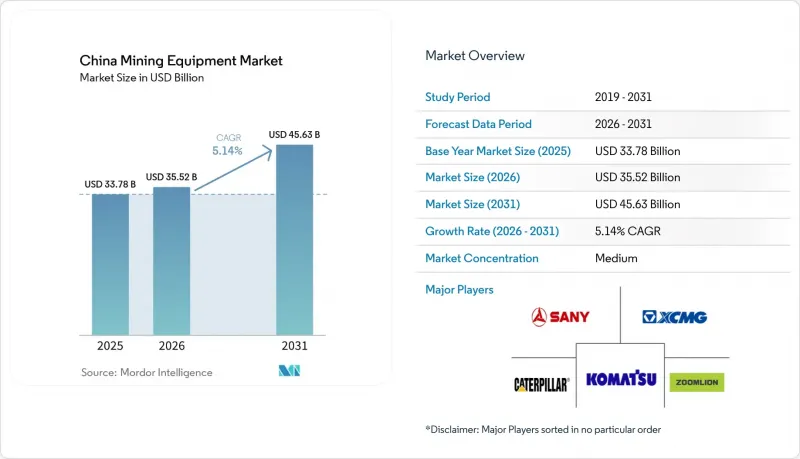
本報告按機器類型(露天鑽孔機、地下鑽孔機等)、自動化程度(手動機器、半自動機器等)、動力傳動系統類型(內燃機、電池驅動馬達等)、功率輸出、應用領域和地區進行細分。市場預測以貨幣價值(美元)和銷售(台)兩種形式呈現。
中國礦山機械市場趨勢與洞察
政府對戰略金屬的基礎建設投資
北京最新的五年規劃包括旨在擴大鋰、稀土元素和鎢等國內金屬供應的專案支出。公共資金正用於支持礦山供電設施的升級改造、道路建設和數位指揮中心的建設,並降低待開發區項目的風險。為這些礦床提供服務的機械供應商也受益於與國家儲備目標相符的可預測性競標。因此,對戰略金屬日益激烈的競爭不僅為需求提供了強勁支撐,也為先進的破碎、研磨和浮選技術提供了試驗場。
礦用車輛向電池驅動電氣化轉型
隨著營運商努力實現碳排放高峰目標並遵守省級排放上限,電池電動運輸車輛正在改變車隊的經濟格局。 「智慧礦山」計畫下的補貼降低了初始成本,促使大規模露天煤礦和稀土元素計畫大力試行部署電動卡車。磷酸鋰鐵鋰電池化學成分的改進提高了能量密度,從而延長了運作週期並減少了充電停機時間。車載分析功能可實現即時路線最佳化,進一步降低了營運成本。因此,中國礦山機械市場對專門設計的電動車型和用於改造現有柴油車輛的模組化改裝套件的訂單激增。
大宗商品價格波動抑制了資本投資。
鐵礦石和動力煤價格的劇烈波動使得現金流規劃變得困難,尤其是對於避險選擇有限的私人礦場而言。工程核准的延誤波及整個供應鏈,導致新設備訂單放緩,設備檢修週期延長。為了應對這一問題,供應商正著力推「按噸收費」契約,並提供靈活的租賃車輛,允許客戶推遲購買決定。這種服務模式的轉變使中國礦山機械市場能夠在價格回升時保持升級換代的勢頭,同時緩解採購凍結帶來的影響。
細分市場分析
預計2025年,露天採礦機械將佔據中國礦山機械市場48.33%的佔有率,凸顯淺層煤礦和鐵礦石的主導地位。隨著營運商力求實現「零柴油」礦床,第二代電動挖土機、拉鏟挖土機和大容量自動卸貨卡車正陸續投入生產。負載容量監控和防碰撞整合系統進一步提升了運轉率。同時,原始設備製造商(OEM)正將培訓和預測性維護軟體整合到產品包中,從而為客戶提供長期服務計劃。
預計到2031年,裝載機和運輸卡車的複合年成長率將達到6.43%,成為該類別中成長最快的領域。這一成長主要歸功於電池組良好的運作週期以及重點礦區便捷的電網接入。省級競標中擴大規定了排放上限,而只有電動或混合動力平台才能滿足這些上限要求。當地企業正在共同開發動力傳動系統和溫度控管零件,從而縮短產品上市時間,並保護中國礦山機械市場生態系統內的智慧財產權。
到2025年,手動採礦機械將佔中國礦山設備市場佔有率的61.09%,因為傳統的柴油動力機械仍將繼續運作且已完全折舊免稅額。然而,監控系統的改造將使操作人員能夠在保持駕駛室設計不變的情況下逐步引入自動化操作。標準化的數據匯流排將支援空中下載(OTA)更新,從而逐步擴展自動化功能。在許多礦場,遠端操控的挖掘和推土作業已被選為初期部署方案,並在不中斷生產的情況下取得了初步成效。
在所有自動化等級中,全自動單元預計將實現最高的複合年成長率(CAGR),達到8.33%。其優點在於排班的可預測性、降低事故責任以及與中國國家人工智慧戰略的契合度。利用國內道路和地質技術資料訓練的專有作業系統能夠實現針對該地區最佳化的高效能。雷射雷達和高階GPU的供應鏈瓶頸仍然是一個挑戰,但一個由國家支持的財團正致力於擴大國內產能,以保護中國礦山機械市場免受外部衝擊。
其他好處:
- Excel格式的市場預測(ME)表
- 3個月的分析師支持
目錄
第1章:引言
- 市場分析與定義的前提條件
- 分析範圍
第2章 分析方法
第3章執行摘要
第4章 市場狀況
- 市場概覽
- 市場促進因素
- 政府在戰略金屬方面的基礎建設支出
- 礦用車輛向電池式電動車的過渡
- 推廣自動化以提高安全性和生產力
- 將稀土元素拓展到潔淨科技供應鏈中
- 政府資助「智慧採礦」試點項目
- 對磷酸鐵鋰電池回收的需求以及為此目的而設立的專用處理生產線。
- 市場限制因素
- 商品價格波動抑制了資本投資。
- 遵守嚴格環境法規的成本
- 自動駕駛感知器和控制設備的半導體短缺
- 由於各州實行碳定價,營運成本不斷增加。
- 價值鍊和供應鏈分析
- 監理情勢
- 技術展望
- 波特五力分析
第5章:預測市場規模與成長率
- 按機器類型
- 露天鑽井機械
- 地下採礦機械
- 礦物加工設備
- 鑽頭破碎機
- 破碎、研磨與分類機
- 裝載機/運輸卡車
- 按自動化級別
- 手動機器
- 半自動機器
- 全自動機器
- 依動力傳動系統類型
- 內燃機
- 電池供電
- 混合
- 輸出類型(HP)
- 低於500馬力
- 500~1,000 HP
- 1000馬力或以上
- 透過使用
- 金屬礦開採
- 非金屬礦物開採
- 採煤
- 按地區(中國境內)
- 中國東部
- 中國北方
- 中國中南部
- 中國東北
- 中國西南地區
- 中國西北地區
第6章 競爭情勢
- 市場集中度
- 策略趨勢
- 市佔率分析
- 公司簡介
- Sany Heavy Equipment
- Xuzhou Construction Machinery Group Co., Ltd.(XCMG)
- Zoomlion Heavy Industry
- CITIC Heavy Industries
- Taiyuan Heavy Industry(TZ)
- China National Coal Mining Equipment
- North Hauler Joint Stock Co.
- Shandong Energy Heavy Equipment
- Komatsu Ltd.
- Caterpillar Inc.
- Sandvik AB
- Epiroc AB
- Liebherr-International
- Hitachi Construction Machinery
- Terex Corporation
- Metso Outotec
- FLSmidth & Co.
- Weir Group PLC
第7章 市場機會與未來展望
According to Mordor Intelligence, the China mining equipment market size was valued at USD 33.78 billion in 2025, and is projected to grow from USD 35.52 billion in 2026 to USD 45.63 billion by 2031, growing at a CAGR of 5.14% over 2026-2031.
This report is Segmented by Equipment Type (Surface Mining Equipment, Underground Mining Equipment, and More), Automation Level (Manual Equipment, Semi-Autonomous Equipment, and More), Powertrain Type (Internal-Combustion Engine Vehicles, Battery-Electric Vehicles, and More), Power Output, Application, and Region. The Market Forecasts are Provided in Terms of Value (USD) and Volume (Units).
China Mining Equipment Market Trends and Insights
Government Infrastructure Spend on Strategic Metals
Beijing's latest five-year plan earmarks targeted spending to expand domestic supplies of lithium, rare earths, and tungsten. Public funding supports mine power-supply upgrades, access roads, and digital command centers, lowering execution risks for greenfield projects. Equipment suppliers serving these deposits benefit from predictable tenders aligned with national stockpiling objectives. The intensified hunt for strategic metals, therefore, provides a durable floor for demand and a testing ground for advanced crushing, grinding, and flotation technologies.
Shift Toward Battery-Electric Mine Fleets
Battery-electric haulage is reshaping fleet economics as operators pursue carbon-peaking commitments and comply with provincial emission caps. Subsidies under the intelligent-mine program reduce upfront costs, prompting large open-pit coal and rare-earth projects to pilot electric trucks en masse. Improvements in lithium-iron-phosphate chemistry have brought energy-density gains that extend duty cycles and cut charging downtime. On-board analytics also enable real-time route optimization, further lowering operating costs. As a result, the Chinese mining equipment market is seeing a surge in orders for purpose-built electric models and modular conversion kits that repurpose existing diesel assets.
Commodity-Price Volatility Dampening CAPEX
Sharp swings in iron ore and thermal coal prices make cash flow planning difficult, particularly for privately owned mines with limited hedging tools. Delayed project sanctions ripple through the supply chain, slowing original-equipment orders and stretching overhaul intervals. To cope, vendors emphasize pay-per-ton contracts and flexible rental fleets that defer ownership decisions. This service shift cushions the Chinese mining equipment market against abrupt procurement freezes while preserving upgrade momentum when prices recover.
Other drivers and restraints analyzed in the detailed report include:
- Automation Push for Safety and Productivity
- Rare-Earth Expansion for Clean-Tech Supply Chains
- Stringent Environmental Compliance Costs
For complete list of drivers and restraints, kindly check the Table Of Contents.
Segment Analysis
Surface mining equipment captured 48.33% of China's mining equipment market share in 2025, underscoring the prevalence of shallow coal and iron ore deposits. Second-generation electric excavators, draglines, and high-capacity dumpers now enter production as operators target zero-diesel benches. Integrated payload-monitoring and collision-avoidance systems further boost utilization. Meanwhile, OEMs bundle training and predictive-maintenance software, anchoring customers to long-term service plans.
Loaders and haul trucks are slated to grow at a 6.43% CAGR through 2031, the quickest within this category. Growth stems from favorable duty cycles for battery packs and ready access to grid power in major basins. Provincial tenders increasingly specify emissions ceilings that only electric or hybrid platforms can meet. Local firms co-develop driveline and thermal-management components, hastening time-to-market and protecting intellectual property within the China mining equipment market ecosystems.
Manual fleets accounted for 61.09% of China's mining equipment market share in 2025, as legacy diesel assets remain serviceable and amortized. Supervisory control retrofits, however, allow operators to phase in autonomy while retaining familiar cab designs. Standardized data buses support over-the-air updates that gradually expand automation functionality. At many sites, the first touchpoint is remote drilling or dozing, providing early wins without disrupting production.
Fully autonomous units are projected to post an 8.33% CAGR, the fastest across automation tiers. Their appeal lies in predictable shift scheduling, reduced liability for accidents, and alignment with China's national AI strategy. In-house operating systems trained on domestic road and geotechnical data deliver highly localized performance. Supply-chain bottlenecks in lidar and high-end GPUs remain a headwind, yet state-backed consortia aim to scale domestic production, safeguarding the Chinese mining equipment market from external shocks.
Complete Report Scope:
- By Equipment Type
- Surface Mining Equipment
- Underground Mining Equipment
- Mineral Processing Equipment
- Drills and Breakers
- Crushing, Pulverizing and Screening Machines
- Loaders and Haul Trucks
- By Automation Level
- Manual Equipment
- Semi-Autonomous Equipment
- Fully Autonomous Equipment
- By Powertrain Type
- Internal-Combustion Engine Vehicles
- Battery-Electric Vehicles
- Hybrid Vehicles
- By Power Output (HP)
- Below 500 HP
- 500 to 1,000 HP
- Above 1,000 HP
- By Application
- Metal Mining
- Mineral Mining (Non-metallic)
- Coal Mining
- By Region (China)
- East China
- North China
- South-Central China
- Northeast China
- Southwest China
- Northwest China
List of Companies Covered in this Report:
- Sany Heavy Equipment
- Xuzhou Construction Machinery Group Co., Ltd. (XCMG)
- Zoomlion Heavy Industry
- CITIC Heavy Industries
- Taiyuan Heavy Industry (TZ)
- China National Coal Mining Equipment
- North Hauler Joint Stock Co.
- Shandong Energy Heavy Equipment
- Komatsu Ltd.
- Caterpillar Inc.
- Sandvik AB
- Epiroc AB
- Liebherr-International
- Hitachi Construction Machinery
- Terex Corporation
- Metso Outotec
- FLSmidth & Co.
- Weir Group PLC
Additional Benefits:
- The market estimate (ME) sheet in Excel format
- 3 months of analyst support
TABLE OF CONTENTS
1 Introduction
- 1.1 Study Assumptions & Market Definition
- 1.2 Scope of the Study
2 Research Methodology
3 Executive Summary
4 Market Landscape
- 4.1 Market Overview
- 4.2 Market Drivers
- 4.2.1 Government Infrastructure Spend on Strategic Metals
- 4.2.2 Shift Toward Battery-Electric Mine Fleets
- 4.2.3 Automation Push for Safety and Productivity
- 4.2.4 Rare-Earth Expansion for Clean-Tech Supply Chains
- 4.2.5 Government-Funded "Intelligent Mine" Pilot Subsidies
- 4.2.6 LFP Battery-Recycling Demand for Specialized Processing Lines
- 4.3 Market Restraints
- 4.3.1 Commodity-Price Volatility Dampening CAPEX
- 4.3.2 Stringent Environmental Compliance Costs
- 4.3.3 Chip Shortages for Autonomy Sensors and Controls
- 4.3.4 Provincial Carbon-Pricing Elevating OPEX
- 4.4 Value / Supply-Chain Analysis
- 4.5 Regulatory Landscape
- 4.6 Technological Outlook
- 4.7 Porter's Five Forces
- 4.7.1 Competitive Rivalry
- 4.7.2 Threat of New Entrants
- 4.7.3 Threat of Substitutes
- 4.7.4 Bargaining Power of Suppliers
- 4.7.5 Bargaining Power of Buyers
5 Market Size & Growth Forecasts (Value (USD) & Volume (Units))
- 5.1 By Equipment Type
- 5.1.1 Surface Mining Equipment
- 5.1.2 Underground Mining Equipment
- 5.1.3 Mineral Processing Equipment
- 5.1.4 Drills and Breakers
- 5.1.5 Crushing, Pulverizing and Screening Machines
- 5.1.6 Loaders and Haul Trucks
- 5.2 By Automation Level
- 5.2.1 Manual Equipment
- 5.2.2 Semi-Autonomous Equipment
- 5.2.3 Fully Autonomous Equipment
- 5.3 By Powertrain Type
- 5.3.1 Internal-Combustion Engine Vehicles
- 5.3.2 Battery-Electric Vehicles
- 5.3.3 Hybrid Vehicles
- 5.4 By Power Output (HP)
- 5.4.1 Below 500 HP
- 5.4.2 500 to 1,000 HP
- 5.4.3 Above 1,000 HP
- 5.5 By Application
- 5.5.1 Metal Mining
- 5.5.2 Mineral Mining (Non-metallic)
- 5.5.3 Coal Mining
- 5.6 By Region (China)
- 5.6.1 East China
- 5.6.2 North China
- 5.6.3 South-Central China
- 5.6.4 Northeast China
- 5.6.5 Southwest China
- 5.6.6 Northwest China
6 Competitive Landscape
- 6.1 Market Concentration
- 6.2 Strategic Moves
- 6.3 Market Share Analysis
- 6.4 Company Profiles (Includes Global Level Overview, Market Level Overview, Core Segments, Financials as Available, Strategic Information, Market Rank/Share for Key Companies, Products and Services, SWOT Analysis, and Recent Developments)
- 6.4.1 Sany Heavy Equipment
- 6.4.2 Xuzhou Construction Machinery Group Co., Ltd. (XCMG)
- 6.4.3 Zoomlion Heavy Industry
- 6.4.4 CITIC Heavy Industries
- 6.4.5 Taiyuan Heavy Industry (TZ)
- 6.4.6 China National Coal Mining Equipment
- 6.4.7 North Hauler Joint Stock Co.
- 6.4.8 Shandong Energy Heavy Equipment
- 6.4.9 Komatsu Ltd.
- 6.4.10 Caterpillar Inc.
- 6.4.11 Sandvik AB
- 6.4.12 Epiroc AB
- 6.4.13 Liebherr-International
- 6.4.14 Hitachi Construction Machinery
- 6.4.15 Terex Corporation
- 6.4.16 Metso Outotec
- 6.4.17 FLSmidth & Co.
- 6.4.18 Weir Group PLC
7 Market Opportunities & Future Outlook
- 7.1 White-space & Unmet-Need Assessment

 印度礦業機械:市場佔有率分析、產業趨勢與統計、成長預測(2026-2031)德國礦業機械:市場佔有率分析、產業趨勢與統計、成長預測(2026-2031)非洲礦業機械:市場佔有率分析、產業趨勢與統計、成長預測(2026-2031 年)馬來西亞礦業機械:市場佔有率分析、產業趨勢與統計、成長預測(2026-2031)日本礦業機械:市場佔有率分析、產業趨勢及統計、成長預測(2026-2031)法國礦業機械:市場佔有率分析、產業趨勢與統計、成長預測(2026-2031)英國礦業機械:市場佔有率分析、產業趨勢與統計、成長預測(2026-2031)西班牙礦業機械:市場佔有率分析、產業趨勢與統計、成長預測(2026-2031)
 礦業機械市場報告:趨勢、預測與競爭分析(至2035年)
 自主採礦機械市場規模、佔有率、成長、全球產業分析、區域趨勢及2026-2034年預測。