


 |
市場調查報告書
商品編碼
2117384
德國礦業機械:市場佔有率分析、產業趨勢與統計、成長預測(2026-2031)Germany Mining Equipment - Market Share Analysis, Industry Trends & Statistics, Growth Forecasts (2026 - 2031) |
||||||

※ 本網頁內容可能與最新版本有所差異。詳細情況請與我們聯繫。
據 Mordor Intelligence 稱,2025 年德國礦業機械市場價值 15.6 億美元,預計將從 2026 年的 16.2 億美元成長到 2031 年的 19.3 億美元,2026 年至 2031 年的複合年成長率為 3.58%。
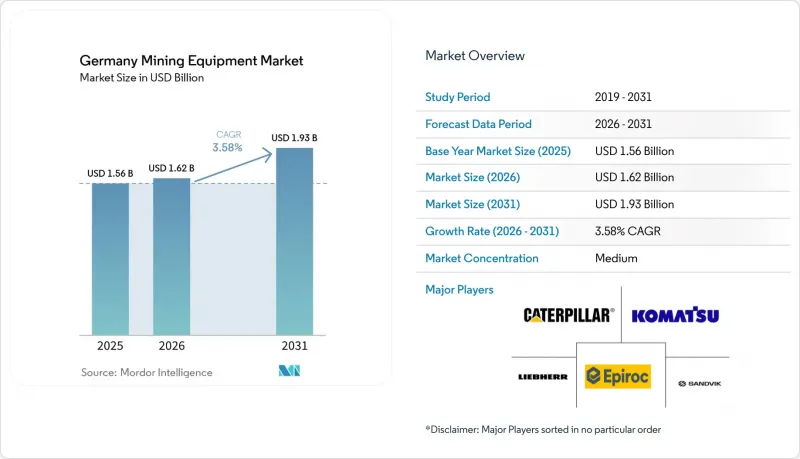
本報告按機械類型(露天採礦機械、地下採礦機械等)、自動化程度(手動機械、半自動機械等)、動力傳動系統類型(內燃機、電池驅動電動等)、產量和應用領域進行分類。市場預測以貨幣價值(美元)和數量(台)兩種形式呈現。
德國礦業機械市場趨勢與洞察
歐盟電池供應鏈中關鍵礦物需求激增
根據德國聯邦地質調查局的數據,德國的鋰資源位居世界前十,凸顯了德國實現歐盟採購目標的決心。 2026年獲得的公共資金表明,投資者對優先採用零碳開採工藝的地熱和鋰礦一體化項目充滿信心。製程流程圖傾向於採用符合第五階段法規標準的模組化破碎機、浮選槽和輸送機。薩克森州和波西米亞的跨境計畫正在促進基礎設施共用,並刺激對移動式加工機械的需求。此外,採用直接鋰提取泵和熱交換器陣列的先導工廠正在推動供應商向耐腐蝕材料轉型。
利用自動化和數位化緩解技術工人短缺問題
採石場營運商認為勞動力短缺是影響生產力的最大風險,這促使他們加快試點部署改裝後的自動駕駛運輸卡車和裝載機。在部署初期,3D車隊協調軟體正被用於防止狹窄隧道內的交通堵塞,這對德國的鉀礦和鹽洞倉儲設施至關重要。大學主導的數位孿生計畫實現了兩位數的運作成長,證明了基於雲端的維護警報的有效性。 OEM遠端資訊處理系統現已整合預測分析功能,使單一主管能夠從中央位置監控多個站點。隨著安全法規的日益嚴格,遠端操作能力正成為採購的必要條件。
由於歐盟排放氣體和噪音法規更加嚴格,機器成本增加。
第五階段引擎排放法規和修訂後的戶外噪音指令迫使汽車製造商(OEM)為車輛後處理系統和隔音罩,導致車輛標價上漲。小規模業者難以負擔改裝套件的費用,這些套件的價格往往超過其設備的殘值,迫使他們選擇電動或混合動力替代方案。雖然財政援助可以抵消部分額外成本,但資金籌措仍然是家族式採石場面臨的一大難題。能夠將合規、資金籌措和維護打包到單一合約中的供應商正在獲得競爭優勢。長期收益包括降低通風成本和提高符合法規要求的車輛車隊的轉售價值。
細分市場分析
2025年,德國礦山機械市場中,露天礦山機械佔據最大佔有率,達47.55%,但預計到2031年,地下礦山機械將以5.35%的複合年成長率(CAGR)實現最高成長。對地下礦場機械的需求主要受鹽隧道儲氫和窄脈鋰礦開採活動的推動,這兩項活動都需要小型裝載機、鑽孔機和通風設備。業者傾向於選擇模組化多用途車輛,這類車輛可以在一個班次內切換不同的模組,用於維修、清掃和岩石運輸等功能。這種柔軟性最大限度地提高了狹窄隧道中機器的運轉率,並減少了所需的車輛數量。原始設備製造商(OEM)正在整合自動駕駛感測器,使客戶能夠透過軟體升級實現無人駕駛操作,而無需購買新設備。由於嚴格的噪音法規,電池驅動的電動裝載機在地下採礦中得到了早期應用,其較低的通風成本可以抵消較高的初始成本。
同時,露天礦場業者正選擇性地投資車輛升級,將柴油運輸卡車與輔助軌道結合,以降低上坡運輸過程中的油耗。中型採石場正在實施數位化負載容量監控,將挖土機、破碎機和輸送機連接起來,以減少閒置時間。全生命週期服務合約正逐漸成為主流,取代了一次性機器銷售模式,並確保原始設備製造商 (OEM) 在整個大修週期中全程參與。隨著客戶對減少排放氣體和縮小碳面積的需求日益成長,專注於高壓破碎輥和地下破碎輸送系統的德國工程公司正受到越來越多的關注。
預計到2025年,手動機械仍將佔據德國礦業設備市場65.33%的佔有率,而全自動系統預計將以18.89%的複合年成長率成長至2031年。自動化是應對德國勞動力短缺和嚴格安全標準的措施。改裝套件使現有的運輸卡車和裝載機能夠利用雷射雷達和人工智慧驅動的感知技術,並按照預設路線行駛。早期採用者報告稱,循環時間穩定性得到提升,換班期間的停機時間減少。諸如ISO 17757之類的法規強制要求功能安全冗餘,這促使買家選擇擁有長期良好記錄的供應商。
半自動駕駛功能、碰撞規避系統和操作員輔助鑽孔循環彌補了傳統車隊的不足,無需徹底改造基礎設施即可即時提高生產效率。位於異地的遠端操控中心為精通技術的工人創造了極具吸引力的新工作崗位,部分抵消了偏遠位置的劣勢。自動駕駛車隊收集的數據被用於預測性維護演算法,以減少意外運作。為此,機械供應商正透過將軟體授權、分析儀表板和網路安全更新捆綁到多年服務包中,來穩定其收入預期。
其他好處:
- Excel格式的市場預測(ME)表
- 3個月的分析師支持
目錄
第1章:引言
- 市場分析與定義的前提條件
- 分析範圍
第2章 分析方法
第3章執行摘要
第4章 市場狀況
- 市場概覽
- 市場促進因素
- 歐盟電池供應鏈中關鍵礦物需求激增
- 利用自動化和數位化緩解技術純熟勞工短缺問題
- 聯邦政府對電池驅動採礦機械的研發獎勵措施
- 擴建地下鹽礦和鉀礦床計畫以用於氫氣儲存
- 褐煤和硬煤礦的現代化改造,以符合排放法規
- 改造地熱井需要一套維修鑽井系統。
- 市場限制因素
- 由於歐盟排放氣體和噪音法規更加嚴格,設備成本增加。
- 大宗商品價格波動正在延緩資本投資。
- 來自東歐的再生商品湧入
- 嚴格的授權程序和當地社區的反對
- 價值鍊和供應鏈分析
- 監理情勢
- 技術展望
- 波特五力分析
第5章:預測市場規模與成長率
- 按機器類型
- 露天鑽井機械
- 地下採礦機械
- 礦物加工機械
- 鑽頭破碎機
- 破碎、研磨與分類機
- 裝載機/運輸卡車
- 按自動化級別
- 手動裝置
- 半自動設備
- 全自動設備
- 依動力傳動系統類型
- 內燃機
- 電池供電
- 混合動力汽車
- 依輸出類型
- 低於500馬力
- 500~1,000 HP
- 1000馬力或以上
- 透過使用
- 金屬礦開採
- 礦產開採
- 採煤
第6章 競爭情勢
- 市場集中度
- 策略趨勢
- 市佔率分析
- 公司簡介
- Caterpillar Inc.
- Komatsu Ltd.
- Liebherr-International AG
- Epiroc AB
- Sandvik AB
- Hitachi Construction Machinery Co., Ltd.
- Volvo Construction Equipment
- Herrenknecht AG
- Thyssenkrupp Mining Technologies GmbH(FLSmidth)
- TAKRAF GmbH
- FAM Mineral Processing Systems GmbH
- Paus Maschinenfabrik GmbH
- Wirtgen GmbH(John Deere)
- Atlas Copco AB
- Sany Germany GmbH
- Terex Corporation
第7章 市場機會與未來展望
According to Mordor Intelligence, the Germany mining equipment market size was valued at USD 1.56 billion in 2025, and is projected to grow from USD 1.62 billion in 2026 to USD 1.93 billion by 2031, growing at a CAGR of 3.58% over 2026-2031.
This report is Segmented by Equipment Type (Surface Mining Equipment, Underground Mining Equipment, and More), Automation Level (Manual Equipment, Semi-Autonomous Equipment, and More), Powertrain Type (Internal-Combustion Engine Vehicles, Battery-Electric Vehicles, and More), Power Output, and Application. The Market Forecasts are Provided in Terms of Value (USD) and Volume (Units).
Germany Mining Equipment Market Trends and Insights
Surge in Demand for Critical Minerals for EU Battery Supply Chain
Federal geology data place Germany's lithium resources among the world's top ten, underpinning domestic ambitions to meet EU sourcing targets. Public financing secured in 2026 demonstrates investor confidence in integrated geothermal-lithium ventures that prioritize zero-carbon extraction processes. Flowsheets favor modular crushers, flotation cells, and conveyors that already comply with Stage V limits. Cross-border projects in Saxony-Bohemia promote shared infrastructure and spur demand for mobile processing equipment. Pilot plants adopting direct-lithium-extraction pumps and heat-exchanger arrays also reshape supplier requirements toward corrosion-resistant materials.
Automation and Digitalization to Mitigate Skilled-Labor Crunch
Quarry operators cite workforce scarcity as a top productivity risk, accelerating trials of retrofitted autonomous haul trucks and loaders. Early deployments rely on 3D fleet-orchestration software that prevents traffic deadlocks in narrow drifts, important for Germany's potash and salt caverns. University-led digital-twin programs report double-digit uptime gains, validating cloud-based maintenance alerts. OEM telematics now bundles predictive analytics, enabling a single supervisor to monitor multiple sites from a central hub. As safety directives tighten, remote-operation readiness becomes a procurement prerequisite.
Stricter EU Emissions and Noise Limits Raising Equipment Costs
Stage V engine rules and updated outdoor-noise directives force OEMs to integrate after-treatment hardware and acoustic enclosures, raising sticker prices. Small operators grapple with retrofit kits that often cost more than the machine's residual value, nudging them toward electric or hybrid options. Funding partially offsets premiums, yet capital hurdles persist for family-owned quarries. Suppliers that bundle compliance, financing, and maintenance into a single contract gain a competitive edge. Long-term benefits include lower ventilation expenses and higher resale value for compliant fleets.
Other drivers and restraints analyzed in the detailed report include:
- Federal R&D Incentives for Battery-Electric Mining Equipment
- Expansion of Underground Salt and Potash Projects for Hydrogen Storage
- Commodity-Price Volatility Delaying CAPEX
For complete list of drivers and restraints, kindly check the Table Of Contents.
Segment Analysis
Surface equipment held the largest share, at 47.55%, in Germany's mining equipment market in 2025, yet underground units are projected to post the fastest CAGR, at 5.35%, through 2031. Underground demand benefits from salt-cavern hydrogen storage and narrow-vein lithium activity, both of which require compact loaders, drilling jumbos, and ventilation packages. Operators favor modular utility vehicles that can switch cassettes between service, scaling, and rock-haul functions within a single shift. Such flexibility maximizes machine utilization in tight headings and reduces fleet size requirements. OEMs embed autonomous-ready sensors so customers can enable driverless features via software upgrades rather than purchasing new iron. Given strict noise ceilings, battery-electric loaders find early adoption underground where reduced ventilation offsets higher acquisition costs.
Meanwhile, surface-mine operators invest selectively in fleet upgrades that pair diesel haul trucks with trolley-assist lines to curb fuel burn on uphill hauls. Mid-sized quarries adopt digital payload monitoring that links shovels, crushers, and conveyor belts, trimming idle times. Lifecycle service contracts replace one-off machine sales, ensuring OEM involvement throughout rebuild cycles. German engineering firms that specialize in high-pressure grinding rolls and in-pit crushing-and-conveying systems gain traction as customers seek lower emissions and smaller footprints.
Manual machines retained 65.33% of the German mining equipment market share in 2025, yet fully autonomous systems are forecast to expand at an 18.89% CAGR through 2031. Autonomy addresses Germany's labor shortage and stringent safety expectations. Retrofit kits allow existing haul trucks and loaders to navigate predefined routes using lidar and AI-enhanced perception. Early adopters report improved cycle-time consistency and reduced shift-change downtime-regulations such as ISO 17757 mandate functional-safety redundancies, steering buyers toward vendors with long operating records.
Semi-autonomous features, collision avoidance, and operator-assist dig cycles act as a bridge for conservative fleets while delivering immediate productivity gains without a full infrastructure overhaul. Tele-operation hubs located off-site create new job profiles that appeal to tech-oriented workers, partially offsetting disadvantages associated with rural locations. Data collected by autonomous fleets feeds into predictive maintenance algorithms, reducing unplanned outages. In response, equipment suppliers bundle software licenses, analytics dashboards, and cybersecurity updates into multiyear service packages that smooth revenue visibility.
Complete Report Scope:
- By Equipment Type
- Surface Mining Equipment
- Underground Mining Equipment
- Mineral Processing Equipment
- Drills and Breakers
- Crushing, Pulverizing and Screening
- Loaders and Haul Trucks
- By Automation Level
- Manual Equipment
- Semi-Autonomous Equipment
- Fully Autonomous Equipment
- By Powertrain Type
- Internal-Combustion Engine Vehicles
- Battery-Electric Vehicles
- Hybrid Vehicles
- By Power Output
- Less than 500 HP
- 500 - 1,000 HP
- Above 1,000 HP
- By Application
- Metal Mining
- Mineral Mining
- Coal Mining
List of Companies Covered in this Report:
- Caterpillar Inc.
- Komatsu Ltd.
- Liebherr-International AG
- Epiroc AB
- Sandvik AB
- Hitachi Construction Machinery Co., Ltd.
- Volvo Construction Equipment
- Herrenknecht AG
- Thyssenkrupp Mining Technologies GmbH (FLSmidth)
- TAKRAF GmbH
- FAM Mineral Processing Systems GmbH
- Paus Maschinenfabrik GmbH
- Wirtgen GmbH (John Deere)
- Atlas Copco AB
- Sany Germany GmbH
- Terex Corporation
Additional Benefits:
- The market estimate (ME) sheet in Excel format
- 3 months of analyst support
TABLE OF CONTENTS
1 Introduction
- 1.1 Study Assumptions & Market Definition
- 1.2 Scope of the Study
2 Research Methodology
3 Executive Summary
4 Market Landscape
- 4.1 Market Overview
- 4.2 Market Drivers
- 4.2.1 Surge in Demand for Critical Minerals for EU Battery Supply Chain
- 4.2.2 Automation and Digitalization to Mitigate Skilled-Labor Crunch
- 4.2.3 Federal R&D Incentives for Battery-Electric Mining Equipment
- 4.2.4 Expansion of Underground Salt and Potash Projects for Hydrogen Storage
- 4.2.5 Modernization of Lignite and Hard-Coal Mines for Emissions Compliance
- 4.2.6 Geothermal Shaft Repurposing Requiring Retrofit Drilling Systems
- 4.3 Market Restraints
- 4.3.1 Stricter EU Emissions and Noise Limits Raising Equipment Costs
- 4.3.2 Commodity-Price Volatility Delaying CAPEX
- 4.3.3 Influx of Refurbished Eastern-European Machines
- 4.3.4 Stringent Permitting and Community Opposition
- 4.4 Value / Supply-Chain Analysis
- 4.5 Regulatory Landscape
- 4.6 Technological Outlook
- 4.7 Porter's Five Forces
- 4.7.1 Threat of New Entrants
- 4.7.2 Bargaining Power of Suppliers
- 4.7.3 Bargaining Power of Buyers
- 4.7.4 Threat of Substitutes
- 4.7.5 Competitive Rivalry
5 Market Size & Growth Forecasts (Value (USD) & Volume (Units))
- 5.1 By Equipment Type
- 5.1.1 Surface Mining Equipment
- 5.1.2 Underground Mining Equipment
- 5.1.3 Mineral Processing Equipment
- 5.1.4 Drills and Breakers
- 5.1.5 Crushing, Pulverizing and Screening
- 5.1.6 Loaders and Haul Trucks
- 5.2 By Automation Level
- 5.2.1 Manual Equipment
- 5.2.2 Semi-Autonomous Equipment
- 5.2.3 Fully Autonomous Equipment
- 5.3 By Powertrain Type
- 5.3.1 Internal-Combustion Engine Vehicles
- 5.3.2 Battery-Electric Vehicles
- 5.3.3 Hybrid Vehicles
- 5.4 By Power Output
- 5.4.1 Less than 500 HP
- 5.4.2 500 - 1,000 HP
- 5.4.3 Above 1,000 HP
- 5.5 By Application
- 5.5.1 Metal Mining
- 5.5.2 Mineral Mining
- 5.5.3 Coal Mining
6 Competitive Landscape
- 6.1 Market Concentration
- 6.2 Strategic Moves
- 6.3 Market Share Analysis
- 6.4 Company Profiles (Includes Global Level Overview, Market Level Overview, Core Segments, Financials as Available, Strategic Information, Market Rank/Share for Key Companies, Products and Services, SWOT Analysis, and Recent Developments)
- 6.4.1 Caterpillar Inc.
- 6.4.2 Komatsu Ltd.
- 6.4.3 Liebherr-International AG
- 6.4.4 Epiroc AB
- 6.4.5 Sandvik AB
- 6.4.6 Hitachi Construction Machinery Co., Ltd.
- 6.4.7 Volvo Construction Equipment
- 6.4.8 Herrenknecht AG
- 6.4.9 Thyssenkrupp Mining Technologies GmbH (FLSmidth)
- 6.4.10 TAKRAF GmbH
- 6.4.11 FAM Mineral Processing Systems GmbH
- 6.4.12 Paus Maschinenfabrik GmbH
- 6.4.13 Wirtgen GmbH (John Deere)
- 6.4.14 Atlas Copco AB
- 6.4.15 Sany Germany GmbH
- 6.4.16 Terex Corporation
7 Market Opportunities & Future Outlook
- 7.1 White-space & Unmet-Need Assessment

 中國礦山機械:市場佔有率分析、產業趨勢與統計、成長預測(2026-2031年)印度礦業機械:市場佔有率分析、產業趨勢與統計、成長預測(2026-2031)非洲礦業機械:市場佔有率分析、產業趨勢與統計、成長預測(2026-2031 年)馬來西亞礦業機械:市場佔有率分析、產業趨勢與統計、成長預測(2026-2031)日本礦業機械:市場佔有率分析、產業趨勢及統計、成長預測(2026-2031)法國礦業機械:市場佔有率分析、產業趨勢與統計、成長預測(2026-2031)英國礦業機械:市場佔有率分析、產業趨勢與統計、成長預測(2026-2031)西班牙礦業機械:市場佔有率分析、產業趨勢與統計、成長預測(2026-2031)
 礦業機械市場報告:趨勢、預測與競爭分析(至2035年)
 自主採礦機械市場規模、佔有率、成長、全球產業分析、區域趨勢及2026-2034年預測。