

 |
市場調查報告書
商品編碼
2117374
日本礦業機械:市場佔有率分析、產業趨勢及統計、成長預測(2026-2031)Japan Mining Equipment - Market Share Analysis, Industry Trends & Statistics, Growth Forecasts (2026 - 2031) |
||||||

※ 本網頁內容可能與最新版本有所差異。詳細情況請與我們聯繫。
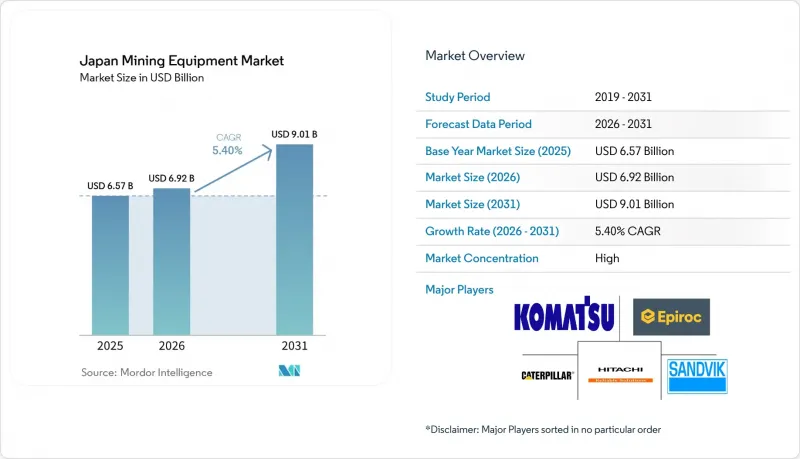
據 Mordor Intelligence 稱,2025 年日本礦業機械市場價值 65.7 億美元,預計到 2031 年將從 2026 年的 69.2 億美元成長至 90.1 億美元,在預測期(2026-2031 年)內複合年成長率為 5.40%。
本報告按機器類型(露天鑽孔機、地下鑽孔機等)、自動化程度(手動機器等)、動力傳動系統類型(內燃機等)、功率輸出(小於500馬力等)和應用領域(金屬礦山等)進行分類。市場預測以美元計價。
日本礦業機械市場趨勢與洞察
政府鼓勵基本礦產自給自足的獎勵
根據日本《經濟安全促進法》,關鍵金屬和採礦機械被認定為「關鍵」產品,從而獲得優惠融資、稅收減免和簡化核准程序。該法案旨在增強供應鏈韌性,並為裝載機、破碎機、海上機器人等關鍵設備提供多年採購保障。此舉旨在減少對進口的依賴,並增強國內產能。此外,財政支持和簡化的核准程序為現有設施的維修和新計畫的啟動提供了穩定的前景,從而促進採礦業的長期發展。
電動車電池金屬需求激增
在豐田進軍固態固態電池和Panasonic雄心勃勃的超級工廠建設的推動下,日本電動車產量實現了顯著成長。隨著對正極材料需求的加速成長,大容量破碎機和浮選機的採購量激增,日本礦業機械市場正朝著更先進的選礦生產線轉型。住友金屬礦業利用5G地下網路遠端控制其山特維克「AutoMine」車隊,顯著提高了生產效率。日立ABB電池電動運輸卡車在北海道的試運轉顯著降低了柴油消耗。在地緣政治層面,中國對鎵和鍺的出口限制導致礦業零件成本飆升,凸顯了國內礦業投資的戰略重要性。
環境授權的挑戰制約了專案進度。
環境影響評估法要求進行一系列關於生物多樣性、水質和文化遺產的調查,這延長了陸上和海上礦山風險評估所需的時間。由於缺乏底棲生態系的基線數據,深海開發案面臨嚴格的審查。礦業開發商必須在融資完成時提供修復資金,這增加了初始資本投資。這些條件促使設備訂購推遲到專案後期,並推動採用模組化、可移動式工廠,以最大限度地減少對海底的永久性變更。合規相關的額外工作量增加了軟成本的比例,減緩了新船隊的部署速度。
細分市場分析
在日本採礦機械市場,露天採礦機械預計到2025年將佔銷售額的37.22%,其作業主要集中在北海道和九州地區。隨著多家煤礦的關閉,地下採礦機械的重要性日益凸顯。這些煤礦的關閉促使人們開挖隧道開採稀土元素,而這個過程越來越依賴小型裝載機和先進的通風系統。礦物加工系統產業正經歷最快的成長。這種快速成長的驅動力源於對更有效率的破碎和浮選能力的需求,以處理低品位礦石。特別是,住友重工對其「菱刈」生產線的升級改造,已成功大幅降低了每噸礦石的成本。
預計到2031年,鑽機和破碎機的複合年成長率將達到8.24%,因為業者需要開採礦床。日本小松公司的「FrontRunner」運輸系統正在提升自主運輸能力並大幅降低人事費用。同時,Hi ROBOROCK公司的Jumbo透過利用預測性維護物聯網技術,在隧道擴建領域處於領先地位。為規避碳排放稅而進行的持續維修正在推動日本礦山機械市場的新訂單和替換訂單。
手動操作的鑽機仍佔已部署鑽機總數的 54.07%,但人手不足和安全法規正在加速向半自動和全自動平台的轉型。Caterpillar的「運輸指揮系統」(Command for Hauling)使一名操作員能夠管理多輛卡車,為需要嚴格控制資本支出 (CAPEX) 的環境提供了一種切實可行的過渡解決方案。
得益於「i-Construction」稅額扣抵,高達30%的購置成本可獲得報銷,使得全自動系統的複合年成長率達到9.22%,在所有類別中位居榜首。根據《礦業安全法》,認證必須使用雙冗餘感測器和故障安全邏輯。雖然這項要求延長了檢驗週期,但也鞏固了日本小松公司、山特維克和Epiroc在日本礦業機械市場作為值得信賴的供應商的地位。對於小規模礦業企業,尤其是年產量較低的企業而言,引進全自動鑽機在經濟上不可行,手動鑽機仍是主流選擇。
其他好處:
- Excel格式的市場預測(ME)表
- 3個月的分析師支持
目錄
第1章:引言
- 市場分析與定義的前提條件
- 分析範圍
第2章 分析方法
第3章執行摘要
第4章 市場狀況
- 市場概覽
- 市場促進因素
- 政府鼓勵基本礦產自給自足的激勵措施
- 電動車電池金屬需求激增
- 人工智慧探勘鑽機的技術進步
- 促進甲烷水合物和深海資源的開發。
- 勞動力老化
- 碳中和目標正在推動純電動車鑽機。
- 市場限制因素
- 嚴格的環境許可製度
- 價格波動
- 土地短缺和城市發展
- 高精度零件供應鏈中的脆弱性
- 價值鍊和供應鏈分析
- 監理情勢
- 技術展望
- 波特五力分析
第5章:預測市場規模與成長率
- 按機器類型
- 露天鑽井機械
- 地下鑽探機械
- 礦物加工設備
- 鑽孔機(挖掘機)/破碎機(破碎機)
- 破碎、研磨與分類機
- 裝載機/運輸卡車
- 按自動化級別
- 手動機器
- 半自動機器
- 全自動機器
- 依動力傳動系統類型
- 內燃機
- 電池供電
- 混合
- 依輸出類型
- 低於500馬力
- 500~1,000 HP
- 1000馬力或以上
- 透過使用
- 金屬礦開採
- 礦石開採
- 採煤
第6章 競爭情勢
- 市場集中度
- 策略趨勢
- 市佔率分析
- 公司簡介
- Epiroc AB
- Sandvik AB
- Caterpillar Inc.
- Komatsu Ltd.
- Hitachi Construction Machinery
- Sumitomo Metal Mining Exploration Tech
- Boart Longyear
- Atlas Copco
- Furukawa Rock Drill
- Mitsui Mining and Smelting Tech
- JFE Engineering Geo-Services
- Yokogawa Electric(GeoSolutions)
- Tokyo Seimitsu(Accretech)
- GeoScan Technologies
- Geometrics Inc.
- Teledyne Reson
- Deep-Ocean Vision
- DJI Enterprise
- Skycatch Japan
- Terra Drone Corp.
第7章 市場機會與未來展望
目錄
第1章:引言
- 市場分析與定義的前提條件
- 分析範圍
第2章 分析方法
第3章執行摘要
第4章 市場狀況
- 市場概覽
- 市場促進因素
- 政府鼓勵基本礦產自給自足的激勵措施
- 電動車電池金屬需求激增
- 人工智慧探勘鑽機的技術進步
- 促進甲烷水合物和深海資源的開發。
- 勞動力老化
- 碳中和目標正在推動純電動車鑽機。
- 市場限制因素
- 嚴格的環境許可製度
- 價格波動
- 土地短缺和城市發展
- 高精度零件供應鏈中的脆弱性
- 價值鍊和供應鏈分析
- 監理情勢
- 技術展望
- 波特五力分析
第5章:預測市場規模與成長率
- 按機器類型
- 露天鑽井機械
- 地下鑽探機械
- 礦物加工設備
- 鑽孔機(挖掘機)/破碎機(破碎機)
- 破碎、研磨、分類
- 裝載機/運輸卡車
- 按自動化級別
- 手動機器
- 半自動機器
- 全自動機器
- 依動力傳動系統類型
- 內燃機
- 電池供電
- 混合
- 依輸出類型
- 低於500馬力
- 500~1,000 HP
- 1000馬力或以上
- 透過使用
- 金屬礦開採
- 礦石開採
- 採煤
第6章 競爭情勢
- 市場集中度
- 策略趨勢
- 市佔率分析
- 公司簡介
- Epiroc AB
- Sandvik AB
- Caterpillar Inc.
- Komatsu Ltd.
- Hitachi Construction Machinery
- Sumitomo Metal Mining Exploration Tech
- Boart Longyear
- Atlas Copco
- Furukawa Rock Drill
- Mitsui Mining and Smelting Tech
- JFE Engineering Geo-Services
- Yokogawa Electric(GeoSolutions)
- Tokyo Seimitsu(Accretech)
- GeoScan Technologies
- Geometrics Inc.
- Teledyne Reson
- Deep-Ocean Vision
- DJI Enterprise
- Skycatch Japan
- Terra Drone Corp.
第7章 市場機會與未來展望
According to Mordor Intelligence, the Japan mining equipment market size was valued at USD 6.57 billion in 2025 and is estimated to grow from USD 6.92 billion in 2026 to reach USD 9.01 billion by 2031, at a CAGR of 5.40% during the forecast period (2026-2031), growing at a CAGR of 5.40% over 2026-2031.
This report is Segmented by Equipment Type (Surface Mining Equipment, Underground Mining Equipment, and More), Automation Level (Manual Equipment, and More), Powertrain Type (Internal-Combustion Engine Vehicles, and More), Power Output (Less Than 500 HP, and More), and Application (Metal Mining and More). The Market Forecasts are Provided in Terms of Value (USD).
Japan Mining Equipment Market Trends and Insights
Government Incentives for Critical-Mineral Self-Sufficiency
Japan's Economic Security Promotion Act has designated key metals and mining equipment as "critical," paving the way for preferential financing, tax relief, and expedited permitting. The act mandates supply-chain resilience, guaranteeing multi-year purchasing pipelines for essential equipment like loaders, crushing circuits, and offshore robotics. This initiative aims to reduce dependency on imports and bolster domestic production capabilities . Additionally, fiscal support and swift regulatory processes provide a stable outlook for brownfield upgrades and new greenfield projects, fostering long-term growth in the mining sector.
Surging EV-Battery Metal Demand
Japan's electric-vehicle production experienced significant growth, driven by Toyota's expansion into solid-state batteries and Panasonic's ambitious gigafactory development. As demand for cathode materials accelerates, there's a surge in the procurement of high-throughput crushers and flotation cells, steering Japan's mining equipment market towards more advanced mineral-processing lines. Sumitomo Metal Mining, leveraging a 5G underground network, is remotely operating Sandvik AutoMine fleets to achieve a substantial productivity boost. Trials of Hitachi's ABB-powered battery-electric haul truck in Hokkaido achieved a notable reduction in diesel consumption. On the geopolitical front, China's export restrictions on gallium and germanium led to a spike in drilling-component costs, underscoring the strategic importance of domestic extraction investments.
Environmental Permitting Challenges Constrain Project Timelines
Environmental Impact Assessment law imposes sequential studies on biodiversity, water quality, and cultural heritage, extending the timeline for risk assessment for both onshore and offshore mines. Deep-sea schemes face heightened scrutiny due to limited baselines for benthic ecosystems. Mining promoters must show rehabilitation funding at financial close, raising up-front capex. These conditions push equipment orders into later project phases and incentivize modular, redeployable plants that minimize permanent seabed alteration. The additional compliance workload raises soft-cost ratios and tempers the velocity of new fleet installations.
Other drivers and restraints analyzed in the detailed report include:
- Tech Advances in AI-Enabled Exploration Rigs
- National Push for Methane-Hydrate and Deep-Sea Resources
- Commodity Price Volatility Impacts Investment Decisions
For complete list of drivers and restraints, kindly check the Table Of Contents.
Segment Analysis
Surface mining equipment accounted for 37.22% of 2025 revenues in the Japan mining equipment market, with operations anchored in Hokkaido and Kyushu. As several coal sites shuttered, underground units have found newfound significance. These closures have opened tunnels for the extraction of rare-earth elements, a process now heavily reliant on compact loaders and advanced ventilation equipment. The mineral-processing systems segment is witnessing the swiftest growth. This surge is driven by the need for enhanced crushing and flotation capacities to handle low-grade ores. Notably, Sumitomo's upgrade to its Hishikari line achieved a remarkable reduction in cost-per-tonne.
Drills and breakers are poised for an 8.24% CAGR to 2031 as operators pursue narrow-vein deposits where bulk excavation is unviable. Komatsu's FrontRunner haulage boosts autonomous haul performance, significantly reducing labor costs. Meanwhile, Hi ROBOROCK's jumbos lead in tunnel expansion, leveraging predictive-maintenance IoT. Ongoing retrofits aimed at sidestepping carbon taxes are driving both new and replacement orders in Japan's mining equipment market.
Manual rigs still account for 54.07% of installed units, yet labor scarcity and safety rules are catalyzing a shift toward semi- and fully autonomous platforms. Caterpillar's Command for Hauling allows a single controller to oversee multiple trucks, delivering a workable bridge solution in environments with strict CAPEX discipline.
Fully autonomous systems post a 9.22% CAGR, the highest among all categories, as the i-Construction tax credit reimburses up to 30% of purchase costs. Under the Mine Safety Act, certification mandates the use of dual-redundant sensors and fail-safe logic. This requirement introduces a lengthy validation cycle, solidifying Komatsu, Sandvik, and Epiroc's positions as trusted suppliers in Japan's mining equipment market. In artisanal operations, manual rigs continue to dominate, especially when annual throughput is low, making autonomy economically unfeasible.
Complete Report Scope:
- By Equipment Type
- Surface Mining Equipment
- Underground Mining Equipment
- Mineral Processing Equipment
- Drills and Breakers
- Crushing, Pulverizing and Screening
- Loaders and Haul Trucks
- By Automation Level
- Manual Equipment
- Semi-Autonomous Equipment
- Fully Autonomous Equipment
- By Powertrain Type
- Internal-Combustion Engine Vehicles
- Battery-Electric Vehicles
- Hybrid Vehicles
- By Power Output
- Less than 500 HP
- 500 to 1,000 HP
- Above 1,000 HP
- By Application
- Metal Mining
- Mineral Mining
- Coal Mining
List of Companies Covered in this Report:
- Epiroc AB
- Sandvik AB
- Caterpillar Inc.
- Komatsu Ltd.
- Hitachi Construction Machinery
- Sumitomo Metal Mining Exploration Tech
- Boart Longyear
- Atlas Copco
- Furukawa Rock Drill
- Mitsui Mining and Smelting Tech
- JFE Engineering Geo-Services
- Yokogawa Electric (GeoSolutions)
- Tokyo Seimitsu (Accretech)
- GeoScan Technologies
- Geometrics Inc.
- Teledyne Reson
- Deep-Ocean Vision
- DJI Enterprise
- Skycatch Japan
- Terra Drone Corp.
Additional Benefits:
- The market estimate (ME) sheet in Excel format
- 3 months of analyst support
TABLE OF CONTENTS
1 Introduction
- 1.1 Study Assumptions and Market Definition
- 1.2 Scope of the Study
2 Research Methodology
3 Executive Summary
4 Market Landscape
- 4.1 Market Overview
- 4.2 Market Drivers
- 4.2.1 Gov. Incentives for Critical-mineral Self-sufficiency
- 4.2.2 Surging EV-battery Metal Demand
- 4.2.3 Tech Advances in AI-enabled Exploration Rigs
- 4.2.4 Push for Methane-hydrate and Deep-sea Resources
- 4.2.5 Ageing Workforce
- 4.2.6 Carbon-neutral Targets Favouring BEV Rigs
- 4.3 Market Restraints
- 4.3.1 Stringent Environmental Permitting
- 4.3.2 Commodity-price Volatility
- 4.3.3 Land Scarcity vs Urban Development
- 4.3.4 High-Precision Component Supply Chain Fragility
- 4.4 Value/Supply-Chain Analysis
- 4.5 Regulatory Landscape
- 4.6 Technological Outlook
- 4.7 Porter's Five Forces
- 4.7.1 Threat of New Entrants
- 4.7.2 Bargaining Power of Suppliers
- 4.7.3 Bargaining Power of Buyers
- 4.7.4 Threat of Substitutes
- 4.7.5 Competitive Rivalry
5 Market Size and Growth Forecasts (Value (USD))
- 5.1 By Equipment Type
- 5.1.1 Surface Mining Equipment
- 5.1.2 Underground Mining Equipment
- 5.1.3 Mineral Processing Equipment
- 5.1.4 Drills and Breakers
- 5.1.5 Crushing, Pulverizing and Screening
- 5.1.6 Loaders and Haul Trucks
- 5.2 By Automation Level
- 5.2.1 Manual Equipment
- 5.2.2 Semi-Autonomous Equipment
- 5.2.3 Fully Autonomous Equipment
- 5.3 By Powertrain Type
- 5.3.1 Internal-Combustion Engine Vehicles
- 5.3.2 Battery-Electric Vehicles
- 5.3.3 Hybrid Vehicles
- 5.4 By Power Output
- 5.4.1 Less than 500 HP
- 5.4.2 500 to 1,000 HP
- 5.4.3 Above 1,000 HP
- 5.5 By Application
- 5.5.1 Metal Mining
- 5.5.2 Mineral Mining
- 5.5.3 Coal Mining
6 Competitive Landscape
- 6.1 Market Concentration
- 6.2 Strategic Moves
- 6.3 Market Share Analysis
- 6.4 Company Profiles (Includes Global-level Overview, Market-level Overview, Core Segments, Financials as available, Strategic Information, Market Rank/Share, Products and Services, Recent Developments)
- 6.4.1 Epiroc AB
- 6.4.2 Sandvik AB
- 6.4.3 Caterpillar Inc.
- 6.4.4 Komatsu Ltd.
- 6.4.5 Hitachi Construction Machinery
- 6.4.6 Sumitomo Metal Mining Exploration Tech
- 6.4.7 Boart Longyear
- 6.4.8 Atlas Copco
- 6.4.9 Furukawa Rock Drill
- 6.4.10 Mitsui Mining and Smelting Tech
- 6.4.11 JFE Engineering Geo-Services
- 6.4.12 Yokogawa Electric (GeoSolutions)
- 6.4.13 Tokyo Seimitsu (Accretech)
- 6.4.14 GeoScan Technologies
- 6.4.15 Geometrics Inc.
- 6.4.16 Teledyne Reson
- 6.4.17 Deep-Ocean Vision
- 6.4.18 DJI Enterprise
- 6.4.19 Skycatch Japan
- 6.4.20 Terra Drone Corp.
7 Market Opportunities and Future Outlook
- 7.1 White-space and Unmet-Need Assessment

 中國礦山機械:市場佔有率分析、產業趨勢與統計、成長預測(2026-2031年)印度礦業機械:市場佔有率分析、產業趨勢與統計、成長預測(2026-2031)德國礦業機械:市場佔有率分析、產業趨勢與統計、成長預測(2026-2031)非洲礦業機械:市場佔有率分析、產業趨勢與統計、成長預測(2026-2031 年)馬來西亞礦業機械:市場佔有率分析、產業趨勢與統計、成長預測(2026-2031)法國礦業機械:市場佔有率分析、產業趨勢與統計、成長預測(2026-2031)英國礦業機械:市場佔有率分析、產業趨勢與統計、成長預測(2026-2031)西班牙礦業機械:市場佔有率分析、產業趨勢與統計、成長預測(2026-2031)
 礦業機械市場報告:趨勢、預測與競爭分析(至2035年)
 自主採礦機械市場規模、佔有率、成長、全球產業分析、區域趨勢及2026-2034年預測。