


 |
市場調查報告書
商品編碼
2117418
法國礦業機械:市場佔有率分析、產業趨勢與統計、成長預測(2026-2031)France Mining Equipment - Market Share Analysis, Industry Trends & Statistics, Growth Forecasts (2026 - 2031) |
||||||

※ 本網頁內容可能與最新版本有所差異。詳細情況請與我們聯繫。
根據 Mordor Intelligence 預測,法國礦業機械市場預計將從 2025 年的 9.4 億美元成長到 2026 年的 9.7 億美元,到 2031 年達到 11.3 億美元,2026 年至 2031 年的複合年成長率預計為 3.16%。
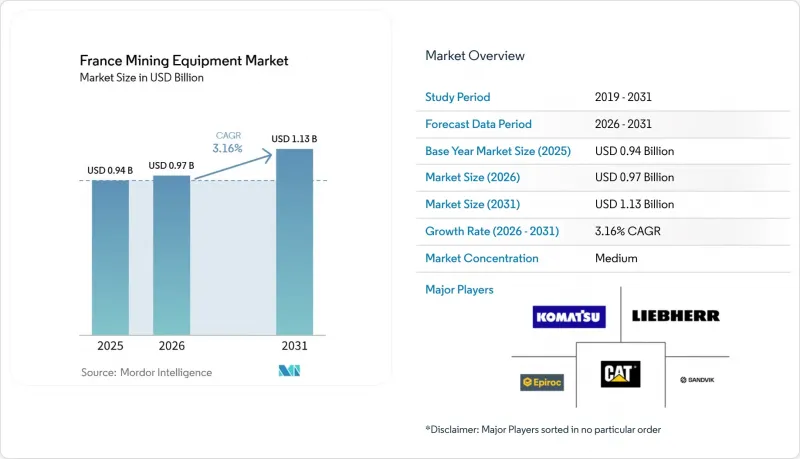
本報告按機器類型(露天採礦機械、地下採礦機械等)、自動化程度(手動機械、半自動機械等)、動力傳動系統類型(內燃機等)、功率輸出(小於500馬力等)和應用領域(金屬礦山開採等)進行分類。市場預測以美元計價。
法國礦業機械市場趨勢與洞察
歐盟的《基本原料法》加快了對國內採礦業的投資。
該法規定,2030年,國內採礦產能必須達到10%,許可證核准時間縮短高達50%,設備採購週期也得以加速。隨著營運商越來越遵守歐盟永續發展資訊揭露標準,符合可追溯性和低排放標準的設備供應商正獲得競爭優勢。這一趨勢源於對環境、社會和管治(ESG)標準的日益重視,這些標準對於企業維持合規性和市場競爭力至關重要。此外,該法還支持地方人力資源發展計劃,以促進當地就業機會和技能發展。這些措施也因此推動了售後服務需求,因為熟練的人員對於有效維護和保養設備、確保營運效率和客戶滿意度至關重要。
「法國2030基金」正在支持重要的礦產計畫。
伊梅里斯(Imerys)的EMILI鋰礦計畫獲得了一筆數額更大的資金,從而獲得了早期發展動力。這筆資金籌措是更廣泛資本投資計畫的第一階段,該計畫涵蓋了包括大型挖土機、電池驅動裝載機和自動駕駛卡車在內的各種設備。該專案選擇股權投資而非傳統的津貼,從而更有效地協調了獎勵。這項策略措施將降低風險溢價並加快融資週期。此外,像InfraVia的關鍵礦產基金這樣的私人公司也在擴大其投資範圍。這些公司專注於各種中小型項目,而這些項目通常更傾向於使用緊湊型模組化機械。
自動駕駛/純電動車隊的資本投資成本高,投資回收期長。
電池驅動裝載機本身就比柴油機型貴得多,而一旦加上自動駕駛功能,成本更是飆升。這些高昂的初始成本,加上營運方面的挑戰,延長了中型礦場的投資回收期,使得這項投資難以回收成本。尤其值得注意的是,二手價格的不確定性以及電池劣化帶來的財務風險,引發了人們對長期經濟效益的擔憂,阻礙了電池驅動裝載機的廣泛應用。
細分市場分析
2025年,露天採礦機械佔法國採礦機械市佔率的41.87%。地下採礦機械雖然目前市場規模較小,但預計2026年至2031年間的複合年成長率將達到6.46%,是同類產品中成長率最高的。造成這種差異的原因在於市政當局對新建露天礦的抵制,以及保護俯瞰鋰礦和鎢礦床的鄉村景觀的必要性。
因此,營運商正將資本投資轉向裝載機、大型挖土機和專為有限礦區設計的自動駕駛運輸卡車,預計這一轉變將使訂單提前至 2026-2028 年期間。雖然骨材,但隨著採石場產量趨於穩定,其成長也已放緩。
至2025年,手動採礦機械將佔法國採礦機械市場64.12%的佔有率。然而,預計到2031年,全自動機械的年複合成長率將達到7.43%,超過其他所有自動化程度。在大規模地下計畫中,雖然初期整合成本較高,但資產利用率的顯著提高和人事費用的大幅降低足以彌補這項投入。
中型礦場業者正傾向選擇半自動化設備,這些設備具備防碰撞和遠端控制功能,且無需在整個礦區部署5G網路。政府主導的數位技能提升計畫可望緩解目前技術工人短缺的局面,並從2027年起推動科技的平穩普及。
其他好處:
- Excel格式的市場預測(ME)表
- 3個月的分析師支持
目錄
第1章:引言
- 研究假設和市場定義
- 調查範圍
第2章:調查方法
第3章執行摘要
第4章 市場狀況
- 市場概覽
- 市場促進因素
- 歐盟的《基本原料法》正在加速國內礦業投資。
- 自動化和電氣化提高了安全性和生產效率的經濟效益。
- 「法國2030基金」正在支持重要的礦產計畫。
- 非鐵路物料供應短缺/歐VI排放氣體法規加速車輛更換
- 由於巴西地質與地質調查局(BRGM)發布了《國家地下資源目錄》,探勘支出正在增加。
- 銅和鋰礦的再開發項目需要專用設備。
- 市場限制因素
- 國內煤炭產量下降抑制了對某些類型機械的需求。
- 自動駕駛汽車/純電動車隊投資額高,投資回收期長
- 根據修訂後的《礦業法》進行長期公眾諮詢
- 缺乏能夠管理先進系統的熟練工程師
- 價值供應鏈分析
- 監理情勢
- 技術展望
- 波特五力模型
第5章 市場規模與成長預測
- 按機器類型
- 露天鑽井機械
- 地下採礦機械
- 礦物加工設備
- 鑽頭破碎機
- 破碎、研磨與分類機
- 裝載機
- 礦用卡車
- 按自動化級別
- 手動機器
- 半自動機器
- 全自動機器
- 依動力傳動系統類型
- 內燃機
- 電池供電
- 混合
- 依輸出類型
- 低於500馬力
- 500~1,000 HP
- 1000馬力或以上
- 透過使用
- 金屬礦開採
- 礦產開採
- 採煤
第6章 競爭情勢
- 市場集中度
- 策略趨勢
- 市佔率分析
- 公司簡介
- Caterpillar Inc.
- Komatsu Ltd.
- Sandvik AB
- Epiroc AB
- Liebherr-International AG
- Volvo Construction Equipment AB
- Hitachi Construction Machinery Co., Ltd.
- Atlas Copco AB
- Doosan Infracore(HD Hyundai)
- Metso Corporation
- Terex Corporation
- Wirtgen Group
- Thyssenkrupp Industrial Solutions AG
- Aramine SAS
- Manitou Group
- SANY Heavy Industry
- XCMG Group
- Fives Group
- Normet Oy
第7章 市場機會與未來展望
According to Mordor Intelligence, the France mining equipment market size is expected to increase from USD 0.94 billion in 2025 to USD 0.97 billion in 2026 and reach USD 1.13 billion by 2031, growing at a CAGR of 3.16% over 2026-2031.
This report is Segmented by Equipment Type (Surface Mining Equipment, Underground Mining Equipment, and More), Automation Level (Manual Equipment, Semi-Autonomous Equipment, and More), Powertrain Type (Internal-Combustion Engine Vehicles and More), Power Output (Less Than 500 HP and More), and Application (Metal Mining and More). The Market Forecasts are Provided in Terms of Value (USD).
France Mining Equipment Market Trends and Insights
EU Critical Raw Materials Act Accelerates Domestic Mining Investment
The Act mandates 10% domestic extraction capacity by 2030, cutting permitting times by up to 50% and compressing equipment procurement cycles. Equipment suppliers that meet traceability and low-emission criteria are gaining an edge, as operators increasingly align with EU sustainability disclosures. This alignment is driven by the growing emphasis on environmental, social, and governance (ESG) standards, which are becoming critical for businesses to maintain compliance and competitiveness in the market. Furthermore, the legislation spurs regional workforce programs to enhance local employment opportunities and skill development. These initiatives, in turn, are boosting the demand for after-sales services, as a skilled workforce is essential for maintaining and servicing equipment effectively, ensuring operational efficiency and customer satisfaction.
France 2030 Fund Spurs Critical-Minerals Projects
Imerys' EMILI lithium project has received an initial boost from a larger allocation. This funding marks the unlocking of the first tranche in a broader capital expenditure plan. The plan encompasses a comprehensive array of equipment, including jumbos, battery-electric loaders, and automated trucks. By choosing equity stakes over traditional grants, the project aligns its incentives more effectively. This strategic move reduces risk premiums and accelerates procurement cycles. Furthermore, private entities, like InfraVia's critical-minerals fund, are broadening the scope of investment. They are focusing on a diverse array of small- to mid-scale projects, which often favor compact modular equipment.
High CAPEX and Long ROI for Autonomous / BEV Fleets
Battery-electric loaders, priced notably higher than diesel models, see their costs surge further with the addition of autonomous features. These higher upfront costs, combined with operational challenges, extend the payback periods for mid-tier mines, making it difficult for them to justify the investment. Broader adoption remains hindered by financial risks, notably from unpredictable secondary-market values and battery degradation, which raise concerns about long-term economic viability.
Other drivers and restraints analyzed in the detailed report include:
- Automation and Electrification Boost Safety-Productivity Economics
- Tight NRMM / Euro-VI Emissions Rules Drive Fleet Renewal
- Domestic Coal Decline Curbs Demand for Certain Machinery
For complete list of drivers and restraints, kindly check the Table Of Contents.
Segment Analysis
Surface mining equipment accounted for 41.87% of the France mining equipment market share in 2025. Underground equipment, while smaller in current value, is projected to record a 6.46% CAGR during 2026-2031, the fastest within the category. This differential stems from municipal resistance to new open pits and the need to protect rural landscapes above lithium and tungsten deposits.
As a result, operators are channeling capex into loaders, jumbos, and autonomous haul trucks designed for confined stopes, a shift that front-loads orders into the 2026-2028 window. Surface fleets remain essential for aggregates, yet their growth plateaus as quarry production levels off.
Manual fleets commanded 64.12% of the France mining equipment market share in 2025. Fully autonomous machines, however, are set to expand at a 7.43% CAGR through 2031, outpacing all other automation tiers. Large underground projects justify their higher upfront integration costs through significant improvements in asset utilization and notable labor savings.
Mid-tier operators favor semi-autonomous kits that deliver collision avoidance and tele-operation without requiring mine-wide 5G coverage. Ongoing government digital-skills programs are expected to ease the current technician bottleneck, smoothing adoption curves after 2027.
Complete Report Scope:
- By Equipment Type
- Surface Mining Equipment
- Underground Mining Equipment
- Mineral Processing Equipment
- Drills and Breakers
- Crushing, Pulverizing and Screening
- Loaders
- Mining Trucks
- By Automation Level
- Manual Equipment
- Semi-Autonomous Equipment
- Fully Autonomous Equipment
- By Powertrain Type
- Internal-Combustion Engine Vehicles
- Battery-Electric Vehicles
- Hybrid Vehicles
- By Power Output
- Less than 500 HP
- 500 - 1,000 HP
- Above 1,000 HP
- By Application
- Metal Mining
- Mineral Mining
- Coal Mining
List of Companies Covered in this Report:
- Caterpillar Inc.
- Komatsu Ltd.
- Sandvik AB
- Epiroc AB
- Liebherr-International AG
- Volvo Construction Equipment AB
- Hitachi Construction Machinery Co., Ltd.
- Atlas Copco AB
- Doosan Infracore (HD Hyundai)
- Metso Corporation
- Terex Corporation
- Wirtgen Group
- Thyssenkrupp Industrial Solutions AG
- Aramine SAS
- Manitou Group
- SANY Heavy Industry
- XCMG Group
- Fives Group
- Normet Oy
Additional Benefits:
- The market estimate (ME) sheet in Excel format
- 3 months of analyst support
TABLE OF CONTENTS
1 Introduction
- 1.1 Study Assumptions & Market Definition
- 1.2 Scope of the Study
2 Research Methodology
3 Executive Summary
4 Market Landscape
- 4.1 Market Overview
- 4.2 Market Drivers
- 4.2.1 EU Critical Raw Materials Act Accelerates Domestic Mining Investment
- 4.2.2 Automation and Electrification Boost Safety-Productivity Economics
- 4.2.3 France 2030 Fund Spurs Critical-Minerals Projects
- 4.2.4 Tight NRMM / Euro-VI Emissions Rules Drive Fleet Renewal
- 4.2.5 BRGM National Subsurface Inventory Increases Exploration Spend
- 4.2.6 Copper and Lithium Revival Projects Require Specialized Equipment
- 4.3 Market Restraints
- 4.3.1 Domestic Coal Decline Curbs Demand for Certain Machinery
- 4.3.2 High Capex and Long ROI For Autonomous / BEV Fleets
- 4.3.3 Lengthy Public Consultations Under Re-Formed Mining Code
- 4.3.4 Shortage of Skilled Technicians for Advanced Systems
- 4.4 Value / Supply-Chain Analysis
- 4.5 Regulatory Landscape
- 4.6 Technological Outlook
- 4.7 Porter's Five Forces
- 4.7.1 Threat of New Entrants
- 4.7.2 Bargaining Power of Suppliers
- 4.7.3 Bargaining Power of Buyers
- 4.7.4 Threat of Substitutes
- 4.7.5 Competitive Rivalry
5 Market Size & Growth Forecasts (Value (USD))
- 5.1 By Equipment Type
- 5.1.1 Surface Mining Equipment
- 5.1.2 Underground Mining Equipment
- 5.1.3 Mineral Processing Equipment
- 5.1.4 Drills and Breakers
- 5.1.5 Crushing, Pulverizing and Screening
- 5.1.6 Loaders
- 5.1.7 Mining Trucks
- 5.2 By Automation Level
- 5.2.1 Manual Equipment
- 5.2.2 Semi-Autonomous Equipment
- 5.2.3 Fully Autonomous Equipment
- 5.3 By Powertrain Type
- 5.3.1 Internal-Combustion Engine Vehicles
- 5.3.2 Battery-Electric Vehicles
- 5.3.3 Hybrid Vehicles
- 5.4 By Power Output
- 5.4.1 Less than 500 HP
- 5.4.2 500 - 1,000 HP
- 5.4.3 Above 1,000 HP
- 5.5 By Application
- 5.5.1 Metal Mining
- 5.5.2 Mineral Mining
- 5.5.3 Coal Mining
6 Competitive Landscape
- 6.1 Market Concentration
- 6.2 Strategic Moves
- 6.3 Market Share Analysis
- 6.4 Company Profiles (Includes Global level Overview, Market level overview, Core Segments, Financials as available, Strategic Information, Market Rank/Share for key companies, Products & Services, and Recent Developments)
- 6.4.1 Caterpillar Inc.
- 6.4.2 Komatsu Ltd.
- 6.4.3 Sandvik AB
- 6.4.4 Epiroc AB
- 6.4.5 Liebherr-International AG
- 6.4.6 Volvo Construction Equipment AB
- 6.4.7 Hitachi Construction Machinery Co., Ltd.
- 6.4.8 Atlas Copco AB
- 6.4.9 Doosan Infracore (HD Hyundai)
- 6.4.10 Metso Corporation
- 6.4.11 Terex Corporation
- 6.4.12 Wirtgen Group
- 6.4.13 Thyssenkrupp Industrial Solutions AG
- 6.4.14 Aramine SAS
- 6.4.15 Manitou Group
- 6.4.16 SANY Heavy Industry
- 6.4.17 XCMG Group
- 6.4.18 Fives Group
- 6.4.19 Normet Oy
7 Market Opportunities & Future Outlook

 中國礦山機械:市場佔有率分析、產業趨勢與統計、成長預測(2026-2031年)印度礦業機械:市場佔有率分析、產業趨勢與統計、成長預測(2026-2031)德國礦業機械:市場佔有率分析、產業趨勢與統計、成長預測(2026-2031)非洲礦業機械:市場佔有率分析、產業趨勢與統計、成長預測(2026-2031 年)馬來西亞礦業機械:市場佔有率分析、產業趨勢與統計、成長預測(2026-2031)日本礦業機械:市場佔有率分析、產業趨勢及統計、成長預測(2026-2031)英國礦業機械:市場佔有率分析、產業趨勢與統計、成長預測(2026-2031)西班牙礦業機械:市場佔有率分析、產業趨勢與統計、成長預測(2026-2031)
 礦業機械市場報告:趨勢、預測與競爭分析(至2035年)
 自主採礦機械市場規模、佔有率、成長、全球產業分析、區域趨勢及2026-2034年預測。