


 |
市場調查報告書
商品編碼
2117383
印度礦業機械:市場佔有率分析、產業趨勢與統計、成長預測(2026-2031)India Mining Equipment - Market Share Analysis, Industry Trends & Statistics, Growth Forecasts (2026 - 2031) |
||||||

※ 本網頁內容可能與最新版本有所差異。詳細情況請與我們聯繫。
據 Mordor Intelligence 稱,2025 年印度採礦機械市場價值 83.5 億美元,預計到 2031 年將達到 115.3 億美元,而 2026 年為 88.1 億美元,2026 年至 2031 年的複合年成長率為 5.52%。
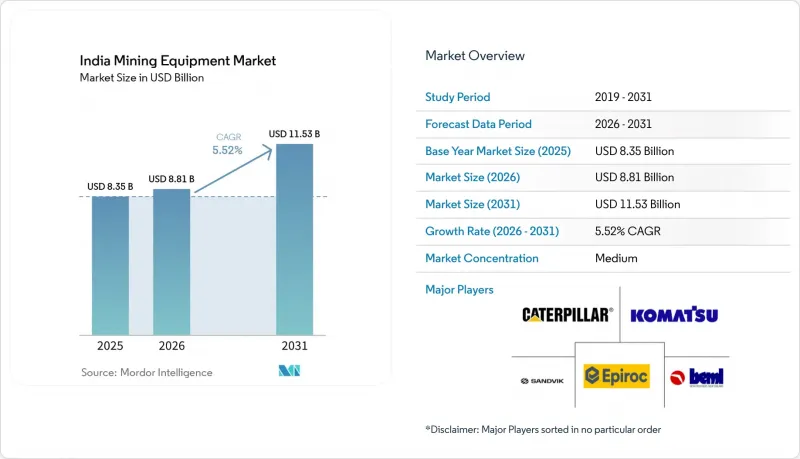
本報告按機械類型(露天採礦機械、地下採礦機械等)、自動化程度(手動機械、半自動機械等)、動力傳動系統類型(內燃機、電池驅動電動等)、產量、應用領域和地區進行細分。市場預測以貨幣價值(美元)和數量(台)兩種形式呈現。
印度礦業機械市場趨勢與洞察
政府基礎建設正在推動礦產需求。
印度2026會計年度創紀錄的基礎設施預算(約1,340億美元)推動了鋼鐵和水泥消費量的成長,進而帶動了對高產能土方和加工機械的需求。公路、地鐵和港口計畫也催生了對石灰石和骨材的新需求,迫使礦商升級破碎機和分類機以滿足需求。印度的焦炭生產目標促使人們對長壁採煤設備產生濃厚興趣,以提高深層礦藏的回收率。每增加一噸原料,就能延長引擎的運作並縮短更換週期,進而在印度的礦業機械市場產生綜效。租賃公司正在資源豐富的地區擴大其設備規模,使中型業者無需大量前期投資即可獲得最先進的機械設備。
印度煤炭公司機械化與產能擴充藍圖
印度煤炭公司計畫興建的機械化連續採礦系統計畫將以切割、輸送和筒倉裝載一體化流程取代傳統的鑽孔爆破作業。該專案將縮短作業週期,提高安全性,並為裝載機、皮帶輸送機系統和自動化運輸單元建立長期穩定的訂單基礎。為了提高筒倉裝載率,該公司的一家子公司正在規範卡車尺寸並實施調度管理軟體,這項變革正在推廣到各級供應商。國內製造商正積極承包工程市場,以利用不斷增加在地採購獎勵;而全球巨頭則將硬體與遙測功能相結合,以確保在整個生命週期內獲得支援合約。因此,這項藍圖將在2020年代後期繼續成為推動印度礦業機械市場發展的關鍵因素。
高昂的初始資本支出(CAPEX)和資金籌措障礙
超大型運輸卡車和連續採礦設備造價可能高達數百萬美元,而貸款機構目前正在降低貸款價值比(LTV),這增加了股本需求。小規模的租賃公司往往會延遲機械化改造,或選擇二手經常出現嚴重停機的二手設備,從而延緩效率提升。雖然租賃設備可以抵消部分成本,但供應商分散和跨州物流阻礙了其廣泛應用。這些資金籌措正在減緩中型企業車輛現代化進程,尤其是地下機械,因為地下機械的價格高且投資回收期長。
細分市場分析
至2025年,露天採礦機械將佔印度採礦機械市場佔有率的50.51%。隨著煤炭、鐵礦石和石灰石露天開採的蓬勃發展,拉鏟挖土機、挖土機和剛性框架卡車在採礦作業中繼續發揮核心作用。隨著作業者對更短作業週期的需求,從人工裝載到液壓挖土機的轉變正在加速。本地組裝製造商正在擴大底盤製造和引擎組裝的產能,旨在縮短交貨週期並擴大售後服務網路。二手機械的進口仍在持續,但隨著國產機型享有補貼,競爭日益激烈。
預計到2031年,地下採礦機械產業將以6.73%的複合年成長率快速成長。隨著深層礦藏開採的開始,連續鑽機、梭車和頂板支撐系統正成為市場的焦點。遠端操控鑽孔和地質構造即時監測等自動化功能正推動採購趨勢轉移到數位化平台。政府對國產錨桿機和裝載機的補貼鼓勵買家選擇本地研發的產品。全球品牌在電池電動和自動駕駛領域仍保持著技術優勢,促使它們與印度製造商合作。更嚴格的安全法規進一步加快了地下採礦機械的更新換代週期。
到2025年,手動操作的機械設備將佔印度礦業設備市場佔有率的73.66%,這反映出人工駕駛的卡車和挖土機仍然佔據主導地位。當地維修店正在以低成本對設備進行基礎遠端資訊處理和安全感測器的改造,以確保符合監管要求。儘管人們對升級改造表現出興趣,但由於缺乏培訓和通訊基礎設施不可靠,許多車輛仍然處於手動操作模式。針對礦工的教育計畫正在逐步彌合技能差距,從而促進向更高自動化水平的平穩過渡。
全自動化機械預計將以17.99%的複合年成長率成長,成為提升生產力的「高速通道」。試點部署已證明其能夠實現無碰撞運行並降低油耗,從而加速其廣泛應用。軟體即服務 (SaaS) 模式使礦場能夠按月支付自動駕駛費用,而無需進行大筆前期投資。網路營運商正在偏遠礦區試點建設專用5G基地台,預計將實現無人車隊所需的延遲控制。互通性標準正在製定中,這將使不同製造商的卡車和鑽孔機能夠透過單一指揮中心協同工作。
其他好處:
- Excel格式的市場預測(ME)表
- 3個月的分析師支持
目錄
第1章:引言
- 市場分析與定義的前提條件
- 分析範圍
第2章 分析方法
第3章執行摘要
第4章 市場狀況
- 市場概覽
- 市場促進因素
- 政府基礎建設正在推動礦產需求。
- 印度煤炭公司機械化與產能擴充藍圖
- 更嚴格的安全標準正在加速自動化技術的應用。
- 鋰和銅的探勘熱潮需要專門的設備。
- 「印度製造」:促進國內機械製造
- 租賃模式的興起擴大了人們獲得尖端車輛的機會。
- 市場限制因素
- 前期資本投入龐大,且資金籌措存在諸多障礙。
- 排放法規和ESG合規成本增加
- 數位/電子機械領域熟練操作人員短缺
- 礦場之間不穩定的通訊環境限制了礦場的自主性。
- 價值鍊和供應鏈分析
- 監理情勢
- 技術展望
- 波特五力分析
第5章:預測市場規模與成長率
- 按機器類型
- 露天採礦機械
- 地下採礦機械
- 礦物加工設備
- 鑽頭破碎機
- 破碎、研磨與分類機
- 裝載機/運輸卡車
- 按自動化級別
- 手動機器
- 半自動機器
- 全自動機器
- 依動力傳動系統類型
- 內燃機
- 電池供電
- 混合
- 依輸出類型
- 低於500馬力
- 500~1,000 HP
- 1000馬力或以上
- 透過使用
- 金屬礦開採
- 礦產開採
- 採煤
- 按地區
- 印度北部
- 東印度
- 西印度群島
- 南印度
- 印度中部
第6章 競爭情勢
- 市場集中度
- 策略趨勢
- 市佔率分析
- 公司簡介
- Caterpillar Inc.
- Komatsu Ltd.
- Sandvik AB
- Epiroc AB
- BEML Limited
- Tata Hitachi Construction Machinery
- Gainwell Engineering
- Liebherr-India Pvt. Ltd.
- Volvo CE India
- JCB India
- Sany Heavy Industry India
- Atlas Copco India
- Wirtgen India
- Doosan Bobcat India
- Hyundai CE India
- XCMG India
- BELAZ(Thriveni Earthmovers)
- Metso Outotec India
- Mahindra Construction Equipment
第7章 市場機會與未來展望
According to Mordor Intelligence, the India mining equipment market size was valued at USD 8.35 billion in 2025, and is projected to grow from USD 8.81 billion in 2026 to reach USD 11.53 billion by 2031, growing at a CAGR of 5.52% over 2026-2031.
This report is Segmented by Equipment Type (Surface Mining Equipment, Underground Mining Equipment, and More), Automation Level (Manual Equipment, Semi-Autonomous Equipment, and More), Powertrain Type (Internal-Combustion Engine Vehicles, Battery-Electric Vehicles, and More), Power Output, Application, and Region. The Market Forecasts are Provided in Terms of Value (USD) and Volume (Units).
India Mining Equipment Market Trends and Insights
Government Infrastructure Build-Out Spurring Mineral Demand
India's record infrastructure allocation (~USD 134 billion) for fiscal 2026 raises steel and cement consumption, which in turn lifts demand for high-capacity earthmoving and processing machines. Highway, metro, and port projects add fresh tonnage for limestone and aggregates, compelling miners to upgrade crushers and screens to keep pace. National coking-coal targets foster interest in longwall equipment that improves recovery in deeper seams. Each incremental tonne of raw material translates to extra engine hours and quicker replacement cycles, creating a multiplier effect for the Indian mining equipment market. Rental firms are scaling fleets in mineral-rich belts so that mid-sized operators can deploy modern gear without heavy upfront outlays.
Coal India's Mechanization and Capacity Expansion Roadmap
Coal India's pipeline of mechanized continuous-miner projects replaces drill-and-blast workflows with integrated cutting, conveying, and silo loading. The program shortens cycle time, improves safety, and anchors long-term orders for loaders, belt systems, and automated haulage units. Subsidiaries that target higher silo-loading ratios are standardizing truck sizes and adopting dispatch software, a shift that percolates across supplier tiers. Domestic fabricators are entering turnkey packages to capture rising localization incentives, while global majors bundle telemetry with hardware to secure full-life support contracts. The roadmap, therefore, remains a decisive catalyst for the Indian mining equipment market through the late 2020s.
High Upfront CAPEX and Financing Hurdles
A single ultra-class haul truck or continuous miner commands a multimillion-dollar price tag, and lenders now offer lower loan-to-value ratios, which raises equity requirements. Smaller leaseholders often postpone mechanization or settle for pre-owned machines with higher downtime, delaying efficiency gains. Equipment rental offsets part of the burden, yet fragmented suppliers and interstate logistics hinder penetration. The financing gap thus slows fleet modernization among mid-tier firms, especially for underground units that carry higher sticker prices and longer payback periods.
Other drivers and restraints analyzed in the detailed report include:
- Stricter Safety Norms Accelerating Automation Adoption
- Lithium-Copper Exploration Boom Requiring Specialty Gear
- Tightening Emission and ESG Compliance Costs
For complete list of drivers and restraints, kindly check the Table Of Contents.
Segment Analysis
Surface mining equipment accounted for 50.51% of India's mining equipment market share in 2025. Strong opencast output in coal, iron ore, and limestone keeps draglines, shovels, and rigid-frame trucks central to mine plans. The replacement of manual loading with hydraulic excavators gains pace as operators seek faster cycle times. Local assemblers expand capacity for body fabrication and engine packaging, improving lead times and after-sales reach. Second-hand imports continue but face growing competition from subsidy-eligible domestic models.
Underground mining equipment is projected to see the fastest expansion at a 6.73% CAGR through 2031. Continuous miners, shuttle cars, and roof-support systems move center stage as deeper seams enter production. Automation features such as tele-remote drilling and real-time strata monitoring shift procurement toward digital-ready platforms. Government incentives for indigenously built bolters and loaders nudge buyers toward local prototypes. Global brands still hold technological edges in battery-electric and autonomous variants, prompting tie-ups with Indian fabricators. Concerted safety enforcement further accelerates the turnover of underground equipment.
Manual equipment commanded 73.66% of India's mining equipment market share in 2025, reflecting the entrenched dominance of operator-driven trucks and excavators. Local workshops retrofit basic telematics and safety sensors to extend compliance at low cost. Training deficits and patchy connectivity keep many fleets in manual mode despite interest in upgrades. Miner education programs are starting to close the skills gap, smoothing the transition to higher automation tiers.
Fully autonomous equipment is set to grow at 17.99% CAGR and represents the speed lane for productivity gains. Pilot deployments demonstrate collision-free operation and lower fuel burn, encouraging wider adoption. Software-as-a-service models let mines pay a monthly autonomy fee instead of a heavy upfront investment. Network operators are testing private 5G cells in remote pits, promising the latency control needed for unmanned fleets. Interoperability standards emerge to enable mixed-brand trucks and drills to share a single command center.
Complete Report Scope:
- By Equipment Type
- Surface Mining Equipment
- Underground Mining Equipment
- Mineral Processing Equipment
- Drills and Breakers
- Crushing, Pulverizing and Screening
- Loaders and Haul Trucks
- By Automation Level
- Manual Equipment
- Semi-Autonomous Equipment
- Fully Autonomous Equipment
- By Powertrain Type
- Internal-Combustion Engine Vehicles
- Battery-Electric Vehicles
- Hybrid Vehicles
- By Power Output
- Less than 500 HP
- 500 - 1,000 HP
- Above 1,000 HP
- By Application
- Metal Mining
- Mineral Mining
- Coal Mining
- By Region
- Northern India
- Eastern India
- Western India
- Southern India
- Central India
List of Companies Covered in this Report:
- Caterpillar Inc.
- Komatsu Ltd.
- Sandvik AB
- Epiroc AB
- BEML Limited
- Tata Hitachi Construction Machinery
- Gainwell Engineering
- Liebherr-India Pvt. Ltd.
- Volvo CE India
- JCB India
- Sany Heavy Industry India
- Atlas Copco India
- Wirtgen India
- Doosan Bobcat India
- Hyundai CE India
- XCMG India
- BELAZ (Thriveni Earthmovers)
- Metso Outotec India
- Mahindra Construction Equipment
Additional Benefits:
- The market estimate (ME) sheet in Excel format
- 3 months of analyst support
TABLE OF CONTENTS
1 Introduction
- 1.1 Study Assumptions & Market Definition
- 1.2 Scope of the Study
2 Research Methodology
3 Executive Summary
4 Market Landscape
- 4.1 Market Overview
- 4.2 Market Drivers
- 4.2.1 Government Infrastructure Build-Out Spurring Mineral Demand
- 4.2.2 Coal India's Mechanization and Capacity Expansion Roadmap
- 4.2.3 Stricter Safety Norms Accelerating Automation Adoption
- 4.2.4 Lithium-Copper Exploration Boom Requiring Specialty Gear
- 4.2.5 "Make in India" Push for Indigenous Equipment Manufacturing
- 4.2.6 Rise of Rental Models Widening Access to Modern Fleets
- 4.3 Market Restraints
- 4.3.1 High Upfront CAPEX and Financing Hurdles
- 4.3.2 Tightening Emission and ESG Compliance Costs
- 4.3.3 Skilled-Operator Deficit for Digital/Electric Machinery
- 4.3.4 Patchy Mine-Site Connectivity Limiting Autonomy
- 4.4 Value / Supply-Chain Analysis
- 4.5 Regulatory Landscape
- 4.6 Technological Outlook
- 4.7 Porter's Five Forces
- 4.7.1 Competitive Rivalry
- 4.7.2 Threat of New Entrants
- 4.7.3 Threat of Substitutes
- 4.7.4 Bargaining Power of Suppliers
- 4.7.5 Bargaining Power of Buyers
5 Market Size & Growth Forecasts (Value (USD) & Volume (Units))
- 5.1 By Equipment Type
- 5.1.1 Surface Mining Equipment
- 5.1.2 Underground Mining Equipment
- 5.1.3 Mineral Processing Equipment
- 5.1.4 Drills and Breakers
- 5.1.5 Crushing, Pulverizing and Screening
- 5.1.6 Loaders and Haul Trucks
- 5.2 By Automation Level
- 5.2.1 Manual Equipment
- 5.2.2 Semi-Autonomous Equipment
- 5.2.3 Fully Autonomous Equipment
- 5.3 By Powertrain Type
- 5.3.1 Internal-Combustion Engine Vehicles
- 5.3.2 Battery-Electric Vehicles
- 5.3.3 Hybrid Vehicles
- 5.4 By Power Output
- 5.4.1 Less than 500 HP
- 5.4.2 500 - 1,000 HP
- 5.4.3 Above 1,000 HP
- 5.5 By Application
- 5.5.1 Metal Mining
- 5.5.2 Mineral Mining
- 5.5.3 Coal Mining
- 5.6 By Region
- 5.6.1 Northern India
- 5.6.2 Eastern India
- 5.6.3 Western India
- 5.6.4 Southern India
- 5.6.5 Central India
6 Competitive Landscape
- 6.1 Market Concentration
- 6.2 Strategic Moves
- 6.3 Market Share Analysis
- 6.4 Company Profiles (Includes Global Level Overview, Market Level Overview, Core Segments, Financials as Available, Strategic Information, Market Rank/Share for Key Companies, Products and Services, SWOT Analysis, and Recent Developments)
- 6.4.1 Caterpillar Inc.
- 6.4.2 Komatsu Ltd.
- 6.4.3 Sandvik AB
- 6.4.4 Epiroc AB
- 6.4.5 BEML Limited
- 6.4.6 Tata Hitachi Construction Machinery
- 6.4.7 Gainwell Engineering
- 6.4.8 Liebherr-India Pvt. Ltd.
- 6.4.9 Volvo CE India
- 6.4.10 JCB India
- 6.4.11 Sany Heavy Industry India
- 6.4.12 Atlas Copco India
- 6.4.13 Wirtgen India
- 6.4.14 Doosan Bobcat India
- 6.4.15 Hyundai CE India
- 6.4.16 XCMG India
- 6.4.17 BELAZ (Thriveni Earthmovers)
- 6.4.18 Metso Outotec India
- 6.4.19 Mahindra Construction Equipment
7 Market Opportunities & Future Outlook
- 7.1 White-space & Unmet-Need Assessment

 中國礦山機械:市場佔有率分析、產業趨勢與統計、成長預測(2026-2031年)德國礦業機械:市場佔有率分析、產業趨勢與統計、成長預測(2026-2031)非洲礦業機械:市場佔有率分析、產業趨勢與統計、成長預測(2026-2031 年)馬來西亞礦業機械:市場佔有率分析、產業趨勢與統計、成長預測(2026-2031)日本礦業機械:市場佔有率分析、產業趨勢及統計、成長預測(2026-2031)法國礦業機械:市場佔有率分析、產業趨勢與統計、成長預測(2026-2031)英國礦業機械:市場佔有率分析、產業趨勢與統計、成長預測(2026-2031)西班牙礦業機械:市場佔有率分析、產業趨勢與統計、成長預測(2026-2031)
 礦業機械市場報告:趨勢、預測與競爭分析(至2035年)
 自主採礦機械市場規模、佔有率、成長、全球產業分析、區域趨勢及2026-2034年預測。