


 |
市場調查報告書
商品編碼
2125713
印尼IT服務:市場佔有率分析、產業趨勢與統計及成長預測(2026-2031年)Indonesia IT Services - Market Share Analysis, Industry Trends & Statistics, Growth Forecasts (2026 - 2031) |
||||||

※ 本網頁內容可能與最新版本有所差異。詳細情況請與我們聯繫。
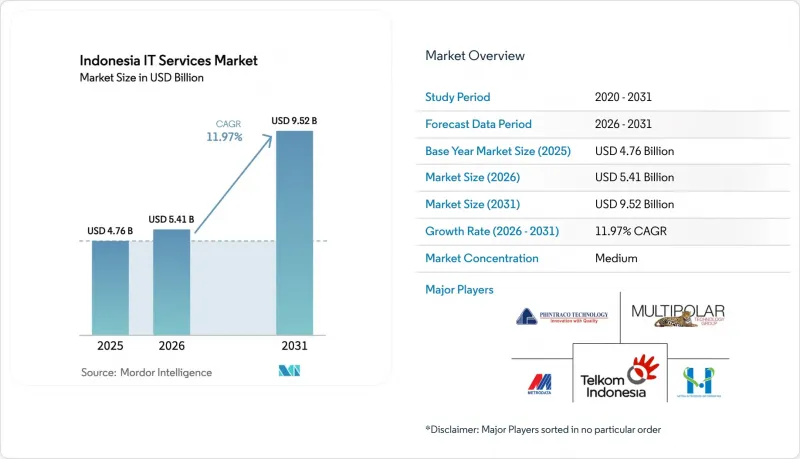
根據 Mordor Intelligence 預測,印尼 IT 服務市場規模將從 2025 年的 47.6 億美元成長到 2026 年的 54.1 億美元,到 2031 年達到 95.2 億美元,2026 年至 2031 年的複合年成長率為 11.97%。
本報告按服務類型(IT諮詢與實施、其他)、公司規模(中小企業、其他)、產業(IT與電信、製造業、其他)、部署模式(本地部署、雲端部署、混合部署)、技術(雲端運算、人工智慧與機器學習、其他)以及地區進行細分。市場預測以美元(USD)計價。
印尼IT服務市場趨勢與洞察
企業快速推行「數位化優先」策略
印尼企業正從分階段升級轉向全面現代化,將雲端ERP、客戶資料平台和人工智慧驅動的分析整合到一個統一的架構中。根據IBM 2025年的一項調查,62%的印尼企業正在試行部署人工智慧,這一比例遠高於該地區其他國家。像GoTo Financial這樣的數位化領導企業已於2025年中期完成了全面的雲端遷移,向現有企業展示了不進行端到端現代化改造所造成的效能差距。這些項目通常伴隨著多年期的管理服務契約,從而確保收入的可預測性,並降低硬體升級帶來的波動風險。由於銀行和電信業者必須通過嚴格的監管審計,擁有ISO 27001和SOC 2認證的整合商在競標中具有競爭優勢。因此,服務供應商正在強調一種包含長期客戶管理的「諮詢式建置和營運」模式。
遷移到雲端原生應用程式的激增
谷歌雲端於2025年5月擴展其雅加達區域,加速了微服務重構專案的浪潮,這些專案需要Kubernetes和無伺服器技術。微軟在印尼投資17億美元,其中包括為84萬名印尼人提供培訓,顯示微軟對平台即服務(PaaS)的需求將超過「遷移式」工作負載充滿信心。採用雲端原生模式的公司報告稱,發布週期縮短了20%,意外停機時間減少了50%,這些指標證明了DevOps諮詢的高昂成本是合理的。印尼央行2024年第2號條例強制要求銀行在雲端基礎設施上重建核心系統,並維持國內資料駐留,將使平均專案規模擴大三倍。 ISO 27001認證要求提高了准入門檻,使利潤豐厚的工作集中在現有系統整合商手中。
國內高級雲端運算和DevSecOps領域人才短缺
儘管人工智慧應用激增,但近半數大型企業表示缺乏雲端安全的專業知識。每年僅有不到5,000名網路安全畢業生從大學畢業,而國家網路與密碼局(NCCA)在2023年偵測到了4.03億起異常流量事件。在人工智慧藍圖培養出足夠人才之前,系統整合商不得不以本地薪資的兩到三倍聘請外籍人才,這擠壓了利潤空間。技能短缺導致專案工期延長,對無力負擔高昂成本的中小型企業客戶而言,問題尤其嚴重。服務提供者試圖透過在成本較低的亞洲地區建立遠端安全營運中心來降低風險,但此舉引發了人們對專案延誤和資料主權的擔憂。
細分市場分析
在印尼的IT服務市場,預計到2025年,「雲端服務和SaaS實施」將佔總收入的29.47%,這表明市場更傾向於基於使用量的收費系統,而非需要大量資本支出(CAPEX)的本地部署。隨著銀行、零售商和製造商將試點模型投入生產環境,人工智慧(AI)和機器學習(ML)相關項目正以每年12.55%的速度成長。 IT諮詢和實施服務持續發揮基礎性作用,協助客戶將架構重構為微服務,並重新設計業務流程。業務流程外包正轉向人工智慧驅動的信用評估和保險理賠處理,從而提升了服務提供者的利潤率。儘管IT外包和管理服務仍然是持續收入的支柱,但與海外供應商的價格競爭正迫使當地企業透過提供全天候印尼語支援和現場服務來脫穎而出。
其他服務類型,主要專注於傳統硬體維修,雖然持續下滑,但仍發揮著至關重要的作用,它們是關鍵任務系統的基礎,而這些系統無法透過單一版本進行遷移。 Telkomsigma 從傳統系統整合轉向雲端原生諮詢,並獲得了 AWS 和 Google Cloud 合作夥伴認證,這表明現有公司如何在保留現有基本客群的同時更新其產品組合。印尼央行的「駐留」要求正在加速從永久授權向 SaaS 的轉變,從而為混合環境授權的整合商確立了長期價值。隨著人工智慧的普及,雲端和數據平台的專業知識正成為獲得高價值轉型專案的關鍵因素。
在印尼的IT服務市場,預計到2025年,大型企業將佔據61.29%的收入佔有率,這反映出它們面臨的監管壓力、大規模的IT資產以及投資數百萬美元項目的能力。銀行、電信業者和多元化企業集團正在簽訂多塔式契約,將諮詢、遷移和託管服務打包,合約期限為三到七年。這些公司正在精簡供應商名單,並將核心轉型任務擴大外包給那些提供經認證的安全框架和審計交付流程的公司。
中小企業市場正以12.97%的複合年成長率快速成長,這主要得益於政府數位代金券計畫對諮詢費用的補貼,以及雲端服務供應商推出針對中小企業的客製化定價方案。典型的合約著重於庫存管理SaaS和物聯網設備遙測等單點解決方案,強調模組化交付和快速投資回報。微軟在全國範圍內的技能學院正在培養一批未來能夠勝任雲端就緒開發的中小企業管理人才,而混合模式則正在彌合農村地區的網路連線差距。隨著中小企業市場的擴張,當地專家透過將模板化服務與固定價格部署相結合,提供無需大量客製化的經濟實惠的解決方案。
其他好處
- Excel格式的市場預測(ME)表
- 3個月的分析師支持
目錄
第1章:引言
- 研究假設和市場定義
- 調查範圍
第2章:調查方法
第3章執行摘要
第4章 市場狀況
- 市場概覽
- 市場促進因素
- 企業快速推行「數位化優先」策略
- 遷移到雲端原生應用程式的激增
- 政府為「印尼4.0」提供的獎勵措施
- 金融科技與電子商務的快速發展
- 與國有企業簽訂資料中心建設、營運和移交(BOT)契約
- 關鍵數據的強制性國內災害復原託管
- 市場限制因素
- 國內高級雲端運算和DevSecOps領域人才短缺
- 主要城市以外地區的老舊基礎設施
- 地方政府採購標準存在差異
- 電費上漲對超大規模經濟體的影響
- 產業價值鏈分析
- 監理情勢
- 技術展望
- 波特五力分析
- 宏觀經濟因素對市場的影響
第5章 市場規模與成長預測
- 按服務類型
- IT諮詢與實施
- 業務流程外包服務
- IT外包與管理服務
- 雲端服務和SaaS簡介
- 其他
- 按公司規模
- 小型企業
- 大公司
- 按行業
- BFSI
- IT/通訊
- 製造業
- 衛生保健
- 政府/公共部門
- 零售與電子商務
- 能源與公共產業
- 教育
- 其他
- 按部署模式
- 現場
- 雲
- 混合
- 透過技術
- 雲端運算
- 人工智慧和機器學習
- 物聯網
- 保全服務
- 巨量資料與分析
- 區塊鏈和新技術
- 其他
第6章 競爭情勢
- 市場集中度
- 策略趨勢
- 市佔率分析
- 公司簡介
- PT Sigma Cipta Caraka(Telkomsigma)
- PT Multipolar Technology Tbk
- PT Mitra Integrasi Informatika
- PT Metrodata Electronics Tbk
- PT Phintraco Technology
- PT Lintasarta
- Accenture Indonesia
- IBM Indonesia
- Microsoft Indonesia
- Hewlett Packard Enterprise Indonesia
- Fujitsu Indonesia
- Tata Consultancy Services Indonesia
- Wipro Indonesia
- PT Indosat Tbk(Indosat Ooredoo Hutchison Business Services)
- PT XL Axiata Tbk(XL Business Solutions)
- PT Biznet Gio Nusantara
- PT WOWrack Indonesia
- PT ABeam Consulting Indonesia
- PT Xapiens Teknologi Indonesia
- TDCX Indonesia
- PT Cloud4C Services Indonesia
- PT DCI Indonesia Tbk
- PT EdgeConneX Indonesia
- PT Equine Global
- PT Jatis Solutions
- PT Soltius Indonesia
第7章 市場機會與未來展望
According to Mordor Intelligence, the Indonesia IT services market size is expected to increase from USD 4.76 billion in 2025 to USD 5.41 billion in 2026 and reach USD 9.52 billion by 2031, growing at a CAGR of 11.97% over 2026-2031.
This report is Segmented by Service Type (IT Consulting and Implementation, and More), Enterprise Size (Small and Medium Enterprises, and More), Industry (IT and Telecom, Manufacturing, and More), Deployment Model (On-Premise, Cloud, and Hybrid), Technology (Cloud Computing, Artificial Intelligence and Machine Learning, and More), and Geography. The Market Forecasts are Provided in Terms of Value (USD).
Indonesia IT Services Market Trends and Insights
Rapid Enterprise Digital-First Strategies
Indonesian corporations now replace incremental upgrades with holistic overhauls that bundle cloud ERP, customer data platforms, and AI-driven analytics into unified architectures. A 2025 IBM survey found 62% of domestic firms piloting AI, well above regional peers. Digital-native leaders such as GoTo Financial completed full cloud migrations in mid-2025, showing incumbents the performance gap that arises without end-to-end modernization. Multi-year managed-services contracts accompany these programs, securing predictable revenue and mitigating hardware refresh volatility. Certified integrators with ISO 27001 and SOC 2 documentation enjoy a bidding advantage because banks and telecom operators must pass strict regulatory audits. Consequently, service providers emphasize consult-build-operate models that embed long-term account control.
Surge in Cloud-Native Application Migration
Google Cloud's Jakarta region expansion in May 2025 catalysed a wave of microservices refactoring projects requiring Kubernetes and serverless skills. Microsoft's USD 1.7 billion commitment, including training for 840,000 Indonesians, signals confidence that platform-as-a-service demand will outpace lift-and-shift workloads. Enterprises adopting cloud-native patterns report 20% faster release cycles and 50% lower unplanned downtime, metrics that justify premium DevOps consulting fees. Bank Indonesia Regulation No.2/2024 compels banks to re-platform core systems on cloud infrastructure with domestic data residency, tripling average project value. Required certifications under ISO 27001 increase entry barriers, concentrating high-margin work among established integrators.
Persistent Domestic Skills Gap in Advanced Cloud and DevSecOps
Nearly half of large enterprises report shortages in cloud-security expertise despite surging AI adoption. Universities produce fewer than 5,000 cybersecurity graduates a year, while the National Cyber and Crypto Agency tracked 403 million anomalous traffic events in 2023. Until the AI roadmap delivers sizable cohorts, integrators import expatriate talent at two to three times local salaries, squeezing margins. Skill scarcity lengthens project timelines, particularly for SME clients that cannot absorb premium rates. Providers hedge by opening remote security-operations centers in lower-cost Asian locations, a move that introduces latency and data-sovereignty concerns.
Other drivers and restraints analyzed in the detailed report include:
- Government Making Indonesia 4.0 Incentives
- Accelerated Fintech and E-Commerce Expansion
- Ageing Legacy Infrastructure Outside Tier-1 Cities
For complete list of drivers and restraints, kindly check the Table Of Contents.
Segment Analysis
Cloud Services and SaaS Implementation held 29.47% of 2025 revenue in the Indonesia IT services market, showing enterprises' strong preference for utility pricing over capex-heavy on-premises deployments. Artificial Intelligence and Machine Learning engagements grow at 12.55% annually, thanks to banks, retailers, and manufacturers moving pilot models into production. IT Consulting and Implementation remains foundational, guiding clients through microservices re-architecture and business-process redesign. Business Process Outsourcing is shifting toward AI-assisted credit underwriting and claims processing, lifting provider margins. IT Outsourcing and Managed Services anchor recurring income, although price competition from offshore vendors pressures local firms to differentiate via 24/7 Indonesian-language support and on-site response.
Other Service Types, dominated by legacy hardware break-fix, continue to contract yet still underpin mission-critical systems that cannot migrate in a single release. Telkomsigma's pivot from classic integration to cloud-native consulting, and its AWS and Google Cloud partner badges, illustrates how incumbents can refresh portfolios while protecting embedded bases. Bank Indonesia's residency mandate accelerates movement from perpetual licenses to SaaS, positioning integrators that manage hybrid entitlements for long-term relevance. As AI accelerates, cloud and data-platform expertise becomes the primary gatekeeper to high-value transformation deals.
Large enterprises contributed 61.29% of 2025 revenue in the Indonesia IT services market, reflecting regulatory burdens, larger IT estates, and capacity to fund multi-million-dollar projects. Banks, telecom operators, and diversified conglomerates sign multi-tower deals that bundle consulting, migration, and managed services for 3-to-7-year terms. They increasingly rationalize supplier rosters, awarding core transformation work to firms offering certified security frameworks and audited delivery processes.
SMEs expand at a 12.97% CAGR as government digital-voucher schemes offset advisory fees and cloud providers launch SME pricing tiers. Typical engagements focus on point solutions such as inventory SaaS or IoT-enabled machinery telemetry, favouring modular delivery and rapid payback. Microsoft's nationwide skills academies nurture a future pool of cloud-ready SME owners, while hybrid models bridge connectivity gaps in provincial areas. The widening SME opportunity prompts local boutiques to package templated offerings with fixed-fee implementation, enhancing affordability without deep customization.
Complete Report Scope:
- By Service Type
- IT Consulting and Implementation
- Business Process Outsourcing Services
- IT Outsourcing and Managed Services
- Cloud Services and SaaS Implementation
- Other Service Types
- By Enterprise Size
- Small and Medium Enterprises
- Large Enterprises
- By Industry
- BFSI
- IT and Telecom
- Manufacturing
- Healthcare
- Government and Public Sector
- Retail and E-Commerce
- Energy and Utilities
- Education
- Other Industries
- By Deployment Model
- On-Premise
- Cloud
- Hybrid
- By Technology
- Cloud Computing
- Artificial Intelligence and Machine Learning
- Internet of Things
- Cybersecurity Services
- Big Data and Analytics
- Blockchain and Emerging Tech
- Other Technologies
List of Companies Covered in this Report:
- PT Sigma Cipta Caraka (Telkomsigma)
- PT Multipolar Technology Tbk
- PT Mitra Integrasi Informatika
- PT Metrodata Electronics Tbk
- PT Phintraco Technology
- PT Lintasarta
- Accenture Indonesia
- IBM Indonesia
- Microsoft Indonesia
- Hewlett Packard Enterprise Indonesia
- Fujitsu Indonesia
- Tata Consultancy Services Indonesia
- Wipro Indonesia
- PT Indosat Tbk (Indosat Ooredoo Hutchison Business Services)
- PT XL Axiata Tbk (XL Business Solutions)
- PT Biznet Gio Nusantara
- PT WOWrack Indonesia
- PT ABeam Consulting Indonesia
- PT Xapiens Teknologi Indonesia
- TDCX Indonesia
- PT Cloud4C Services Indonesia
- PT DCI Indonesia Tbk
- PT EdgeConneX Indonesia
- PT Equine Global
- PT Jatis Solutions
- PT Soltius Indonesia
Additional Benefits:
- The market estimate (ME) sheet in Excel format
- 3 months of analyst support
TABLE OF CONTENTS
1 INTRODUCTION
- 1.1 Study Assumptions And Market Definition
- 1.2 Scope of the Study
2 RESEARCH METHODOLOGY
3 EXECUTIVE SUMMARY
4 MARKET LANDSCAPE
- 4.1 Market Overview
- 4.2 Market Drivers
- 4.2.1 Rapid Enterprise Digital-First Strategies
- 4.2.2 Surge in Cloud-Native Application Migration
- 4.2.3 Government "Making Indonesia 4.0" Incentives
- 4.2.4 Accelerated Fintech and E-Commerce Expansion
- 4.2.5 Data-Center Build-Operate-Transfer Deals with SOEs
- 4.2.6 Mandated Domestic Disaster-Recovery Hosting for Critical Data
- 4.3 Market Restraints
- 4.3.1 Persistent Domestic Skills Gap in Advanced Cloud and DevSecOps
- 4.3.2 Ageing Legacy Infrastructure Outside Tier-1 Cities
- 4.3.3 Fragmented Provincial Procurement Standards
- 4.3.4 Rising Electricity Tariffs Impacting Hyperscale Economics
- 4.4 Industry Value-Chain Analysis
- 4.5 Regulatory Landscape
- 4.6 Technological Outlook
- 4.7 Porter's Five Forces Analysis
- 4.7.1 Bargaining Power of Buyers
- 4.7.2 Bargaining Power of Suppliers
- 4.7.3 Threat of New Entrants
- 4.7.4 Threat of Substitutes
- 4.7.5 Intensity of Competitive Rivalry
- 4.8 Impact of Macroeconomic Factors on the Market
5 MARKET SIZE AND GROWTH FORECASTS (VALUE)
- 5.1 By Service Type
- 5.1.1 IT Consulting and Implementation
- 5.1.2 Business Process Outsourcing Services
- 5.1.3 IT Outsourcing and Managed Services
- 5.1.4 Cloud Services and SaaS Implementation
- 5.1.5 Other Service Types
- 5.2 By Enterprise Size
- 5.2.1 Small and Medium Enterprises
- 5.2.2 Large Enterprises
- 5.3 By Industry
- 5.3.1 BFSI
- 5.3.2 IT and Telecom
- 5.3.3 Manufacturing
- 5.3.4 Healthcare
- 5.3.5 Government and Public Sector
- 5.3.6 Retail and E-Commerce
- 5.3.7 Energy and Utilities
- 5.3.8 Education
- 5.3.9 Other Industries
- 5.4 By Deployment Model
- 5.4.1 On-Premise
- 5.4.2 Cloud
- 5.4.3 Hybrid
- 5.5 By Technology
- 5.5.1 Cloud Computing
- 5.5.2 Artificial Intelligence and Machine Learning
- 5.5.3 Internet of Things
- 5.5.4 Cybersecurity Services
- 5.5.5 Big Data and Analytics
- 5.5.6 Blockchain and Emerging Tech
- 5.5.7 Other Technologies
6 COMPETITIVE LANDSCAPE
- 6.1 Market Concentration
- 6.2 Strategic Moves
- 6.3 Market Share Analysis
- 6.4 Company Profiles (includes Global Level Overview, Market Level Overview, Core Segments, Financials as available, Strategic Information, Market Rank/Share, Products and Services, Recent Developments)
- 6.4.1 PT Sigma Cipta Caraka (Telkomsigma)
- 6.4.2 PT Multipolar Technology Tbk
- 6.4.3 PT Mitra Integrasi Informatika
- 6.4.4 PT Metrodata Electronics Tbk
- 6.4.5 PT Phintraco Technology
- 6.4.6 PT Lintasarta
- 6.4.7 Accenture Indonesia
- 6.4.8 IBM Indonesia
- 6.4.9 Microsoft Indonesia
- 6.4.10 Hewlett Packard Enterprise Indonesia
- 6.4.11 Fujitsu Indonesia
- 6.4.12 Tata Consultancy Services Indonesia
- 6.4.13 Wipro Indonesia
- 6.4.14 PT Indosat Tbk (Indosat Ooredoo Hutchison Business Services)
- 6.4.15 PT XL Axiata Tbk (XL Business Solutions)
- 6.4.16 PT Biznet Gio Nusantara
- 6.4.17 PT WOWrack Indonesia
- 6.4.18 PT ABeam Consulting Indonesia
- 6.4.19 PT Xapiens Teknologi Indonesia
- 6.4.20 TDCX Indonesia
- 6.4.21 PT Cloud4C Services Indonesia
- 6.4.22 PT DCI Indonesia Tbk
- 6.4.23 PT EdgeConneX Indonesia
- 6.4.24 PT Equine Global
- 6.4.25 PT Jatis Solutions
- 6.4.26 PT Soltius Indonesia
7 MARKET OPPORTUNITIES AND FUTURE OUTLOOK
- 7.1 White-Space And Unmet-Need Assessment

 北美IT服務:市場佔有率分析、產業趨勢與統計、成長預測(2026-2031年)歐洲IT服務:市場佔有率分析、產業趨勢與統計、成長預測(2026-2031年)
 2026-2030年全球IT服務市場美國IT服務:市場佔有率分析、產業趨勢與統計、成長預測(2026-2031年)英國IT服務:市場佔有率分析、產業趨勢與統計、成長預測(2026-2031年)零售商個人化服務:市場佔有率分析、產業趨勢與統計及成長預測(2026-2031 年)IT服務:市場佔有率分析、產業趨勢與統計、成長預測(2026-2031年)
 BlockConnect 服務市場預測至 2034 年—按服務類型、部署模式、技術、應用、最終用戶和地區分類的全球分析個人化服務:市場佔有率分析、產業趨勢與統計、成長預測(2026-2031)亞太地區IT服務:市場佔有率分析、產業趨勢與統計及成長預測(2026-2031年)