


 |
市場調查報告書
商品編碼
2125305
英國IT服務:市場佔有率分析、產業趨勢與統計、成長預測(2026-2031年)United Kingdom IT Services - Market Share Analysis, Industry Trends & Statistics, Growth Forecasts (2026 - 2031) |
||||||

※ 本網頁內容可能與最新版本有所差異。詳細情況請與我們聯繫。
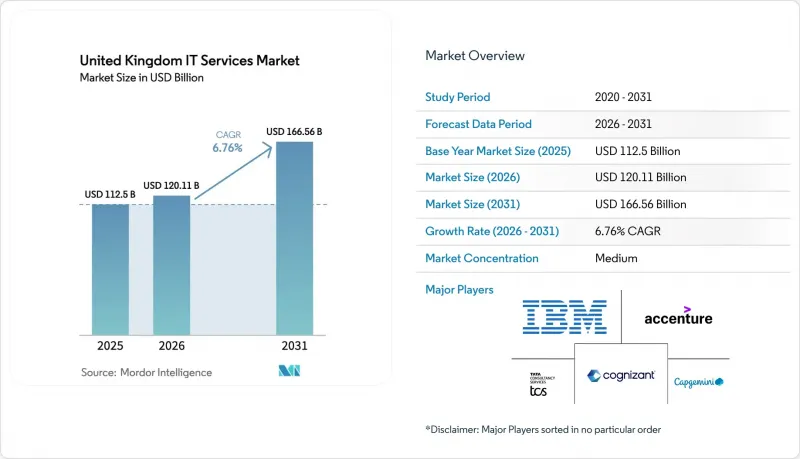
據 Mordor Intelligence 稱,英國IT 服務市場在 2025 年的價值為 1125 億美元,預計到 2031 年將達到 1665.6 億美元,而 2026 年為 1201.1 億美元,預測期(2026-2031 年)的複合年成長率為 6.76%。
本報告按服務類型(IT諮詢與實施、IT外包、業務流程外包等)、最終用戶公司規模(中小企業、大型企業)、部署模式(境內交付、近岸交付等)以及最終用戶行業(銀行、金融服務和保險業、政府/公共部門等)進行分類。市場預測以美元計價。
英國IT服務市場的趨勢與洞察
人工智慧主導的數位轉型浪潮
英國目前擁有全球第三大人工智慧經濟體,並計劃透過人工智慧的應用,每年將生產力提高1.5%。儘管如此,只有16%的製造商表示具備足夠的人工智慧知識,這為服務供應商創造了大量的諮詢機會。 40億美元的公共投資和140億美元的私人投資正在為以人工智慧為中心的項目建立一個強大的項目儲備。光是Accenture一家就已在2025會計年度第二季獲得了價值14億美元的生成式人工智慧相關訂單,顯示企業需求強勁。政府指定的「人工智慧成長區」(首批專案位於剪切機卡勒姆)將需要大規模的系統整合和雲端容量。這些因素共同推動了英國IT服務市場的持續成長。
「雲端優先」政府採購政策
G-Cloud 14目錄中列出的4000家供應商提供的46000項服務充分證明了「雲端優先」模式正在改變公共部門的採購方式。自2012年以來,透過框架協議節省的23億美元成本凸顯了其經濟效益,並鼓勵中小企業參與其中。即將啟動的160億美元「技術服務4」計畫為供應商提供了一個巨大的商機。在「數位科技產業計畫」下,雲端技術的應用也擴展到了策略夥伴關係,模糊了採購和創新之間的界線。隨著受監管產業效仿公共部門的標準,這種模式對私部門的連鎖反應日益顯著,推動了英國IT服務市場平台服務的兩位數成長。
IT人才市場薪資通膨高企
預計到2024年,科技業的薪資將上漲7%至10%,76%的雇主表示面臨嚴重的技能短缺。隨著國民健康保險費率從13.8%上調至15%(2025年4月生效),雇主的成本將進一步增加。英國脫歐後,30萬名歐盟出生的專業人士離開英國,造成了60萬個職缺,預計每年將對英國經濟造成630億美元的損失。儘管企業正透過近岸外包和自動化策略來應對這一人才短缺問題,但不斷上漲的人事費用正在擠壓利潤空間,並減緩英國IT服務市場的成長。
細分市場分析
到2025年,雲端平台服務將佔英國IT服務市場佔有率的28.15%,憑藉G-Cloud 14產品目錄的擴展以及舊有系統向公共雲端的持續遷移,確立主導地位。在160億美元的「技術服務4」框架的支持下,英國IT服務市場預計將穩定成長。同時,受《網路安全彈性法案》合規要求的推動,預計到2031年,資安管理服務的複合年成長率將達到9.38%。企業人工智慧專案的推動使IT諮詢業務保持強勁成長,而IT外包和業務流程外包(BPO)在自動化程度不斷提高的背景下也呈現均衡成長。
雲端遷移和增強安全性的協同效應正在推動服務提供者的收入成長。隨著機構替換本地系統,託管安全包正被整合到平台合約中,從而擴大市場佔有率。價值 14 億美元的英國國家醫療服務體系 (NHS)競標清楚地表明了特定產業框架如何推動生態系統供應商的發展。因此,將超大規模專業知識與零信任架構結合的供應商在英國IT 服務市場中佔據主導地位。
到2025年,大型企業將佔據英國IT服務市場64.25%的佔有率,它們投入巨資推動多重雲端部署、生成式人工智慧試點計畫以及監管現代化。儘管大型企業佔據主導地位,但隨著轉型藍圖的日趨成熟,其成長速度正在放緩。相較之下,中小企業市場預計到2031年將以8.98%的複合年成長率成長,這主要得益於中小企業數位轉型工作小組的十步行行動計畫。儘管中小企業在英國IT服務市場中的佔有率仍然小規模,但人工智慧驅動的生產力提升所帶來的781億美元經濟價值潛力,使其成為一個極具潛力的目標市場。
服務模式需要適應中小企業偏好的更短銷售週期和基於績效的定價模式。區域性人工智慧創新中心、稅額扣抵和雲端市場正在降低准入門檻,使服務供應商能夠開發可複製的軟體包。因此,英國IT服務市場正在見證面向倫敦以外微企業的客製化訂閱解決方案的興起。
其他好處:
- Excel格式的市場預測(ME)表
- 3個月的分析師支持
目錄
第1章:引言
- 研究假設和市場定義
- 調查範圍
第2章:調查方法
第3章執行摘要
第4章 市場狀況
- 市場概覽
- 市場促進因素
- 人工智慧主導的數位轉型浪潮
- 「雲端優先」政府採購政策
- 網路威脅的嚴峻情勢
- 英國製造業中營運技術與資訊科技的融合
- 強制性綠色IT(永續性目標)的興起
- 英國脫歐導致監管變得更加複雜
- 市場限制因素
- IT人才市場薪資成長率高
- 短期宏觀經濟放緩
- 關於離岸交貨的數據主權問題
- 倫敦以外中小企業採用率的差異
- 產業價值鏈分析
- 宏觀經濟因素的影響
- 重要法規結構的評估
- 技術展望
- 波特五力分析
第5章 市場規模與成長預測
- 按服務類型
- IT諮詢與實施
- IT外包(ITO)
- 業務流程外包(BPO)
- 資安管理服務
- 雲端平台服務
- 按最終用戶公司規模分類
- 中小企業
- 大公司
- 按部署模式
- 陸上交付
- 近岸交付
- 離岸交付
- 按行業分類的最終用戶
- BFSI
- 製造業
- 政府/公共部門
- 醫療保健和生命科學
- 零售和消費品
- 通訊與媒體
- 物流/運輸
- 能源公用事業
- 其他終端用戶產業
第6章 競爭情勢
- 市場集中度
- 策略趨勢
- 市佔率分析
- 公司簡介
- Accenture plc
- IBM UK Ltd.
- Capgemini SE
- Tata Consultancy Services(TCS)UK
- Infosys Ltd. UK
- Cognizant Technology Solutions UK
- HCL Technologies UK
- Wipro Ltd. UK
- Fujitsu Services Ltd.
- DXC Technology UK
- CGI IT UK Ltd.
- Sopra Steria Ltd.
- Computacenter plc
- Softcat plc
- Kainos Group plc
- BJSS Ltd.
- Endava plc
- Version 1 Software UK Ltd.
- FDM Group plc
- PA Consulting Group
- Civica Ltd.
- NTT DATA UK Ltd.
- Capita IT Services
- Rackspace Technology UK
- Mastek(UK)Ltd.
第7章 市場機會與未來展望
According to Mordor Intelligence, the UK IT services market size was valued at USD 112.5 billion in 2025 and estimated to grow from USD 120.11 billion in 2026 to reach USD 166.56 billion by 2031, at a CAGR of 6.76% during the forecast period (2026-2031).
This report is Segmented by Service Type (IT Consulting and Implementation, IT Outsourcing, Business Process Outsourcing, and More), End-User Enterprise Size (Small and Medium Enterprises, and Large Enterprises), Deployment Model (Onshore Delivery, Nearshore Delivery, and More), and End-User Vertical (BFSI, Government and Public Sector, and More). The Market Forecasts are Provided in Terms of Value (USD).
United Kingdom IT Services Market Trends and Insights
AI-led Digital Transformation Wave
The United Kingdom now ranks as the world's third-largest AI economy and is targeting annual productivity gains of 1.5% through AI deployment. Despite enthusiasm, only 16% of manufacturers report adequate AI knowledge, opening consultative opportunities for service providers. Public investment of USD 4 billion and USD 14 billion in private commitments form a durable pipeline for AI-centric engagements. Accenture alone secured USD 1.4 billion in generative-AI bookings during Q2 FY25, signaling robust enterprise appetite. Government-designated AI Growth Zones-beginning with Culham, Oxfordshire-will require extensive systems integration and cloud capacity. Together, these factors generate a sustained uplift in the UK IT services market.
Cloud-first Government Procurement Policies
The cloud-first mandate, highlighted by G-Cloud 14's catalog of 46,000 services from 4,000 suppliers, is reshaping public-sector procurement. Framework savings of USD 2.3 billion since 2012 validate economic benefits and stimulate SME participation. The forthcoming USD 16 billion Technology Services 4 competition represents the largest single opportunity for vendors. Cloud uptake extends into strategic partnerships under the Digital and Technologies Sector Plan, blurring lines between procurement and innovation. Private-sector spillovers are visible as regulated industries replicate public-sector standards, reinforcing double-digit growth in platform services across the UK IT services market.
High Wage Inflation in Tech Talent Pool
Tech salaries escalated 7-10% in 2024, with 76% of employers citing acute skill shortages. The April 2025 National Insurance hike from 13.8% to 15% inflate employer costs. Post-Brexit workforce attrition of 300,000 EU professionals leaves 600,000 vacancies that cost the economy USD 63 billion annually. Firms offset gaps by expanding nearshore and automation strategies, yet elevated labor costs compress margins and temper growth in the UK IT services market.
Other drivers and restraints analyzed in the detailed report include:
- Acute Cyber-threat Environment
- Convergence of OT-IT in UK Manufacturing
- Near-term Macroeconomic Slowdown
For complete list of drivers and restraints, kindly check the Table Of Contents.
Segment Analysis
Cloud and platform services represented 28.15% of the UK IT services market share in 2025, a leadership position supported by G-Cloud 14's widened catalog and ongoing migration of legacy estates to the public cloud. The UK IT services market size for this segment is projected to compound steadily on the back of the USD 16 billion Technology Services 4 framework. Simultaneously, managed security services are forecast to post a 9.38% CAGR to 2031, reflecting mandatory compliance under the Cyber Security and Resilience Bill. IT consulting remains resilient thanks to enterprise AI programs, while IT outsourcing and BPO experience balanced growth amid automation.
Cross-pollination between cloud migration and security hardening underpins provider revenue expansion. As agencies replace on-premise systems, bundled managed-security contracts accompany platform deals, magnifying wallet share. NHS tenders worth USD 1.4 billion illustrate how sector-specific frameworks pull along ecosystem suppliers. The UK IT services market, therefore, rewards vendors that combine hyperscale know-how with zero-trust architectures.
Large enterprises controlled 64.25% of the UK IT services market size in 2025, leveraging substantial budgets for multi-cloud rollouts, generative-AI pilots, and regulatory modernization. Despite dominance, their growth rate moderates as transformation roadmaps mature. In contrast, the SME cohort is projected to expand at a 8.98% CAGR to 2031, propelled by the SME Digital Adoption Taskforce's 10-step action plan. UK IT services market share among SMEs remains modest, yet the economic value potential-USD 78.1 billion in AI-enabled productivity gains-creates a fertile addressable base.
Service models must adjust to shorter sales cycles and outcome-based pricing preferred by smaller firms. Regional AI innovation hubs, tax credits, and cloud marketplaces lower entry barriers, allowing providers to develop repeatable packages. Accordingly, the UK IT services market is witnessing a rise in subscription-oriented solutions tailored to micro-enterprises outside London.
Complete Report Scope:
- By Service Type
- IT Consulting and Implementation
- IT Outsourcing (ITO)
- Business Process Outsourcing (BPO)
- Managed Security Services
- Cloud and Platform Services
- By End-User Enterprise Size
- Small and Medium Enterprises (SMEs)
- Large Enterprises
- By Deployment Model
- Onshore Delivery
- Nearshore Delivery
- Offshore Delivery
- By End-user Vertical
- BFSI
- Manufacturing
- Government and Public Sector
- Healthcare and Life-Sciences
- Retail and Consumer Goods
- Telecom and Media
- Logistics and Transport
- Energy and Utilities
- Other End-user Verticals
List of Companies Covered in this Report:
- Accenture plc
- IBM UK Ltd.
- Capgemini SE
- Tata Consultancy Services (TCS) UK
- Infosys Ltd. UK
- Cognizant Technology Solutions UK
- HCL Technologies UK
- Wipro Ltd. UK
- Fujitsu Services Ltd.
- DXC Technology UK
- CGI IT UK Ltd.
- Sopra Steria Ltd.
- Computacenter plc
- Softcat plc
- Kainos Group plc
- BJSS Ltd.
- Endava plc
- Version 1 Software UK Ltd.
- FDM Group plc
- PA Consulting Group
- Civica Ltd.
- NTT DATA UK Ltd.
- Capita IT Services
- Rackspace Technology UK
- Mastek (UK) Ltd.
Additional Benefits:
- The market estimate (ME) sheet in Excel format
- 3 months of analyst support
TABLE OF CONTENTS
1 INTRODUCTION
- 1.1 Study Assumptions and Market Definition
- 1.2 Scope of the Study
2 RESEARCH METHODOLOGY
3 EXECUTIVE SUMMARY
4 MARKET LANDSCAPE
- 4.1 Market Overview
- 4.2 Market Drivers
- 4.2.1 AI-led Digital Transformation Wave
- 4.2.2 Cloud-first Government Procurement Policies
- 4.2.3 Acute Cyber-threat Environment
- 4.2.4 Convergence of OT-IT in UK Manufacturing
- 4.2.5 Rise of Green-IT Mandates (Sustainability Targets)
- 4.2.6 Brexit-Driven Regulatory Complexity
- 4.3 Market Restraints
- 4.3.1 High Wage Inflation in Tech Talent Pool
- 4.3.2 Near-term Macroeconomic Slowdown
- 4.3.3 Data-Sovereignty Concerns with Offshore Delivery
- 4.3.4 Fragmented SME Adoption Outside London
- 4.4 Industry Value Chain Analysis
- 4.5 Impact of Macroeconomic Factors
- 4.6 Evaluation of Critical Regulatory Framework
- 4.7 Technological Outlook
- 4.8 Porter's Five Forces Analysis
- 4.8.1 Competitive Rivalry
- 4.8.2 Threat of New Entrants
- 4.8.3 Bargaining Power of Suppliers
- 4.8.4 Bargaining Power of Buyers
- 4.8.5 Threat of Substitutes
5 MARKET SIZE AND GROWTH FORECASTS (VALUE)
- 5.1 By Service Type
- 5.1.1 IT Consulting and Implementation
- 5.1.2 IT Outsourcing (ITO)
- 5.1.3 Business Process Outsourcing (BPO)
- 5.1.4 Managed Security Services
- 5.1.5 Cloud and Platform Services
- 5.2 By End-User Enterprise Size
- 5.2.1 Small and Medium Enterprises (SMEs)
- 5.2.2 Large Enterprises
- 5.3 By Deployment Model
- 5.3.1 Onshore Delivery
- 5.3.2 Nearshore Delivery
- 5.3.3 Offshore Delivery
- 5.4 By End-user Vertical
- 5.4.1 BFSI
- 5.4.2 Manufacturing
- 5.4.3 Government and Public Sector
- 5.4.4 Healthcare and Life-Sciences
- 5.4.5 Retail and Consumer Goods
- 5.4.6 Telecom and Media
- 5.4.7 Logistics and Transport
- 5.4.8 Energy and Utilities
- 5.4.9 Other End-user Verticals
6 COMPETITIVE LANDSCAPE
- 6.1 Market Concentration
- 6.2 Strategic Moves
- 6.3 Market Share Analysis
- 6.4 Company Profiles (includes Global level Overview, Market level overview, Core Segments, Financials as available, Strategic Information, Market Rank/Share for key companies, Products and Services, and Recent Developments)
- 6.4.1 Accenture plc
- 6.4.2 IBM UK Ltd.
- 6.4.3 Capgemini SE
- 6.4.4 Tata Consultancy Services (TCS) UK
- 6.4.5 Infosys Ltd. UK
- 6.4.6 Cognizant Technology Solutions UK
- 6.4.7 HCL Technologies UK
- 6.4.8 Wipro Ltd. UK
- 6.4.9 Fujitsu Services Ltd.
- 6.4.10 DXC Technology UK
- 6.4.11 CGI IT UK Ltd.
- 6.4.12 Sopra Steria Ltd.
- 6.4.13 Computacenter plc
- 6.4.14 Softcat plc
- 6.4.15 Kainos Group plc
- 6.4.16 BJSS Ltd.
- 6.4.17 Endava plc
- 6.4.18 Version 1 Software UK Ltd.
- 6.4.19 FDM Group plc
- 6.4.20 PA Consulting Group
- 6.4.21 Civica Ltd.
- 6.4.22 NTT DATA UK Ltd.
- 6.4.23 Capita IT Services
- 6.4.24 Rackspace Technology UK
- 6.4.25 Mastek (UK) Ltd.
7 MARKET OPPORTUNITIES AND FUTURE OUTLOOK
- 7.1 White-space and Unmet-need Assessment

 印尼IT服務:市場佔有率分析、產業趨勢與統計及成長預測(2026-2031年)北美IT服務:市場佔有率分析、產業趨勢與統計、成長預測(2026-2031年)歐洲IT服務:市場佔有率分析、產業趨勢與統計、成長預測(2026-2031年)
 2026-2030年全球IT服務市場美國IT服務:市場佔有率分析、產業趨勢與統計、成長預測(2026-2031年)零售商個人化服務:市場佔有率分析、產業趨勢與統計及成長預測(2026-2031 年)IT服務:市場佔有率分析、產業趨勢與統計、成長預測(2026-2031年)
 BlockConnect 服務市場預測至 2034 年—按服務類型、部署模式、技術、應用、最終用戶和地區分類的全球分析個人化服務:市場佔有率分析、產業趨勢與統計、成長預測(2026-2031)亞太地區IT服務:市場佔有率分析、產業趨勢與統計及成長預測(2026-2031年)