


 |
市場調查報告書
商品編碼
2099482
個人化服務:市場佔有率分析、產業趨勢與統計、成長預測(2026-2031)Personalization Services - Market Share Analysis, Industry Trends & Statistics, Growth Forecasts (2026 - 2031) |
||||||

※ 本網頁內容可能與最新版本有所差異。詳細情況請與我們聯繫。
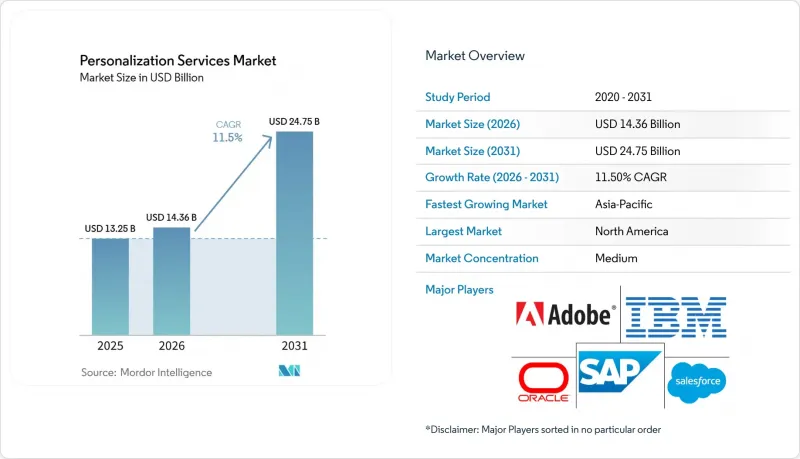
根據 Mordor Intelligence 預測,個人化服務市場規模將從 2025 年的 132.5 億美元和 2026 年的 143.6 億美元成長到 2031 年的 247.5 億美元,2026 年至 2031 年的年複合成長率(CAGR)為 11.50%。
本報告按服務類型(例如,個人化策略和諮詢)、部署模式(雲端、本地部署、混合部署)、技術(例如,Web個人化平台)、企業規模(大型企業、中小企業)、最終用戶產業(例如,零售/電子商務、銀行、金融服務和保險)以及地區進行細分。市場預測以美元(USD)計價。
全球個人化服務市場趨勢與洞察
對即時客戶體驗編配的需求日益成長
在個人化服務市場,即時編配正日益成為企業客戶策略的核心。如今,企業需要能夠即時回應客戶行為的系統,而不是等待固定的宣傳活動週期。 Adobe 於 2026 年 4 月發布了“CX Enterprise”,該版本以基於代理的 AI 技術為核心,涵蓋受眾構建、內容確定和旅程執行等各個方面。 Amperity 也於 2026 年 5 月發布了即時網站個人化和購物車放棄預防工具,這表明,能夠即時感知並觸發客戶挽回流程的方案正變得越來越易於操作。這種轉變正在推動對整合和諮詢支援的需求,因為許多公司仍然以各自獨立的方式經營其行銷、商務和服務系統。此外,能夠縮短從資料收集到整個客戶旅程中採取行動的流程的供應商,將獲得更大的競爭優勢。
人工智慧主導的建議和決策引擎的廣泛應用。
人工智慧主導的建議工具是個人化服務市場中最顯著的成長引擎之一,因為它們能夠幫助買家直接實現轉換和相關性目標。市場正從基於規則的建議邏輯轉向能夠全面解讀行為、交易和情境訊號的模型。 2026年,Databricks在其Lakehouse環境中推出了基於代理的客戶資料平台(CDP)CustomerLake。此次發布表明,自主宣傳活動分析和受眾激活正逐漸成為標準實踐。同樣在2026年3月,Salesforce完成了對Cimulate的收購,在其強大的平台堆疊中新增了人工智慧驅動的產品發現和基於代理的商務功能。這些發展正在縮小產品發現、建議邏輯和執行之間的差距。此外,由於企業在初始部署後需要持續進行調整,因此對託管支援的需求也日益成長。
數據品質差會導致個人化效能下降。
數據品質差仍然是個人化服務市場中最明顯的營運限制因素之一。一份2025年的報告顯示,雖然90%的企業認為CRM資料是營運的核心,但76%的企業擁有的CRM資料準確率和完整性不足一半。這一差距是一個重大問題,因為記錄不完整不僅會降低建議的準確性,還會惡化客戶體驗,而一旦發布,這種惡化就難以彌補。許多公司仍在各種系統中管理客戶訊息,包括CRM、電商、會員系統、行銷自動化、POS和行動系統,而這些系統整合方面的任何缺陷都會增加客戶識別和通訊錯誤的風險。因此,在實現更廣泛的個人化目標之前,對資料清洗、身分解析和客戶資料平台(CDP)服務的需求仍然很高。這也減緩了供應商在買家尚未建立穩固的核心客戶數據基礎之前進入市場的投資回報。
細分市場分析
到2025年,部署和系統整合將佔市場佔有率的28.41%,這反映了將個人化工具與CRM、CDP、電商和執行系統整合所需的工作量。在個人化服務市場,買家仍然面臨著所購買平台與其預期結果之間存在的巨大營運差距。正因如此,儘管技術本身的普及程度有所提高,但與部署相關的收入仍高度集中。策略、設計、支援和培訓服務仍然至關重要,因為企業需要的不僅僅是軟體授權才能跨通路部署個人化互動。預計到2031年,人工智慧驅動的個人化平台將以14.82%的複合年成長率成長,這一成長速度預示著未來服務需求的發展方向,因為自動化將成為服務交付的核心。
該領域的下一個轉變並非服務的終止,而是部署後哪些服務變得最為重要。培訓和賦能變得日益重要,因為許多採購公司仍然缺乏能夠長期管理人工智慧主導決策系統的內部團隊。根據經合組織2026年的一項調查,人工智慧的整合在不同規模的組織中仍然不均衡,時間限制和技能差距仍然是主要障礙。同樣的壓力也推動了對諮詢和託管交付服務的需求,因為企業希望在部署後保持效能的連續性。因此,託管個人化支援正日益被視為部署的實際延伸,而非一個獨立的選項層。在個人化服務產業的這一領域,能夠將系統整合與部署後營運支援相結合的供應商將能夠與客戶建立更牢固的關係。
到2025年,基於雲端的部署將佔總量的71.26%,成為個人化服務市場中大多數專案的明確營運基礎。買家持續青睞雲端環境,因為雲端環境可以縮短配置時間,並支援對海量客戶訊號進行彈性處理。這項優勢對於建議邏輯、旅程自動化和多通路執行工作負載而言尤其顯著。同時,市場並非沿著從本地部署到雲端的單向路徑發展。混合部署預計到2031年將以13.69%的複合年成長率成長,顯示合規性、資料居住和系統管理問題正在影響下一階段的部署。
混合部署的擴展意味著一些買家在尋求雲端規模速度的同時,又不願放棄對敏感資料的本地控制權。這在受監管行業尤其明顯,因為出於法律或營運原因,完全遷移到雲端仍然困難重重。 2026 年 4 月,Braze 透過增加歐盟託管的 AI 決策環境基礎設施來應對這一趨勢,使其產品和服務更緊密地符合資料居住要求。對許多公司而言,混合架構正逐漸成為穩定的長期模式,而非臨時的過渡階段。這推動了對涵蓋雲端原生和託管本地環境的部署規劃、架構設計和整合服務的需求。這也確保了個人化服務市場與合規性基礎設施緊密相連。
區域分析
預計到2025年,北美將佔據34.72%的市場佔有率,成為個人化服務市場最大的區域板塊。該地區受益於成熟的雲端基礎設施、企業軟體的廣泛應用以及眾多領先的客戶經驗行銷技術供應商。美國佔據了這一市場佔有率的大部分,這主要歸功於大規模企業客戶和不斷擴展其個性化服務能力的供應商的共存。加拿大和墨西哥也為該地區的市場注入了活力,這主要得益於金融服務和零售業的應用。北美個人化服務市場佔有率的提升也反映出供應商產品開發與企業部署之間更短的反饋週期,使得專案能夠更快地從採購階段過渡到執行階段。
歐洲仍然是主要的需求中心,但商業環境正日益受到隱私和管治要求的影響。 GDPR及相關的透明度要求迫使企業在比其他許多地區更嚴格的同意和文件基礎上建立個人化系統。德國、英國和法國繼續推動區域需求,尤其是在金融服務、汽車和電子商務領域。南美洲仍處於成長週期的早期階段,巴西和阿根廷引領採用,而隱私法規也持續影響資料基礎設施的決策。
預計到2031年,亞太地區將以14.21%的複合年成長率成長,成為個人化服務市場成長最快的地區。這一成長主要得益於行動優先的數位化行為、大規模的線上商務生態系統以及企業對人工智慧驅動營運模式的日益普及。印度正在崛起,成為電子商務和醫療保健應用領域蘊藏巨大機會的市場;而中國和東南亞憑藉其龐大的規模和深厚的數位化基礎,持續推動著平台的廣泛應用。中東和非洲仍處於起步階段,但沙烏地阿拉伯和阿拉伯聯合大公國的國家級數位轉型措施正在為未來的個人化需求奠定堅實的基礎。
其他好處:
- Excel格式的市場預測(ME)表
- 3個月的分析師支持
目錄
第1章:引言
- 研究假設和市場定義
- 調查範圍
第2章:調查方法
第3章執行摘要
第4章 市場狀況
- 市場概覽
- 市場促進因素
- 對即時客戶體驗編配的需求日益成長
- 擴大第一方數據在所有數位觸點上的應用
- 人工智慧驅動的建議和決策引擎的廣泛應用
- 需要提高整個電子商務和零售通路的轉換率。
- 以隱私為優先的個人化架構正在加速企業投資。
- 將行銷、服務和商務數據整合到一個統一的平台中。
- 市場限制因素
- 數據品質差導致個人化性能下降。
- 企業對同意管理和資料管治的關注
- 與傳統行銷技術和客戶關係管理環境整合的複雜性
- 個人化策略、模型部署和評估方面人才短缺。
- 宏觀經濟因素對市場的影響
- 產業價值鏈分析
- 科技趨勢
- 監理情勢
- 波特五力分析
第5章 市場規模與成長預測
- 按服務類型
- 個人化策略與諮詢
- 實施和系統整合
- 個人化設計與體驗最佳化
- 託管個人化服務
- 支援與維護
- 培訓與賦能
- 不同的發展
- 基於雲端的
- 現場
- 混合
- 透過技術
- 網站個人化平台
- 行動應用個人化平台
- 客戶資料平台(CDP)
- 建議和決策引擎
- 人工智慧驅動的個人化平台
- 全通路個性化平台
- 按公司規模
- 大公司
- 小型企業
- 按最終用戶行業分類
- 零售與電子商務
- BFSI
- 醫療保健和生命科學
- 資訊科技/通訊
- 媒體與娛樂
- 工業製造
- 政府和公共行政
- 其他終端用戶產業
- 按地區
- 北美洲
- 美國
- 加拿大
- 墨西哥
- 南美洲
- 巴西
- 阿根廷
- 其他南美國家
- 歐洲
- 德國
- 英國
- 法國
- 義大利
- 西班牙
- 俄羅斯
- 其他歐洲國家
- 亞太地區
- 中國
- 印度
- 日本
- 韓國
- 澳洲
- 其他亞太國家
- 中東和非洲
- 中東
- 沙烏地阿拉伯
- 阿拉伯聯合大公國
- 其他中東國家
- 非洲
- 南非
- 奈及利亞
- 其他非洲國家
- 中東
- 北美洲
第6章 競爭情勢
- 市場集中度
- 策略趨勢
- 市佔率分析
- 公司簡介
- Adobe Inc.
- Salesforce, Inc.
- Oracle Corporation
- SAP SE
- IBM Corporation
- Braze, Inc.
- Bloomreach, Inc.
- Dynamic Yield Ltd.
- Insider
- MoEngage, Inc.
- Iterable, Inc.
- Klaviyo, Inc.
- Acoustic, LP
- Optimizely
- Tealium
- Treasure Data, Inc.
- Amperity, Inc.
- Segment.io, Inc.
- Zeta Global
- Kibo Commerce, Inc.
第7章 市場機會與未來展望
According to Mordor Intelligence, the personalization services market size is projected to expand from USD 13.25 billion in 2025 and USD 14.36 billion in 2026 to USD 24.75 billion by 2031, registering a CAGR of 11.50% between 2026 and 2031.
This report is Segmented by Service Type (Personalization Strategy and Consulting, and More), Deployment (Cloud-Based, On-Premise, and Hybrid), Technology (Web Personalization Platforms, and More), Enterprise Size (Large Enterprises, and Small and Medium Enterprises), End-User Industry (Retail and E-Commerce, BFSI, and More), and Geography. The Market Forecasts are Provided in Terms of Value (USD).
Global Personalization Services Market Trends and Insights
Rising Demand for Real-Time Customer Experience Orchestration
Real-time orchestration has moved closer to the center of enterprise customer strategy in the Personalization Services Market. Enterprises now want systems that can react to customer behavior in real time, rather than waiting for fixed campaign cycles. Adobe introduced CX Enterprise in April 2026, and the launch centered on agentic AI across audience assembly, content decisions, and journey execution. Amperity also introduced real-time site personalization and cart abandonment tools in May 2026, which showed that instant recognition and triggered recovery journeys are becoming more operationally accessible. This shift is driving demand for integration and consulting support, as many enterprises still run disconnected marketing, commerce, and service systems. It is also widening the advantage for vendors that can shorten the path from data capture to action across the full customer journey.
Wider Adoption of AI-Led Recommendation and Decision Engines
AI-led recommendation tools are one of the clearest growth engines in the Personalization Services Market because buyers can connect them directly to conversion and relevance goals. The market is moving away from rule-based recommendation logic and toward models that can interpret behavioral, transactional, and contextual signals together. Databricks introduced CustomerLake in 2026 as an agentic CDP within its lakehouse environment, and the launch showed how autonomous campaign analysis and audience activation are moving closer to standard deployment practice. Salesforce also completed the Cimulate acquisition in March 2026, which added AI-powered product discovery and agentic commerce capability to its broader platform stack. These developments are reducing the distance between product discovery, recommendation logic, and execution. They are also increasing demand for managed support because enterprises need continuous tuning after the initial rollout.
Weak Personalization Performance Caused by Poor Data Quality
Poor data quality remains one of the clearest operational limits on the Personalization Services Market. In 2025, a report found that 76% of organizations had less than half of their CRM data accurate and complete, even though 90% recognized CRM data as central to operations. That gap matters because weak records not only reduce recommendation precision but also create poor customer experiences that are harder to correct after launch. Many enterprises still manage customer information across CRM, commerce, loyalty, marketing automation, point-of-sale, and mobile systems, and every break in that chain raises the risk of identity and messaging errors. This keeps demand high for data cleaning, identity resolution, and customer data platform services before broader personalization goals can be met. It also slows returns for vendors that enter the account before the buyer has fixed its core customer data foundation.
Other drivers and restraints analyzed in the detailed report include:
- Expansion of First-Party Data Activation Across Digital Touchpoints
- Need for Higher Conversion Rates Across E-Commerce and Retail Funnels
- Enterprise Concerns Over Consent Management and Data Governance
For complete list of drivers and restraints, kindly check the Table Of Contents.
Segment Analysis
Implementation and system integration held 28.41% share in 2025, and that position reflects the amount of work required to connect personalization tools with CRM, CDP, commerce, and execution systems. In the Personalization Services Market, buyers still face large operational gaps between the platform they purchase and the outcomes they expect. This is why implementation revenue remains concentrated even as the technology itself becomes easier to access. Strategy, design, support, and training services continue to matter because enterprises need more than software licenses to run personalized engagement across channels. AI-driven personalization platforms are projected to grow at a 14.82% CAGR through 2031, and that pace shows where future service demand is moving as automation becomes more central to delivery.
The next shift in this segment is not the removal of services, but the change in which services matter most after launch. Training and enablement are gaining relevance because many buyers still lack in-house teams that can manage AI-led decision systems over time. OECD findings in 2026 showed that AI integration remained uneven across organizations of different sizes, with time constraints and skill gaps still the main barriers. That same pressure supports advisory and managed delivery work because enterprises want performance continuity after implementation. Managed personalization support is therefore becoming a practical extension of deployment rather than a separate optional layer. In this part of the Personalization Services industry, vendors that can combine system integration with post-launch operating support are likely to hold stronger client relationships.
Cloud-based deployment accounted for 71.26% of the mix in 2025, which made it the clear operating base for most programs in the Personalization Services Market. Buyers continue to prefer cloud environments because they reduce provisioning time and support elastic processing for high-volume customer signals. That advantage remains important for recommendation logic, journey automation, and multichannel execution workloads. At the same time, the market is not moving along a simple one-way path from on-premises to the cloud. Hybrid deployment is projected to grow at a 13.69% CAGR through 2031, which shows that compliance, residency, and system control issues are shaping the next phase of adoption.
The practical meaning of hybrid growth is that some buyers want cloud-scale speed without giving up local control over sensitive data. This is especially visible in regulated sectors where full cloud migration remains difficult for legal or operational reasons. Braze responded to this pattern in April 2026 by adding European Union-hosted infrastructure for its AI decisioning environment, aligning its offer more closely with data residency requirements. For many enterprises, hybrid architecture is becoming a stable long-term model rather than a temporary transition stage. That supports demand for deployment planning, architecture design, and integration services spanning both cloud-native and controlled local environments. It also keeps the Personalization Services Market tied closely to compliance-aware infrastructure work.
Complete Report Scope:
- By Service Type
- Personalization Strategy and Consulting
- Implementation and System Integration
- Personalization Design and Experience Optimization
- Managed Personalization Services
- Support and Maintenance
- Training and Enablement
- By Deployment
- Cloud-Based
- On-Premise
- Hybrid
- By Technology
- Web Personalization Platforms
- Mobile App Personalization Platforms
- Customer Data Platforms (CDPs)
- Recommendation and Decisioning Engines
- AI-Driven Personalization Platforms
- Omnichannel Personalization Platforms
- By Enterprise Size
- Large Enterprises
- Small And Medium Enterprises
- By End-User Industry
- Retail and E-Commerce
- BFSI
- Healthcare and Life Sciences
- IT and Telecom
- Media and Entertainment
- Industrial Manufacturing
- Government and Public Administration
- Other End-User Industries
- By Geography
- North America
- United States
- Canada
- Mexico
- South America
- Brazil
- Argentina
- Rest of South America
- Europe
- Germany
- United Kingdom
- France
- Italy
- Spain
- Russia
- Rest of Europe
- Asia-Pacific
- China
- India
- Japan
- South Korea
- Australia
- Rest of Asia-Pacific
- Middle East and Africa
- Middle East
- Saudi Arabia
- United Arab Emirates
- Rest of Middle East
- Africa
- South Africa
- Nigeria
- Rest of Africa
- Middle East
- North America
Geography Analysis
North America held a 34.72% share in 2025, making it the largest regional block in the Personalization Services Market. The region benefits from mature cloud infrastructure, deep enterprise software adoption, and a large concentration of major customer experience and marketing technology vendors. The United States accounts for most of this position because it combines large enterprise buyers with vendors that continue to expand their personalization service capabilities. Canada and Mexico add regional depth, with financial services and retail use cases supporting adoption. The North American Personalization Services Market share also reflects shorter feedback loops between vendor product development and enterprise deployment, which helps move projects from procurement to execution more quickly.
Europe remains a major demand center, but the operating environment is increasingly shaped by privacy and governance requirements. GDPR and related transparency expectations push enterprises to build personalization systems on a stronger consent and documentation base than in many other regions. Germany, the United Kingdom, and France continue to lead regional demand, especially across financial services, automotive, and e-commerce. South America is still earlier in its growth cycle, with Brazil and Argentina leading adoption while privacy regulation continues to influence data infrastructure decisions.
Asia-Pacific is projected to expand at a 14.21% CAGR through 2031, making it the fastest-growing geography in the Personalization Services Market. Mobile-first digital behavior, large online commerce ecosystems, and stronger enterprise use of AI-enabled operating models are supporting growth. India is emerging as a high-opportunity market for e-commerce and healthcare use cases, while China and Southeast Asia continue to support broader platform adoption through scale and deep digital engagement. The Middle East and Africa remain at an earlier stage, but national digital transformation efforts in Saudi Arabia and the United Arab Emirates are helping create a stronger foundation for future personalization demand.
- Adobe Inc.
- Salesforce, Inc.
- Oracle Corporation
- SAP SE
- IBM Corporation
- Braze, Inc.
- Bloomreach, Inc.
- Dynamic Yield Ltd.
- Insider
- MoEngage, Inc.
- Iterable, Inc.
- Klaviyo, Inc.
- Acoustic, L.P.
- Optimizely
- Tealium
- Treasure Data, Inc.
- Amperity, Inc.
- Segment.io, Inc.
- Zeta Global
- Kibo Commerce, Inc.
Additional Benefits:
- The market estimate (ME) sheet in Excel format
- 3 months of analyst support
TABLE OF CONTENTS
1 INTRODUCTION
- 1.1 Study Assumptions and Market Definition
- 1.2 Scope of the Study
2 RESEARCH METHODOLOGY
3 EXECUTIVE SUMMARY
4 MARKET LANDSCAPE
- 4.1 Market Overview
- 4.2 Market Drivers
- 4.2.1 Rising Demand for Real-Time Customer Experience Orchestration
- 4.2.2 Expansion of First-Party Data Activation Across Digital Touchpoints
- 4.2.3 Wider Adoption of AI-Led Recommendation And Decision Engines
- 4.2.4 Need for Higher Conversion Rates Across E-Commerce and Retail Funnels
- 4.2.5 Privacy-First Personalization Architecture Upshifts Enterprise Investment
- 4.2.6 Unification of Marketing, Service, and Commerce Data in One Stack
- 4.3 Market Restraints
- 4.3.1 Weak Personalization Performance Caused by Poor Data Quality
- 4.3.2 Enterprise Concerns Over Consent Management and Data Governance
- 4.3.3 High Integration Complexity With Legacy MarTech and CRM Environments
- 4.3.4 Talent Gaps in Personalization Strategy, Model Operations, And Measurement
- 4.4 Impact of Macroeconomic Factors on the Market
- 4.5 Industry Value Chain Analysis
- 4.6 Technology Outlook
- 4.7 Regulatory Landscape
- 4.8 Porter's Five Forces Analysis
- 4.8.1 Threat of New Entrants
- 4.8.2 Bargaining Power of Suppliers
- 4.8.3 Bargaining Power of Buyers
- 4.8.4 Threat of Substitutes
- 4.8.5 Intensity of Competitive Rivalry
5 MARKET SIZE AND GROWTH FORECASTS (VALUE)
- 5.1 By Service Type
- 5.1.1 Personalization Strategy and Consulting
- 5.1.2 Implementation and System Integration
- 5.1.3 Personalization Design and Experience Optimization
- 5.1.4 Managed Personalization Services
- 5.1.5 Support and Maintenance
- 5.1.6 Training and Enablement
- 5.2 By Deployment
- 5.2.1 Cloud-Based
- 5.2.2 On-Premise
- 5.2.3 Hybrid
- 5.3 By Technology
- 5.3.1 Web Personalization Platforms
- 5.3.2 Mobile App Personalization Platforms
- 5.3.3 Customer Data Platforms (CDPs)
- 5.3.4 Recommendation and Decisioning Engines
- 5.3.5 AI-Driven Personalization Platforms
- 5.3.6 Omnichannel Personalization Platforms
- 5.4 By Enterprise Size
- 5.4.1 Large Enterprises
- 5.4.2 Small And Medium Enterprises
- 5.5 By End-User Industry
- 5.5.1 Retail and E-Commerce
- 5.5.2 BFSI
- 5.5.3 Healthcare and Life Sciences
- 5.5.4 IT and Telecom
- 5.5.5 Media and Entertainment
- 5.5.6 Industrial Manufacturing
- 5.5.7 Government and Public Administration
- 5.5.8 Other End-User Industries
- 5.6 By Geography
- 5.6.1 North America
- 5.6.1.1 United States
- 5.6.1.2 Canada
- 5.6.1.3 Mexico
- 5.6.2 South America
- 5.6.2.1 Brazil
- 5.6.2.2 Argentina
- 5.6.2.3 Rest of South America
- 5.6.3 Europe
- 5.6.3.1 Germany
- 5.6.3.2 United Kingdom
- 5.6.3.3 France
- 5.6.3.4 Italy
- 5.6.3.5 Spain
- 5.6.3.6 Russia
- 5.6.3.7 Rest of Europe
- 5.6.4 Asia-Pacific
- 5.6.4.1 China
- 5.6.4.2 India
- 5.6.4.3 Japan
- 5.6.4.4 South Korea
- 5.6.4.5 Australia
- 5.6.4.6 Rest of Asia-Pacific
- 5.6.5 Middle East and Africa
- 5.6.5.1 Middle East
- 5.6.5.1.1 Saudi Arabia
- 5.6.5.1.2 United Arab Emirates
- 5.6.5.1.3 Rest of Middle East
- 5.6.5.2 Africa
- 5.6.5.2.1 South Africa
- 5.6.5.2.2 Nigeria
- 5.6.5.2.3 Rest of Africa
- 5.6.5.1 Middle East
- 5.6.1 North America
6 COMPETITIVE LANDSCAPE
- 6.1 Market Concentration
- 6.2 Strategic Moves
- 6.3 Market Share Analysis
- 6.4 Company Profiles (includes Global Level Overview, Market Level Overview, Core Segments, Financials as available, Strategic Information, Market Rank/Share, Products and Services, Recent Developments)
- 6.4.1 Adobe Inc.
- 6.4.2 Salesforce, Inc.
- 6.4.3 Oracle Corporation
- 6.4.4 SAP SE
- 6.4.5 IBM Corporation
- 6.4.6 Braze, Inc.
- 6.4.7 Bloomreach, Inc.
- 6.4.8 Dynamic Yield Ltd.
- 6.4.9 Insider
- 6.4.10 MoEngage, Inc.
- 6.4.11 Iterable, Inc.
- 6.4.12 Klaviyo, Inc.
- 6.4.13 Acoustic, L.P.
- 6.4.14 Optimizely
- 6.4.15 Tealium
- 6.4.16 Treasure Data, Inc.
- 6.4.17 Amperity, Inc.
- 6.4.18 Segment.io, Inc.
- 6.4.19 Zeta Global
- 6.4.20 Kibo Commerce, Inc.
7 MARKET OPPORTUNITIES AND FUTURE OUTLOOK
- 7.1 White-Space and Unmet-Need Assessment

 印尼IT服務:市場佔有率分析、產業趨勢與統計及成長預測(2026-2031年)北美IT服務:市場佔有率分析、產業趨勢與統計、成長預測(2026-2031年)歐洲IT服務:市場佔有率分析、產業趨勢與統計、成長預測(2026-2031年)
 2026-2030年全球IT服務市場美國IT服務:市場佔有率分析、產業趨勢與統計、成長預測(2026-2031年)英國IT服務:市場佔有率分析、產業趨勢與統計、成長預測(2026-2031年)零售商個人化服務:市場佔有率分析、產業趨勢與統計及成長預測(2026-2031 年)IT服務:市場佔有率分析、產業趨勢與統計、成長預測(2026-2031年)
 BlockConnect 服務市場預測至 2034 年—按服務類型、部署模式、技術、應用、最終用戶和地區分類的全球分析亞太地區IT服務:市場佔有率分析、產業趨勢與統計及成長預測(2026-2031年)