


 |
市場調查報告書
商品編碼
2072551
亞太地區IT服務:市場佔有率分析、產業趨勢與統計及成長預測(2026-2031年)Asia Pacific IT Services - Market Share Analysis, Industry Trends & Statistics, Growth Forecasts (2026 - 2031) |
||||||

※ 本網頁內容可能與最新版本有所差異。詳細情況請與我們聯繫。
根據 Mordor Intelligence 預測,亞太地區的 IT 服務市場規模將從 2025 年的 4031.5 億美元和 2026 年的 4396.6 億美元成長到 2031 年的 6784.3 億美元,2026 年至 2031 年的複合年成長率為 9.06%。
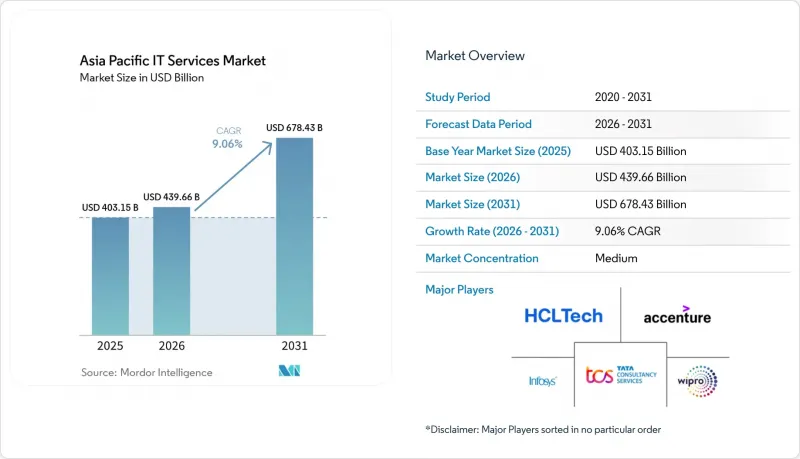
本報告按服務類型(IT諮詢與實施、IT外包等)、部署模式(本地部署、公共雲端、私有雲端等)、企業規模(大型企業、中型企業、中小企業和微企業)、最終用戶行業(銀行、金融服務和保險、製造業等)以及國家/地區進行細分。市場預測以美元計價。
亞太地區IT服務市場趨勢及洞察。
各產業的快速數字化轉型
金融機構、製造商和零售商正在圍繞API驅動的微服務重建其核心系統,以支援即時分析和全通路功能,並投入大量資金用於雲端遷移和整合諮詢。區域調查顯示,73%的組織計畫增加轉型預算,但能力差距依然存在,僅有42%的泰國主管制定了詳細的藍圖。這種不匹配導致對能夠彌合傳統大型主機和雲端平台之間差距的諮詢合作夥伴的需求持續成長。新加坡和日本的銀行正在實施即時支付和人工智慧驅動的信用評分,而零售商則投資於邊緣分析以實現動態定價,從而與電商競爭對手競爭。因此,雲端遷移、資料平台整合和全通路客戶體驗設計等專案激增,每個專案都催生了以最佳化和支援為重點的多年期託管服務合約。
人工智慧和生成式人工智慧的託管服務蓬勃發展。
隨著企業尋求提升開發人員效率並實現客服中心工作流程自動化,生成式人工智慧的採用正在加速。儘管預計到2024年,知識工作者的每週利用率將達到78%,處於世界領先水平,但只有三分之一的企業建立了正式的管治結構,這為提供模型選擇、微調和負責任的人工智慧控制等服務的託管服務供應商提供者創造了機會。印度的試驗計畫顯示,生產力提高了43-45%,這促使該技術在軟體、保險和電信公司中迅速擴展。提供預先訓練的產業專用的模型、持續監控和成本最佳化的推理基礎設施的提供者正在獲得高利潤率。新加坡和韓國等早期採用者市場目前正從概念驗證(PoC)階段過渡到企業級部署,推動人工智慧營運外包達到兩位數成長。
關鍵地區勞動力嚴重短缺和工資上漲
雲端架構師、網路安全分析師和人工智慧工程師的供不應求依然嚴峻,班加羅爾、深圳和新加坡的薪資漲幅更是高達兩位數。光輝國際預測,到2030年,全部區域將面臨470萬技術人才缺口,光是印度就將缺口高達150萬。由於人事費用每年上漲10%至15%,而客戶又抵制物價上漲,服務提供者的利潤率正面臨巨大壓力。為了緩解這一困境,供應商正在努力實現日常服務台工作的自動化,培訓中級工程師掌握雲端安全技能,並將營運中心遷至越南和菲律賓等區域性城市。儘管這些措施能夠緩解壓力,但預計供需失衡的情況將持續到2027年,這將限制高度複雜服務的發展。
細分市場分析
隨著企業擴大選擇更靈活的使用模式而非固定容量契約,託管雲端和 XaaS 服務預計將以 10.11% 的複合年成長率成長。到 2025 年,亞太地區的 IT 外包市場仍將保持其主導地位,佔據 32.74% 的市場佔有率,並支撐著對基礎設施管理和應用支援的需求。然而,市場需求正轉向基於結果的配套服務,這些服務在統一的服務等級協定 (SLA) 下整合了基礎設施、平台和軟體層。供應商正透過行業特定的藍圖、Kubernetes編配和雲端成本最佳化來實現差異化競爭。同時,IT 諮詢在大規模現代化專案中仍然具有戰略意義,尤其是在核心銀行系統升級和汽車製造工廠車間數位化方面。業務流程外包 (BPO) 繼續吸引尋求財務和人力資源工作流程成本效益的零售商和通訊業者的注意。由於自助服務入口網站和 AIOps 的推動,支援和維護服務面臨工單量下降的壓力,但其收入和客戶留存率仍保持穩定。這些趨勢共同導致亞太地區 IT 服務市場向「即服務」交付模式轉變,合作夥伴生態系統也圍繞著以雲端為中心的參考架構進行重組。
同時,超大規模資料中心業者服務商正將託管服務工具包整合到其市場平台中,使小規模的服務供應商能夠以白牌提供監控、備份和安全功能,而無需投資建立自己的平台。 Flexera 的研究顯示,全球 89% 的企業正在推行多重雲端策略,亞太地區也呈現同樣的趨勢,客戶正利用託管服務供應商來確保亞馬遜雲端服務 (AWS)、微軟 Azure 和谷歌雲端之間的互通性。儘管由於多重雲端的複雜性,傳統基礎設施外包面臨日益成長的商品化壓力,但整合專家仍保持高於平均的收入成長。
受監管、延遲和成本因素的影響,混合雲和多重雲端環境正以10.46%的複合年成長率快速擴張。儘管預計到2025年,公共雲端將佔總支出的49.73%,但許多金融機構和政府機構為了滿足資料居住要求,仍在私有基礎設施上維護敏感工作負載。雖然亞太地區IT服務市場的本地部署系統正在穩步下降,但製造和能源公司仍優先考慮對延遲要求極高的應用(例如機器視覺檢測和SCADA控制)進行本地處理。混合架構提供了一個切實可行的過渡方案,能夠在保持現有投資的同時實現分階段過渡。 HashiCorp的報告指出,到2024年,亞太地區72%的公司將整合至少兩家雲端服務供應商,凸顯了互通性工具的重要性。服務合作夥伴目前正在將策略即程式碼管治、FinOps和工作負載部署分析打包在一起,使客戶能夠在滿足合規性審計要求的同時最佳化支出。
邊緣運算進一步推動了對混合解決方案的需求。尤其是在物流和零售行業,近乎即時的分析正在顯著提昇路線最佳化和店內個人化體驗。能夠將單一螢幕可觀測性擴展到邊緣、私有雲端和超大規模區域的供應商正在獲得更高的利潤率。隨著人工智慧推理越來越接近資料來源,混合模式變得至關重要,並在亞太地區IT服務市場的發展趨勢中扮演著日益重要的角色。
其他好處:
- Excel格式的市場預測(ME)表
- 3個月的分析師支持
目錄
第1章:引言
- 研究假設和市場定義
- 調查範圍
第2章:調查方法
第3章執行摘要
第4章 市場狀況
- 市場概覽
- 市場促進因素
- 各產業的快速數字化轉型
- 主權雲端的強制實施正在改變本地社區的服務交付方式。
- 成本效益的提高正在推動ITO和BPO的採用。
- 人工智慧/生成式人工智慧託管服務的蓬勃發展。
- 東協和印度的智慧城市大型企劃
- 氣候科技與綠色IT合規性的外包
- 市場限制因素
- 一線城市面臨嚴重的勞動力短缺和薪資上漲問題
- 與網路安全和資料主權相關的合規成本不斷上升
- 國營企業遺留技術債
- 地緣政治數位集團的崛起正在擾亂供應鏈。
- 產業價值鏈分析
- 監理情勢
- 技術展望
- 波特五力分析
- 價格分析
- 宏觀經濟因素的影響
第5章 市場規模與成長預測
- 按服務類型
- IT諮詢與實施
- IT外包(ITO)
- 業務流程外包(BPO)
- 託管雲端和 XaaS
- 支援、維護和其他服務
- 按部署模式
- 本地部署/專屬式
- 公共雲端
- 私有雲端
- 混合/多重雲端
- 按公司規模
- 大公司
- 中型公司
- 小規模和微企業
- 按最終用戶行業分類
- 銀行、金融服務和保險(BFSI)
- 製造業和工業
- 政府/公共部門
- 醫療保健和生命科學
- 零售、電子商務、消費品
- 通訊與媒體
- 運輸/物流
- 能源公用事業
- 其他終端用戶產業
- 國家
- 中國
- 印度
- 日本
- 韓國
- 印尼
- 馬來西亞
- 新加坡
- 台灣
- 泰國
- 澳洲
- 其他亞太國家
第6章 競爭情勢
- 市場集中度
- 策略趨勢
- 市佔率分析
- 公司簡介
- Accenture plc
- Tata Consultancy Services Ltd.
- Infosys Ltd.
- Wipro Ltd.
- HCL Technologies Ltd.
- Tech Mahindra Ltd.
- Cognizant Technology Solutions Corp.
- Capgemini SE
- Fujitsu Ltd.
- NTT DATA Corp.
- NEC Corp.
- Samsung SDS Co., Ltd.
- LG CNS Co., Ltd.
- Alibaba Cloud Computing Co., Ltd.
- Tencent Cloud Computing(Beijing)Ltd.
- IBM Corp.
- DXC Technology Co.
- Deloitte Touche Tohmatsu Ltd.
- Ernst and Young Global Ltd.
- PricewaterhouseCoopers International Ltd.
- KPMG International Ltd.
- Singtel NCS Pte. Ltd.
- PCCW Solutions Ltd.
- Datacom Group Ltd.
- UST Global(Singapore)Pte. Ltd.
- Nihon Unisys, Ltd.
- Hitachi Vantara LLC
- Amazon Web Services Singapore Pte. Ltd.
- Google Cloud Asia Pacific Pte. Ltd.
- Huawei Cloud Computing Technologies Co., Ltd.
第7章 市場機會與未來展望
According to Mordor Intelligence, the asia pacific IT services market size is projected to expand from USD 403.15 billion in 2025 and USD 439.66 billion in 2026 to USD 678.43 billion by 2031, registering a CAGR of 9.06% between 2026 to 2031.
This report is Segmented by Service Type (IT Consulting and Implementation, IT Outsourcing, and More), Deployment Model (On-Premises, Public Cloud, Private Cloud, and More), Enterprise Size (Large, Medium-Sized, and Small and Micro), End-User Industry (BFSI, Manufacturing, and More), and Country. The Market Forecasts are Provided in Terms of Value (USD).
Asia Pacific IT Services Market Trends and Insights
Rapid Digital Transformation Across Industries
Financial institutions, manufacturers, and retailers are rebuilding core systems around API-driven microservices to support real-time analytics and omnichannel engagement, redirecting substantial capital toward cloud migration and integration consulting. A regional survey found that 73% of organizations plan to raise transformation budgets, yet capability gaps persist, with only 42% of Thai executives maintaining detailed roadmaps. This mismatch fuels steady demand for advisory partners that can bridge legacy mainframes and cloud platforms. Banks in Singapore and Japan are rolling out real-time payments and AI-based credit scoring, while retailers invest in edge analytics for dynamic pricing to counter e-commerce rivals. The resulting project pipeline spans cloud migration, data-platform unification, and omnichannel customer-experience design, each feeding multi-year managed-service contracts focused on optimization and support.
AI and Generative-AI Managed-Services Boom
Generative AI adoption is accelerating as firms seek to boost developer productivity and automate call-center workflows. Weekly usage among knowledge workers reached 78% in 2024, the highest global rate, yet just one-third of companies have formal governance, opening the door for managed service providers that bundle model selection, fine-tuning, and responsible-AI controls. Pilot programs in India demonstrated 43-45% productivity gains, prompting rapid scaling across software, insurance, and telecom firms. Providers that deliver pre-trained vertical models, continuous monitoring, and cost-optimized inference infrastructure are capturing premium margins. Early adopter markets such as Singapore and South Korea are now moving from proofs of concept to enterprise-wide rollouts, driving double-digit growth in AI-operations outsourcing.
Severe Talent Shortages and Wage Inflation in Tier-1 Hubs
Cloud architects, cybersecurity analysts, and AI engineers remain in short supply, driving double-digit wage jumps in Bengaluru, Shenzhen, and Singapore. Korn Ferry forecasts a regional deficit of 4.7 million skilled professionals by 2030, with India alone lacking up to 1.5 million experts. Providers face margin compression as labor costs rise 10-15% annually and clients resist billing-rate hikes. To mitigate, vendors are automating routine service-desk tasks, reskilling mid-level engineers in cloud security, and shifting delivery to secondary cities in Vietnam and the Philippines. While these measures relieve pressure, the supply-demand imbalance is projected to persist through 2027, constraining growth in high-complexity services.
Other drivers and restraints analyzed in the detailed report include:
- Sovereign-Cloud Mandates Reshaping In-Region Delivery
- Cost-Efficiency Push Driving ITO and BPO Adoption
- Escalating Cybersecurity and Data-Sovereignty Compliance Costs
For complete list of drivers and restraints, kindly check the Table Of Contents.
Segment Analysis
Managed cloud and XaaS services are forecast to grow at a 10.11% CAGR as enterprises opt for elastic consumption over fixed-capacity contracts. The Asia-Pacific IT Services market size for IT outsourcing remained dominant in 2025, holding a 32.74% share and underpinning infrastructure management and application support requirements. However, demand is tilting toward outcome-based bundles that integrate infrastructure, platform, and software layers under unified SLAs. Vendors differentiate through industry blueprints, Kubernetes orchestration, and cloud-cost optimization. Meanwhile, IT consulting retains strategic relevance for large-scale modernization projects, particularly in banking core-system replacement and plant-floor digitization within automotive manufacturing. Business-process outsourcing continues to attract retailers and telecom operators seeking cost efficiency in finance and human resources workflows. Support and maintenance services face price erosion as self-service portals and AIOps reduce ticket volumes, yet they sustain recurring revenue and client stickiness. Collectively, these dynamics pivot the Asia-Pacific IT Services market toward as-a-service delivery, reshaping partner ecosystems around cloud-centric reference architectures.
In parallel, hyperscalers are embedding managed-service toolkits into their marketplaces, enabling smaller providers to white-label monitoring, backup, and security features without investing in proprietary platforms. Flexera recorded that 89% of global enterprises pursue multi-cloud strategies, a pattern mirrored in Asia-Pacific where clients engage managed providers to navigate interoperability across Amazon Web Services, Microsoft Azure, and Google Cloud. This multi-cloud complexity sustains above-average revenue growth for integration specialists even as commoditization pressures intensify in traditional infrastructure outsourcing.
Hybrid and multi-cloud environments are expanding at a 10.46% CAGR, reflecting regulatory, latency, and cost considerations. Public cloud accounted for 49.73% of spending in 2025, but many financial institutions and governments maintain sensitive workloads on private infrastructure to comply with residency mandates. The Asia-Pacific IT Services market share attached to on-premises systems is steadily declining, yet manufacturing and energy companies still prioritize local processing for latency-critical applications such as machine-vision inspection and SCADA control. Hybrid architectures provide a pragmatic bridge, allowing gradual migration while preserving existing investments. HashiCorp reported that 72% of Asia-Pacific enterprises had integrated at least two cloud providers by 2024, underscoring the premium placed on interoperability tooling. Service partners now bundle policy-as-code governance, FinOps, and workload-placement analytics, enabling clients to optimize spend while satisfying compliance auditors.
Edge computing is further amplifying hybrid demand, particularly in logistics and retail where near-real-time analytics enhance route optimization and in-store personalization. Vendors that can extend single-pane observability across edge, private-cloud, and hyperscale regions are commanding higher margins. As AI inference moves closer to data sources, hybrid models become indispensable, reinforcing their centrality to the Asia-Pacific IT Services market trajectory.
Complete Report Scope:
- By Service Type
- IT Consulting and Implementation
- IT Outsourcing (ITO)
- Business-Process Outsourcing (BPO)
- Managed Cloud and XaaS
- Support, Maintenance and Other Services
- By Deployment Model
- On-premises / Captive
- Public Cloud
- Private Cloud
- Hybrid / Multi-cloud
- By Enterprise Size
- Large Enterprises
- Medium-sized Businesses
- Small and Micro Businesses
- By End-user Industry
- Banking, Financial Services and Insurance (BFSI)
- Manufacturing and Industrial
- Government and Public Sector
- Healthcare and Life Sciences
- Retail, E-Commerce and Consumer Goods
- Telecom and Media
- Transportation and Logistics
- Energy and Utilities
- Other End-user Industries
- By Country
- China
- India
- Japan
- South Korea
- Indonesia
- Malaysia
- Singapore
- Taiwan
- Thailand
- Australia
- Rest of Asia-Pacific
List of Companies Covered in this Report:
- Accenture plc
- Tata Consultancy Services Ltd.
- Infosys Ltd.
- Wipro Ltd.
- HCL Technologies Ltd.
- Tech Mahindra Ltd.
- Cognizant Technology Solutions Corp.
- Capgemini SE
- Fujitsu Ltd.
- NTT DATA Corp.
- NEC Corp.
- Samsung SDS Co., Ltd.
- LG CNS Co., Ltd.
- Alibaba Cloud Computing Co., Ltd.
- Tencent Cloud Computing (Beijing) Ltd.
- IBM Corp.
- DXC Technology Co.
- Deloitte Touche Tohmatsu Ltd.
- Ernst and Young Global Ltd.
- PricewaterhouseCoopers International Ltd.
- KPMG International Ltd.
- Singtel NCS Pte. Ltd.
- PCCW Solutions Ltd.
- Datacom Group Ltd.
- UST Global (Singapore) Pte. Ltd.
- Nihon Unisys, Ltd.
- Hitachi Vantara LLC
- Amazon Web Services Singapore Pte. Ltd.
- Google Cloud Asia Pacific Pte. Ltd.
- Huawei Cloud Computing Technologies Co., Ltd.
Additional Benefits:
- The market estimate (ME) sheet in Excel format
- 3 months of analyst support
TABLE OF CONTENTS
1 INTRODUCTION
- 1.1 Study Assumptions and Market Definition
- 1.2 Scope of the Study
2 RESEARCH METHODOLOGY
3 EXECUTIVE SUMMARY
4 MARKET LANDSCAPE
- 4.1 Market Overview
- 4.2 Market Drivers
- 4.2.1 Rapid Digital Transformation Across Industries
- 4.2.2 Sovereign-Cloud Mandates Reshaping In-Region Delivery
- 4.2.3 Cost-Efficiency Push Driving Ito And Bpo Adoption
- 4.2.4 Ai / Gen-Ai Managed-Services Boom
- 4.2.5 Smart-City Mega-Projects In Asean And India
- 4.2.6 Climate-Tech And Green-It Compliance Outsourcing
- 4.3 Market Restraints
- 4.3.1 Severe Talent Shortages And Wage Inflation In Tier-1 Hubs
- 4.3.2 Escalating Cybersecurity / Data-Sovereignty Compliance Costs
- 4.3.3 Legacy Tech-Debt In State-Owned Enterprises
- 4.3.4 Geopolitical Digital Blocs Fragmenting Supply Chains
- 4.4 Industry Value Chain Analysis
- 4.5 Regulatory Landscape
- 4.6 Technological Outlook
- 4.7 Porter's Five Forces Analysis
- 4.7.1 Bargaining Power of Suppliers
- 4.7.2 Bargaining Power of Consumers
- 4.7.3 Threat of New Entrants
- 4.7.4 Threat of Substitutes
- 4.7.5 Intensity of Competitive Rivalry
- 4.8 Pricing Analysis
- 4.9 Impact of Macroeconomic Factors
5 MARKET SIZE AND GROWTH FORECASTS (VALUE)
- 5.1 By Service Type
- 5.1.1 IT Consulting and Implementation
- 5.1.2 IT Outsourcing (ITO)
- 5.1.3 Business-Process Outsourcing (BPO)
- 5.1.4 Managed Cloud and XaaS
- 5.1.5 Support, Maintenance and Other Services
- 5.2 By Deployment Model
- 5.2.1 On-premises / Captive
- 5.2.2 Public Cloud
- 5.2.3 Private Cloud
- 5.2.4 Hybrid / Multi-cloud
- 5.3 By Enterprise Size
- 5.3.1 Large Enterprises
- 5.3.2 Medium-sized Businesses
- 5.3.3 Small and Micro Businesses
- 5.4 By End-user Industry
- 5.4.1 Banking, Financial Services and Insurance (BFSI)
- 5.4.2 Manufacturing and Industrial
- 5.4.3 Government and Public Sector
- 5.4.4 Healthcare and Life Sciences
- 5.4.5 Retail, E-Commerce and Consumer Goods
- 5.4.6 Telecom and Media
- 5.4.7 Transportation and Logistics
- 5.4.8 Energy and Utilities
- 5.4.9 Other End-user Industries
- 5.5 By Country
- 5.5.1 China
- 5.5.2 India
- 5.5.3 Japan
- 5.5.4 South Korea
- 5.5.5 Indonesia
- 5.5.6 Malaysia
- 5.5.7 Singapore
- 5.5.8 Taiwan
- 5.5.9 Thailand
- 5.5.10 Australia
- 5.5.11 Rest of Asia-Pacific
6 COMPETITIVE LANDSCAPE
- 6.1 Market Concentration
- 6.2 Strategic Moves
- 6.3 Market Share Analysis
- 6.4 Company Profiles (includes Global level Overview, Market level overview, Core Segments, Financials as available, Strategic Information, Market Rank/Share for key companies, Products and Services, and Recent Developments)
- 6.4.1 Accenture plc
- 6.4.2 Tata Consultancy Services Ltd.
- 6.4.3 Infosys Ltd.
- 6.4.4 Wipro Ltd.
- 6.4.5 HCL Technologies Ltd.
- 6.4.6 Tech Mahindra Ltd.
- 6.4.7 Cognizant Technology Solutions Corp.
- 6.4.8 Capgemini SE
- 6.4.9 Fujitsu Ltd.
- 6.4.10 NTT DATA Corp.
- 6.4.11 NEC Corp.
- 6.4.12 Samsung SDS Co., Ltd.
- 6.4.13 LG CNS Co., Ltd.
- 6.4.14 Alibaba Cloud Computing Co., Ltd.
- 6.4.15 Tencent Cloud Computing (Beijing) Ltd.
- 6.4.16 IBM Corp.
- 6.4.17 DXC Technology Co.
- 6.4.18 Deloitte Touche Tohmatsu Ltd.
- 6.4.19 Ernst and Young Global Ltd.
- 6.4.20 PricewaterhouseCoopers International Ltd.
- 6.4.21 KPMG International Ltd.
- 6.4.22 Singtel NCS Pte. Ltd.
- 6.4.23 PCCW Solutions Ltd.
- 6.4.24 Datacom Group Ltd.
- 6.4.25 UST Global (Singapore) Pte. Ltd.
- 6.4.26 Nihon Unisys, Ltd.
- 6.4.27 Hitachi Vantara LLC
- 6.4.28 Amazon Web Services Singapore Pte. Ltd.
- 6.4.29 Google Cloud Asia Pacific Pte. Ltd.
- 6.4.30 Huawei Cloud Computing Technologies Co., Ltd.
7 MARKET OPPORTUNITIES AND FUTURE OUTLOOK
- 7.1 White-space and Unmet-Need Assessment

 印尼IT服務:市場佔有率分析、產業趨勢與統計及成長預測(2026-2031年)北美IT服務:市場佔有率分析、產業趨勢與統計、成長預測(2026-2031年)歐洲IT服務:市場佔有率分析、產業趨勢與統計、成長預測(2026-2031年)
 2026-2030年全球IT服務市場美國IT服務:市場佔有率分析、產業趨勢與統計、成長預測(2026-2031年)英國IT服務:市場佔有率分析、產業趨勢與統計、成長預測(2026-2031年)零售商個人化服務:市場佔有率分析、產業趨勢與統計及成長預測(2026-2031 年)IT服務:市場佔有率分析、產業趨勢與統計、成長預測(2026-2031年)
 BlockConnect 服務市場預測至 2034 年—按服務類型、部署模式、技術、應用、最終用戶和地區分類的全球分析個人化服務:市場佔有率分析、產業趨勢與統計、成長預測(2026-2031)