


 |
市場調查報告書
商品編碼
2125609
歐洲IT服務:市場佔有率分析、產業趨勢與統計、成長預測(2026-2031年)Europe IT Services - Market Share Analysis, Industry Trends & Statistics, Growth Forecasts (2026 - 2031) |
||||||

※ 本網頁內容可能與最新版本有所差異。詳細情況請與我們聯繫。
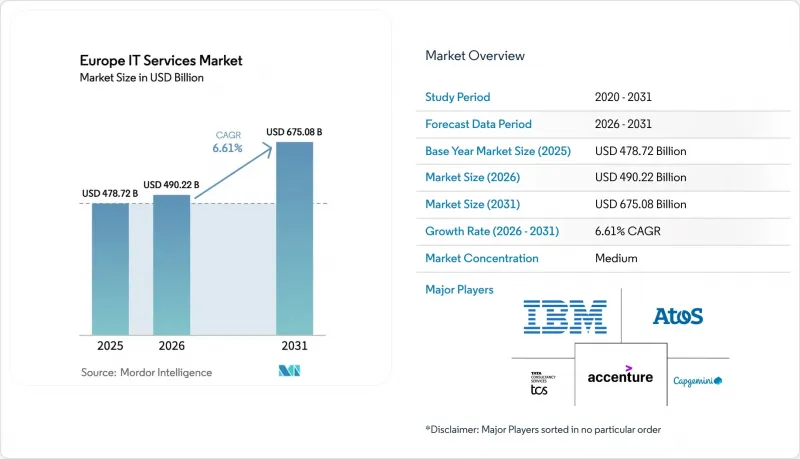
根據 Mordor Intelligence 預測,歐洲 IT 服務市場規模預計將在 2025 年達到 4,787.2 億美元,2026 年達到 4902.2 億美元,2031 年達到 6,750.8 億美元,2026 年至 2031 年的複合年成長率為 6.61%。
本報告按服務類型(IT諮詢與實施、IT外包等)、公司規模(中小企業、大型企業)、部署模式(境內、近岸、離岸)、最終用戶行業(銀行、金融服務和保險、製造業、政府機構、醫療保健、零售、電信等)以及地區進行細分。市場預測以美元計價。
歐洲IT服務市場的趨勢與洞察
公司整體雲端遷移的激增
NIS2 指示強制關鍵業者維護備用處理站點,這促使雲端採用率激增。這使得多重雲端冗餘成為法律要求,而不僅僅是最佳實踐。德國製造業正在將高度敏感的工作負載遷移到符合 Gaia-X 標準的自主雲,同時將較不重要的資料保留在全球超大規模資料中心業者上。 「數位十年」計畫的目標是到 2030 年實現歐洲企業 75% 的雲端採用率,並持續推進遷移和現代化專案。能夠將 SAP 的專業知識與基於容器的微服務相結合的供應商正在訂單大規模轉型專案。此外,多重雲端日益複雜化,對財務營運 (FinOps)、可觀測性和跨雲端安全閘道產生了連鎖反應,從而增強了長期託管服務收入。
在歐盟網路威脅應對指令的背景下,向託管安全模式過渡
NIS2 指示將受監管組織的範圍從約 2,000 家擴大到 2025 年 1 月的超過 160,000 家。 24 小時違規報告要求和供應鏈風險映射給企業內部安全團隊帶來了沉重負擔,促使採購方轉向能夠提供全天候安全營運中心 (SOC) 監控和零信任架構的託管安全服務提供者 (MSSP)。法國國家安全資訊系統安全局 (ANSSI) 和德國聯邦資訊安全局 (BSI) 發布的行業特定指南規範了競標規範,消除了採購流程中的歧義,並加快了合約簽署速度。固定費率的「合規即服務」套餐在沒有專職首席資訊安全安全長 (CISO) 的中型企業中越來越受歡迎,企業正從臨時審計轉向可預測的訂閱服務。
主要服務場所面臨勞動力短缺和薪資上漲的問題
根據歐盟統計局的數據,到2025年,將有50萬個資訊通訊技術(ICT)相關職缺無人填補。德國開發人員的薪資中位數預計將年增8.2%,這將削弱近岸開發的成本優勢。波蘭和羅馬尼亞薪資水準的急劇上漲(漲幅達9%)給那些受低通膨時期簽訂的固定物價合約約束的供應商帶來了壓力。人才流失到北美加劇了人才短缺,迫使供應商使用生成式人工智慧聊天機器人實現一級支援的自動化,並優先考慮高利潤的諮詢業務。然而,這些權宜之計只能部分解決結構性人才短缺問題,並且正在抑制歐洲IT服務市場的成長潛力。
細分市場分析
至2025年,雲端和平台服務將佔歐洲IT服務市場的33.74%,但託管安全服務以6.72%的複合年成長率領先成長榜單,預計到2031年將持續成長。基於NIS2和DORA的強制性威脅監控使得全天候安全營運中心(SOC)系統成為經營團隊的首要任務,而可選的安全先導計畫也逐漸成為必要的營運成本。將持續合規性檢查整合到ERP部署和雲端遷移中的供應商正在逐步擴大其市場佔有率。
諮詢和實施業務的收入主要來自向 SAP S/4HANA 的遷移、與 CSRD 相關的 ESG 平台開發以及與歐洲健康資料空間的整合。隨著機器人流程自動化 (RPA) 和人工智慧驅動的文件提取技術重塑後勤部門合約模式,IT 外包 (ITO) 和業務流程外包 (BPO) 之間的界限正在逐漸模糊,而可擴展檢測與響應 (EDR) 平台的普及正促使安全支出從邊界防禦轉向預測性威脅狩獵。
大型企業憑藉多年期全球支持契約,在2025年貢獻了60.36%的收入,而中小企業(SME)預計到2031年將保持6.96%的複合年成長率。歐盟的「數位十年」基金和德國的「數位時代」計畫津貼可覆蓋高達50%的符合條件的雲端成本,從而降低了採用雲端技術的門檻。預先配置的SaaS軟體包縮短了引進週期,但系統整合、資料遷移和網路安全態勢評估仍需要外部專業知識,這為模組化服務目錄拓展了商機。
推動成長的另一個動力是諮詢主導的「數位化成熟度」評估。這有助於企業利用公共補貼,並促進對已通過國家補貼計劃認證的解決方案供應商的支出。這為企業在初始實施工作之外提供持續諮詢服務創造了機會。
其他好處:
- Excel格式的市場預測(ME)表
- 3個月的分析師支持
目錄
第1章:引言
- 市場分析與定義的前提條件
- 分析範圍
第2章 分析方法
第3章執行摘要
第4章 市場狀況
- 市場概覽
- 市場促進因素
- 企業範圍內的雲端遷移激增
- 對成本最佳化的ITO和BPO合約的需求
- 向託管安全模式的轉變,是由歐盟範圍內的網路威脅應對措施指令所推動的。
- 人工智慧驅動的供應商選擇平台正在加速外包進程。
- 企業亟需在 2027 年停止支援之前對 SAP 和傳統 ERP 系統進行現代化改造。
- 與歐盟相關的 ESG 報告服務,特別是與 CSRD(企業社會責任發展)相關的服務,正在推動諮詢需求的成長。
- 市場限制因素
- 主要配送中心面臨勞動力短缺和工資上漲的問題
- 地緣政治資料主權障礙(Schrems II 裁決,人工智慧法)
- 宏觀經濟的不確定性正在延長消費者的決策週期。
- 加強對高能耗資料中心碳足跡的處罰
- 價值鏈分析
- 監理情勢
- 技術展望
- 波特五力分析
第5章:預測市場規模與成長率
- 按服務類型
- IT諮詢與實施
- IT外包(ITO)
- 業務流程外包(BPO)
- 託管保全服務
- 雲端/平台服務
- 按公司規模
- 中小企業
- 大公司
- 按部署模式
- 陸上交付
- 近岸交付
- 離岸交付
- 按最終用戶行業分類
- 銀行、金融服務和保險業 (BFSI)
- 製造業
- 政府/公共部門
- 醫學與生命科學
- 零售和消費品
- 通訊與媒體
- 物流/運輸
- 能源公用事業
- 其他終端用戶產業
- 國家
- 英國
- 德國
- 法國
- 義大利
- 西班牙
- 其他歐洲國家
第6章 競爭情勢
- 市場集中度
- 策略趨勢
- 市佔率分析
- 公司簡介
- Accenture plc
- Capgemini SE
- IBM Consulting
- Atos SE
- Tata Consultancy Services Ltd
- Cognizant Technology Solutions Corp.
- Infosys Ltd
- Wipro Ltd
- CGI Inc.
- Sopra Steria Group SA
- DXC Technology Co.
- NTT DATA Europe and LATAM
- Tietoevry Oyj
- EVRYTHNG Group AB
- Fujitsu Services Ltd
- Orange Business Services
- Swisscom Ltd(Enterprise Services)
- Telefonica Tech
- GFT Technologies SE
- Reply SpA
- Endava plc
- Luxoft(DXC Technology)
- Kyndryl Holdings Inc.
- HCLTech Ltd
- NCC Group plc
第7章 市場機會與未來展望
According to Mordor Intelligence, the Europe IT services market size is projected to be USD 478.72 billion in 2025, USD 490.22 billion in 2026 and reach USD 675.08 billion by 2031, growing at a CAGR of 6.61% from 2026 to 2031.
This report is Segmented by Service Type (IT Consulting and Implementation, IT Outsourcing, and More), Enterprise Size (Small and Medium Enterprises and Large Enterprises), Deployment Model (Onshore, Nearshore, and Offshore), End-User Vertical (BFSI, Manufacturing, Government, Healthcare, Retail, Telecom, and More), and Geography. The Market Forecasts are Provided in Terms of Value (USD).
Europe IT Services Market Trends and Insights
Surging Enterprise-Wide Cloud Migration
Cloud adoption jumped after the NIS2 Directive obliged essential entities to maintain alternate processing sites, making multi-cloud redundancy a legal necessity rather than a best practice. German industrial firms are moving sensitive workloads to Gaia-X-aligned sovereign clouds while keeping non-critical data on global hyperscalers. The Digital Decade program targets 75% cloud usage among European companies by 2030, sustaining a pipeline of lift-and-shift and modernization projects. Vendors able to combine SAP expertise with container-based microservices are winning large transformation mandates. Multi-cloud complexity also unlocks follow-on demand for FinOps, observability, and inter-cloud security gateways, strengthening long-term managed-services revenues.
Shift to Managed Security Amid EU-Wide Cyber-Threat Directives
The NIS2 Directive expanded the scope of regulated entities from roughly 2,000 to more than 160,000 organizations in January 2025. Mandatory 24-hour breach reporting and supply-chain risk mapping overloaded in-house security teams, pushing buyers toward Managed Security Service Providers that can deliver round-the-clock SOC monitoring and zero-trust design. Sector guides from France's ANSSI and Germany's BSI standardized tender specifications, cutting procurement ambiguity and accelerating deal closure. Fixed-fee "compliance-as-a-service" bundles appeal to mid-market firms that lack chief information-security officers, converting ad-hoc audits into predictable subscriptions.
Talent Scarcity and Wage Inflation in Key Delivery Hubs
Eurostat recorded 500,000 unfilled ICT posts in 2025 and median developer pay in Germany rose 8.2% year-on-year, eroding nearshore cost advantages. Wage spikes of 9% in Poland and Romania squeezed vendors locked into fixed-price contracts signed during the low-inflation era. Brain drain toward North America compounds shortages, forcing providers to automate tier-1 support through generative-AI chatbots and prioritize high-margin advisory work. These stopgaps, however, only partly offset the structural talent gap, trimming Europe IT services market growth potential.
Other drivers and restraints analyzed in the detailed report include:
- Corporate Urgency to Modernize SAP and Legacy ERP Before 2027 Support Sunset
- EU CSRD-Linked ESG-Reporting Services Boosting Consulting Demand
- Geopolitical Data-Sovereignty Barriers (Schrems II, AI Act)
For complete list of drivers and restraints, kindly check the Table Of Contents.
Segment Analysis
Managed Security Services sits atop growth rankings with a 6.72% CAGR to 2031 even though Cloud and Platform Services controlled a 33.74% Europe IT services market share in 2025. Mandatory threat-monitoring duties under NIS2 and DORA make 24x7 SOC coverage a board-level concern, converting discretionary security pilots into non-negotiable opex. Vendors that embed continuous compliance checks into ERP rollouts and cloud migrations capture incremental wallet share.
Consulting and Implementation revenue is buoyed by SAP S/4HANA conversions, CSRD-linked ESG platform buildouts, and European Health Data Space integrations. ITO and BPO lines are converging as robotic process automation and AI-driven document extraction reshape back-office deals, while Extended Detection and Response platforms push security spending from perimeter defense into predictive threat hunting.
Large Enterprises generated 60.36% of 2025 revenue thanks to multi-year global support deals, yet Small and Medium Enterprises are on course for a 6.96% CAGR through 2031. EU Digital Decade funds and Germany's Digital Now grants cover up to 50% of eligible cloud costs, lowering adoption hurdles. Pre-configured SaaS bundles shorten deployment cycles, but integrations, data migration and cyber-posture assessments still require external expertise, expanding opportunity for modular service catalogs.
A secondary growth lever is consultancy-led "digital maturity" diagnostics, which unlock public subsidies and channel spend toward solution providers already accredited under national voucher schemes. This creates recurring advisory assignments alongside initial implementation work.
Complete Report Scope:
- By Service Type
- IT Consulting and Implementation
- IT Outsourcing (ITO)
- Business Process Outsourcing (BPO)
- Managed Security Services
- Cloud and Platform Services
- By Enterprise Size
- Small and Medium Enterprises (SMEs)
- Large Enterprises
- By Deployment Model
- Onshore Delivery
- Nearshore Delivery
- Offshore Delivery
- By End-User Vertical
- BFSI
- Manufacturing
- Government and Public Sector
- Healthcare and Life-Sciences
- Retail and Consumer Goods
- Telecom and Media
- Logistics and Transport
- Energy and Utilities
- Other End-User Verticals
- By Country
- United Kingdom
- Germany
- France
- Italy
- Spain
- Rest of Europe
List of Companies Covered in this Report:
- Accenture plc
- Capgemini SE
- IBM Consulting
- Atos SE
- Tata Consultancy Services Ltd
- Cognizant Technology Solutions Corp.
- Infosys Ltd
- Wipro Ltd
- CGI Inc.
- Sopra Steria Group SA
- DXC Technology Co.
- NTT DATA Europe and LATAM
- Tietoevry Oyj
- EVRYTHNG Group AB
- Fujitsu Services Ltd
- Orange Business Services
- Swisscom Ltd (Enterprise Services)
- Telefonica Tech
- GFT Technologies SE
- Reply SpA
- Endava plc
- Luxoft (DXC Technology)
- Kyndryl Holdings Inc.
- HCLTech Ltd
- NCC Group plc
Additional Benefits:
- The market estimate (ME) sheet in Excel format
- 3 months of analyst support
TABLE OF CONTENTS
1 INTRODUCTION
- 1.1 Study Assumptions and Market Definition
- 1.2 Scope of the Study
2 RESEARCH METHODOLOGY
3 EXECUTIVE SUMMARY
4 MARKET LANDSCAPE
- 4.1 Market Overview
- 4.2 Market Drivers
- 4.2.1 Surging Enterprise-Wide Cloud Migration
- 4.2.2 Demand For Cost-Optimised ITO And BPO Contracts
- 4.2.3 Shift To Managed Security Amid EU-Wide Cyber-Threat Directives
- 4.2.4 AI-Driven Vendor-Selection Platforms Accelerating Outsourcing
- 4.2.5 Corporate Urgency To Modernise SAP And Legacy ERP Before 2027 Support Sunset
- 4.2.6 EU CSRD-Linked ESG-Reporting Services Boosting Consulting Demand
- 4.3 Market Restraints
- 4.3.1 Talent Scarcity And Wage Inflation In Key Delivery Hubs
- 4.3.2 Geopolitical Data-Sovereignty Barriers (Schrems II, AI Act)
- 4.3.3 Prolonged Client-Decision Cycles Owing To Macro-Uncertainty
- 4.3.4 Rising Carbon-Footprint Penalties On Energy-Intensive Data Centres
- 4.4 Value Chain Analysis
- 4.5 Regulatory Landscape
- 4.6 Technological Outlook
- 4.7 Porter's Five Forces Analysis
- 4.7.1 Threat of New Entrants
- 4.7.2 Bargaining Power of Suppliers
- 4.7.3 Bargaining Power of Buyers
- 4.7.4 Threat of Substitutes
- 4.7.5 Industry Rivalry
5 MARKET SIZE AND GROWTH FORECASTS (VALUE)
- 5.1 By Service Type
- 5.1.1 IT Consulting and Implementation
- 5.1.2 IT Outsourcing (ITO)
- 5.1.3 Business Process Outsourcing (BPO)
- 5.1.4 Managed Security Services
- 5.1.5 Cloud and Platform Services
- 5.2 By Enterprise Size
- 5.2.1 Small and Medium Enterprises (SMEs)
- 5.2.2 Large Enterprises
- 5.3 By Deployment Model
- 5.3.1 Onshore Delivery
- 5.3.2 Nearshore Delivery
- 5.3.3 Offshore Delivery
- 5.4 By End-User Vertical
- 5.4.1 BFSI
- 5.4.2 Manufacturing
- 5.4.3 Government and Public Sector
- 5.4.4 Healthcare and Life-Sciences
- 5.4.5 Retail and Consumer Goods
- 5.4.6 Telecom and Media
- 5.4.7 Logistics and Transport
- 5.4.8 Energy and Utilities
- 5.4.9 Other End-User Verticals
- 5.5 By Country
- 5.5.1 United Kingdom
- 5.5.2 Germany
- 5.5.3 France
- 5.5.4 Italy
- 5.5.5 Spain
- 5.5.6 Rest of Europe
6 COMPETITIVE LANDSCAPE
- 6.1 Market Concentration
- 6.2 Strategic Moves
- 6.3 Market Share Analysis
- 6.4 Company Profiles (includes Global-level overview, Market-level overview, Core Segments, Financials, Strategic Information, Market Rank/Share, Products and Services, Recent Developments)
- 6.4.1 Accenture plc
- 6.4.2 Capgemini SE
- 6.4.3 IBM Consulting
- 6.4.4 Atos SE
- 6.4.5 Tata Consultancy Services Ltd
- 6.4.6 Cognizant Technology Solutions Corp.
- 6.4.7 Infosys Ltd
- 6.4.8 Wipro Ltd
- 6.4.9 CGI Inc.
- 6.4.10 Sopra Steria Group SA
- 6.4.11 DXC Technology Co.
- 6.4.12 NTT DATA Europe and LATAM
- 6.4.13 Tietoevry Oyj
- 6.4.14 EVRYTHNG Group AB
- 6.4.15 Fujitsu Services Ltd
- 6.4.16 Orange Business Services
- 6.4.17 Swisscom Ltd (Enterprise Services)
- 6.4.18 Telefonica Tech
- 6.4.19 GFT Technologies SE
- 6.4.20 Reply SpA
- 6.4.21 Endava plc
- 6.4.22 Luxoft (DXC Technology)
- 6.4.23 Kyndryl Holdings Inc.
- 6.4.24 HCLTech Ltd
- 6.4.25 NCC Group plc
7 MARKET OPPORTUNITIES AND FUTURE OUTLOOK
- 7.1 White-space and Unmet-need Assessment

 印尼IT服務:市場佔有率分析、產業趨勢與統計及成長預測(2026-2031年)北美IT服務:市場佔有率分析、產業趨勢與統計、成長預測(2026-2031年)
 2026-2030年全球IT服務市場美國IT服務:市場佔有率分析、產業趨勢與統計、成長預測(2026-2031年)英國IT服務:市場佔有率分析、產業趨勢與統計、成長預測(2026-2031年)零售商個人化服務:市場佔有率分析、產業趨勢與統計及成長預測(2026-2031 年)IT服務:市場佔有率分析、產業趨勢與統計、成長預測(2026-2031年)
 BlockConnect 服務市場預測至 2034 年—按服務類型、部署模式、技術、應用、最終用戶和地區分類的全球分析個人化服務:市場佔有率分析、產業趨勢與統計、成長預測(2026-2031)亞太地區IT服務:市場佔有率分析、產業趨勢與統計及成長預測(2026-2031年)