

 |
市場調查報告書
商品編碼
2125408
印度電子商務物流:市場佔有率分析、行業趨勢和統計數據以及成長預測(2026-2031 年)India E-commerce Logistics - Market Share Analysis, Industry Trends & Statistics, Growth Forecasts (2026 - 2031) |
||||||

※ 本網頁內容可能與最新版本有所差異。詳細情況請與我們聯繫。
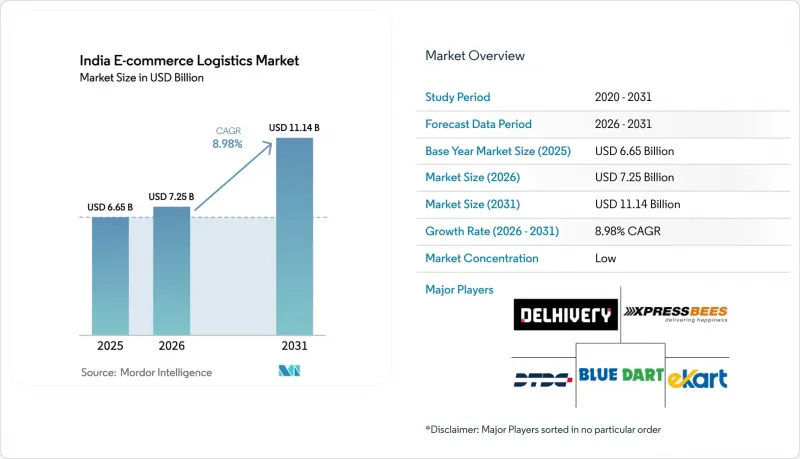
據 Mordor Intelligence 稱,2025 年印度電子商務物流市場價值 66.5 億美元,預計到 2031 年將達到 111.4 億美元,而 2026 年為 72.5 億美元,預測期(2026-2031 年)的複合年成長率為 8.98%。
本報告按服務(運輸、倉儲及履約、附加價值服務)、經營模式(B2C、B2B、C2C)、目的地(國內及跨境)、配送速度(當日達等)、產品類別(食品飲料等)、城市等級(一線城市、第二線城市及其他)及地區(北部、南部及其他)進行細分。市場預測以以金額為準。
印度電子商務物流市場的趨勢與洞察
ONDC主導的中小微型企業進入
ONDC打破了平台壁壘,使物流公司能夠透過標準化API服務多個賣家生態系統。這降低了整合成本,提高了資產利用率。這種模式尤其有利於傳統電商覆蓋範圍有限的二、三線城市,它不僅創造了新的收入管道,也迫使現有公司在透明度和服務品質方面競爭。 ONDC的交易量正在全國範圍內成長,凸顯了其在普及物流服務方面發揮的重要作用。
D2C品牌的激增
直接面對消費者 (D2C) 的品牌對整合庫存管理、個人化包裝和靈活退貨的需求日益成長,促使供應商投資自動化和預測分析。儘管 SKU 數量的增加和季節性需求高峰帶來了複雜性,但對消費者體驗的重視使得透過專業附加價值服務實現更高的利潤率成為可能。這一趨勢正在推動倉庫管理系統的應用,這些系統能夠同步多節點履約並支援差異化定價。
農村地區道路和倉儲基礎設施不足
在區域市場,基礎設施不發達會增加每次出貨的成本並延長交貨前置作業時間。倉儲空間不足限制了對溫度敏感和超大件商品的處理,阻礙了商品種類的多樣化。儘管政府的道路建設正在縮小差距,但基礎建設仍落後於電子商務的需求。在運輸選擇有限的地區,逆向物流的複雜性進一步增加了成本。
細分市場分析
預計到2025年,運輸業將佔印度電子商務物流市場佔有率的71.42%,附加價值服務預計到2031年將以7.11%的複合年成長率成長。提供品牌包裝、套件組裝和檢測服務的供應商擁有強大的定價權。儘管運輸業面臨商品化帶來的壓力,但道路運輸仍是印度電子商務物流市場規模的基礎。鐵路發展縮短了大宗貨物的運輸時間,而空運對於時效性要求高的跨境小包裹遞送仍然至關重要。
技術主導的倉庫營運自動化可降低錯誤率並支援規模化發展。此外,人工智慧驅動的品管使企業能夠在不增加相應成本的情況下實現擴張。這些能力有助於客戶維繫策略的實施,並建構競爭壁壘。
至2025年,B2C領域將佔印度電子商務物流市場規模的62.58%,並持續樹立服務水準的標竿。受社群電商活動驅動的C2C領域正以6.42%的複合年成長率(2026-2031年)快速成長,對專業追蹤服務、保險以及個人企業主支援的需求日益成長。 B2B物流雖然穩定性強,但技術差異化的機會有限。
B2C業務的成長與消費者對快速購物體驗日益成長的期望以及智慧型手機的普及同步發生,迫使供應商改善其末端網路和客戶溝通工具。隨著社群電商的擴張,對能夠滿足賣家個人化需求的、高度擴充性的微型倉配方案的需求也日益成長。
其他好處:
- Excel格式的市場預測(ME)表
- 3個月的分析師支持
目錄
第1章:引言
- 研究假設和市場定義
- 調查範圍
第2章:調查方法
第3章執行摘要
第4章 市場狀況
- 市場概覽
- 市場促進因素
- 利用國家機會發展中心(ONDC)進入微企業(MSME)市場
- D2C品牌的激增
- 當日送達/快速商務(本地化履約)的蓬勃發展
- UPI和數位支付的普及
- 鐵路貨運高速鐵路走廊(Ghati Shakti,DFC)
- 社群電商平台的成長
- 市場限制因素
- 當地道路和倉儲基礎設施不足
- 高退貨率/貨到付款率
- 關於電子商務和資料在地化成本的法規草案
- 更嚴格遵守ESG和脫碳規定
- 價值供應鏈分析
- 監理情勢
- 技術展望
- 需求與供給分析
- 產業吸引力—五力分析
- 新進入者的威脅
- 買方的議價能力
- 供應商的議價能力
- 替代品的威脅
- 競爭公司之間的競爭
- 地緣政治事件對供應鏈轉型的影響
- 逆向/退貨物流洞察
第5章 市場規模與成長預測
- 按服務
- 運輸
- 路
- 鐵路
- 航空
- 海
- 倉儲和履約
- 附加價值服務(貼標籤、包裝、套件組裝)
- 運輸
- 按經營模式
- B2C
- B2B
- C2C
- 按目的地
- 國內的
- 跨境(國際)
- 按配送速度
- 當日送達(24小時內)
- 隔日送達(24-48小時)
- 標準(3-5天)
- 其他(5天或以上)
- 產品類型
- 食品/飲料
- 個人及居家護理
- 時尚與生活方式(配件、服裝、鞋類)
- 家具
- 家用電子設備/電器產品
- 其他產品
- 城市排名
- 一級
- 二級
- 三級及以下
- 按地區(印度)
- 北方
- 南部
- 東
- 西方
- 中部
第6章 競爭情勢
- 市場集中度
- 策略趨勢
- 市佔率分析
- 公司簡介
- Delhivery
- Ekart Logistics
- XpressBees
- Blue Dart Express
- DTDC
- TVS Supply Chain Solutions
- FedEx India
- DHL Express India
- Gati-KWE
- Shadowfax
- Mahindra Logistics
- Shiprocket
- Wow Express
- Pickrr
- AAJ Supply Chain Management
- ARK India
- Borzo
- NimbusPost
- Godamwale
- Emiza
第7章 市場機會與未來展望
第8章附錄
- 總體經濟指標
- 關於資本流動的考量
- 電子商務與個人消費統計數據
- 外貿統計數據
According to Mordor Intelligence, the India e-commerce logistics market size was valued at USD 6.65 billion in 2025 and estimated to grow from USD 7.25 billion in 2026 to reach USD 11.14 billion by 2031, at a CAGR of 8.98% during the forecast period (2026-2031).
This report is Segmented by Service (Transportation, Warehousing & Fulfilment, and Value-Added Services), Business Model (B2C, B2B, and C2C), Destination (Domestic and Cross-Border), Delivery Speed (Same-Day, and More), Product Category (Foods & Beverages, and More), City Tier (Tier 1, 2, and More), and Region (North, South, and More). Market Forecasts are Provided in Terms of Value (USD).
India E-commerce Logistics Market Trends and Insights
ONDC-Driven MSME Onboarding
ONDC removes platform silos, enabling logistics firms to serve multiple seller ecosystems through standardized APIs that cut integration costs and elevate asset utilization. The model especially benefits tier 2 and tier 3 markets where traditional e-commerce reach was limited, spurring fresh revenue channels while forcing incumbents to compete on transparency and service quality. Transaction volumes on ONDC have scaled nationwide, confirming its role in democratizing logistics access.
D2C Brand Proliferation
Direct-to-consumer labels demand integrated inventory management, personalized packaging, and agile returns, pushing providers to invest in automation and predictive analytics. SKU proliferation coupled with seasonal surges raises complexity, yet the premium on consumer experience allows higher margins through specialized value-added services. This trend strengthens the adoption of warehouse management systems that synchronize multi-node fulfillment and support differentiated pricing.
Sub-Optimal Rural Road & Warehousing Infrastructure
Connectivity gaps increase per-shipment costs and elongate delivery windows in rural markets. Warehousing shortages restrict temperature-sensitive and bulky product categories, limiting SKU variety. Government road initiatives continue to narrow the gap, yet infrastructure development trails e-commerce demand. Reverse logistics complexities further raise costs where transport options remain sparse.
Other drivers and restraints analyzed in the detailed report include:
- Same-Day / Quick-Commerce Boom
- UPI and Digital-Payments Ubiquity
- High Product-Return / COD Ratio
For complete list of drivers and restraints, kindly check the Table Of Contents.
Segment Analysis
Transportation generated 71.42% of the India e-commerce logistics market share in 2025, and the Value-Added Services segment CAGR stands at 7.11% to 2031. Providers offering branded packaging, kitting, and inspection enjoy strong pricing power. Transportation faces commoditization, but road haulage still offers the volume backbone for the India e-commerce logistics market. Rail improvements shorten transit times for bulk shipments, and air freight remains critical for time-sensitive cross-border parcels.
Technology-driven automation in warehousing cuts error rates and supports scale, while AI-enabled quality control allows providers to expand without proportional cost escalation. These capabilities sustain customer-retention strategies and create competitive barriers.
The B2C segment contributed 62.58% to the India e-commerce logistics market size in 2025 and continues to set service-level benchmarks. The C2C corridor, propelled by social-commerce activity, is advancing at a 6.42% CAGR (2026-2031) and demands professional tracking, insurance, and support for individual entrepreneurs. B2B shipments offer stability but yield lower technology differentiation opportunities.
B2C growth aligns with rising quick-commerce expectations and widespread smartphone adoption, compelling providers to refine last-mile networks and customer-communication tools. Social-commerce expansion amplifies the need for scalable micro-fulfillment solutions that meet individualized seller requirements.
Complete Report Scope:
- By Service
- Transportation
- Road
- Rail
- Air
- Sea
- Warehousing & Fulfilment
- Value-Added Services (Labelling, Packaging, Kitting)
- Transportation
- By Business Model
- B2C
- B2B
- C2C
- By Destination
- Domestic
- Cross-border (international)
- By Delivery Speed
- Same-day (less than 24 h)
- Next-day (24-48 h)
- Standard (3-5 days)
- Others (more than 5 days)
- By Product Category
- Foods & Beverages
- Personal & Household Care
- Fashion & Lifestyle (accessories, apparel, footwear)
- Furniture
- Consumer Electronics & Household Appliances
- Other Products
- By City Tier
- Tier 1
- Tier 2
- Tier 3 and Below
- By Region (India)
- North
- South
- East
- West
- Central
List of Companies Covered in this Report:
- Delhivery
- Ekart Logistics
- XpressBees
- Blue Dart Express
- DTDC
- TVS Supply Chain Solutions
- FedEx India
- DHL Express India
- Gati-KWE
- Shadowfax
- Mahindra Logistics
- Shiprocket
- Wow Express
- Pickrr
- AAJ Supply Chain Management
- ARK India
- Borzo
- NimbusPost
- Godamwale
- Emiza
Additional Benefits:
- The market estimate (ME) sheet in Excel format
- 3 months of analyst support
TABLE OF CONTENTS
1 Introduction
- 1.1 Study Assumptions & Market Definition
- 1.2 Scope of the Study
2 Research Methodology
3 Executive Summary
4 Market Landscape
- 4.1 Market Overview
- 4.2 Market Drivers
- 4.2.1 ONDC-driven MSME onboarding
- 4.2.2 D2C brand proliferation
- 4.2.3 Same-day/quick-commerce boom (hyperlocal fulfilment)
- 4.2.4 UPI & digital-payments ubiquity
- 4.2.5 Rail-based express cargo corridors (Gati Shakti, DFC)
- 4.2.6 Growth of social-commerce platforms
- 4.3 Market Restraints
- 4.3.1 Sub-optimal rural road & warehousing infra
- 4.3.2 High product-return / COD ratio
- 4.3.3 Draft e-commerce rules & data-localisation costs
- 4.3.4 Stricter ESG & decarbonisation compliance
- 4.4 Value / Supply-Chain Analysis
- 4.5 Regulatory Landscape
- 4.6 Technological Outlook
- 4.7 Demand & Supply Analysis
- 4.8 Industry Attractiveness - Porter's Five Forces
- 4.8.1 Threat of New Entrants
- 4.8.2 Bargaining Power of Buyers
- 4.8.3 Bargaining Power of Suppliers
- 4.8.4 Threat of Substitutes
- 4.8.5 Competitive Rivalry
- 4.9 Impact of Geo-Political Events on Supply Chain Shifts
- 4.10 Reverse / Return Logistics Insights
5 Market Size & Growth Forecasts
- 5.1 By Service
- 5.1.1 Transportation
- 5.1.1.1 Road
- 5.1.1.2 Rail
- 5.1.1.3 Air
- 5.1.1.4 Sea
- 5.1.2 Warehousing & Fulfilment
- 5.1.3 Value-Added Services (Labelling, Packaging, Kitting)
- 5.1.1 Transportation
- 5.2 By Business Model
- 5.2.1 B2C
- 5.2.2 B2B
- 5.2.3 C2C
- 5.3 By Destination
- 5.3.1 Domestic
- 5.3.2 Cross-border (international)
- 5.4 By Delivery Speed
- 5.4.1 Same-day (less than 24 h)
- 5.4.2 Next-day (24-48 h)
- 5.4.3 Standard (3-5 days)
- 5.4.4 Others (more than 5 days)
- 5.5 By Product Category
- 5.5.1 Foods & Beverages
- 5.5.2 Personal & Household Care
- 5.5.3 Fashion & Lifestyle (accessories, apparel, footwear)
- 5.5.4 Furniture
- 5.5.5 Consumer Electronics & Household Appliances
- 5.5.6 Other Products
- 5.6 By City Tier
- 5.6.1 Tier 1
- 5.6.2 Tier 2
- 5.6.3 Tier 3 and Below
- 5.7 By Region (India)
- 5.7.1 North
- 5.7.2 South
- 5.7.3 East
- 5.7.4 West
- 5.7.5 Central
6 Competitive Landscape
- 6.1 Market Concentration
- 6.2 Strategic Moves
- 6.3 Market Share Analysis
- 6.4 Company Profiles (includes Global level Overview, Market level overview, Core Segments, Financials as available, Strategic Information, Market Rank/Share for key companies, Products & Services, and Recent Developments)
- 6.4.1 Delhivery
- 6.4.2 Ekart Logistics
- 6.4.3 XpressBees
- 6.4.4 Blue Dart Express
- 6.4.5 DTDC
- 6.4.6 TVS Supply Chain Solutions
- 6.4.7 FedEx India
- 6.4.8 DHL Express India
- 6.4.9 Gati-KWE
- 6.4.10 Shadowfax
- 6.4.11 Mahindra Logistics
- 6.4.12 Shiprocket
- 6.4.13 Wow Express
- 6.4.14 Pickrr
- 6.4.15 AAJ Supply Chain Management
- 6.4.16 ARK India
- 6.4.17 Borzo
- 6.4.18 NimbusPost
- 6.4.19 Godamwale
- 6.4.20 Emiza
7 Market Opportunities & Future Outlook
- 7.1 White-space & Unmet-need Assessment
8 Appendix
- 8.1 Macroeconomic Indicators
- 8.2 Capital-flow Insights
- 8.3 E-commerce & Consumer-spend Statistics
- 8.4 External Trade Statistics

 英國電子商務物流:市場佔有率分析、產業趨勢與統計、成長預測(2026-2031)東協電子商務物流:市場佔有率分析、產業趨勢與統計及成長預測(2026-2031年)
 電子商務物流市場:全球市場預測(2026-2032)中國跨境電商物流:市佔率分析、產業趨勢與統計及成長預測(2026-2031年)中國電子商務物流:市場佔有率分析、產業趨勢與統計及成長預測(2026-2031年)印尼電子商務物流:市場佔有率分析、產業趨勢與統計及成長預測(2026-2031)印度跨境B2C電子商務物流:市場佔有率分析、產業趨勢與統計及成長預測(2026-2031年)美國跨境電子商務物流:市場佔有率分析、產業趨勢與統計及成長預測(2026-2031)越南跨境B2C電子商務物流:市場佔有率分析、產業趨勢與統計及成長預測(2026-2031年)印度跨境電子商務物流:市場佔有率分析、產業趨勢與統計及成長預測(2026-2031)