


 |
市場調查報告書
商品編碼
2072917
印度跨境電子商務物流:市場佔有率分析、產業趨勢與統計及成長預測(2026-2031)India Cross-Border E-Commerce Logistics - Market Share Analysis, Industry Trends & Statistics, Growth Forecasts (2026 - 2031) |
||||||

※ 本網頁內容可能與最新版本有所差異。詳細情況請與我們聯繫。
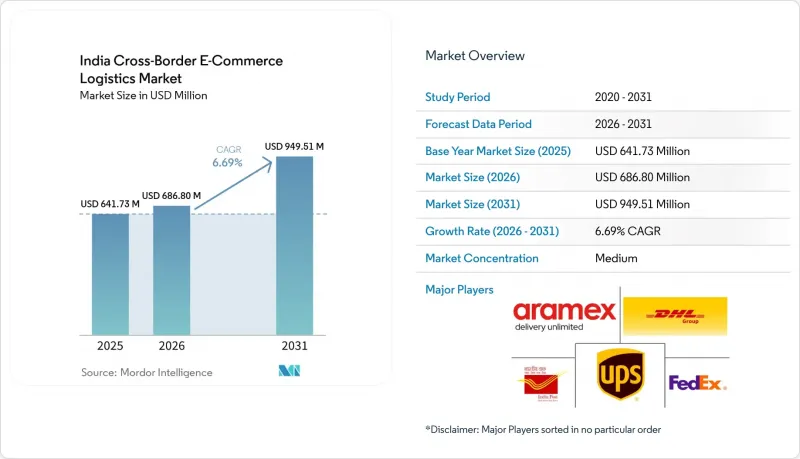
根據 Mordor Intelligence 預測,印度跨境電子商務物流市場規模將從 2025 年的 6.4173 億美元成長到 2026 年的 6.868 億美元,到 2031 年達到 9.4951 億美元,2026 年至 2031 年的複合年成長率為 6.69%。
在更廣泛的出口促進措施的支持下,印度的跨境電商物流市場正穩步拓展賣家群體,不再局限於主要大都市地區。這些措施包括建立電商出口大都會圈、郵政收出貨中心(Dak Ghar Niryat Kendras)、提供便利的宅配,以及為微型、小型和微企業(MSME)提供直接進入電商平台的管道。本報告按產品類型(食品、個人護理、時尚、家具、電子產品等)、物流功能(運輸、附加價值服務等)、經營模式(B2C等)、配送速度(快遞、標準)和物流流向(出境[北美、歐洲等]、入境[北美、歐洲等])進行細分。市場預測以美元計價。
印度跨境電子商務物流市場的趨勢與洞察
電子商務出口中心、DNK 和出口獎勵支持
印度的出口促進體係正變得更加務實,尤其對小規模賣家而言,因為它將實體網路基地台與數位化處理支援相結合。政府已在全國設立了1013個「Dak Ghar Niryat Kendras」(郵政出口中心),為偏遠或二線叢集的出口商提供正規的出口管道,取代了以往非正式的變通方式。該正式架構也明確規定建置電子商務出口樞紐,旨在降低物流成本和時間,簡化監管流程,並簡化再進口。這包括為清關、包裝、品質認證和倉儲提供一體化支援。實際上,這對印度的跨境電子商務物流市場意義重大,因為小包裹出口不僅取決於賣家的需求,還取決於可複製流程的品質。這也意味著,印度的跨境電子商務物流市場能夠吸引來自以往擁有產品供應但缺乏有效出口通路地區的新訂單量。
全球對印度時尚、室內設計、美容產品和傳統工藝品的需求。
對於印度已在電商出口領域佔據強勢地位的品類,市場需求依然強勁。亞馬遜全球賣場於2025年10月宣布,印度賣家的電商出口累計額將超過200億美元。 2024年的主要出口市場包括美國、英國、英國、加拿大、阿拉伯聯合大公國、法國、義大利、西班牙和沙烏地阿拉伯。該公告也指出,過去十年來成長最快的品類包括醫療保健、個人護理和美容產品,凸顯了非電子產品品類在出口小包裹流通中日益成長的重要性。這對印度的跨境電商物流市場具有重大意義,因為與低價的普通商品小包裹相比,品牌知名度高、品牌價值高的品類更容易承擔更高的運費、DDP(關稅和清關費用)以及退貨處理費用。這也是為什麼在印度的跨境電子商務物流市場中,時尚、室內設計、美容產品和具有文化獨特性的產品比主要依靠價格競爭的類別獲得更強勁的長期支持的原因之一。
海關清關、文書工作和付款核對的複雜性。
對於小規模出口商而言,海關清關和結算流程的持續有效管理仍然充滿挑戰。印度儲備銀行(RBI)的PA-CB框架對跨境進出口線上支付交易中介機構進行了直接監管,明確規定了商家註冊、交易處理、結算帳戶、實質審查和報告等方面的規則。雖然這是朝著系統長期改善邁出的積極一步,但也凸顯了跨境電子商務對仲介業者和賣家而言不再是低合規性活動。在印度的跨境電商物流市場,由於出口商必須協調多個相關人員之間的平台工作流程、付款時間表、報關單和交貨承諾,營運摩擦仍然存在。對於小規模經銷商而言,真正的挑戰不僅在於取得需求,還在於如何順利完成所有文件和結算流程,避免出現延誤、例外或不符之處。
細分市場分析
到2025年,時尚生活類商品將佔印度跨境電商物流市場的30.76%,成為市場中最大的類別。這一地位反映了印度對配件、服裝和鞋類產品的穩定需求,而印度在這些領域擁有深厚的製造實力和成熟的出口品牌優勢。此外,這些產品的體積適中,非常適合以市場為主導的銷售模式,因此與以小包裹運輸為主的貿易模式相契合。基於以上原因,時尚生活類商品將繼續在塑造印度跨境電商物流市場的整體交易量方面發揮核心作用。
預計從2026年到2031年,健康美容/個人護理類別將以7.68%的複合年成長率成長,成為成長最快的產品類別。根據亞馬遜2025年10月發布的最新報告,健康美容和個人護理類別是過去十年印度賣家成長最快的類別之一,這印證了印度跨境電商物流市場已呈現的強勁成長動能。美容類別具有結構性優勢,其平均訂單價值通常高於許多低價服飾類產品,從而提高了獲利能力和飲料類別雖然絕對規模仍然較小,但其在民族食品和特色食品類別中的物流路線深度正在不斷提升,海外印度人的重複購買需求支撐著穩定的小包裹遞送。手工藝品仍然是「時尚與生活方式」行業成長的關鍵驅動力,這表明具有文化差異化的產品對於出口產品組合的品質仍然很重要。
預計到2025年,運輸環節將佔印度跨境電商物流市場規模的71.42%,這印證了長途運輸仍是整個營運流程中最有價值的部分。空運在這一領域繼續發揮至關重要的作用,因為跨境小包裹交易高度依賴時效性,尤其是在時尚、健康相關類別和高階消費品訂單中。運輸環節的主導地位反映了長期以來在最後一公里配送前,需要將貨物跨越多個國界和服務區域進行運輸的需求。因此,運輸環節仍是印度跨境電商物流市場的產生收入來源。
預計2026年至2031年間,附加價值服務及其他細分市場將以11.87%的複合年成長率成長,成為成長最快的細分市場。這反映出市場對海關即服務(CaaS)、完稅後交貨(DDP)管理、退貨支援、重新貼標以及目的地特定合規處理等服務的需求日益成長。德迅集團在印度五個城市新增10萬平方公尺的倉儲能力,顯示履約基礎設施的擴展不僅體現在實體面積上,更體現在自動化程度的提高,進而為這些高附加價值服務層提供支援。海運和內河航運在企業對企業(B2B)物流的重要性日益凸顯,這一趨勢在馬士基推出FI2(遠東至印度)航線後尤為明顯,FI2是馬士基繼FI3之後的第二條直飛航線。儘管鐵路運輸規模仍然相對較小,但馬士基每週從海得拉巴到納瓦舍瓦的冷藏鐵路運輸服務表明,針對特定出口行業的專業多模態選擇正在擴大。因此,印度的跨境電商物流業正朝著以多層次服務而非單純的貨運為核心的獲利模式轉變。未來,提供涵蓋倉儲管理、合規和退貨處理等一站式服務的企業預計將在印度跨境電商物流市場獲得更大的附加價值。
其他好處:
- Excel格式的市場預測(ME)表
- 3個月的分析師支持
目錄
第1章:引言
- 研究假設和市場定義
- 調查範圍
第2章:調查方法
第3章執行摘要
第4章 市場狀況
- 市場概況及跨境電子商務物流在電子商務市場中的作用。
- 電子商務產業趨勢
- 消費者行為及供需分析
- 法律規範
- 價值鍊和通路分析
- 市場促進因素
- 電子商務出口中心、DNK 和出口促進支持
- 全球對印度時尚、室內設計、美容產品和傳統工藝品的需求。
- 市場和聚合平台主導的中小微型微企業出口進入
- 數位化和視覺化工具能夠幫助宅配業者加快跨境履約。
- 統一郵政路線獎勵可以提高平均訂單價值 (AOV) 較低的小包裹業務的盈利。
- 印度儲備銀行監管的跨境支付網路和UPI整合,實現支付創新。
- 市場限制因素
- 海關清關、文件準備和付款核對的複雜性。
- 高昂的收貨成本、DDP負擔和逆向物流損失。
- 美國撤回其「最低限度」措施正在擾亂低成本小包裹業務的經濟可行性。
- 歐盟收緊對中小企業出口商的ICS2和增值稅資料合規要求
- 技術創新前景
- 波特五力分析
- 跨境電子商務物流需求的變化
- 地緣政治事件對供應鏈轉型的影響
第5章 市場規模與成長預測
- 產品類型
- 食品/飲料
- 個人護理和居家護理
- 時尚與生活方式(配件、服裝、鞋類)
- 家具
- 家用電子電器和電器產品
- 其他產品
- 透過物流功能
- 運輸
- 道路運輸
- 航空
- 海路和內河水道
- 鐵路
- 倉儲、物流和庫存管理
- 附加價值服務及其他
- 運輸
- 按經營模式
- B2C
- B2B
- C2C
- 按配送速度
- 表達
- 標準
- 按流向
- 出口
- 北美洲
- 歐洲
- 亞太地區
- 中東和非洲
- 南美洲
- 入境(進口)
- 北美洲
- 歐洲
- 亞太地區
- 中東和非洲
- 南美洲
- 出口
第6章 競爭情勢
- 市場集中度
- 關鍵策略趨勢
- 市佔率分析
- 公司簡介
- DHL Group
- FedEx
- United Parcel Service of America, Inc.(UPS)
- Aramex
- India Post
- Delhivery, Ltd.
- Shiprocket X
- Blue Dart Express Pvt. Ltd.
- DTDC Express Pvt. Ltd.
- XpressBees
- Allcargo Gati Logistics Pvt. Ltd.
- SEKO Logistics
- Kuehne+Nagel
- AP Moller-Maersk
- NimbusPost
- Ekart Logistics
- Amazon, Inc.
- ShipGlobal.in
- iThink Logistics
- Shadowfax
- Easyship
- Shipyaari
第7章 市場機會與未來展望
According to Mordor Intelligence, the india cross-border e-commerce logistics market size is expected to increase from USD 641.73 million in 2025 to USD 686.80 million in 2026 and reach USD 949.51 million by 2031, growing at a CAGR of 6.69% over 2026-2031.
The India cross-border e-commerce logistics market is supported by a broader export enablement push that now combines e-commerce export hubs, Dak Ghar Niryat Kendras, courier facilitation, and direct marketplace onboarding for MSMEs, steadily broadening the seller base beyond the largest metros. This report is Segmented by Product Category (Foods, Personal Care, Fashion, Furniture, Electronics, Others), by Logistics Function (Transportation, VAS, and More), by Business Model (B2C, and More), by Delivery Speed (Express, Standard), and by Flow Direction (Outbound [North America, Europe, and More], Inbound [North America, Europe, and More]). The Market Forecasts are in Value (USD).
India Cross-Border E-Commerce Logistics Market Trends and Insights
E-Commerce Export Hubs, DNKs, and Export-Incentive Support
India's export enablement architecture is becoming more practical for small sellers because it now combines physical access points with digital processing support. The government had established 1,013 Dak Ghar Niryat Kendras across the country, which give exporters in remote and secondary clusters a formal export access node rather than an informal workaround. The same official framework also states that e-commerce export hubs are being built to reduce logistics costs and time, streamline regulation, and simplify re-imports, with integrated support around customs clearance, packaging, quality certification, and warehousing. In practice, this matters for the India cross-border e-commerce logistics market because parcel exports depend on repeatable process quality, not only on seller demand. It also means the India cross-border e-commerce logistics market can pull new volume from places that previously had product supply but lacked a viable export channel.
Global Demand for Indian Fashion, Decor, Beauty, and Heritage Products
Demand conditions remain favorable for categories where India already has a visible online export identity. Amazon Global Selling stated in October 2025 that Indian sellers had crossed USD 20 billion in cumulative e-commerce exports, with the United States, United Kingdom, Germany, Canada, UAE, France, Italy, Spain, and Saudi Arabia among key export markets in 2024. The same release showed that health and personal care and beauty were among the fastest-growing categories over the last 10 years, and non-electronics categories are becoming more important in export parcel flows. For the India cross-border e-commerce logistics market, that matters because categories with stronger brand pull and higher perceived value can absorb premium freight, DDP handling, and returns processing more easily than low-value commodity parcels. That is one reason the India cross-border e-commerce logistics market is seeing stronger long-run support from fashion, decor, beauty, and culturally differentiated products than from categories that compete mainly on price.
Customs, Documentation, and Payment Reconciliation Complexity
The customs and payment layer is still difficult for small exporters to handle consistently. RBI's PA-CB framework brought entities facilitating cross-border online payment transactions for import and export under direct regulation, with clear rules around merchant onboarding, transaction handling, settlement accounts, due diligence, and reporting. That is a positive step for long-term system quality, but it also confirms that cross-border commerce is no longer a light-compliance activity for intermediaries or sellers. The India cross-border e-commerce logistics market still faces operating friction when exporters must align platform workflows, payment timelines, customs declarations, and delivery commitments across several parties. For smaller sellers, the real challenge is not just access to demand. It is the ability to complete every documentation and settlement step without delays, exceptions, or reconciliation gaps.
Other drivers and restraints analyzed in the detailed report include:
- Marketplace and Aggregator-Led MSME Export Onboarding
- Faster Cross-Border Fulfillment Through Courier Digitization and Visibility Tools
- US De Minimis Withdrawal Disrupting Low-Ticket Parcel Economics
For complete list of drivers and restraints, kindly check the Table Of Contents.
Segment Analysis
Fashion and lifestyle held 30.76% of the India cross-border e-commerce logistics market share in 2025, making it the largest category in the market. Its position reflects steady demand for accessories, apparel, and footwear, where India combines manufacturing depth with a recognizable export identity. These products also align well with parcel-led trade because they ship in manageable sizes and fit marketplace-led selling models. That keeps fashion and lifestyle central to volume formation across the India cross-border e-commerce logistics market.
Health and beauty / personal care is projected to expand at a 7.68% CAGR over 2026-2031, making it the fastest-growing product segment. Amazon's October 2025 update showed that health and personal care and beauty were among the fastest-growing categories for Indian sellers over the last decade, supporting the momentum already visible in the India cross-border e-commerce logistics market. Beauty is also structurally favorable because average order values tend to be stronger than in many low-ticket apparel lines, which improves the economics of premium shipping and DDP handling. Consumer electronics, household appliances, and furniture remain smaller contributors, but they create more complex packaging, customs valuation, and damage-control requirements. Foods and beverages is still smaller in absolute terms, yet it adds corridor depth in ethnic and specialty categories where repeat diaspora demand supports steady parcel traffic. Handicrafts remained an important growth lever inside Fashion and Lifestyle, which shows that culturally differentiated products continue to matter for export mix quality.
Transportation accounted for 71.42% of the India cross-border e-commerce logistics market size in 2025, which confirms that line-haul movement still absorbs most value in the operating stack. Air freight remains especially important in this segment because cross-border parcel trade depends on time-definite delivery, particularly for fashion, health-linked categories, and premium consumer orders. The dominance of transportation also reflects the long-standing need to move shipments across multiple borders and service zones before the last-mile handoff occurs. As a result, transport still anchors revenue generation in the India cross-border e-commerce logistics market.
The value-added services and others segment is forecast to grow at a 11.87% CAGR over 2026-2031, making it the fastest-growing segment. This reflects stronger demand for customs-as-a-service, DDP management, returns support, relabeling, and destination-specific compliance processing. Kuehne+Nagel's 100,000 m2 capacity addition across five Indian cities shows that fulfillment infrastructure is being expanded through automation rather than just square footage, which supports these higher service layers. Sea transport and inland waterway activity are becoming more relevant for organized B2B flows, especially after Maersk launched its FI2 Far East Asia to India service as a second direct lane alongside FI3. Rail remains smaller, but Maersk's weekly reefer rail link from Hyderabad to Nhava Sheva shows that specialized multimodal options are expanding for specific export sectors. The India cross-border e-commerce logistics industry is therefore shifting toward a margin structure where service layering matters more than basic freight movement alone. Over time, the India cross-border e-commerce logistics market should see more value captured by operators that convert warehousing, compliance, and returns processing into a bundled offering.
Complete Report Scope:
- By Product Category
- Foods and Beverages
- Personal and Household Care
- Fashion and Lifestyle (Accessories, Apparel, Footwear)
- Furniture
- Consumer Electronics and Household Appliances
- Other Products
- By Logistics Function
- Transportation
- Road
- Air
- Sea and Inland Waterways
- Rail
- Warehousing, Distribution and Inventory Management
- Value-added Services and Others
- Transportation
- By Business Model
- B2C
- B2B
- C2C
- By Delivery Speed
- Express
- Standard
- By Flow Direction
- Outbound (Exports)
- North America
- Europe
- Asia-Pacific
- Middle East and Africa
- South America
- Inbound (Imports)
- North America
- Europe
- Asia-Pacific
- Middle East and Africa
- South America
- Outbound (Exports)
List of Companies Covered in this Report:
- DHL Group
- FedEx
- United Parcel Service of America, Inc. (UPS)
- Aramex
- India Post
- Delhivery, Ltd.
- Shiprocket X
- Blue Dart Express Pvt. Ltd.
- DTDC Express Pvt. Ltd.
- XpressBees
- Allcargo Gati Logistics Pvt. Ltd.
- SEKO Logistics
- Kuehne+Nagel
- A.P. Moller - Maersk
- NimbusPost
- Ekart Logistics
- Amazon, Inc.
- ShipGlobal.in
- IThink Logistics
- Shadowfax
- Easyship
- Shipyaari
Additional Benefits:
- The market estimate (ME) sheet in Excel format
- 3 months of analyst support
TABLE OF CONTENTS
1 Introduction
- 1.1 Study Assumptions and Market Definition
- 1.2 Scope of the Study
2 Research Methodology
3 Executive Summary
4 Market Landscape
- 4.1 Market Overview and Role of Cross-border E-commerce Logistics in E-commerce Market
- 4.2 Trends in E-Commerce Industry
- 4.3 Consumer Behavior and Demand-Supply Analysis
- 4.4 Regulatory Framework
- 4.5 Value Chain and Distribution Channel Analysis
- 4.6 Market Drivers
- 4.6.1 E-Commerce Export Hubs, DNKs, and Export-Incentive Support
- 4.6.2 Global Demand for Indian Fashion, Decor, Beauty, and Heritage Products
- 4.6.3 Marketplace and Aggregator-Led MSME Export Onboarding
- 4.6.4 Faster Cross-Border Fulfillment Through Courier Digitization and Visibility Tools
- 4.6.5 Postal-Route Incentive Parity Improving Low-AOV Parcel Economics
- 4.6.6 RBI-Regulated Cross-Border Payment Rails and UPI-Linked Settlement Innovation
- 4.7 Market Restraints
- 4.7.1 Customs, Documentation, and Payment Reconciliation Complexity
- 4.7.2 High Landed Cost, DDP Burden, and Reverse-Logistics Losses
- 4.7.3 US De Minimis Withdrawal Disrupting Low-Ticket Parcel Economics
- 4.7.4 EU ICS2 And VAT Data-Compliance Tightening for SME Exporters
- 4.8 Technology Innovations Outlook
- 4.9 Porter's Five Forces Analysis
- 4.9.1 Threat of New Entrants
- 4.9.2 Bargaining Power of Suppliers
- 4.9.3 Bargaining Power of Buyers
- 4.9.4 Threat of Substitutes
- 4.9.5 Rivalry Among Competitors
- 4.10 Evolution of Cross-border E-commerce Logistics Requirements
- 4.11 Impact of Geo-Political Events on Supply Chain Shifts
5 Market Size and Growth Forecasts
- 5.1 By Product Category
- 5.1.1 Foods and Beverages
- 5.1.2 Personal and Household Care
- 5.1.3 Fashion and Lifestyle (Accessories, Apparel, Footwear)
- 5.1.4 Furniture
- 5.1.5 Consumer Electronics and Household Appliances
- 5.1.6 Other Products
- 5.2 By Logistics Function
- 5.2.1 Transportation
- 5.2.1.1 Road
- 5.2.1.2 Air
- 5.2.1.3 Sea and Inland Waterways
- 5.2.1.4 Rail
- 5.2.2 Warehousing, Distribution and Inventory Management
- 5.2.3 Value-added Services and Others
- 5.2.1 Transportation
- 5.3 By Business Model
- 5.3.1 B2C
- 5.3.2 B2B
- 5.3.3 C2C
- 5.4 By Delivery Speed
- 5.4.1 Express
- 5.4.2 Standard
- 5.5 By Flow Direction
- 5.5.1 Outbound (Exports)
- 5.5.1.1 North America
- 5.5.1.2 Europe
- 5.5.1.3 Asia-Pacific
- 5.5.1.4 Middle East and Africa
- 5.5.1.5 South America
- 5.5.2 Inbound (Imports)
- 5.5.2.1 North America
- 5.5.2.2 Europe
- 5.5.2.3 Asia-Pacific
- 5.5.2.4 Middle East and Africa
- 5.5.2.5 South America
- 5.5.1 Outbound (Exports)
6 Competitive Landscape
- 6.1 Market Concentration
- 6.2 Key Strategic Moves
- 6.3 Market Share Analysis
- 6.4 Company Profiles (Includes Global Level Overview, Market Level Overview, Core Segments, Financials as Available, Strategic Information, Market Rank/Share for Key Companies, Products and Services, and Recent Developments)
- 6.4.1 DHL Group
- 6.4.2 FedEx
- 6.4.3 United Parcel Service of America, Inc. (UPS)
- 6.4.4 Aramex
- 6.4.5 India Post
- 6.4.6 Delhivery, Ltd.
- 6.4.7 Shiprocket X
- 6.4.8 Blue Dart Express Pvt. Ltd.
- 6.4.9 DTDC Express Pvt. Ltd.
- 6.4.10 XpressBees
- 6.4.11 Allcargo Gati Logistics Pvt. Ltd.
- 6.4.12 SEKO Logistics
- 6.4.13 Kuehne+Nagel
- 6.4.14 A.P. Moller - Maersk
- 6.4.15 NimbusPost
- 6.4.16 Ekart Logistics
- 6.4.17 Amazon, Inc.
- 6.4.18 ShipGlobal.in
- 6.4.19 iThink Logistics
- 6.4.20 Shadowfax
- 6.4.21 Easyship
- 6.4.22 Shipyaari
7 Market Opportunities and Future Outlook
- 7.1 White-space and Unmet-Need Assessment

 電子商務物流市場:全球市場預測(2026-2032)
 中國跨境電商物流:市佔率分析、產業趨勢與統計及成長預測(2026-2031年)中國電子商務物流:市場佔有率分析、產業趨勢與統計及成長預測(2026-2031年)印尼電子商務物流:市場佔有率分析、產業趨勢與統計及成長預測(2026-2031)印度跨境B2C電子商務物流:市場佔有率分析、產業趨勢與統計及成長預測(2026-2031年)美國跨境電子商務物流:市場佔有率分析、產業趨勢與統計及成長預測(2026-2031)越南跨境B2C電子商務物流:市場佔有率分析、產業趨勢與統計及成長預測(2026-2031年)越南跨境電商物流:市佔率分析、產業趨勢與統計及成長預測(2026-2031年)
 電子商務物流市場:依服務類型、運輸方式及地區分類電子商務倉儲:市場佔有率分析、行業趨勢和統計數據以及成長預測(2026-2031 年)