


 |
市場調查報告書
商品編碼
2097219
中國電子商務物流:市場佔有率分析、產業趨勢與統計及成長預測(2026-2031年)China E-commerce Logistics - Market Share Analysis, Industry Trends & Statistics, Growth Forecasts (2026 - 2031) |
||||||

※ 本網頁內容可能與最新版本有所差異。詳細情況請與我們聯繫。
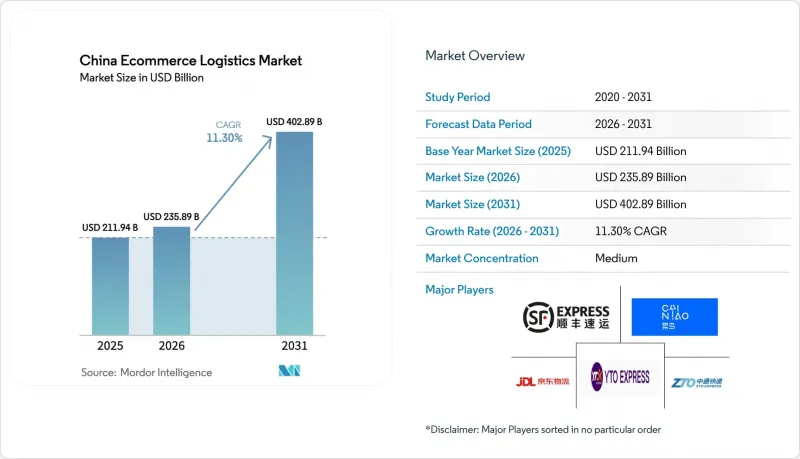
根據 Mordor Intelligence 估計,中國電子商務物流市場規模在 2026 年將達到 2,358.9 億美元,高於 2025 年的 2,119.4 億美元,預計到 2031 年將達到 4,028.9 億美元。
預計 2026 年至 2031 年的複合年成長率為 11.30%。
本報告按服務(運輸(道路運輸等)、倉儲和履約)、經營模式(B2C、B2B等)、目的地(國內等)、配送速度(當日達等)、產品類別(食品飲料等)、城市等級(一線城市等)和地區(華東及其他地區)進行分類。市場預測以美元計價。
中國電子商務物流市場趨勢與洞察
由於二、三線城市居民可支配收入的增加,EC 的 GMV 正在向一線城市中心以外的地區擴展。
目前,中小城市在全國線上零售總額中所佔佔有率高於主要大都市地區,這促使物流網路進行重新設計,並投資建設新的物流中心。僅重慶一地就已在物流項目上投資400億元人民幣(約55.6億美元),使當地貨運成本降低了3.5%。同時,電子商務在農村地區的普及使家庭經濟韌性提高了9.63%,凸顯了擴大履約覆蓋範圍帶來的社會經濟效益。
透過直播和短影片購物正在提高衝動消費的轉換率。
病毒式行銷引發的衝動性購買推動了需求激增,超越了傳統庫存計畫的承受能力。為了應對這一局面,物流供應商正利用預測分析和雲端控制塔,將安全庫存重新分配到人口密集都市區的微型倉配中心。隨著零售商以「一小時送達」的承諾吸引顧客,這種彈性正在推動中國電商物流市場的利潤成長。
儘管自動化程度不斷提高,但主要城市樞紐的最後一公里人事費用卻在上升。
在人口密集的都市區,企業競相爭取送貨上門的人才,導致宅配司機的薪資不斷上漲。儘管自動駕駛卡車試點計畫和自動分揀機已經投入使用,但對於需要高水準服務的訂單而言,人工宅配仍然必不可少,這限制了中國電商物流市場降低成本的潛力。
細分市場分析
至2025年,運輸業將佔中國電子商務物流市場的60.12%。這得歸功於連接生產區和消費中心的16.9萬公里高速公路網。 「一帶一路」沿線的鐵路走廊運輸著運往歐洲的出口小包裹,而航空貨運則支持高階電子產品的運輸。隨著企業對客製化包裝、逆向物流處理和合規標籤的需求不斷成長,附加價值服務正以13.86%的複合年成長率快速擴張。順豐速運的豐智雲端平台展示如何透過數據分析、庫存調整和即時視覺化,將基礎運輸合約轉變為一體化的供應鏈夥伴關係。
隨著倉庫和微型倉配網路不斷擴張,更貼近消費者的配送中心得以實現當日送達。機器人技術正在實現收貨和揀貨的自動化,在工資持續上漲的同時,降低了單位成本。順豐速運和阿提哈德航空貨運的合資企業等航空貨運聯盟正在拓展其在中東的業務。海運小包航線,特別是經由深圳和寧波的航線,對希望利用退稅政策的跨境經銷商來說極具優勢。競爭優勢不再僅僅體現在單一運輸方式的卓越表現上,而是體現在貫穿整個服務線的端到端協調能力上,這正在重塑中國電商物流市場供應商的選擇標準。
到2025年,B2C將佔據中國電商物流市場71.86%的佔有率,這得益於一個由聚合賣家需求和規範履約流程的平台生態系統。品牌商將從入庫出貨到上門退貨的整個流程外包出去,並利用承運商的API連接前端訂單管道。 C2C領域正以13.12%的複合年成長率快速成長,Z世代消費者交易二手時尚單品和收藏品的趨勢推動了社群電商的發展。新創公司透過推出訂閱式小包裹套裝和可透過小程式產生運單的智慧型手機應用程式,簡化了不頻繁的個人寄件流程。
B2C 商店和 C2C 轉售平台之間的交叉銷售模糊了界限,賣家正將未售出的庫存轉移到 P2P 通路。這一趨勢導致小包裹來源多樣化,要求承運商提供全國範圍的取件服務,從而擴大了中國的電商物流市場。同時,B2B 數位採購平台正在引入批量運輸合約以穩定利潤率,但這需要對多模態進行調整,因此,中國電商物流行業的承運商被鼓勵對企業對企業 (B2B) 和消費者對企業 (C2B) 的貨運採用不同的定價結構。
其他好處:
- Excel格式的市場預測(ME)表
- 3個月的分析師支持
目錄
第1章:引言
- 研究假設和市場定義
- 調查範圍
第2章:調查方法
第3章執行摘要
第4章 市場狀況
- 市場概覽
- 市場促進因素
- 二、三線城市居民可支配所得的增加,正促使電子商務GMV從一線城市中心區域向外擴張。
- 利用直播和短影片進行購物正在提高衝動消費的轉換率。
- 社區團購正在幫助人們養成頻繁在線購買食品雜貨的習慣。
- 簡化版應用程式在銀髮經濟中的普及,正在擴大老年購物者的客戶群。
- 跨境免稅試點區正在提振奢侈品進口需求。
- 30分鐘內微型倉配,正在創造一種追求即時滿足的購買預期。
- 市場限制因素
- 儘管自動化程度不斷提高,但一級樞紐的最後一公里人事費用卻在上升。
- 農村地區地址資料的品質仍有差異,導致郵件未送達率居高不下。
- 更嚴格的跨境資料法令遵循導致海關手續延誤。
- 由於環保目標,電動車的成本不斷上升。
- 價值供應鏈分析
- 政府政策和法規
- 市場中的技術進步
- 地緣政治事件對市場的影響
- 波特五力模型
第5章 市場規模及成長預測(價值,10億元)
- 按服務
- 運輸
- 路
- 航空
- 鐵路
- 船運
- 倉儲和履約
- 附加價值服務(貼標籤、包裝、套件組裝)
- 運輸
- 按經營模式
- B2C
- B2B
- C2C
- 目的地
- 國內的
- 跨境貿易-入境
- 跨境貿易 - 出境
- 配送速度
- 當日送達(24小時內)
- 隔日送達(24-48小時)
- 標準(3-5天)
- 經濟艙(5天或以上)
- 其他
- 產品類型
- 食品/飲料
- 個人護理和居家護理
- 時尚與生活方式(配件、服裝、鞋類)
- 家具
- 電子設備及家用電器
- 其他產品
- 城市層級
- 一級
- 二級
- 三級及以下
- 按地區
- 華東
- 華南
- 華北
- 華中地區
- 中國東北
- 中國西北地區
- 中國西南地區
第6章 競爭情勢
- 市場集中度
- 策略趨勢
- 市佔率分析
- 公司簡介
- SF Express
- JD Logistics
- Cainiao Network(Alibaba)
- ZTO Express
- YTO Express
- Yunda Express
- STO Express
- Best Inc.
- China Post EMS
- Deppon Logistics
- Suning Logistics
- J&T Express China
- Dada Group(JDDJ)
- DHL eCommerce China
- FedEx Express China
- UPS China
- Kerry SCM
- CTS International Logistics
- Sinotrans
- 4PX Express
- YunExpress
- Zongteng Group(Winsync, EWE)
- FlashEx
- Meituan Delivery
- YDH Express
- CNE Express
第7章 市場機會與未來展望
According to Mordor Intelligence, China e-commerce logistics market size in 2026 is estimated at USD 235.89 billion, growing from 2025 value of USD 211.94 billion with 2031 projections showing USD 402.89 billion, growing at 11.30% CAGR over 2026-2031.
This report Segments by Service (Transportation (Road and More), Warehousing and Fulfilment), by Business Model (B2C, B2B and More), by Destination (Domestic and More), by Delivery Speed (Same-Day and More), by Product Category (Foods and Beverages and More), by City-Tier (Tier 1 and More) and by Geography (East China and More). The Market Forecasts are Provided in Terms of Value (USD).
China E-commerce Logistics Market Trends and Insights
Rising tier-2 / tier-3 disposable incomes shifting e-commerce GMV beyond tier-1 hubs
Secondary cities now deliver a larger share of national online retail value than premier metros, prompting network redesign and fresh distribution-center investments. Chongqing alone committed RMB 40 billion (USD 5.56 billion) to logistics projects that lowered local freight costs by 3.5%. Rural e-commerce participation, meanwhile, improved household financial resilience by 9.63%, highlighting the socioeconomic benefit of broader fulfillment coverage.
Livestream and short-video shopping are elevating impulse-buy conversion rates
Impulse purchases triggered by viral broadcasts generate demand spikes that stretch traditional inventory planning. Providers respond with predictive analytics and cloud-based control towers that redeploy safety stock to micro-fulfillment sites inside dense urban trade areas. Agility becomes a profit driver within the China e-commerce logistics market as retailers lean on one-hour delivery promises to lock in shoppers.
Escalating last-mile labor costs in tier-1 hubs despite automation
Courier wages rise as operators compete for talent to execute doorstep delivery in densely populated towers. Even with driverless truck pilots and automated sorters, human couriers remain indispensable for high-service-level orders, limiting cost-down potential in the Chinese e-commerce logistics market.
Other drivers and restraints analyzed in the detailed report include:
- Community group-buying normalizes high-frequency online grocery purchases
- Silver-economy adoption of simplified apps is expanding the senior shopper base
- Persistent rural address data-quality gaps are raising failed-delivery ratios
For complete list of drivers and restraints, kindly check the Table Of Contents.
Segment Analysis
Transportation dominated 60.12% of the China e-commerce logistics market in 2025, underpinned by a 169,000-km expressway grid that connects production zones with consumption hubs. Rail corridors along the Belt and Road funnel export parcels to Europe, while airfreight supports premium electronics. Value-added services are scaling at a 13.86% CAGR as merchants seek unique packaging, reverse-logistics handling, and compliance-ready labeling. SF Express' "Fengzhiyun" platform shows how data analytics, inventory orchestration, and real-time visibility convert basic haulage contracts into integrated supply-chain partnerships.
Warehousing and micro-fulfillment networks multiply near consumers to enable same-day cut-off times. Robotics automates put-away and picking, trimming unit costs even as wage inflation persists. Air-cargo alliances such as the SF Express-Etihad Cargo joint venture extend reach into the Middle East. Maritime e-packet lanes, especially via Shenzhen and Ningbo, benefit cross-border sellers chasing tax-rebate programs. Competitive advantage now hinges on end-to-end orchestration across these service lines rather than isolated modal excellence, reshaping supplier criteria in the China e-commerce logistics market.
B2C held 71.86% of the China e-commerce logistics market share in 2025, anchored by platform ecosystems that aggregate merchant demand and standardize fulfillment practices. Brands outsource everything from inbound freight to doorstep returns, relying on carrier APIs to sync front-end ordering channels. The C2C segment, expanding at 13.12% CAGR, taps social-commerce momentum as Gen-Z consumers trade secondhand fashion and collectibles. Start-ups launch flat-rate parcel kits and smartphone apps that generate labels through mini-programs, simplifying sporadic shipping for individuals.
Cross-listing between B2C storefronts and C2C resale marketplaces blurs boundaries, with sellers shifting unsold inventory to peer-to-peer channels. That flow diversifies parcel origination points and pushes carriers to offer nationwide pick-up, thereby enlarging the China e-commerce logistics market. Meanwhile, B2B digital procurement platforms deploy bulk rate contracts that stabilize margins yet require multimodal coordination, encouraging carriers to maintain distinct pricing ladders for enterprise versus consumer traffic within the wider China e-commerce logistics industry.
Complete Report Scope:
- By Service
- Transportation
- Road
- Air
- Rail
- Maritime
- Warehousing and Fulfilment
- Value-Added (Labelling, Packaging, Kitting)
- Transportation
- By Business Model
- B2C
- B2B
- C2C
- By Destination
- Domestic
- Cross-Border - Inbound
- Cross-Border - Outbound
- By Delivery Speed
- Same-day (less than 24 h)
- Next-day (24-48 h)
- Standard (3-5 days)
- Economy (more than 5 days)
- Others
- By Product Category
- Foods and Beverages
- Personal and Household Care
- Fashion and Lifestyle (accessories, apparel, footwear)
- Furniture
- Electronics and Household Appliances
- Other Products
- By City-Tier
- Tier 1
- Tier 2
- Tier 3 and Below
- By Geography
- East China
- South China
- North China
- Central China
- Northeast China
- Northwest China
- Southwest China
List of Companies Covered in this Report:
- SF Express
- JD Logistics
- Cainiao Network (Alibaba)
- ZTO Express
- YTO Express
- Yunda Express
- STO Express
- Best Inc.
- China Post EMS
- Deppon Logistics
- Suning Logistics
- J&T Express China
- Dada Group (JDDJ)
- DHL eCommerce China
- FedEx Express China
- UPS China
- Kerry SCM
- CTS International Logistics
- Sinotrans
- 4PX Express
- YunExpress
- Zongteng Group (Winsync, EWE)
- FlashEx
- Meituan Delivery
- YDH Express
- CNE Express
Additional Benefits:
- The market estimate (ME) sheet in Excel format
- 3 months of analyst support
TABLE OF CONTENTS
1 Introduction
- 1.1 Study Assumptions and Market Definition
- 1.2 Scope of the Study
2 Research Methodology
3 Executive Summary
4 Market Landscape
- 4.1 Market Overview
- 4.2 Market Drivers
- 4.2.1 Rising Tier-2/3 Disposable Incomes Shifting E-commerce GMV Beyond Tier-1 Hubs
- 4.2.2 Livestream and Short-Video Shopping Elevating Impulse-Buy Conversion Rates
- 4.2.3 Community Group-Buying Normalising High-Frequency Online Grocery Purchases
- 4.2.4 Silver-Economy Adoption of Simplified Apps Expanding Senior Shopper Base
- 4.2.5 Duty-Free Cross-Border Pilot Zones Fueling Appetite for Premium Imports
- 4.2.6 30-Minute Micro-Fulfilment Creating Instant-Gratification Purchase Expectations
- 4.3 Market Restraints
- 4.3.1 Escalating last-mile labour costs in Tier-1 hubs despite automation
- 4.3.2 Persistent rural address data-quality gaps raising failed-delivery ratio
- 4.3.3 Tightened cross-border data-compliance rules delaying customs clearance
- 4.3.4 Environmental targets raising fleet electrification costs
- 4.4 Value / Supply-Chain Analysis
- 4.5 Government Policies and Regulations
- 4.6 Technological Developments in the Market
- 4.7 Impact of Geopolitical Events on the Market
- 4.8 Porter's Five Forces
- 4.8.1 Threat of New Entrants
- 4.8.2 Bargaining Power of Buyers
- 4.8.3 Bargaining Power of Suppliers
- 4.8.4 Threat of Substitutes
- 4.8.5 Competitive Rivalry
5 Market Size and Growth Forecasts (Value, CNY bn)
- 5.1 By Service
- 5.1.1 Transportation
- 5.1.1.1 Road
- 5.1.1.2 Air
- 5.1.1.3 Rail
- 5.1.1.4 Maritime
- 5.1.2 Warehousing and Fulfilment
- 5.1.3 Value-Added (Labelling, Packaging, Kitting)
- 5.1.1 Transportation
- 5.2 By Business Model
- 5.2.1 B2C
- 5.2.2 B2B
- 5.2.3 C2C
- 5.3 By Destination
- 5.3.1 Domestic
- 5.3.2 Cross-Border - Inbound
- 5.3.3 Cross-Border - Outbound
- 5.4 By Delivery Speed
- 5.4.1 Same-day (less than 24 h)
- 5.4.2 Next-day (24-48 h)
- 5.4.3 Standard (3-5 days)
- 5.4.4 Economy (more than 5 days)
- 5.4.5 Others
- 5.5 By Product Category
- 5.5.1 Foods and Beverages
- 5.5.2 Personal and Household Care
- 5.5.3 Fashion and Lifestyle (accessories, apparel, footwear)
- 5.5.4 Furniture
- 5.5.5 Electronics and Household Appliances
- 5.5.6 Other Products
- 5.6 By City-Tier
- 5.6.1 Tier 1
- 5.6.2 Tier 2
- 5.6.3 Tier 3 and Below
- 5.7 By Geography
- 5.7.1 East China
- 5.7.2 South China
- 5.7.3 North China
- 5.7.4 Central China
- 5.7.5 Northeast China
- 5.7.6 Northwest China
- 5.7.7 Southwest China
6 Competitive Landscape
- 6.1 Market Concentration
- 6.2 Strategic Moves
- 6.3 Market Share Analysis
- 6.4 Company Profiles (includes Global-level Overview, Market-level Overview, Core Segments, Financials, Strategic Info, Market Rank/Share, Products and Services, Recent Developments)
- 6.4.1 SF Express
- 6.4.2 JD Logistics
- 6.4.3 Cainiao Network (Alibaba)
- 6.4.4 ZTO Express
- 6.4.5 YTO Express
- 6.4.6 Yunda Express
- 6.4.7 STO Express
- 6.4.8 Best Inc.
- 6.4.9 China Post EMS
- 6.4.10 Deppon Logistics
- 6.4.11 Suning Logistics
- 6.4.12 J&T Express China
- 6.4.13 Dada Group (JDDJ)
- 6.4.14 DHL eCommerce China
- 6.4.15 FedEx Express China
- 6.4.16 UPS China
- 6.4.17 Kerry SCM
- 6.4.18 CTS International Logistics
- 6.4.19 Sinotrans
- 6.4.20 4PX Express
- 6.4.21 YunExpress
- 6.4.22 Zongteng Group (Winsync, EWE)
- 6.4.23 FlashEx
- 6.4.24 Meituan Delivery
- 6.4.25 YDH Express
- 6.4.26 CNE Express
7 Market Opportunities and Future Outlook

 英國電子商務物流:市場佔有率分析、產業趨勢與統計、成長預測(2026-2031)印度電子商務物流:市場佔有率分析、行業趨勢和統計數據以及成長預測(2026-2031 年)東協電子商務物流:市場佔有率分析、產業趨勢與統計及成長預測(2026-2031年)
 電子商務物流市場:全球市場預測(2026-2032)中國跨境電商物流:市佔率分析、產業趨勢與統計及成長預測(2026-2031年)印尼電子商務物流:市場佔有率分析、產業趨勢與統計及成長預測(2026-2031)印度跨境B2C電子商務物流:市場佔有率分析、產業趨勢與統計及成長預測(2026-2031年)美國跨境電子商務物流:市場佔有率分析、產業趨勢與統計及成長預測(2026-2031)越南跨境B2C電子商務物流:市場佔有率分析、產業趨勢與統計及成長預測(2026-2031年)印度跨境電子商務物流:市場佔有率分析、產業趨勢與統計及成長預測(2026-2031)