


 |
市場調查報告書
商品編碼
2073167
美國跨境電子商務物流:市場佔有率分析、產業趨勢與統計及成長預測(2026-2031)United States Cross-Border E-Commerce Logistics - Market Share Analysis, Industry Trends & Statistics, Growth Forecasts (2026 - 2031) |
||||||

※ 本網頁內容可能與最新版本有所差異。詳細情況請與我們聯繫。
根據 Mordor Intelligence 預測,美國跨境電子商務物流市場規模預計將在 2025 年達到 161.4 億美元,從 2026 年的 175.5 億美元成長到 2031 年的 261.5 億美元,在 2026 年至 2031 年的預測期內8.30%。
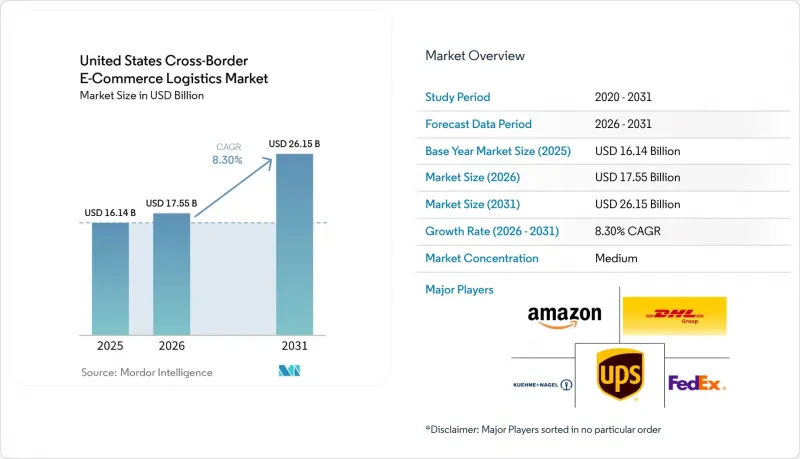
本報告按產品類型(食品、個人護理及家居用品、其他)、物流功能(運輸、倉儲、其他)、經營模式(B2C、B2B、C2C)、配送速度(快遞、標準)以及物流流向(出境/入境:加拿大、墨西哥、歐洲、亞太地區、中東和非洲、南美洲)進行細分。市場預測以美元計價。
美國跨境電子商務物流市場趨勢與洞察
市場主導的國際銷售擴張
電商平台正在擴大海外需求管道,使美國跨境電商物流市場擁有比以往更廣泛的出境基礎,這與以往跨境銷售僅限於大規模經銷商的時代截然不同。 2026年5月4日,亞馬遜推出Amazon Supply Chain Services(亞馬遜供應鏈服務),向各行各業的企業開放其貨運代理、配送、履約和小包裹網路。這是迄今為止規模最大的平台主導型物流服務之一,尤其與線上商務相關。據亞馬遜稱,支援該服務的網路包括100多架飛機、超過24,000個多式聯運貨櫃以及清關能力,這使得該平台能夠比以往任何時候都更直接地與現有的跨境物流整合商和貨運代理展開競爭。這對美國跨境電商物流市場意義重大,因為隨著清關、配送和履約工具越來越接近銷售點,企業無需組成完整的內部貿易合規團隊即可拓展國際銷售管道。因此,那些先前認為海外銷售管理過於複雜或成本過高的品牌,如今正將出口業務轉向美國跨境電商物流市場。此外,平台整合的銷售模式降低了數位需求與實體貨物運輸安排之間的營運壁壘,進一步加速了出口物流的成長前景。
人工智慧驅動的物流視覺化與海關清關作業整合
隨著清關、路線規劃和中斷管理對速度和一致性的要求日益提高,而人工流程已無法滿足這些需求,而人工智慧工具在美國跨境電商物流市場中正發揮著至關重要的作用。馬士基於2025年6月25日推出「貿易與關稅工作室」(Trade & Tariff Studio),該系統基於2700多名海關專家提供的即時資訊,將人工智慧應用於超過6000個商品編號和20000多個子代碼。這標誌著分類和關稅分析正朝著結構化的數位化工作流程轉變。馬士基也指出,20%的貨物延誤是由於海關準備工作不足造成的,這凸顯了公司為何越來越重視那些能夠在貨物到達邊境前減少單據錯誤的供應商。 Project44於2026年5月11日宣布推出「自動駕駛」(Autopilot)平台,該平台每天處理來自186個國家/地區25.9萬家承運商的超過7億條物流事件,並已證明其能夠降低4%的貨運成本,以及降低高達40%的中斷相關成本。在美國跨境電商物流市場,這種事件可視性將使中小企業能夠利用以往只有大型企業才能獲得的運輸資訊。隨著商業競爭的重點從單純的運輸能力轉向更高效的異常管理、關稅計算和報關準備,該平台還將促進附加價值服務的成長。
取消最低限度措施和累積關稅
在美國跨境電商物流市場,短期內最大的限制因素是取消最低限額免稅政策,這將徹底改變以小包裹運輸為主的龐大營運模式。白宮宣布,該政策將於2025年8月29日生效,屆時將取消全球範圍內低價值商業貨物的免稅待遇,從而終結了先前支撐800美元以下小包裹直接運輸的主要閾值來源。美國海關與邊防安全(CBP)表示,所有電商貨物仍需符合適用的進口和合規要求,並且與先前的「無摩擦」小包裹模式相比,其指導方針現在更加強調準確的商品分類、申報價值和清關流程。白宮也指出,2024年將有超過13.6億個「最低限額」包裹進入美國,這反映了經銷商、承運商和報關行目前被迫適應的營運重組規模之大。在美國跨境電商物流市場,這不會消除需求,但會增加每個小包裹相關的單證、清關和收貨成本。此外,隨著企業需要更嚴格地管理關稅風險並確保交付確定性,保稅倉庫、自由貿易區庫存以及能夠進行正規清關的物流網路的重要性日益凸顯。
細分市場分析
到2025年,時尚和生活風格產業將占美國跨境電商物流市場規模的23.65%,成為最大的收入來源。這一主導地位源自於亞洲生產基地服裝和配件的高頻進口,以及美國品牌向亞太和中東地區買家出口奢侈品和生活方式產品。與其他監管更嚴格的產品類別相比,時尚和生活風格行業的分揀流程、退貨處理和小包裹遞送路線已經成熟,因此該行業仍然保持強勁成長勢頭。在美國跨境電商物流市場,時尚和生活風格產業持續受益於消費者的重複購買行為以及涵蓋全球品牌和小規模經銷商的龐大經銷商群體。此外,這些成熟路線意味著供應商之間的競爭不再僅限於運輸,還包括遞送速度、海關預付選項和退貨管理。
預計到2031年,個人護理和家居用品將以9.29%的複合年成長率成長,成為美國跨境電商物流市場中成長動能最強勁的產品類別。美國跨境電商物流產業的這一領域受益於對專業保健產品、高階美妝產品和健康相關產品的需求,而這些產品僅靠國內分銷管道難以取得。這種轉變表明,未來市佔率的擴張不僅來自服裝處理量的增加,也來自對處理要求嚴格的高附加價值品類。消費性電子產品和電器產品仍然佔據著重要的進口需求,但航空運輸中電池法規的實施增加了營運這些航線的營運商的複雜性。食品飲料和家具仍然是美國跨境電商物流市場的重要組成部分,但其成長一方面受到易腐性的限制,另一方面又受到基於體積重量的成本結構的限制,因此,供應商的專業技能比單純的小包裹處理量更為重要。
到2025年,運輸業將占美國跨境電商物流市場佔有率的68.39%,這反映了國際航線上空運、海運、陸運和鐵路運輸成本加權佔有率的組成。這一主導地位在北美走廊尤為顯著,陸路運輸仍然是區域貿易和快速補貨的核心。儘管運輸能力仍然是美國跨境電商物流市場最大的收入來源,但由於合規要求的不斷提高,企業的獲利結構正在改變。隨著「最低限度」規定的取消,倉儲、配送和庫存管理仍然是關鍵職能,因為企業需要更好地管理入庫成本、庫存出庫和退貨路線的時間表。此外,在文書工作負擔日益加重的貿易環境中,保稅倉庫和自由貿易區(FTZ)內的設施在美國跨境電商物流市場中的重要性日益凸顯,因為它們允許延期繳納關稅並提供更靈活的報關方案。
預計到2031年,附加價值服務及其他相關業務將以13.48%的複合年成長率成長,成為美國跨境電商物流市場成長最快的領域。這一成長不僅反映了卡車和飛機數量的增加,也反映了對DDP管理、清關、退貨處理、商品分類支援以及經銷商視覺化工具等日益成長的需求。 SEKO Logistics於2025年5月推出了「DutyPay」服務,旨在簡化海關合規流程,這表明服務供應商正在將先前分散處理的海關和進口流程系統化。馬士基和project44也正在擴展其海關和事件管理的技術基礎,推動美國跨境電商物流市場轉型為軟體驅動的附加價值服務。因此,儘管運輸仍然是主要的收入來源,但一個新興市場正在興起,在這個市場中,合規智慧和數位化管理將佔據更大的商業性價值佔有率。
其他好處:
- Excel格式的市場預測(ME)表
- 3個月的分析師支持
目錄
第1章:引言
- 研究假設和市場定義
- 調查範圍
第2章:調查方法
第3章執行摘要
第4章 市場狀況
- 市場概況及跨境電子商務物流在電子商務市場中的作用。
- 電子商務產業趨勢
- 消費者行為及供需分析
- 法律規範
- 價值鍊和通路分析
- 市場促進因素
- 市場主導的國際銷售擴張
- 人工智慧驅動的物流視覺化和海關清關流程整合
- 利用美墨加協定最佳化北美走廊
- 希望了解出貨速度和支付流程的透明度。
- 實現DDP結帳和配送成本視覺化。
- 過渡到美國保稅倉庫和自由貿易區(FTZ)的庫存存放
- 市場限制因素
- 最低限度的回溯和關稅累積
- 受監管和電池相關類別的法規非常複雜。
- UFLPA對低價值小包裹的原產地追蹤義務的負擔
- 關稅繳納後退貨以及拒收貨物所造成的摩擦。
- 技術創新的前景
- 波特五力分析
- 跨境電子商務物流需求的演變
- 地緣政治事件對供應鏈轉型的影響
第5章 市場規模與成長預測
- 產品類型
- 食品/飲料
- 個人護理和居家護理
- 時尚與生活方式(配件、服裝、鞋類)
- 家具
- 家用電子電器和電器產品
- 其他產品
- 按職能分類的物流
- 運輸
- 路
- 航空
- 海路和內河航道
- 鐵路
- 倉儲、物流和庫存管理
- 附加價值服務及其他
- 運輸
- 按經營模式
- B2C
- B2B
- C2C
- 配送速度
- 表達
- 標準
- 按流向
- 出口
- 加拿大
- 墨西哥
- 歐洲
- 亞太地區
- 中東和非洲
- 南美洲
- 入境(進口)
- 加拿大
- 墨西哥
- 歐洲
- 亞太地區
- 中東和非洲
- 南美洲
- 出口
第6章 競爭情勢
- 市場集中度
- 關鍵策略趨勢
- 市佔率分析
- 公司簡介
- United Parcel Service of America, Inc.(UPS)
- FedEx
- DHL Group
- Amazon, Inc.
- Pitney Bowes
- Kuehne+Nagel
- DSV A/S
- Expeditors International of Washington, Inc.
- CMA CGM Group(Including CEVA Logistics)
- GEODIS
- AP Moller-Maersk
- CH Robinson
- Nippon Express Holdings(NX Group)
- SEKO Logistics
- Flexport
- Global-e Online
- Asendia
- ShipBob
- ShipMonk
- Passport Shipping
- Easyship
- Zonos
第7章 市場機會與未來展望
According to Mordor Intelligence, the united states cross-border e-commerce logistics market was valued at USD 16.14 billion in 2025 and is estimated to grow from USD 17.55 billion in 2026 to reach USD 26.15 billion by 2031, at a CAGR of 8.30% during the forecast period from 2026 to 2031.
This report is Segmented by Product Category (Foods, Personal and Household Care, and More), by Logistics Function (Transportation, Warehousing, and More), by Business Model (B2C, B2B, C2C), by Delivery Speed (Express, Standard), and by Flow Direction (Outbound/Inbound: Canada, Mexico, Europe, Asia-Pacific, MEA, South America). The Market Forecasts are Provided in Terms of Value (USD).
United States Cross-Border E-Commerce Logistics Market Trends and Insights
Marketplace-Led International Selling Expansion
Marketplace platforms are expanding access to overseas demand, giving the United States cross-border e-commerce logistics market a broader outbound base than it had when cross-border selling was limited to large merchants. Amazon opened Amazon Supply Chain Services on May 4, 2026, and made its freight, distribution, fulfillment, and parcel network available to businesses across industries, which marks one of the largest platform-led entries into the logistics stack tied to online commerce. Amazon said the network behind this offer includes more than 100 aircraft, more than 24,000 intermodal containers, and customs clearance capability, which means the platform is now competing more directly with established integrators and freight providers for cross-border flows. This matters for the United States cross-border e-commerce logistics market because customs, delivery, and fulfillment tools are moving closer to the point of sale, and merchants can add international channels without building a full internal trade compliance team. The result is that the United States cross-border e-commerce logistics market is capturing more export activity from brands that once treated foreign sales as too complex or too expensive to manage. It also reinforces the faster growth outlook for outbound flows, because marketplace-linked selling lowers the operational barrier between digital demand and physical shipment creation.
AI-Enabled Logistics Visibility and Customs Orchestration
AI tools are becoming more central to the United States' cross-border e-commerce logistics market because customs work, routing decisions, and disruption handling now require greater speed and consistency than manual processes can provide. Maersk launched Trade & Tariff Studio on June 25, 2025, and said the system applies AI across more than 6,000 product codes and 20,000 sub-codes with live input from more than 2,700 customs experts, which shows how classification and tariff analysis are moving into structured digital workflows. Maersk also stated that 20% of shipments are delayed by inadequate customs preparation, underscoring why merchants are placing greater value on providers that can reduce document errors before cargo reaches the border. project44 launched Autopilot on May 11, 2026, and said the platform processes more than 700 million logistics events daily across 259,000 carriers in 186 countries, with documented outcomes that included a 4% reduction in freight spend and up to 40% lower disruption-related costs. In the United States cross-border e-commerce logistics market, that kind of event visibility helps smaller merchants gain access to shipment intelligence that was once concentrated among larger enterprises. It also supports the growth of value-added services, because the commercial advantage is shifting from pure transport capacity toward better exception management, duty calculation, and customs readiness.
De Minimis Rollback and Tariff Stacking
The largest near-term restraint on the United States cross-border e-commerce logistics market is the rollback of de minimis treatment, because it changes the operating model for a very large parcel base. The White House stated that the suspension, effective August 29, 2025, removed duty-free treatment for low-value commercial shipments globally, which ended the main cost pathway that had supported direct parcel flows under the USD 800 threshold. The United States Customs and Border Protection said every e-commerce shipment still has to meet the applicable entry and compliance requirements, and the agency's guidance now places more weight on accurate classification, declared value, and entry processing than the prior low-friction parcel model did. The White House also noted that more than 1.36 billion de minimis shipments entered the United States in 2024, which shows the scale of the operational reset now being absorbed by merchants, carriers, and brokers. In the United States cross-border e-commerce logistics market, this does not remove demand, but it does raise the documentation, customs labor, and landed-cost burden tied to each parcel. It also strengthens the case for bonded warehousing, FTZ inventory positioning, and logistics networks capable of formal entry, because merchants now need more controlled ways to manage duty exposure and delivery certainty.
Other drivers and restraints analyzed in the detailed report include:
- USMCA-Enabled North American Corridor Optimization
- Delivery-Speed Visibility and Checkout Transparency Expectations
- Regulatory Complexity for Regulated and Battery-Linked Categories
For complete list of drivers and restraints, kindly check the Table Of Contents.
Segment Analysis
Fashion and Lifestyle accounted for 23.65% of the United States cross-border e-commerce logistics market size in 2025, making it the largest revenue contributor. That lead came from a mix of high-frequency inbound apparel and accessories from Asian production hubs and outbound luxury and lifestyle shipments from US brands to buyers in Asia-Pacific and the Middle East. The segment remains strong because classification workflows, return handling, and parcel routing are already well established compared with more regulated product groups. In the United States cross-border e-commerce logistics market, fashion and lifestyle still benefit from repeat purchase behavior and a broad merchant base that ranges from global labels to smaller marketplace sellers. The maturity of the lane also means providers compete less on basic movement and more on delivery speed, prepaid duty options, and return control.
Personal and household Care is projected to grow at a 9.29% CAGR through 2031, which gives it the strongest momentum among product categories in the United States cross-border e-commerce logistics market. This part of the United States cross-border e-commerce logistics industry is benefiting from demand for specialty wellness items, prestige beauty products, and health-related goods that are not always easy to source through domestic channels alone. The shift suggests that future share gains will come from categories with higher value density and tighter handling needs rather than only from apparel volume. Consumer electronics and household appliances still account for meaningful inbound demand, but the battery rules on air shipments are increasing execution complexity for providers that serve those lanes. Foods and beverages and furniture remain part of the United States cross-border e-commerce logistics market, but their growth is held back by perishability on one side and dimensional weight economics on the other, which makes provider specialization more important than simple parcel scale.
Transportation accounted for 68.39% of the United States cross-border e-commerce logistics market share in 2025, reflecting the cost-weighted share of air, ocean, road, and rail movements across international lanes. This lead is especially visible on North American corridors, where road transport remains central to regional trade and rapid replenishment. The United States cross-border e-commerce logistics market still relies on transport capacity as its largest revenue pool, but the margin profile of the business is changing as compliance demands rise. Warehousing, distribution, and inventory management remain the next major functions because merchants need better control over landed cost timing, inventory release, and returns routing after the de minimis rollback. Bonded and FTZ facilities are becoming more relevant in the United States cross-border e-commerce logistics market because they allow duty deferral and more flexible release planning in a trade environment with higher documentation pressure.
Value-added services and others is projected to grow at a 13.48% CAGR through 2031, making it the fastest-expanding function in the United States cross-border e-commerce logistics market. That growth reflects rising demand for DDP management, customs brokerage, returns handling, classification support, and merchant-facing visibility tools rather than only more trucks or more aircraft. SEKO Logistics launched DutyPay in May 2025 to improve customs compliance and clearance execution, which shows how service providers are formalizing duty and entry workflows that used to be handled in a more fragmented way. Maersk and project44 have also expanded the technology layer around tariff and event management, which supports the move toward software-enabled value-added offerings inside the United States cross-border e-commerce logistics market. The result is a market where transportation still anchors revenue, but compliance intelligence and digital control are capturing a larger share of commercial value.
Complete Report Scope:
- By Product Category
- Foods and Beverages
- Personal and Household Care
- Fashion and Lifestyle (Accessories, Apparel, Footwear)
- Furniture
- Consumer Electronics and Household Appliances
- Other Products
- By Logistics Function
- Transportation
- Road
- Air
- Sea and Inland Waterways
- Rail
- Warehousing, Distribution and Inventory Management
- Value-added Services and Others
- Transportation
- By Business Model
- B2C
- B2B
- C2C
- By Delivery Speed
- Express
- Standard
- By Flow Direction
- Outbound (Exports)
- Canada
- Mexico
- Europe
- Asia-Pacific
- Middle East and Africa
- South America
- Inbound (Imports)
- Canada
- Mexico
- Europe
- Asia-Pacific
- Middle East and Africa
- South America
- Outbound (Exports)
List of Companies Covered in this Report:
- United Parcel Service of America, Inc. (UPS)
- FedEx
- DHL Group
- Amazon, Inc.
- Pitney Bowes
- Kuehne+Nagel
- DSV A/S
- Expeditors International of Washington, Inc.
- CMA CGM Group (Including CEVA Logistics)
- GEODIS
- A.P. Moller - Maersk
- C.H. Robinson
- Nippon Express Holdings (NX Group)
- SEKO Logistics
- Flexport
- Global-e Online
- Asendia
- ShipBob
- ShipMonk
- Passport Shipping
- Easyship
- Zonos
Additional Benefits:
- The market estimate (ME) sheet in Excel format
- 3 months of analyst support
TABLE OF CONTENTS
1 Introduction
- 1.1 Study Assumptions and Market Definition
- 1.2 Scope of the Study
2 Research Methodology
3 Executive Summary
4 Market Landscape
- 4.1 Market Overview and Role of Cross-border E-commerce Logistics in E-commerce Market
- 4.2 Trends in E-Commerce Industry
- 4.3 Consumer Behavior and Demand-Supply Analysis
- 4.4 Regulatory Framework
- 4.5 Value Chain and Distribution Channel Analysis
- 4.6 Market Drivers
- 4.6.1 Marketplace-Led International Selling Expansion
- 4.6.2 AI-Enabled Logistics Visibility and Customs Orchestration
- 4.6.3 USMCA-Enabled North American Corridor Optimization
- 4.6.4 Delivery-Speed Visibility and Checkout Transparency Expectations
- 4.6.5 DDP Checkout and Landed-Cost Visibility Adoption
- 4.6.6 Shift Toward US-Based Bonded and FTZ Inventory Positioning
- 4.7 Market Restraints
- 4.7.1 De Minimis Rollback and Tariff Stacking
- 4.7.2 Regulatory Complexity for Regulated and Battery-Linked Categories
- 4.7.3 UFLPA-Origin Traceability Burden on Low-Value Parcels
- 4.7.4 Duty-Paid Returns and Refused-Delivery Friction
- 4.8 Technology Innovations Outlook
- 4.9 Porter's Five Forces Analysis
- 4.9.1 Threat of New Entrants
- 4.9.2 Bargaining Power of Suppliers
- 4.9.3 Bargaining Power of Buyers
- 4.9.4 Threat of Substitutes
- 4.9.5 Rivalry Among Competitors
- 4.10 Evolution of Cross-border E-commerce Logistics Requirements
- 4.11 Impact of Geo-Political Events on Supply Chain Shifts
5 Market Size and Growth Forecasts
- 5.1 By Product Category
- 5.1.1 Foods and Beverages
- 5.1.2 Personal and Household Care
- 5.1.3 Fashion and Lifestyle (Accessories, Apparel, Footwear)
- 5.1.4 Furniture
- 5.1.5 Consumer Electronics and Household Appliances
- 5.1.6 Other Products
- 5.2 By Logistics Function
- 5.2.1 Transportation
- 5.2.1.1 Road
- 5.2.1.2 Air
- 5.2.1.3 Sea and Inland Waterways
- 5.2.1.4 Rail
- 5.2.2 Warehousing, Distribution and Inventory Management
- 5.2.3 Value-added Services and Others
- 5.2.1 Transportation
- 5.3 By Business Model
- 5.3.1 B2C
- 5.3.2 B2B
- 5.3.3 C2C
- 5.4 By Delivery Speed
- 5.4.1 Express
- 5.4.2 Standard
- 5.5 By Flow Direction
- 5.5.1 Outbound (Exports)
- 5.5.1.1 Canada
- 5.5.1.2 Mexico
- 5.5.1.3 Europe
- 5.5.1.4 Asia-Pacific
- 5.5.1.5 Middle East and Africa
- 5.5.1.6 South America
- 5.5.2 Inbound (Imports)
- 5.5.2.1 Canada
- 5.5.2.2 Mexico
- 5.5.2.3 Europe
- 5.5.2.4 Asia-Pacific
- 5.5.2.5 Middle East and Africa
- 5.5.2.6 South America
- 5.5.1 Outbound (Exports)
6 Competitive Landscape
- 6.1 Market Concentration
- 6.2 Key Strategic Moves
- 6.3 Market Share Analysis
- 6.4 Company Profiles (Includes Global Level Overview, Market Level Overview, Core Segments, Financials as Available, Strategic Information, Market Rank/Share for Key Companies, Products and Services, and Recent Developments)
- 6.4.1 United Parcel Service of America, Inc. (UPS)
- 6.4.2 FedEx
- 6.4.3 DHL Group
- 6.4.4 Amazon, Inc.
- 6.4.5 Pitney Bowes
- 6.4.6 Kuehne+Nagel
- 6.4.7 DSV A/S
- 6.4.8 Expeditors International of Washington, Inc.
- 6.4.9 CMA CGM Group (Including CEVA Logistics)
- 6.4.10 GEODIS
- 6.4.11 A.P. Moller - Maersk
- 6.4.12 C.H. Robinson
- 6.4.13 Nippon Express Holdings (NX Group)
- 6.4.14 SEKO Logistics
- 6.4.15 Flexport
- 6.4.16 Global-e Online
- 6.4.17 Asendia
- 6.4.18 ShipBob
- 6.4.19 ShipMonk
- 6.4.20 Passport Shipping
- 6.4.21 Easyship
- 6.4.22 Zonos
7 Market Opportunities and Future Outlook
- 7.1 White-space and Unmet-Need Assessment

 全球電子商務物流市場規模、佔有率、趨勢和成長分析報告(2026-2034年)
 英國電子商務物流:市場佔有率分析、產業趨勢與統計、成長預測(2026-2031)印度電子商務物流:市場佔有率分析、行業趨勢和統計數據以及成長預測(2026-2031 年)東協電子商務物流:市場佔有率分析、產業趨勢與統計及成長預測(2026-2031年)
 電子商務物流市場:全球市場預測(2026-2032)中國跨境電商物流:市佔率分析、產業趨勢與統計及成長預測(2026-2031年)中國電子商務物流:市場佔有率分析、產業趨勢與統計及成長預測(2026-2031年)印尼電子商務物流:市場佔有率分析、產業趨勢與統計及成長預測(2026-2031)印度跨境B2C電子商務物流:市場佔有率分析、產業趨勢與統計及成長預測(2026-2031年)越南跨境B2C電子商務物流:市場佔有率分析、產業趨勢與統計及成長預測(2026-2031年)