


 |
市場調查報告書
商品編碼
2073184
印度跨境B2C電子商務物流:市場佔有率分析、產業趨勢與統計及成長預測(2026-2031年)India Cross-Border B2C E-commerce Logistics - Market Share Analysis, Industry Trends & Statistics, Growth Forecasts (2026 - 2031) |
||||||

※ 本網頁內容可能與最新版本有所差異。詳細情況請與我們聯繫。
根據 Mordor Intelligence 預測,印度跨境B2C 電子商務物流市場規模預計在 2025 年達到 2.8096 億美元,在 2026 年達到 3.4797 億美元,在 2031 年達到 8.806 億美元,2026 年至 2031 年的複合年成長率為 20.41%。
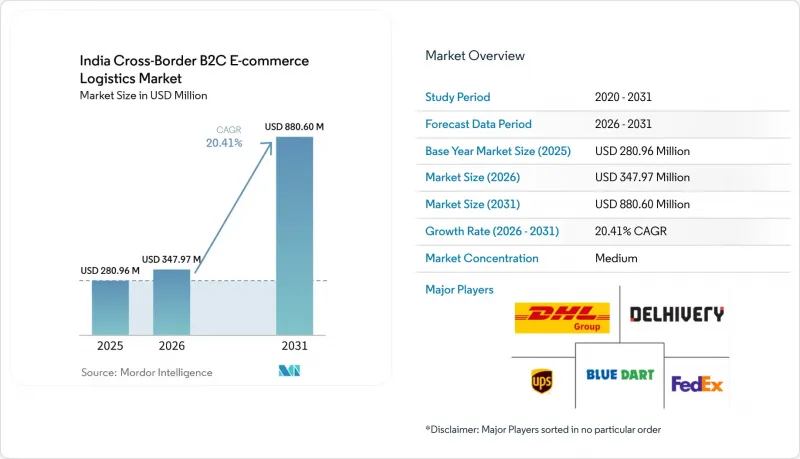
印度跨境B2C電商物流市場正在擴張。這主要得益於監管政策的調整,使得企業更容易透過宅配出口商品,而此前他們不得不拆分貨物或選擇速度較慢的貨運路線。此外,2026年實施的改革引入了正式的退貨途徑,允許尚未清關的小包裹退回原產國。本報告按產品類型(時尚生活、家用電器及家居用品、個人護理及家居用品、其他)、物流功能(運輸方式[公路、其他]、附加價值服務、其他)、配送速度(特快和標準)以及物流流向(出境和入境)進行細分。市場預測以美元計價。
印度跨境B2C電子商務物流市場的趨勢與洞察
改革宅配出口,取消價值上限:為中小企業出口通路提供結構性解放。
2026年4月1日,宅配系統改革取消了長期以來每件貨物10拉克(約10,510美元)的出口限額。這項限額迫使高價值小包裹只能走傳統貨運路線,削弱了B2C經銷商使用宅配的速度和成本優勢。這項變更對印度跨境B2C電商物流市場意義重大,因為經銷商不再需要將訂單拆分成小件貨物並重複處理單據,而是可以透過現有管道直接向消費者配送大規模訂單。此外,2026年的新框架還引入了正式的「退回原產地」機制,用於處理15天後仍未清關的貨物,從而減少宅配站的貨物堵塞,並最大限度地降低因配送失敗而帶來的運營不不確定性。這對營運資金的影響也十分顯著,因為減少小包裹拆分意味著減少處理週期、減少重複提交單據,並減少因分散的出口流程而佔用的資金。從實際角度來看,如果法律體制能夠更好地適應高成本宅配和更清晰的退貨處理,印度的跨境B2C 電子商務物流市場將對微企業(MSME) 更具擴充性。
海外印度人對印度生活風格產品的需求:超越懷舊,走向持續的跨境需求。
受海外市場對印度製造的時尚、健康、美容和生活必需品的需求推動,印度跨境B2C電商物流市場規模持續成長,尤其是在擁有龐大且富裕的印度僑民群體的國家。這種需求並非僅限於假日購物,產品的真實性、合身度、文化認同感以及海外零售通路產品種類的匱乏等因素,都促使消費者重複購買。這種影響在時尚和生活風格類商品領域尤其顯著,印度賣家不僅可以在價格上競爭,還能在設計相關性和產品種類方面取勝。健康美容產業的需求也不斷成長,不再局限於僑民群體,融合了阿育吠陀和草藥成分的產品正受到廣大消費者的青睞,他們追求的是高階健康和潔淨標示產品。因此,印度跨境B2C電商物流市場受惠於龐大的需求基礎,既支援頻繁的低價訂單,也支持透過多種貿易路線出口更高階的產品組合。
美國取消「最低限度」豁免和歐盟更嚴格的ICS2法規:印度主要出口路線的合規成本上升。
2025年8月29日,美國取消了全球800美元的最低限額免稅政策,結束了低價值商業貨物長期以來享受關稅優惠的局面。對於印度B2C出口商而言,這將增加低價值商品類別的收貨成本,因為所有商業小包裹都將面臨更嚴格的商品分類、關稅評估和海關要求。時尚配件、美容產品和手工藝品受到的影響尤其顯著,因為對於這些小小包裹而言,關稅可能佔訂單價值的很大一部分。歐洲也在推行自己的法規。自2025年9月1日起,ICS2 Release 3將在歐盟全面實施,要求所有運輸方式的貨物在抵達前提交準確的「入境概要申報單」。在這些法規的限制下,印度的跨境B2C電子商務物流市場仍有成長空間。然而,人們認為只有擁有自動化申報、更高品質的產品數據和更嚴格的海關清關系統的企業才能為經銷商維持交貨速度和利潤率。
細分市場分析
至2025年,時尚與生活風格類別將佔印度跨境B2C電商物流市場規模的41.90%,成為銷售額最大的產品類別。這個類別受益於海外對印度服裝、配件和鞋類的持續需求,因為在目的地市場往往難以找到種類齊全、品質正宗的同類產品。此外,這些產品大多重量較輕,空運成本合理,且與電子產品和食品相比,認證門檻通常較低,因此在跨境小包裹遞送方面具有經濟可行性。
預計到2031年,健康與美容產業將以21.39%的複合年成長率成長,超過所有其他產品類別。這一成長與海外市場對阿育吠陀保健產品、草本護膚產品以及具有鮮明印度特色的高階美容產品的需求不斷成長密切相關。這種定位至關重要,因為該行業可以銷售其配方和品牌故事,而不僅僅是依賴低價,這將有助於其長期打造更高品質的出口產品組合。家用電器和家居用品的擴張則更為謹慎。這是由於印度標準局(BIS)和2026年《品管法》提出了更嚴格的要求,這將增加許多類別產品透過受監管的分銷管道順利擴張所需的時間和成本。
預計到2025年,貨運將佔印度跨境B2C電商物流市場73.02%的市場佔有率,凸顯了該行業對跨境快速可靠運輸小包裹這一基本需求的持續依賴。由於許多跨境B2C貨物的時效性要求很高,空運仍佔據主導地位,平台賣家難以承受長達數週的運輸時間。雖然海運在體積較大且非緊急的商品類別中仍然發揮作用,但它無法滿足大多數基於小包裹的線上零售購物的交付預期。
預計到2031年,附加價值服務將以25.58%的複合年成長率成長,成為物流領域內成長最快的業務。這反映了結構性變化,因為營運商對小包裹實體運輸以外的服務需求日益成長,這些服務包括關稅計算、HS編碼分類、進口商支援、海關狀態查詢和合規指導。在印度的跨境B2C電子商務物流市場,這些服務不再是像美國和歐洲那樣受監管路線上的附加服務。
其他好處:
- Excel格式的市場預測(ME)表
- 3個月的分析師支持
目錄
第1章:引言
- 研究假設和市場定義
- 調查範圍
第2章:調查方法
第3章執行摘要
第4章 市場狀況
- 市場概況及跨境電商物流在電商市場的作用
- 電子商務產業趨勢
- 消費者行為及供需分析
- 法律規範
- 價值鍊和通路分析
- 市場促進因素
- 改革宅配政策並取消價值上限
- 電子商務出口樞紐和郵政出口路線
- 海外印度人對印度生活風格產品的需求
- UPI支援全球和跨境支付。
- 預設引入DDP
- 合規平台聚合器
- 市場限制因素
- 退貨和再進口的複雜性
- 不搞最低限度主義,也不承擔配送成本負擔
- 美國最低限度損失和歐盟加強ICS2法規
- 本地化和品類合規的負擔
- 技術創新的前景
- 波特五力模型
- 跨境電子商務物流需求的變化
- 地緣政治事件對供應鏈轉型的影響
第5章 市場規模及成長預測(價值與數量,2020-2031 年)
- 產品類型
- 食品/飲料
- 個人護理和居家護理
- 時尚與生活方式(配件、服裝、鞋類)
- 家具
- 家用電子電器和電器產品
- 其他產品
- 按職能分類的物流
- 運輸
- 道路運輸
- 航空
- 海路和內河航道
- 鐵路
- 倉儲、物流和庫存管理
- 附加價值服務及其他
- 運輸
- 按配送速度
- 表達
- 標準
- 按流向
- 出口
- 北美洲
- 歐洲
- 亞太地區
- 中東和非洲
- 南美洲
- 入境(進口)
- 北美洲
- 歐洲
- 亞太地區
- 中東和非洲
- 南美洲
- 出口
第6章 競爭情勢
- 市場集中度
- 關鍵策略趨勢
- 市佔率分析
- 公司簡介
- Delhivery
- Blue Dart Express
- DHL Group
- FedEx
- UPS
- Aramex
- DTDC Express
- Xpressbees
- Shadowfax
- Ekart Logistics
- Shiprocket X
- NimbusPost
- Pickrr
- iThink Logistics
- Easyship
- ShipGlobal.in
- Cogoport
- Allcargo Gati Ltd.
- Mahindra Logistics
- Safexpress
- India Post
- Shypmax
第7章 市場機會與未來展望
According to Mordor Intelligence, the india cross-border B2C e-commerce logistics market size was valued at USD 280.96 million in 2025, and is expected to reach USD 347.97 million in 2026 and USD 880.60 million by 2031, growing at a CAGR of 20.41% over 2026-2031.
The India cross-border B2C e-commerce logistics market is expanding as regulatory changes have made courier exports easier for merchants that previously had to split shipments or route them through slower cargo channels, and the 2026 reform also introduced a formal return-to-origin path for uncleared parcels. This report is Segmented by Product Category (Fashion and Lifestyle, Consumer Electronics and Household Appliances, Personal and Household Care, and More), by Logistics Function (Transportation [Road, and More], Value-Added Services, and More), by Delivery Speed (Express and Standard), and by Flow Direction (Outbound and Inbound). The Market Forecasts are Provided in Terms of Value (USD).
India Cross-Border B2C E-commerce Logistics Market Trends and Insights
Courier Export Reform and Value-Cap Removal: Structural Unlocking of SME Export Corridors
On April 1, 2026, courier reform removed the long-standing INR 10 lakh (USD 10,510) per-consignment export cap, which had forced higher-value parcels into conventional cargo channels and reduced the speed and cost benefits of courier shipping for B2C sellers. This change matters in the India cross-border B2C e-commerce logistics market because merchants can now move larger orders through the same channel that already fits direct-to-consumer parcel flows, instead of breaking orders into smaller shipments and repeating documentation. The 2026 framework also introduced a formal return-to-origin mechanism for uncleared shipments after 15 days, helping reduce pileups at courier terminals and lowering operational uncertainty associated with failed deliveries. The working-capital effect is important because fewer parcel splits mean fewer handling cycles, fewer duplicate filings, and less cash trapped in fragmented export workflows. In practical terms, the India cross-border B2C e-commerce logistics market becomes more scalable for MSMEs when the legal framework supports higher-value courier consignments and clearer reverse handling.
Diaspora Demand for Indian Lifestyle Categories: Beyond Nostalgia and Into Repeat Cross-Border Demand
The India cross-border B2C e-commerce logistics market continues to draw volume from overseas demand for Indian-origin fashion, wellness, beauty, and household staples, especially in countries with large and affluent diaspora communities. This demand is not limited to occasional festive buying, because repeat purchases depend on product authenticity, fit, cultural familiarity, and availability gaps in overseas retail channels. The strongest effect is visible in fashion and lifestyle goods, where Indian sellers can compete on design relevance and assortment depth rather than only on discounting. Health and beauty are also moving beyond diaspora demand, as Ayurvedic and herbal formulations are reaching broader buyers seeking premium wellness and clean-label alternatives. As a result, the India cross-border B2C e-commerce logistics market benefits from a demand base that supports both frequent lower-ticket orders and more premium export baskets across multiple corridors.
United States De Minimis Loss and EU ICS2 Tightening: Compliance Costs Rise in India's Largest Export Corridors
The United States suspended the USD 800 de minimis exemption globally on August 29, 2025, ending a long period during which low-value commercial shipments could enter with a reduced customs burden. For Indian B2C exporters, this raises landed costs for lower-value categories because every commercial parcel now faces more thorough classification, duty assessment, and entry requirements. The pressure is especially visible in fashion accessories, beauty items, and handicrafts, where customs overhead can absorb a large share of the order value if the parcel is small. Europe is adding its own discipline: ICS2 Release 3 has been fully enforced across the European Union since September 1, 2025, and requires accurate pre-arrival Entry Summary Declarations across all transport modes. The India cross-border B2C e-commerce logistics market can still grow under these rules. Still, only operators with automated filing, better product data, and stronger customs discipline are likely to protect delivery speed and merchant margins.
Other drivers and restraints analyzed in the detailed report include:
- UPI Global and Cross-Border Payment Enablement: Reducing Conversion Friction for Export Sellers
- DDP-By-Default Adoption: Compliance Moves Closer to the Customer Checkout
- Returns and Re-Import Complexity: Reverse Logistics Still Drains Margin
For complete list of drivers and restraints, kindly check the Table Of Contents.
Segment Analysis
Fashion and lifestyle accounted for 41.90% of the India cross-border B2C e-commerce logistics market size in 2025, making it the largest product segment by revenue. The segment benefits from sustained overseas demand for Indian apparel, accessories, and footwear that are often difficult to source with the same variety and authenticity in destination markets. It also aligns with the economics of cross-border parcel shipping because many products are relatively light, can travel by air at a manageable cost, and usually face fewer certification hurdles than electronics or food.
Health and beauty is projected to grow at a 21.39% CAGR through 2031, placing it ahead of every other product category. Growth is tied to stronger demand for ayurvedic wellness products, herbal skincare, and premium beauty lines that carry a distinct Indian-origin identity in overseas channels. That positioning matters because the segment can sell on formulation and brand story rather than relying solely on low pricing, which supports a better export mix over time. Consumer electronics and household appliances are expanding more selectively, as tightening BIS requirements and the 2026 Quality Control Order add certification time and cost for many categories before they can scale cleanly through regulated channels.
Transportation accounted for 73.02% of the India cross-border B2C e-commerce logistics market share in 2025, underscoring the industry's continued reliance on the basic need to move parcels quickly and reliably across borders. Air freight remains central because many cross-border B2C shipments are time sensitive, and platform sellers cannot easily compete with transit times that stretch into multiple weeks. Sea freight still has a role for bulky and less urgent categories, but it does not align well with the delivery expectations that shape most parcel-based online retail purchases.
Value-added services are forecast to grow at a 25.58% CAGR through 2031, the fastest rate among the logistics functions. This reflects a structural change because merchants increasingly need duty calculation, HS classification, importer support, customs visibility, and compliance guidance alongside physical parcel movement. In the India cross-border B2C e-commerce logistics market, those tasks are no longer optional extras for regulated corridors such as the United States and Europe.
Complete Report Scope:
- By Product Category
- Foods and Beverages
- Personal and Household Care
- Fashion and Lifestyle (Accessories, Apparel, Footwear)
- Furniture
- Consumer Electronics and Household Appliances
- Other Products
- By Logistics Function
- Transportation
- Road
- Air
- Sea and Inland Waterways
- Rail
- Warehousing, Distribution and Inventory Management
- Value-added Services and Others
- Transportation
- By Delivery Speed
- Express
- Standard
- By Flow Direction
- Outbound (Exports)
- North America
- Europe
- Asia-Pacific
- Middle East and Africa
- South America
- Inbound (Imports)
- North America
- Europe
- Asia-Pacific
- Middle East and Africa
- South America
- Outbound (Exports)
List of Companies Covered in this Report:
- Delhivery
- Blue Dart Express
- DHL Group
- FedEx
- UPS
- Aramex
- DTDC Express
- Xpressbees
- Shadowfax
- Ekart Logistics
- Shiprocket X
- NimbusPost
- Pickrr
- IThink Logistics
- Easyship
- ShipGlobal.in
- Cogoport
- Allcargo Gati Ltd.
- Mahindra Logistics
- Safexpress
- India Post
- Shypmax
Additional Benefits:
- The market estimate (ME) sheet in Excel format
- 3 months of analyst support
TABLE OF CONTENTS
1 Introduction
- 1.1 Study Assumptions & Market Definition
- 1.2 Scope of the Study
2 Research Methodology
3 Executive Summary
4 Market Landscape
- 4.1 Market Overview & Role of Cross-border E-commerce Logistics in E-commerce Market
- 4.2 Trends in E-Commerce Industry
- 4.3 Consumer Behavior and Demand-Supply Analysis
- 4.4 Regulatory Framework
- 4.5 Value Chain and Distribution Channel Analysis
- 4.6 Market Drivers
- 4.6.1 Courier Export Reform and Value-Cap Removal
- 4.6.2 E-Commerce Export Hubs and Postal Export Rails
- 4.6.3 Diaspora Demand for Indian Lifestyle Categories
- 4.6.4 UPI Global and Cross-Border Payment Enablement
- 4.6.5 DDP-By-Default Adoption
- 4.6.6 Compliance-Platform Aggregators
- 4.7 Market Restraints
- 4.7.1 Returns and Re-Import Complexity
- 4.7.2 No-De-Minimis and Landed-Cost Burden
- 4.7.3 US De Minimis Loss and EU ICS2 Tightening
- 4.7.4 Localization and Category-Compliance Burden
- 4.8 Technology Innovations Outlook
- 4.9 Porter's Five Forces
- 4.9.1 Threat of New Entrants
- 4.9.2 Bargaining Power of Suppliers
- 4.9.3 Bargaining Power of Buyers
- 4.9.4 Threat of Substitutes
- 4.9.5 Rivalry Among Competitors
- 4.10 Evolution of Cross-border E-commerce Logistics Requirements
- 4.11 Impact of Geo-Political Events on Supply Chain Shifts
5 Market Size & Growth Forecasts (Value and Volume, 2020-2031)
- 5.1 By Product Category
- 5.1.1 Foods and Beverages
- 5.1.2 Personal and Household Care
- 5.1.3 Fashion and Lifestyle (Accessories, Apparel, Footwear)
- 5.1.4 Furniture
- 5.1.5 Consumer Electronics and Household Appliances
- 5.1.6 Other Products
- 5.2 By Logistics Function
- 5.2.1 Transportation
- 5.2.1.1 Road
- 5.2.1.2 Air
- 5.2.1.3 Sea and Inland Waterways
- 5.2.1.4 Rail
- 5.2.2 Warehousing, Distribution and Inventory Management
- 5.2.3 Value-added Services and Others
- 5.2.1 Transportation
- 5.3 By Delivery Speed
- 5.3.1 Express
- 5.3.2 Standard
- 5.4 By Flow Direction
- 5.4.1 Outbound (Exports)
- 5.4.1.1 North America
- 5.4.1.2 Europe
- 5.4.1.3 Asia-Pacific
- 5.4.1.4 Middle East and Africa
- 5.4.1.5 South America
- 5.4.2 Inbound (Imports)
- 5.4.2.1 North America
- 5.4.2.2 Europe
- 5.4.2.3 Asia-Pacific
- 5.4.2.4 Middle East and Africa
- 5.4.2.5 South America
- 5.4.1 Outbound (Exports)
6 Competitive Landscape
- 6.1 Market Concentration
- 6.2 Key Strategic Moves
- 6.3 Market Share Analysis
- 6.4 Company Profiles (includes Global level Overview, Market level overview, Core Segments, Financials as available, Strategic Information, Market Rank/Share for key companies, Products & Services, and Recent Developments)
- 6.4.1 Delhivery
- 6.4.2 Blue Dart Express
- 6.4.3 DHL Group
- 6.4.4 FedEx
- 6.4.5 UPS
- 6.4.6 Aramex
- 6.4.7 DTDC Express
- 6.4.8 Xpressbees
- 6.4.9 Shadowfax
- 6.4.10 Ekart Logistics
- 6.4.11 Shiprocket X
- 6.4.12 NimbusPost
- 6.4.13 Pickrr
- 6.4.14 iThink Logistics
- 6.4.15 Easyship
- 6.4.16 ShipGlobal.in
- 6.4.17 Cogoport
- 6.4.18 Allcargo Gati Ltd.
- 6.4.19 Mahindra Logistics
- 6.4.20 Safexpress
- 6.4.21 India Post
- 6.4.22 Shypmax
7 Market Opportunities & Future Outlook
- 7.1 White-space & Unmet-Need Assessment

 全球電子商務物流市場規模、佔有率、趨勢和成長分析報告(2026-2034年)
 英國電子商務物流:市場佔有率分析、產業趨勢與統計、成長預測(2026-2031)印度電子商務物流:市場佔有率分析、行業趨勢和統計數據以及成長預測(2026-2031 年)東協電子商務物流:市場佔有率分析、產業趨勢與統計及成長預測(2026-2031年)
 電子商務物流市場:全球市場預測(2026-2032)中國跨境電商物流:市佔率分析、產業趨勢與統計及成長預測(2026-2031年)中國電子商務物流:市場佔有率分析、產業趨勢與統計及成長預測(2026-2031年)印尼電子商務物流:市場佔有率分析、產業趨勢與統計及成長預測(2026-2031)美國跨境電子商務物流:市場佔有率分析、產業趨勢與統計及成長預測(2026-2031)越南跨境B2C電子商務物流:市場佔有率分析、產業趨勢與統計及成長預測(2026-2031年)