


 |
市場調查報告書
商品編碼
2119888
英國電子商務物流:市場佔有率分析、產業趨勢與統計、成長預測(2026-2031)United Kingdom E-commerce Logistics - Market Share Analysis, Industry Trends & Statistics, Growth Forecasts (2026 - 2031) |
||||||

※ 本網頁內容可能與最新版本有所差異。詳細情況請與我們聯繫。
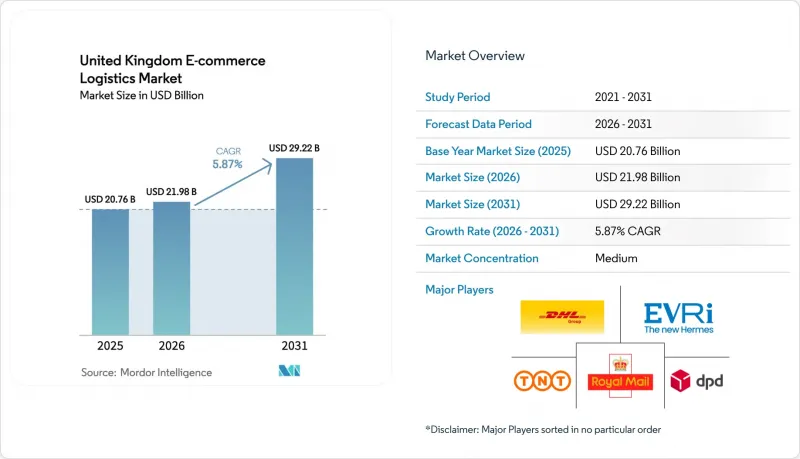
根據 Mordor Intelligence 估計,英國電子商務物流市場規模在 2026 年將達到 219.8 億美元,高於 2025 年的 207.6 億美元,預計到 2031 年將達到 292.2 億美元。
預計從 2026 年到 2031 年,其複合年成長率將達到 5.87%。
本報告按服務(運輸(道路運輸等))、倉儲/履約、經營模式(B2C、B2B等)、目的地(國內等)、配送速度(當日達等)、產品類型(食品飲料等)、城市等級(一線城市等)和地區(英國等)進行分類。市場預測以美元計價。
英國電子商務物流市場的趨勢與洞察
英國消費者對當日達和隔天達的期望越來越高。
儘管配送路線日益複雜且成本不斷上漲,但預計到2030年,當日小包裹遞送業務仍將以9.6%的複合年成長率成長。一線城市佔小包裹總量的63%,其人口密度足以提供快速服務。英國皇家郵政與YEEP!合作,將於2025年1月起新增1000個小包裹櫃,使包裹櫃覆蓋超過21000個地點。此次網路擴張降低了首次投遞失敗率,並維持了利潤率。小規模宅配業者難以跟上這種服務水平,DHL與Evri的合作——將宅配網路的規模與高階貨車運輸能力相結合——凸顯了這種不平衡。車輛創新仍在繼續,ELM Mobility推出了一款售價25,000英鎊(約33,604.80美元)的電動四輪車,該車能夠運輸全尺寸歐標托盤,並可在狹窄的城市區域行駛。食品飲料產業直接受益於 30 分鐘內送達的雜貨配送服務,因為它依賴位於消費者附近的高密度、快速履約中心。
英國脫歐後,歐盟跨境履約迅速從歐盟擴展到英國。
英國脫歐引進了新的海關檢查措施,但也促使歐盟零售商在英國境內維持本地庫存。目前,跨境出口物流的複合年成長率 (CAGR) 為 8.1%,這主要得益於英國經銷商對歐盟非食品線上市場的關注。 2025 年 1 月,新電腦化運輸系統 (NCTS) 第五階段將正式投入運作,屆時將允許使用行動參考編號 (MRN) 取代紙本單據。雖然這項變更節省了時間,但荷蘭承運商在邊境的平均等待時間仍然高達四個小時。在英吉利海峽隧道附近或北愛爾蘭設立保稅樞紐的營運商,相較於那些在運輸路線上處理海關手續的競爭對手,擁有時間優勢。由於複雜的跨境合規要求推動了對高容量分類設備的需求,自動化設備供應商的諮詢量激增。
英國物流業長期面臨司機短缺和薪資上漲的問題
如今,運輸公司正與建設業和公共產業直接爭奪專業司機。自2024年以來,招聘廣告上的薪資上漲了21%,削弱了長途運輸路線的成本競爭力。一些業者為了維持利潤率,正在減少運輸頻率或限制配送區域,間接限制了英國電子商務物流市場的規模。跨境運輸業者受到的衝擊尤其嚴重,因為海關程序需要經驗豐富的司機。由大型第三方物流公司資助的司機培訓學校或許是一個長期的解決方案,但短期運輸能力仍依賴加班和臨時工,這導致準時送達率下降。
細分市場分析
預計到2025年,運輸服務將佔總營收的67.45%,凸顯其在英國電子商務物流市場的核心地位。道路運輸仍是主要運輸方式,因為它即使在時限緊迫的情況下也能提供門到門配送服務。鐵路運輸方面,連接倫敦聖潘克拉斯車站和英吉利海峽隧道的線路正在降低成本,這得益於近期提案的貨運費率折扣。雖然由於英國皇家郵政將空運航班減少到每天18班,空運貨物的處理量有所下降,但航線的最佳化提高了資產利用率並減少了二氧化碳排放。
包括貼標、套件組裝和客製化包裝在內的附加價值服務預計到2031年將以7.18%的複合年成長率成長。這個細分市場蓬勃發展,主要得益於中小企業(SME)直接面對消費者(D2C)訂單的不斷成長,這些企業需要品牌驅動的開箱體驗和個性化SKU。隨著自動化技術的進步,中型第三方物流(3PL)公司正在部署擴充性的分類系統,以適應這些特殊的物流流程。這種動態支持系統能夠帶來比傳統運輸更高的溢價,並使以往僅依賴低利潤運輸的承運商的收入來源多元化。
預計到2025年,B2C配送將佔市場佔有率的71.85%,反映出成熟的零售平台和全通路門市網路能夠穩定需求。需求的可預測性使得都市區配送路線的分配更加均衡,而這正是提高盈利的關鍵因素。
在二手交易和P2P應用程式的推動下,C2C小包裹正以7.36%的複合年成長率快速成長,消費者越來越重視永續性和成本績效。物流供應商正在將自提點配送(PUDO)解決方案商業化,專注於單件商品物流,以抵消上門取貨的成本。 B2B需求依然強勁,但數位化採購平台正在模糊傳統界限,一些B2B物流正在融入混合網路路線。
其他好處:
- Excel格式的市場預測(ME)表
- 3個月的分析師支持
目錄
第1章:引言
- 研究假設和市場定義
- 調查範圍
第2章:調查方法
第3章執行摘要
第4章 市場狀況
- 市場概覽
- 市場促進因素
- 英國消費者對當日/隔天送達的期望越來越高。
- 英國脫歐後,歐盟跨境履約迅速從歐盟擴展到英國。
- 中小企業利用線上市場快速發展D2C品牌
- 加速引入倉庫自動化以解決英國勞動力短缺問題
- 大型城市(倫敦、曼徹斯特)城市微型倉配中心的興起
- 零售商轉向全通路「點選提貨」模式的轉變
- 市場限制因素
- 英國物流業長期面臨司機短缺和薪資上漲的問題
- 都市區道路交通擁擠導致最後一公里配送成本上升。
- 加強對運輸過程中排放的ESG監管(英國「2050淨零排放」計劃)
- 英格蘭東南部倉庫建築許可證相關規定
- 價值供應鏈分析
- 政府政策和法規
- 市場中的技術進步
- 地緣政治事件對市場的影響
- 波特五力模型
第5章 市場規模與成長預測
- 按服務
- 運輸
- 路
- 航空
- 鐵路
- 船運
- 倉儲和履約
- 附加價值服務(貼標籤、包裝、套件組裝)
- 運輸
- 按經營模式
- B2C
- B2B
- C2C
- 按目的地
- 國內的
- 跨境入境
- 跨境 - 出境
- 配送速度
- 當天(24小時內)
- 隔日送達(24-48小時)
- 標準(3-5天)
- 經濟艙(5天或以上)
- 其他
- 產品類型
- 食品/飲料
- 個人及居家護理
- 時尚與生活方式(配件、服裝、鞋類)
- 家具
- 電子設備/家用電器
- 其他產品
- 城市排名
- 一級
- 二級
- 三級及以下
- 按地區
- 英格蘭
- 蘇格蘭
- 威爾斯
- 北愛爾蘭
第6章 競爭情勢
- 市場集中度
- 策略舉措和夥伴關係
- 市佔率分析
- 公司簡介
- Royal Mail
- Evri(Hermes UK)
- DPD UK
- DHL Parcel UK
- FedEx/TNT
- UPS
- Yodel
- APC Overnight
- GXO Logistics
- Clipper Logistics
- Parcel2Go
- Agility Logistics
- Palletforce
- CitySprint
- Deliveroo HOP Logistics
- Gophr
- Whistl
- DHL Supply Chain
- Huboo Technologies
- ShipBob UK
- Stowga
- Zeus Labs
- International Distributions Services(IDS)
- Parcelforce Worldwide
第7章 市場機會與未來展望
According to Mordor Intelligence, the United Kingdom e-commerce logistics market size in 2026 is estimated at USD 21.98 billion, growing from 2025 value of USD 20.76 billion with 2031 projections showing USD 29.22 billion, growing at 5.87% CAGR over 2026-2031.
This report Segments by Service (Transportation (Road and More)), Warehousing and Fulfilment, by Business Model (B2C, B2B and More), by Destination (Domestic and More), by Delivery Speed (Same-Day and More), by Product Category (Foods and Beverages and More), by City-Tier (Tier 1 and More) and by Geography (England and More). The Market Forecasts are Provided in Terms of Value (USD).
United Kingdom E-commerce Logistics Market Trends and Insights
Expanding Same-Day and Next-Day Delivery Expectations Among UK Consumers
Same-day parcels are growing at a 9.6% CAGR through 2030, even though they involve higher route complexity and elevated cost. Tier-1 cities, which host 63% of overall parcels, provide the density needed for viable rapid services. Royal Mail has enlarged its parcel locker estate by 1,000 units since January 2025 in partnership with YEEP!, making lockers available at over 21,000 sites. The network upgrade has cut failed first-time deliveries and preserved margins. Smaller couriers struggle to match these service levels, an imbalance highlighted by the DHL-Evri tie-up that joins courier scale with premium van capacity. Vehicle innovation continues as ELM Mobility deploys GBP 25,000 (USD 33,604.8) electric quadricycles engineered for narrow city streets while still carrying full euro-pallets. Foods & beverages receive a direct boost because sub-30-minute grocery missions depend on dense, rapid fulfilment rings close to shoppers.
Post-Brexit Boom in Cross-Border EU-to-UK Fulfilment Hubs
Brexit introduced new customs checks but also incentivized EU retailers to hold local inventory in Britain. Cross-border outbound logistics now records an 8.1% CAGR, driven by UK sellers eyeing the EU's online non-food market. The New Computerized Transit System Phase 5 went live in January 2025, allowing Movement Reference Numbers to replace paper documents, a change that saves time, yet border queues for Dutch carriers still average 4 hours. Providers that erected bonded hubs near the Channel Tunnel and in Northern Ireland gain a timing edge over rivals that rely on in-line clearance. Automation suppliers report surging enquiries because complex cross-border compliance drives demand for high-throughput sortation equipment.
Chronic Driver Shortage and High Wage Inflation in UK Logistics
Carrier payrolls now compete directly with construction and utilities for scarce vocational drivers. Advertised pay has risen 21% since 2024, eroding the cost competitiveness of long-haul lanes. Some operators cut service frequency or cap distance radii to preserve margin, indirectly limiting the achievable scale of the UK e-commerce logistics market. Cross-border specialists feel the pinch most because customs paperwork requires experienced operators. Driver academies funded by large 3PLs signal a long-term solution, but near-term capacity still relies on overtime and agency labor, depressing on-time performance metrics.
Other drivers and restraints analyzed in the detailed report include:
- Rapid Growth of SME D2C Brands Leveraging Online Marketplaces
- Accelerated Warehouse Automation Adoption to Offset UK Labor Shortage
- Congested Urban Road Networks Raising Last-mile Costs
For complete list of drivers and restraints, kindly check the Table Of Contents.
Segment Analysis
Transportation services contributed 67.45% of 2025 revenue, underscoring their central role in the UK e-commerce logistics market. Road haulage remains the workhorse because it offers door-to-door reach within tight delivery windows. Rail has begun to shave costs on routes linking London St Pancras with the Channel Tunnel, encouraged by recently proposed freight rebates. Air cargo volumes eased after Royal Mail cut flights to 18 per day, yet lane rationalization improved asset utilization and cut CO2.
Value-added lines, covering labelling, kitting, and custom packaging, are pacing ahead with a 7.18% CAGR to 2031. The segment thrives on rising SME D2C orders that need branded unboxing and SKU personalization. As automation spreads, mid-cap 3PLs deploy scalable sortation systems to support these specialized flows. Those dynamic supports price premiums above general haulage and diversifies earnings profiles for carriers that once relied solely on thin-margin transport.
B2C shipping dominated with a 71.85% stake in 2025, reflecting entrenched retail platforms and omnichannel store networks that stabilize volume. Predictability allows route balancing across urban and rural drops, an essential lever for profitability.
C2C parcels, spurred by recommerce and peer-to-peer apps, are advancing at 7.36% CAGR as consumers prioritize sustainability and budget values. Logistics providers commercialize pick-up-drop-off (PUDO) solutions tailored to single-item flows, offsetting the cost of doorstep collection. B2B demand remains steady, yet digital procurement portals blur traditional boundaries, folding some B2B traffic into blended network lanes.
Complete Report Scope:
- By Service
- Transportation
- Road
- Air
- Rail
- Maritime
- Warehousing & Fulfilment
- Value-Added (Labelling, Packaging, Kitting)
- Transportation
- By Business Model
- B2C
- B2B
- C2C
- By Destination
- Domestic
- Cross-Border - Inbound
- Cross-Border - Outbound
- By Delivery Speed
- Same-day (less than 24 h)
- Next-day (24-48 h)
- Standard (3-5 days)
- Economy (more than 5 days)
- Others
- By Product Category
- Foods & Beverages
- Personal & Household Care
- Fashion & Lifestyle (accessories, apparel, footwear)
- Furniture
- Electronics & Household Appliances
- Other Products
- By City-Tier
- Tier 1
- Tier 2
- Tier 3 & Below
- By Geography
- England
- Scotland
- Wales
- Northern Ireland
List of Companies Covered in this Report:
- Royal Mail
- Evri (Hermes UK)
- DPD UK
- DHL Parcel UK
- FedEx/TNT
- UPS
- Yodel
- APC Overnight
- GXO Logistics
- Clipper Logistics
- Parcel2Go
- Agility Logistics
- Palletforce
- CitySprint
- Deliveroo HOP Logistics
- Gophr
- Whistl
- DHL Supply Chain
- Huboo Technologies
- ShipBob UK
- Stowga
- Zeus Labs
- International Distributions Services (IDS)
- Parcelforce Worldwide
Additional Benefits:
- The market estimate (ME) sheet in Excel format
- 3 months of analyst support
TABLE OF CONTENTS
1 Introduction
- 1.1 Study Assumptions & Market Definition
- 1.2 Scope of the Study
2 Research Methodology
3 Executive Summary
4 Market Landscape
- 4.1 Market Overview
- 4.2 Market Drivers
- 4.2.1 Expanding Same-Day & Next-Day Delivery Expectations Among UK Consumers
- 4.2.2 Post-Brexit Boom in Cross-border EU-to-UK Fulfilment Hubs
- 4.2.3 Rapid Growth of SME D2C Brands Leveraging Online Marketplaces
- 4.2.4 Accelerated Warehouse Automation Adoption to Offset UK Labour Shortage
- 4.2.5 Rise of Urban Micro-Fulfilment Centres in Tier-1 Cities (London, Manchester)
- 4.2.6 Retailers' Shift Toward Omnichannel Click-&-Collect Models
- 4.3 Market Restraints
- 4.3.1 Chronic Driver Shortage & High Wage Inflation in UK Logistics
- 4.3.2 Congested Urban Road Networks Raising Last-mile Costs
- 4.3.3 Heightened ESG Regulations on Delivery Emissions (UK Net-Zero 2050)
- 4.3.4 Restrictions on Warehouse Planning Permissions in South-East England
- 4.4 Value / Supply-Chain Analysis
- 4.5 Government Policies & Regulations
- 4.6 Technological Developments in the Market
- 4.7 Impact of Geopolitical Events on the Market
- 4.8 Porter's Five Forces
- 4.8.1 Bargaining Power of Suppliers
- 4.8.2 Bargaining Power of Buyers
- 4.8.3 Threat of New Entrants
- 4.8.4 Threat of Substitutes
- 4.8.5 Competitive Rivalry
5 Market Size & Growth Forecasts (Value & Volume)
- 5.1 By Service
- 5.1.1 Transportation
- 5.1.1.1 Road
- 5.1.1.2 Air
- 5.1.1.3 Rail
- 5.1.1.4 Maritime
- 5.1.2 Warehousing & Fulfilment
- 5.1.3 Value-Added (Labelling, Packaging, Kitting)
- 5.1.1 Transportation
- 5.2 By Business Model
- 5.2.1 B2C
- 5.2.2 B2B
- 5.2.3 C2C
- 5.3 By Destination
- 5.3.1 Domestic
- 5.3.2 Cross-Border - Inbound
- 5.3.3 Cross-Border - Outbound
- 5.4 By Delivery Speed
- 5.4.1 Same-day (less than 24 h)
- 5.4.2 Next-day (24-48 h)
- 5.4.3 Standard (3-5 days)
- 5.4.4 Economy (more than 5 days)
- 5.4.5 Others
- 5.5 By Product Category
- 5.5.1 Foods & Beverages
- 5.5.2 Personal & Household Care
- 5.5.3 Fashion & Lifestyle (accessories, apparel, footwear)
- 5.5.4 Furniture
- 5.5.5 Electronics & Household Appliances
- 5.5.6 Other Products
- 5.6 By City-Tier
- 5.6.1 Tier 1
- 5.6.2 Tier 2
- 5.6.3 Tier 3 & Below
- 5.7 By Geography
- 5.7.1 England
- 5.7.2 Scotland
- 5.7.3 Wales
- 5.7.4 Northern Ireland
6 Competitive Landscape
- 6.1 Market Concentration
- 6.2 Strategic Moves & Partnerships
- 6.3 Market Share Analysis
- 6.4 Company Profiles (includes Global level Overview, Market level overview, Core Segments, Financials as available, Strategic Information, Market Rank/Share for key companies, Products & Services, and Recent Developments)
- 6.4.1 Royal Mail
- 6.4.2 Evri (Hermes UK)
- 6.4.3 DPD UK
- 6.4.4 DHL Parcel UK
- 6.4.5 FedEx/TNT
- 6.4.6 UPS
- 6.4.7 Yodel
- 6.4.8 APC Overnight
- 6.4.9 GXO Logistics
- 6.4.10 Clipper Logistics
- 6.4.11 Parcel2Go
- 6.4.12 Agility Logistics
- 6.4.13 Palletforce
- 6.4.14 CitySprint
- 6.4.15 Deliveroo HOP Logistics
- 6.4.16 Gophr
- 6.4.17 Whistl
- 6.4.18 DHL Supply Chain
- 6.4.19 Huboo Technologies
- 6.4.20 ShipBob UK
- 6.4.21 Stowga
- 6.4.22 Zeus Labs
- 6.4.23 International Distributions Services (IDS)
- 6.4.24 Parcelforce Worldwide
7 Market Opportunities & Future Outlook
- 7.1 White-space & Unmet-need Assessment

 全球電子商務物流市場規模、佔有率、趨勢和成長分析報告(2026-2034年)
 印度電子商務物流:市場佔有率分析、行業趨勢和統計數據以及成長預測(2026-2031 年)東協電子商務物流:市場佔有率分析、產業趨勢與統計及成長預測(2026-2031年)
 電子商務物流市場:全球市場預測(2026-2032)中國跨境電商物流:市佔率分析、產業趨勢與統計及成長預測(2026-2031年)中國電子商務物流:市場佔有率分析、產業趨勢與統計及成長預測(2026-2031年)印尼電子商務物流:市場佔有率分析、產業趨勢與統計及成長預測(2026-2031)印度跨境B2C電子商務物流:市場佔有率分析、產業趨勢與統計及成長預測(2026-2031年)美國跨境電子商務物流:市場佔有率分析、產業趨勢與統計及成長預測(2026-2031)越南跨境B2C電子商務物流:市場佔有率分析、產業趨勢與統計及成長預測(2026-2031年)