

 |
市場調查報告書
商品編碼
2124765
馬來西亞潤滑油市場:市場佔有率分析、產業趨勢與統計、成長預測(2026-2031)Malaysia Lubricants - Market Share Analysis, Industry Trends & Statistics, Growth Forecasts (2026 - 2031) |
||||||

※ 本網頁內容可能與最新版本有所差異。詳細情況請與我們聯繫。
根據 Mordor Intelligence 估計,馬來西亞潤滑油市場在 2026 年將達到 5.2776 億公升,高於 2025 年的 5.1919 億公升,預計到 2031 年將達到 5.7266 億公升。
預計 2026 年至 2031 年的複合年成長率為 1.65%。
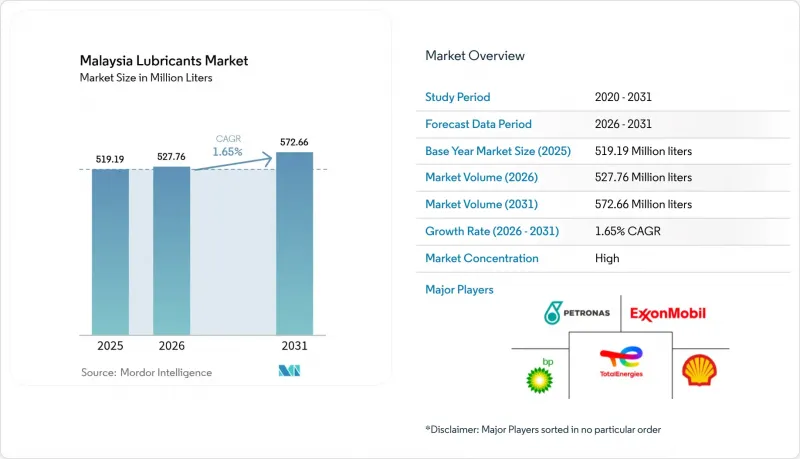
本報告按產品類型(汽車引擎油、工業引擎油、變速箱油、齒輪油、煞車油、液壓油、潤滑脂等)、終端用戶產業(汽車、船舶、航太、重型機械、工業)和基料類型(礦物油基、合成油、半合成油、生物基)進行細分。市場預測以銷售量(公升)為單位。
馬來西亞潤滑油市場趨勢與洞察
汽車保有量和新車銷售的成長正在推動持續的需求。
2024年汽車總銷量達816,747輛,較去年同期成長2.1%,儘管市場已趨於成熟,但仍帶動了潤滑油銷售量的成長。由於乘用車銷量已超過摩托車銷量,市場需求正從摩托車潤滑油轉向更高品質的汽車機油。歐盟5燃油標準的實施促使維修店和車主轉向使用低硫全合成產品,以保護觸媒後後處理系統。商用車也對市場做出了貢獻,更大的承油盤容量和更嚴格的車輛保養計劃抵消了乘用車銷售成長放緩的影響。產業組織預計,到2030年,汽車保有量將持續成長,尤其是在巴生谷、檳城和柔佛地區,這將支撐基礎消費。
第十二個馬來西亞計劃下的工業和基礎設施擴張
馬來西亞的目標是到2030年創造70萬個高技能製造業就業機會,並將高科技產品出口佔有率加倍,達到6%。半導體、電子和石化專案需要可靠的液壓油、切削液和製程油,這些產品必須能夠承受嚴苛的無塵室和高溫環境。 2023年,製造業投資金額達到1,520億馬幣,其中近70%的資本流入來自外國投資者,這充分體現了他們對該產業持續成長的信心。柔佛-新加坡經濟特區、東海岸鐵路(ECRL)和邊佳蘭綜合體等加工油項目,從建設階段到工廠的日常運作,都增加了對施工機械、重型引擎和石化設備潤滑油的需求。
換油週期延長限制了銷售量成長。
現代合成機油單次加註即可行駛 15,000 至 20,000 公里,而老式礦物油的換油週期僅為 5,000 至 10,000 公里。因此,儘管行駛里程持續增加,但每輛車的年用油量(公升)卻顯著下降。車隊管理人員正利用在運作中油液分析來延長換油週期,同時又不影響保固範圍。因此,入門級礦物油銷售量的下降抵消了車輛數量成長帶來的收益,製造商正透過加強高利潤率全合成機油的銷售來確保利潤。維修店也透過提供諸如更換濾芯、四輪定位和更換空調濾芯等捆綁服務來應對潤滑油更換頻率的降低。
細分市場分析
預計到2025年,汽車機油將佔馬來西亞潤滑油市場佔有率的50.60%。龐大且持續成長的車輛數量支撐著基本需求,而更嚴格的OEM規範正在加速從API SN等級向SP和ILSAC GF-6等級的轉變,這些等級具有更高的抗氧化穩定性。變速箱油是成長最快的產品,預計複合年成長率將達到2.50%,主要得益於自動變速箱、雙離合器變速箱和無段變速箱(CVT)的普及。混合動力汽車採用專用的電子變速箱潤滑迴路,進一步擴大了變速箱油的需求。此外,由於半導體工廠、精密加工中心和化學聯合企業對無污染運作和延長潤滑油使用壽命的需求,馬來西亞潤滑油市場也在不斷擴張,同時也推動了液壓油、金屬加工液和加工油市場規模的擴大。
其他好處:
- Excel格式的市場預測(ME)表
- 3個月的分析師支持
目錄
第1章:引言
- 研究假設和市場定義
- 調查範圍
第2章:調查方法
第3章執行摘要
第4章 市場狀況
- 市場概覽
- 市場促進因素
- 汽車擁有量和新車銷量均有所成長
- 工業和基礎設施的擴張
- 過渡到合成/高性能潤滑油
- 根據第十二個馬來西亞計劃制定的大型政府項目
- 潤滑油零售業(二線城市)電子商務的興起
- 市場限制因素
- 延長換油週期,提高引擎效率
- 加速推廣電動車
- 原油價格波動給利潤率帶來壓力。
- 價值鏈分析
- 法律規範
- 終端用戶趨勢
- 汽車產業
- 製造業
- 波特五力模型
第5章 市場規模與成長預測
- 依產品類型
- 汽車引擎油
- 工業機油
- 變速箱油
- 齒輪油
- 煞車油
- 油壓
- 潤滑脂
- 加工油(包括橡膠加工油和白油)
- 金屬加工用潤滑液
- 渦輪機油
- 變壓器油
- 其他產品類型
- 按最終用戶行業分類
- 車
- 搭乘用車
- 商用車輛
- 摩托車
- 海上
- 航太
- 重型機械
- 建造
- 礦業
- 農業
- 產業
- 發電
- 冶金/金屬加工
- 紡織品
- 石油和天然氣
- 其他終端用戶產業
- 車
- 依基油類型
- 礦物油性潤滑劑
- 合成潤滑油
- 半合成潤滑油
- 生物性潤滑劑
第6章 競爭情勢
- 市場集中度
- 策略趨勢
- 市佔率和排名分析
- 公司簡介
- Advance Lube Enterprise Sdn Bhd
- BP Plc(Castrol)
- Chevron Corporation
- Excelube Marketing Sdn Bhd
- Exxon Mobil Corporation
- FUCHS
- Idemitsu Kosan Co., Ltd.
- Liqui Moly Malaysia
- MSB Global Group Sdn. Bhd.
- Petroliam Nasional Berhad(PETRONAS)
- Petron
- Shell plc
- SINOPEC
- TotalEnergies
- UMW Lubetech Sdn Bhd
- Valvoline(Saudi Arabian Oil Co.)
第7章 市場機會與未來展望
第8章:執行長面臨的關鍵策略挑戰
According to Mordor Intelligence, Malaysia lubricants market size in 2026 is estimated at 527.76 million liters, growing from 2025 value of 519.19 million liters with 2031 projections showing 572.66 million liters, growing at 1.65% CAGR over 2026-2031.
This report is Segmented by Product Type (Automotive Engine Oil, Industrial Engine Oil, Transmission Fluids, Gear Oil, Brake Fluids, Hydraulic Fluids, Greases, and More), End-User Industry (Automotive, Marine, Aerospace, Heavy Equipment, and Industrial), and Base Stock Type (Mineral Oil-Based, Synthetic, Semi-Synthetic, and Bio-Based). The Market Forecasts are Provided in Terms of Volume (Liters).
Malaysia Lubricants Market Trends and Insights
Rising Vehicle Parc and New-Car Sales Drive Sustained Demand
Total vehicle sales reached 816,747 units in 2024, a 2.1% gain that supports lubricant volume growth despite market maturity. Passenger cars already outnumber two-wheelers, so demand shifts toward higher-grade automotive engine oils rather than motorcycle lubricants. The implementation of Euro 5 fuel standards prompts workshops and motorists to switch to low-sulfur, full-synthetic formulations that protect catalytic after-treatment systems. Commercial vehicles also contribute because larger sump capacities and stricter fleet maintenance schedules offset slower passenger-car sales growth. Industry associations expect continuous parc expansion through 2030, particularly in the Klang Valley, Penang, and Johor, anchoring base-level consumption.
Industrial and Infrastructure Expansion Under 12th Malaysia Plan
Malaysia aims to create 700,000 high-skill manufacturing jobs by 2030 and double its high-tech export share to 6%. Semiconductor, electronics, and petrochemical projects require reliable hydraulic fluids, metalworking fluids, and process oils that withstand stringent clean-room or high-temperature environments. Manufacturing investments reached RM152 billion in 2023, with foreign investors accounting for nearly 70% of the chemical sector's capital inflows, indicating confidence in continued industrial growth. Infrastructure projects, such as the Johor-Singapore Special Economic Zone, East Coast Rail Link, and Pengerang Integrated Complex, increase lubricant demand for construction machinery, heavy-duty engines, and petrochemical equipment throughout the build-out phase and in routine plant operations.
Longer Oil-Drain Intervals Constrain Volume Growth
Modern synthetics enable drain intervals of 15,000-20,000 kilometers on a single fill, compared with 5,000-10,000 kilometers for older mineral formulations. This sharply lowers annual liter consumption per vehicle, even though the number of kilometers driven continues to rise. Fleet managers rely on in-service oil analysis to extend drains without compromising warranty coverage. Consequently, volume erosion within entry-level mineral categories offsets gains from the rising car population, and producers bolster revenues by marketing higher-margin full synthetics. Workshops adapt by offering bundled services-such as filter changes, alignment, and cabin-air filtration-to compensate for reduced lubricant frequency.
Other drivers and restraints analyzed in the detailed report include:
- Synthetic and High-Performance Lubricant Adoption Accelerates
- Government Mega-Projects Create Infrastructure Lubricant Demand
- Electric Vehicle Adoption Reshapes Long-Term Demand Patterns
For complete list of drivers and restraints, kindly check the Table Of Contents.
Segment Analysis
Automotive engine oil accounted for 50.60% of the Malaysia lubricants market share in 2025. A large and growing car population sustains baseline demand, while stricter OEM specifications accelerate the migration from API SN to SP and ILSAC GF-6 categories, which offer higher oxidative stability. Transmission fluids are the fastest-growing product, registering a 2.50% CAGR as automatic, dual-clutch, and continuously variable gearboxes proliferate. Hybrid vehicles further expand this need due to dedicated e-transmission lubrication circuits. The Malaysian lubricants market size, linked to hydraulic fluids, metalworking fluids, and process oils, also rises because semiconductor plants, precision machining centers, and chemical complexes require contamination-free operations and extended fluid life.
Complete Report Scope:
- By Product Type
- Automotive Engine Oil
- Industrial Engine Oil
- Transmission Fluids
- Gear Oil
- Brake Fluids
- Hydraulic Fluids
- Greases
- Process Oil (Including Rubber Process Oil and White Oil)
- Metalworking Fluids
- Turbine Oil
- Transformer Oil
- Other Product Types
- By End-user Industry
- Automotive
- Passenger Vehicles
- Commercial Vehicles
- Two-Wheelers
- Marine
- Aerospace
- Heavy Equipment
- Construction
- Mining
- Agriculture
- Industrial
- Power Generation
- Metallurgy and Metalworking
- Textiles
- Oil and Gas
- Other End-Use Industries
- Automotive
- By Base Stock Type
- Mineral Oil-Based Lubricants
- Synthetic Lubricants
- Semi-Synthetic Lubricants
- Bio-Based Lubricants
List of Companies Covered in this Report:
- Advance Lube Enterprise Sdn Bhd
- BP Plc (Castrol)
- Chevron Corporation
- Excelube Marketing Sdn Bhd
- Exxon Mobil Corporation
- FUCHS
- Idemitsu Kosan Co., Ltd.
- Liqui Moly Malaysia
- MSB Global Group Sdn. Bhd.
- Petroliam Nasional Berhad (PETRONAS)
- Petron
- Shell plc
- SINOPEC
- TotalEnergies
- UMW Lubetech Sdn Bhd
- Valvoline (Saudi Arabian Oil Co.)
Additional Benefits:
- The market estimate (ME) sheet in Excel format
- 3 months of analyst support
TABLE OF CONTENTS
1 Introduction
- 1.1 Study Assumptions and Market Definition
- 1.2 Scope of the Study
2 Research Methodology
3 Executive Summary
4 Market Landscape
- 4.1 Market Overview
- 4.2 Market Drivers
- 4.2.1 Rising vehicle parc and new-car sales
- 4.2.2 Industrial and infrastructure expansion
- 4.2.3 Shift toward synthetic/high-performance lubricants
- 4.2.4 Government mega-projects under 12th Malaysia Plan
- 4.2.5 E-commerce emergence for lubricant retail (Tier-2 cities)
- 4.3 Market Restraints
- 4.3.1 Longer oil-drain intervals and engine efficiency gains
- 4.3.2 Accelerating electric-vehicle adoption
- 4.3.3 Crude-oil price volatility pressuring margins
- 4.4 Value Chain Analysis
- 4.5 Regulatory Framework
- 4.6 End-User Trends
- 4.6.1 Automotive Industry
- 4.6.2 Manufacturing Industry
- 4.7 Porter's Five Forces
- 4.7.1 Bargaining Power of Suppliers
- 4.7.2 Bargaining Power of Buyers
- 4.7.3 Threat of New Entrants
- 4.7.4 Threat of Substitutes
- 4.7.5 Degree of Competition
5 Market Size and Growth Forecasts (Volume)
- 5.1 By Product Type
- 5.1.1 Automotive Engine Oil
- 5.1.2 Industrial Engine Oil
- 5.1.3 Transmission Fluids
- 5.1.4 Gear Oil
- 5.1.5 Brake Fluids
- 5.1.6 Hydraulic Fluids
- 5.1.7 Greases
- 5.1.8 Process Oil (Including Rubber Process Oil and White Oil)
- 5.1.9 Metalworking Fluids
- 5.1.10 Turbine Oil
- 5.1.11 Transformer Oil
- 5.1.12 Other Product Types
- 5.2 By End-user Industry
- 5.2.1 Automotive
- 5.2.1.1 Passenger Vehicles
- 5.2.1.2 Commercial Vehicles
- 5.2.1.3 Two-Wheelers
- 5.2.2 Marine
- 5.2.3 Aerospace
- 5.2.4 Heavy Equipment
- 5.2.4.1 Construction
- 5.2.4.2 Mining
- 5.2.4.3 Agriculture
- 5.2.5 Industrial
- 5.2.5.1 Power Generation
- 5.2.5.2 Metallurgy and Metalworking
- 5.2.5.3 Textiles
- 5.2.5.4 Oil and Gas
- 5.2.5.5 Other End-Use Industries
- 5.2.1 Automotive
- 5.3 By Base Stock Type
- 5.3.1 Mineral Oil-Based Lubricants
- 5.3.2 Synthetic Lubricants
- 5.3.3 Semi-Synthetic Lubricants
- 5.3.4 Bio-Based Lubricants
6 Competitive Landscape
- 6.1 Market Concentration
- 6.2 Strategic Moves
- 6.3 Market Share (%)/Ranking Analysis
- 6.4 Company Profiles (includes Global level Overview, Market level overview, Core Segments, Financials as available, Strategic Information, Market Rank/Share, Products and Services, Recent Developments)
- 6.4.1 Advance Lube Enterprise Sdn Bhd
- 6.4.2 BP Plc (Castrol)
- 6.4.3 Chevron Corporation
- 6.4.4 Excelube Marketing Sdn Bhd
- 6.4.5 Exxon Mobil Corporation
- 6.4.6 FUCHS
- 6.4.7 Idemitsu Kosan Co., Ltd.
- 6.4.8 Liqui Moly Malaysia
- 6.4.9 MSB Global Group Sdn. Bhd.
- 6.4.10 Petroliam Nasional Berhad (PETRONAS)
- 6.4.11 Petron
- 6.4.12 Shell plc
- 6.4.13 SINOPEC
- 6.4.14 TotalEnergies
- 6.4.15 UMW Lubetech Sdn Bhd
- 6.4.16 Valvoline (Saudi Arabian Oil Co.)
7 Market Opportunities and Future Outlook
- 7.1 White-space and Unmet-need Assessment
8 Key Strategic Questions for CEOs

 北美潤滑油市場:市場佔有率分析、產業趨勢與統計、成長預測(2026-2031)防銹潤滑劑氣霧劑:市場佔有率分析、行業趨勢和統計數據以及成長預測(2026-2031 年)法國潤滑油市場:市場佔有率分析、產業趨勢與統計及成長預測(2026-2031)
 2026-2030年全球潤滑油市場中國潤滑油市場:市場佔有率分析、產業趨勢與統計、成長預測(2026-2031年)印尼潤滑油市場:市場佔有率分析、產業趨勢與統計、成長預測(2026-2031)印度潤滑油市場:市場佔有率分析、產業趨勢與統計、成長預測(2026-2031)英國潤滑油市場:市場佔有率分析、產業趨勢與統計及成長預測(2026-2031)越南潤滑油市場:市場佔有率分析、產業趨勢與統計、成長預測(2026-2031)非洲潤滑油市場:市場佔有率分析、產業趨勢與統計、成長預測(2026-2031)