


 |
市場調查報告書
商品編碼
2116412
印度潤滑油市場:市場佔有率分析、產業趨勢與統計、成長預測(2026-2031)India Lubricants - Market Share Analysis, Industry Trends & Statistics, Growth Forecasts (2026 - 2031) |
||||||

※ 本網頁內容可能與最新版本有所差異。詳細情況請與我們聯繫。
根據 Mordor Intelligence 預測,印度潤滑油市場預計將從 2025 年的 56 億公升成長到 2026 年的 57.7 億公升,然後在 2031 年達到 67.3 億公升,2026 年至 2031 年的複合年成長率為 3.12%。
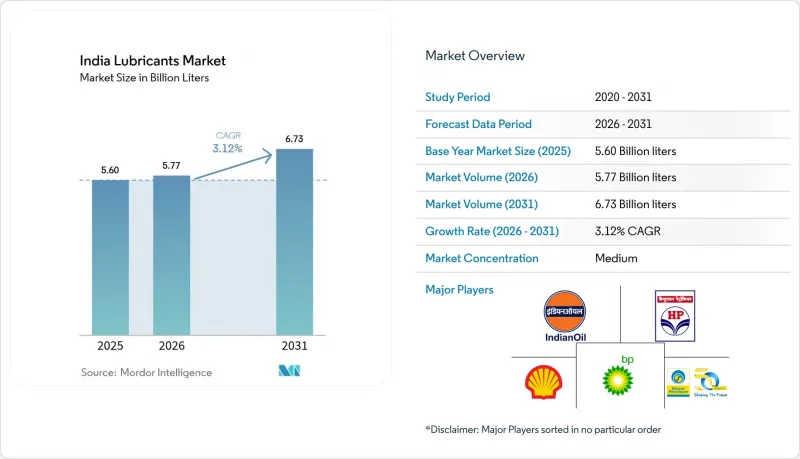
本報告按產品類型(汽車引擎油、工業引擎油、變速箱油、齒輪油、煞車油、液壓油、潤滑脂等)、終端用戶產業(汽車、船舶、航太、重型機械、工業)和基料類型(礦物油基、合成油、半合成油、生物基)進行分類。市場預測以銷售量(公升)為單位。
印度潤滑油市場趨勢與洞察
車輛擁有數量和行駛里程增加
儘管電氣化趨勢加速發展,但西部各州新乘用車註冊量的成長仍推動了潤滑油的持續需求。電子商務物流和高速公路基礎設施的改善增加了商用車的年行駛里程,導致換油頻率增加。正規車隊營運商依靠遠端資訊處理技術來製定換油計劃,以保護引擎並最大限度地減少停機時間,這促使他們更傾向於選擇優質合成機油。預計到2024年,汽車產業將佔據54.72%的市場佔有率,這清楚地表明了這項核心需求的穩固基礎。老舊的摩托車和輕型商用車車隊也促進了礦物油的銷售量,使其在農村市場擁有廣泛的基本客群。
「印度製造」政策下的工業生產成長
政府對製造業的激勵措施持續吸引資本流入古吉拉突邦、馬哈拉斯特拉邦和泰米爾納德邦的化學、金屬和重型機械產業。運轉率的提高推動了液壓油、齒輪油和壓縮機潤滑油需求的成長。汽車和航太工廠精密加工的擴張正以5.51%的複合年成長率推動金屬加工液市場的發展,尤其是用於拉削和硬質合金研磨的純切削液。對石化聯合企業投資的增加也擴大了對高溫運作的渦輪機油和壓縮機油的需求。對特定應用配方的偏好正推動著從通用型潤滑油向高性能合成油的轉變,從而延長換油週期並減少意外停機時間。
基礎油和添加劑價格波動
由於I類基礎油在許多成品油調配中佔比最大,原油價格的波動會迅速擠壓調配商的利潤空間。儘管印度正在擴大其國內基礎油產能,但仍依賴進口高品質的III類和IV類基礎油,這使得調配商面臨外匯波動和運費上漲的風險。添加劑,特別是用於符合BS-VI排放標準的合成油中的分散劑和摩擦改進劑,也容易受到全球事件期間供應鏈中斷的影響。小規模的區域調配商難以維持庫存緩衝,可能會將市場佔有率拱手讓給能夠更有效應對原料價格波動的綜合煉油企業。頻繁的價格調整可能導致對成本敏感的用戶轉向低等級產品或延長換油週期,可能減緩印度潤滑油市場短期內的銷售量成長。
細分市場分析
到2025年,汽車機油將佔印度潤滑油市場佔有率的41.95%。這反映了印度道路上龐大的車輛數量以及多塵的運作環境加速了機油的劣化。高交通流量和高溫環境縮短了換油週期,確保了乘用車、商用卡車和摩托車的重複購買。工業機油為港口作業的柴油發電機、施工機械和船舶引擎提供動力,為高銷量奠定了穩定的基礎。隨著汽車產量的成長,對變速箱油和齒輪油的需求也在成長,而潤滑脂則透過保護重型機械的軸承,維持了產品組合的平衡。
金屬加工液預計將以5.29%的複合年成長率成為所有品類中成長最快的,這主要得益於汽車和航太零件精密加工需求的不斷成長。純切削液在齒輪滾齒和拉削加工中提供卓越的潤滑和散熱性能,而可溶性切削液則可在高速銑削鋁材時保護刀具。用於輪胎和食品行業的橡膠和白加工油受監管純度標準的約束,因此可以以更高的價格出售。由於液壓迴路在緊急煞車和停車功能(包括再生煞車系統)中必不可少,因此煞車油的需求保持穩定。這些趨勢共同推動了特種潤滑油成為印度整體潤滑油市場策略成長的驅動力。
其他好處:
- Excel格式的市場預測(ME)表
- 3個月的分析師支持
目錄
第1章:引言
- 研究假設和市場定義
- 調查範圍
第2章:調查方法
第3章執行摘要
第4章 市場狀況
- 市場概覽
- 市場促進因素
- 車輛擁有數量和行駛里程增加
- 「印度製造」政策下的工業生產成長
- BS-VI 和 CAFE 標準正在推動對優質潤滑油的需求。
- CNG汽車的快速成長對專用機油提出了要求。
- 透過數位化狀態監測實現預測性維護和潤滑油更換。
- 市場限制因素
- 基礎油和添加劑價格波動
- 電動車的快速普及抑制了對內燃機潤滑油的需求。
- 對III/IV類基礎油的進口依賴性
- 價值鏈分析
- 法律規範
- 終端用戶趨勢
- 汽車產業
- 製造業
- 發電業
- 波特五力模型
第5章 市場規模與成長預測
- 依產品類型
- 汽車引擎油
- 工業機油
- 變速箱油
- 齒輪油
- 煞車油
- 油壓
- 潤滑脂
- 加工油(包括橡膠加工油和白油)
- 金屬加工用潤滑液
- 渦輪機油
- 變壓器油
- 其他產品類型
- 按最終用戶行業分類
- 車
- 搭乘用車
- 商用車輛
- 摩托車
- 海上
- 航太
- 重型機械
- 建造
- 礦業
- 農業
- 產業
- 發電
- 冶金/金屬加工
- 紡織品
- 石油和天然氣
- 其他終端用戶產業
- 車
- 依基油類型
- 礦物油性潤滑劑
- 合成潤滑油
- 半合成潤滑油
- 生物性潤滑劑
第6章 競爭情勢
- 市場集中度
- 策略趨勢
- 市佔率和排名分析
- 公司簡介
- Bharat Petroleum Corporation Limited
- BP plc
- Chevron Corporation
- Exxon Mobil Corporation
- FUCHS
- Gulf Oil International Ltd
- Hindustan Petroleum Corporation Limited
- Indian Oil Corporation Limited
- MOTUL
- PETRONAS Lubricants International
- Shell plc
- TotalEnergies
- VALVOLINE INC.
- Veedol Corporation Limited
第7章 市場機會與未來展望
第8章:執行長面臨的關鍵策略挑戰
According to Mordor Intelligence, the India lubricants market size is expected to grow from 5.60 billion liters in 2025 to 5.77 billion liters in 2026 and is forecast to reach 6.73 billion liters by 2031 at 3.12% CAGR over 2026-2031.
This report is Segmented by Product Type (Automotive Engine Oil, Industrial Engine Oil, Transmission Fluids, Gear Oil, Brake Fluids, Hydraulic Fluids, Greases, and More), End-User Industry (Automotive, Marine, Aerospace, Heavy Equipment, and Industrial), and Base Stock Type (Mineral Oil-Based, Synthetic, Semi-Synthetic, and Bio-Based). The Market Forecasts are Provided in Terms of Volume (Liters).
India Lubricants Market Trends and Insights
Rising Vehicle Parc and Miles-driven
Passenger vehicle capacity additions in the western states are driving sustained demand for lubricants, even as electrification accelerates. Commercial fleets clock higher annual mileage due to e-commerce logistics and highway upgrades, which increases the frequency of lubricant replacement. Organized fleet operators rely on telematics to schedule oil changes that protect engines while minimizing downtime, reinforcing preference for premium synthetics. The automotive segment's 54.72% share in 2024 illustrates this core demand anchor. Ageing two-wheeler and light-commercial fleets also bolster mineral oil volumes and maintain a broad customer base across rural markets.
Industrial Output Growth Under "Make in India"
Government manufacturing incentives continue to channel capital toward hubs for chemicals, metals, and heavy machinery in Gujarat, Maharashtra, and Tamil Nadu. Rising capacity utilization increases consumption of hydraulic fluids, gear oils, and compressor lubricants. The growth in precision machining at automotive and aerospace plants fuels a 5.51% CAGR in metalworking fluids, particularly neat cutting oils designed for broaching and carbide grinding. Investment in petrochemical complexes expands demand for turbine and compressor oils that operate under high temperatures. The preference for application-specific formulations supports the migration from commodity grades to performance-oriented synthetics, which extend drain intervals and limit unplanned shutdowns.
Volatility in Base oil and Additive Prices
Group I base oils constitute a major portion of many finished blends, so crude price swings quickly erode blender margins. India is ramping up its domestic base-oil capacity, yet premium Group III and IV stocks must still be imported, leaving formulators exposed to currency fluctuations and freight spikes. Additive packages, particularly dispersants and friction modifiers used in BS-VI compliant synthetics, also face supply chain disruptions during global events. Smaller regional blenders struggle to maintain inventory buffers and may cede market share to integrated refiners that manage feedstock volatility more effectively. Frequent price adjustments can nudge cost-sensitive users toward lower-grade products or extend drain intervals, shaving near-term volume growth for the India lubricants market.
Other drivers and restraints analyzed in the detailed report include:
- BS-VI and CAFE Norms Pushing Premium Lubricants
- Rapid CNG Fleet Expansion Needs Dedicated Engine Oils
- Accelerating EV Adoption Curbing ICE Lubricant Demand
For complete list of drivers and restraints, kindly check the Table Of Contents.
Segment Analysis
Automotive engine oil held 41.95% of the India lubricants market share in 2025, reflecting the country's large on-road fleet and dusty operating environment that accelerates oil degradation. Heavy traffic and high ambient temperatures shorten drain intervals, locking in repeat purchases for passenger cars, commercial trucks, and two-wheelers. Industrial engine oils support diesel generator sets, earth-moving equipment, and marine engines that power port operations, providing a stable base for high volumes. Transmission and gear oils accompany the rise in vehicle production, while greases secure bearings in heavy machinery, maintaining a balanced product mix.
Metalworking fluids are projected to grow at a 5.29% CAGR, the fastest among all categories, driven by an increase in precision machining for automotive and aerospace components. Neat cutting oils provide superior lubrication and heat dissipation in gear hobbing and broaching, while soluble oils protect tools during high-speed aluminium milling. Rubber and white process oils serve tire and food applications, with regulatory purity norms enabling premium pricing. Brake fluid requirements remain steady because even regenerative braking systems retain hydraulic circuits for emergency and parking functions. Collectively, these trends elevate specialty fluids as a strategic growth lever within the broader India lubricants market.
Complete Report Scope:
- By Product Type
- Automotive Engine Oil
- Industrial Engine Oil
- Transmission Fluids
- Gear Oil
- Brake Fluids
- Hydraulic Fluids
- Greases
- Process Oil (Including Rubber Process Oil and White Oil)
- Metalworking Fluids
- Turbine Oil
- Transformer Oil
- Other Product Types
- By End-user Industry
- Automotive
- Passenger Vehicles
- Commercial Vehicles
- Two-Wheelers
- Marine
- Aerospace
- Heavy Equipment
- Construction
- Mining
- Agriculture
- Industrial
- Power Generation
- Metallurgy and Metalworking
- Textiles
- Oil and Gas
- Other End-Use Industries
- Automotive
- By Base Stock Type
- Mineral Oil-Based Lubricants
- Synthetic Lubricants
- Semi-Synthetic Lubricants
- Bio-Based Lubricants
List of Companies Covered in this Report:
- Bharat Petroleum Corporation Limited
- BP p.l.c.
- Chevron Corporation
- Exxon Mobil Corporation
- FUCHS
- Gulf Oil International Ltd
- Hindustan Petroleum Corporation Limited
- Indian Oil Corporation Limited
- MOTUL
- PETRONAS Lubricants International
- Shell plc
- TotalEnergies
- VALVOLINE INC.
- Veedol Corporation Limited
Additional Benefits:
- The market estimate (ME) sheet in Excel format
- 3 months of analyst support
TABLE OF CONTENTS
1 Introduction
- 1.1 Study Assumptions and Market Definition
- 1.2 Scope of the Study
2 Research Methodology
3 Executive Summary
4 Market Landscape
- 4.1 Market Overview
- 4.2 Market Drivers
- 4.2.1 Rising Vehicle Parc and Miles-driven
- 4.2.2 Industrial Output Growth Under "Make in India"
- 4.2.3 BS-VI and CAFE Norms Pushing Premium Lubricants
- 4.2.4 Rapid CNG Fleet Expansion Needs Dedicated Engine Oils
- 4.2.5 Digital Condition-monitoring Enabling Predictive Lube Changes
- 4.3 Market Restraints
- 4.3.1 Volatility in Base-oil and Additive Prices
- 4.3.2 Accelerating EV Adoption Curbing ICE Lubricant Demand
- 4.3.3 Import Dependency on Group III/IV Base Oils
- 4.4 Value Chain Analysis
- 4.5 Regulatory Framework
- 4.6 End-User Trends
- 4.6.1 Automotive Industry
- 4.6.2 Manufacturing Industry
- 4.6.3 Power Generation Industry
- 4.7 Porter's Five Forces
- 4.7.1 Bargaining Power of Suppliers
- 4.7.2 Bargaining Power of Buyers
- 4.7.3 Threat of New Entrants
- 4.7.4 Threat of Substitutes
- 4.7.5 Degree of Competition
5 Market Size and Growth Forecasts (Volume)
- 5.1 By Product Type
- 5.1.1 Automotive Engine Oil
- 5.1.2 Industrial Engine Oil
- 5.1.3 Transmission Fluids
- 5.1.4 Gear Oil
- 5.1.5 Brake Fluids
- 5.1.6 Hydraulic Fluids
- 5.1.7 Greases
- 5.1.8 Process Oil (Including Rubber Process Oil and White Oil)
- 5.1.9 Metalworking Fluids
- 5.1.10 Turbine Oil
- 5.1.11 Transformer Oil
- 5.1.12 Other Product Types
- 5.2 By End-user Industry
- 5.2.1 Automotive
- 5.2.1.1 Passenger Vehicles
- 5.2.1.2 Commercial Vehicles
- 5.2.1.3 Two-Wheelers
- 5.2.2 Marine
- 5.2.3 Aerospace
- 5.2.4 Heavy Equipment
- 5.2.4.1 Construction
- 5.2.4.2 Mining
- 5.2.4.3 Agriculture
- 5.2.5 Industrial
- 5.2.5.1 Power Generation
- 5.2.5.2 Metallurgy and Metalworking
- 5.2.5.3 Textiles
- 5.2.5.4 Oil and Gas
- 5.2.5.5 Other End-Use Industries
- 5.2.1 Automotive
- 5.3 By Base Stock Type
- 5.3.1 Mineral Oil-Based Lubricants
- 5.3.2 Synthetic Lubricants
- 5.3.3 Semi-Synthetic Lubricants
- 5.3.4 Bio-Based Lubricants
6 Competitive Landscape
- 6.1 Market Concentration
- 6.2 Strategic Moves
- 6.3 Market Share (%)/Ranking Analysis
- 6.4 Company Profiles (includes Global level Overview, Market level overview, Core Segments, Financials as available, Strategic Information, Market Rank/Share, Products and Services, Recent Developments)
- 6.4.1 Bharat Petroleum Corporation Limited
- 6.4.2 BP p.l.c.
- 6.4.3 Chevron Corporation
- 6.4.4 Exxon Mobil Corporation
- 6.4.5 FUCHS
- 6.4.6 Gulf Oil International Ltd
- 6.4.7 Hindustan Petroleum Corporation Limited
- 6.4.8 Indian Oil Corporation Limited
- 6.4.9 MOTUL
- 6.4.10 PETRONAS Lubricants International
- 6.4.11 Shell plc
- 6.4.12 TotalEnergies
- 6.4.13 VALVOLINE INC.
- 6.4.14 Veedol Corporation Limited
7 Market Opportunities and Future Outlook
- 7.1 White-space and Unmet-need Assessment
8 Key Strategic Questions for CEOs

 北美潤滑油市場:市場佔有率分析、產業趨勢與統計、成長預測(2026-2031)防銹潤滑劑氣霧劑:市場佔有率分析、行業趨勢和統計數據以及成長預測(2026-2031 年)法國潤滑油市場:市場佔有率分析、產業趨勢與統計及成長預測(2026-2031)
 2026-2030年全球潤滑油市場中國潤滑油市場:市場佔有率分析、產業趨勢與統計、成長預測(2026-2031年)印尼潤滑油市場:市場佔有率分析、產業趨勢與統計、成長預測(2026-2031)英國潤滑油市場:市場佔有率分析、產業趨勢與統計及成長預測(2026-2031)越南潤滑油市場:市場佔有率分析、產業趨勢與統計、成長預測(2026-2031)非洲潤滑油市場:市場佔有率分析、產業趨勢與統計、成長預測(2026-2031)馬來西亞潤滑油市場:市場佔有率分析、產業趨勢與統計、成長預測(2026-2031)