


 |
市場調查報告書
商品編碼
2116411
中國潤滑油市場:市場佔有率分析、產業趨勢與統計、成長預測(2026-2031年)China Lubricants - Market Share Analysis, Industry Trends & Statistics, Growth Forecasts (2026 - 2031) |
||||||

※ 本網頁內容可能與最新版本有所差異。詳細情況請與我們聯繫。
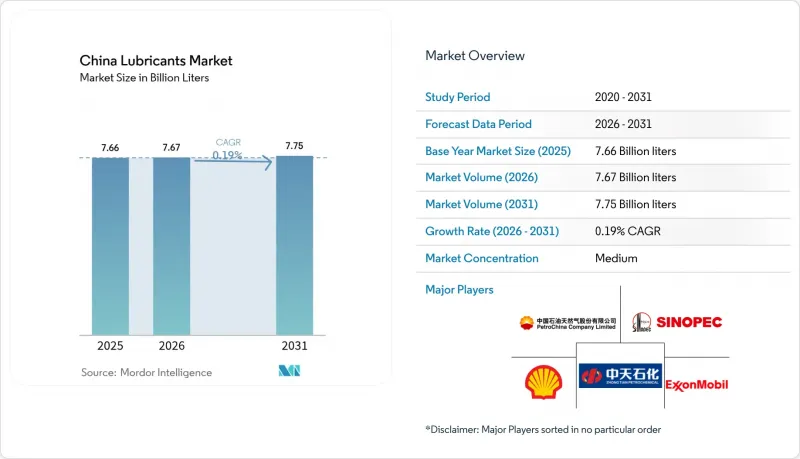
據 Mordor Intelligence 稱,2025 年中國潤滑油市值為 76.6 億公升,預計到 2031 年將達到 77.5 億公升,而 2026 年為 76.7 億公升,預測期(2026-2031 年)的複合年成長率為 0.19%。
本報告按產品類型(汽車引擎油、工業引擎油、變速箱油、齒輪油、煞車油、液壓油等)、終端用戶產業(汽車、船舶、航太、重型機械、工業)和基礎油類型(礦物油、合成油、半合成油、生物基油)進行細分。市場預測以體積(公升)為單位。
中國潤滑油市場趨勢與洞察
柴油卡車數量的恢復將穩定商用潤滑油的需求。
2025年初,隨著物流活動的正常化,註冊的重型柴油卡車數量增加,支撐了對高黏度引擎油和變速箱油的穩定需求。基礎設施項目導致2025年2月從新加坡進口的基礎油增加了15%,凸顯了建設活動與潤滑油消耗之間的正相關性。然而,液化天然氣(LNG)卡車在長途貨運中的應用降低了傳統柴油潤滑油的消耗量,因為燃氣引擎需要不同的配方和更長的換油週期。這種需求的轉變促使供應商開發適用於柴油和替代燃料動力系統的最佳化潤滑油。車主關注的是整體擁有成本,他們更傾向於使用合成油,因為合成油可以延長換油週期並減少停機時間。
恢復國內基礎油生產將減少對進口的依賴。
中油和中石化旗下的煉油廠已恢復其基礎油生產設施的運營,這些設施此前因故停產,停產時間從2020年持續到2022年。此舉降低了中國對新加坡和韓國進口基礎油的依賴。國產原油具有運作優勢,並縮短了本地調配企業的供應鏈。儘管到2024年煉油廠的平均運轉率降至75%,但由於原物料競爭的減少緩解了價格壓力,基礎油利潤率反而有所提高。供應穩定性的提升使中國調配企業能夠減少與進口庫存相關的營運資金需求。國內成本的降低可望提升中國基礎油在東南亞市場的競爭力,並開闢新的出口管道。
電動車的加速普及將減少對內燃機潤滑油的需求。
預計到2025年初,電池式電動車(BEV)將佔新車銷量的40%以上,每年每輛車將減少4-5公升機油的使用,導致汽油需求預測下調。 2024年成品油消費量下降1.7%,顯示市場結構性變化而非週期性下滑[SINOLUB.COM]。大型石油公司已採取措施,將加油站改造為具備電動車充電功能的混合能源中心,但僅靠這項改造無法彌補潤滑油銷售量的損失。汽油產量下降導致非汽車產業基礎油供應緊張,進而影響整個中國潤滑油市場的價格走勢。
細分市場分析
預計到2025年,汽車機油將佔中國潤滑油市場佔有率的45.05%,但隨著新能源汽車的普及,這一佔有率正在下降。變速箱油預計將以1.03%的複合年成長率成長,這主要得益於自動變速箱和專用電驅動橋油的廣泛應用。液壓油和潤滑脂廣泛應用於施工機械,並受益於基礎設施建設項目。煞車油在內燃機和電動車平台的需求均保持穩定,但由於更換週期延長,銷售量成長受到限制。齒輪油的需求主要來自礦業和重型機械產業,這些產業需要極壓產品。
電池驅動系統需要液壓油進行溫度控管和絕緣,而非引擎油,這導致產品組合轉向特種合成油方向。工業機油主要面向發電和船舶引擎,這些領域電氣化程度有限。加工油和金屬加工液與製造業產出密切相關,隨著中國工業產能的擴張,其市場呈現溫和成長。渦輪機油和變壓器油則受益於可再生能源設備的引入。這種不斷變化的產品系列表明,中國潤滑油市場的規模正在從萎縮的乘用車機油市場重新分配到利基工業和電動車潤滑油領域。
其他好處:
- Excel格式的市場預測(ME)表
- 3個月的分析師支持
目錄
第1章:引言
- 研究假設和市場定義
- 調查範圍
第2章:調查方法
第3章執行摘要
第4章 市場狀況
- 市場概覽
- 市場促進因素
- 新冠疫情後物流業柴油卡車保有量的復甦
- 國內基礎油項目已恢復生產,供應穩定性改善。
- 原廠設備製造商延長保固期,推高了對優質長效合成機油的需求。
- HDMO 和 PCMO 的電子商務通路爆炸性成長
- 「雙碳」政策的加速推進正在促進生物潤滑油的採用。
- 市場限制因素
- 電動車的快速普及降低了對內燃機引擎油的需求。
- 由於汽車製造商延長了換油週期,保養期間添加的燃油量減少了。
- 原油價格的劇烈波動給調和原油的利潤率帶來了壓力。
- 層出不窮的仿冒品正在削弱品牌自主定價的能力。
- 價值鏈分析
- 法律規範
- 終端用戶趨勢
- 汽車產業
- 製造業
- 發電業
- 波特五力模型
第5章 市場規模與成長預測
- 依產品類型
- 汽車引擎油
- 工業機油
- 變速箱油
- 齒輪油
- 煞車油
- 油壓
- 潤滑脂
- 加工油(包括橡膠加工油和白油)
- 金屬加工潤滑劑
- 渦輪機油
- 變壓器油
- 其他產品類型
- 按最終用戶行業分類
- 車
- 搭乘用車
- 商用車輛
- 摩托車
- 海上
- 航太
- 重型機械
- 建造
- 礦業
- 農業
- 產業
- 發電
- 冶金/金屬加工
- 紡織品
- 石油和天然氣
- 其他終端用戶產業
- 車
- 依基油類型
- 礦物油性潤滑劑
- 合成潤滑油
- 半合成潤滑油
- 生物性潤滑劑
第6章 競爭情勢
- 市場集中度
- 策略趨勢
- 市佔率** (%) / 排名分析
- 公司簡介
- PetroChina Company Limited
- Sinopec(China Petrochemical Corporation)
- Shell plc
- ExxonMobil Corporation
- BP plc(Castrol)
- TotalEnergies SE
- FUCHS SE
- Valvoline Global
- Idemitsu Kosan
- ENEOS Holdings
- JIANGSU LOPAL TECH CO. LTD
- Qingdao COPTON Technology Co. Ltd
- Jiangsu Gaoke Petrochemical Co. Ltd
- ZHONGTIAN PETROCHEMICAL
- Quaker Houghton
第7章 市場機會與未來展望
第8章:執行長面臨的關鍵策略挑戰
According to Mordor Intelligence, the China lubricants market size was valued at 7.66 billion liters in 2025 and estimated to grow from 7.67 billion liters in 2026 to reach 7.75 billion liters by 2031, at a CAGR of 0.19% during the forecast period (2026-2031).
This report is Segmented by Product Type (Automotive Engine Oil, Industrial Engine Oil, Transmission Fluids, Gear Oil, Brake Fluids, Hydraulic Fluids, and More), End-User Industry (Automotive, Marine, Aerospace, Heavy Equipment, Industrial), and Base Stock Type (Mineral Oil-Based, Synthetic, Semi-Synthetic, Bio-Based). The Market Forecasts are Provided in Terms of Volume (Liters).
China Lubricants Market Trends and Insights
Diesel-Truck Parc Recovery Stabilizes Commercial Lubricant Demand
Heavy-duty diesel truck registrations increased in early 2025 as logistics activity returned to normal, underpinning steady demand for high-viscosity engine oils and transmission fluids. Infrastructure projects increased base-oil imports from Singapore by 15% in February 2025, highlighting the positive correlation between construction activity and lubricant consumption. However, the adoption of LNG trucks in long-haul freight reduces conventional diesel lubricant volumes because gas engines require different formulations and longer service intervals. The resulting split encourages suppliers to develop fluids tailored for both diesel and alternative-fuel drivetrains. Fleet owners prioritize total cost of ownership, favoring synthetics that enable extended drains and reduced downtime.
Domestic Base-Oil Production Restart Reduces Import Dependency
Refineries owned by PetroChina and Sinopec restarted their base-oil units, which had been idle during 2020-2022, reducing their reliance on imports from Singapore and South Korea. Domestic crude feedstock offers cost advantages and shortens supply chains for local blenders. Average refinery utilization fell to 75% in 2024, which paradoxically improved base-oil margins because lower competition for feedstock eased price pressure. Enhanced supply stability enables Chinese blenders to reduce working-capital requirements associated with imported inventories. Lower domestic costs may make Chinese base oils competitive in Southeast Asia, opening new export avenues.
Electric Vehicle Adoption Accelerates ICE Lubricant Demand Destruction
Battery electric vehicles surpassed 40% of new car sales in early 2025, displacing annual engine oil consumption by 4-5 liters per vehicle and lowering gasoline demand projections. Refined-product consumption declined 1.7% in 2024, signaling a structural shift rather than a cyclical dip [SINOLUB.COM]. Oil majors responded by converting service stations into mixed-energy hubs with EV charging, but this pivot cannot replace lost lubricant volume. Reduced gasoline production also tightens base-oil supply for non-automotive segments, influencing price dynamics across the China lubricants market.
Other drivers and restraints analyzed in the detailed report include:
- OEM Warranty Extensions Accelerate Synthetic Lubricant Adoption
- E-Commerce Penetration Transforms Distribution While Enabling Counterfeits
- Extended Drain Intervals Compress Service Market Volumes
For complete list of drivers and restraints, kindly check the Table Of Contents.
Segment Analysis
Automotive engine oil held 45.05% of China lubricants market share in 2025, yet faces decline as NEV adoption rises. Transmission Fluids are forecast to grow at a 1.03% CAGR, helped by the wider adoption of automatic gearboxes and dedicated e-axle fluids. Hydraulic Fluids and Greases serve construction machinery, which benefits from infrastructure programs. Brake Fluids show stable demand across ICE and EV platforms, though longer intervals limit volume growth. Gear Oil gains from mining and heavy-duty equipment that require extreme-pressure formulations.
Battery-electric drivetrains require thermal management and dielectric fluids, rather than engine oil, shifting the product mix toward specialty synthetics. Industrial Engine Oil targets power generation and marine engines where electrification remains limited. Process Oils and Metalworking Fluids correlate with manufacturing output, posting moderate gains as China upgrades industrial capacity. Turbine and Transformer Oils benefit from renewable-energy installations. The evolving portfolio indicates how China's lubricants market size redistributes from declining passenger-car engine oils to niche industrial and electric-vehicle fluids.
Complete Report Scope:
- By Product Type
- Automotive Engine Oil
- Industrial Engine Oil
- Transmission Fluids
- Gear Oil
- Brake Fluids
- Hydraulic Fluids
- Greases
- Process Oil (Including Rubber Process Oil and White Oil)
- Metalworking Fluids
- Turbine Oil
- Transformer Oil
- Other Product Types
- By End-user Industry
- Automotive
- Passenger Vehicles
- Commercial Vehicles
- Two-Wheelers
- Marine
- Aerospace
- Heavy Equipment
- Construction
- Mining
- Agriculture
- Industrial
- Power Generation
- Metallurgy and Metalworking
- Textiles
- Oil and Gas
- Other End-Use Industries
- Automotive
- By Base Stock Type
- Mineral Oil-Based Lubricants
- Synthetic Lubricants
- Semi-Synthetic Lubricants
- Bio-Based Lubricants
List of Companies Covered in this Report:
- PetroChina Company Limited
- Sinopec (China Petrochemical Corporation)
- Shell plc
- ExxonMobil Corporation
- BP plc (Castrol)
- TotalEnergies SE
- FUCHS SE
- Valvoline Global
- Idemitsu Kosan
- ENEOS Holdings
- JIANGSU LOPAL TECH CO. LTD
- Qingdao COPTON Technology Co. Ltd
- Jiangsu Gaoke Petrochemical Co. Ltd
- ZHONGTIAN PETROCHEMICAL
- Quaker Houghton
Additional Benefits:
- The market estimate (ME) sheet in Excel format
- 3 months of analyst support
TABLE OF CONTENTS
1 Introduction
- 1.1 Study Assumptions and Market Definition
- 1.2 Scope of the Study
2 Research Methodology
3 Executive Summary
4 Market Landscape
- 4.1 Market Overview
- 4.2 Market Drivers
- 4.2.1 Diesel-truck parc rebound in post-COVID logistics
- 4.2.2 Restart of domestic base-oil projects improves supply stability
- 4.2.3 OEM warranty extension pushes demand for premium long-drain synthetics
- 4.2.4 Explosion of e-commerce channels for HDMO and PCMO
- 4.2.5 Accelerated "dual-carbon" policy drives bio-lube adoption
- 4.3 Market Restraints
- 4.3.1 Rapid BEV penetration shrinks ICE engine-oil pool
- 4.3.2 Longer OEM drain intervals cut service-fill volumes
- 4.3.3 Volatile crude swings squeeze blender margins
- 4.3.4 Persistent counterfeits undermine brand pricing power
- 4.4 Value Chain Analysis
- 4.5 Regulatory Framework
- 4.6 End-User Trends
- 4.6.1 Automotive Industry
- 4.6.2 Manufacturing Industry
- 4.6.3 Power Generation Industry
- 4.7 Porter's Five Forces
- 4.7.1 Bargaining Power of Suppliers
- 4.7.2 Bargaining Power of Buyers
- 4.7.3 Threat of New Entrants
- 4.7.4 Threat of Substitutes
- 4.7.5 Degree of Competition
5 Market Size and Growth Forecasts (Volume)
- 5.1 By Product Type
- 5.1.1 Automotive Engine Oil
- 5.1.2 Industrial Engine Oil
- 5.1.3 Transmission Fluids
- 5.1.4 Gear Oil
- 5.1.5 Brake Fluids
- 5.1.6 Hydraulic Fluids
- 5.1.7 Greases
- 5.1.8 Process Oil (Including Rubber Process Oil and White Oil)
- 5.1.9 Metalworking Fluids
- 5.1.10 Turbine Oil
- 5.1.11 Transformer Oil
- 5.1.12 Other Product Types
- 5.2 By End-user Industry
- 5.2.1 Automotive
- 5.2.1.1 Passenger Vehicles
- 5.2.1.2 Commercial Vehicles
- 5.2.1.3 Two-Wheelers
- 5.2.2 Marine
- 5.2.3 Aerospace
- 5.2.4 Heavy Equipment
- 5.2.4.1 Construction
- 5.2.4.2 Mining
- 5.2.4.3 Agriculture
- 5.2.5 Industrial
- 5.2.5.1 Power Generation
- 5.2.5.2 Metallurgy and Metalworking
- 5.2.5.3 Textiles
- 5.2.5.4 Oil and Gas
- 5.2.5.5 Other End-Use Industries
- 5.2.1 Automotive
- 5.3 By Base Stock Type
- 5.3.1 Mineral Oil-Based Lubricants
- 5.3.2 Synthetic Lubricants
- 5.3.3 Semi-Synthetic Lubricants
- 5.3.4 Bio-Based Lubricants
6 Competitive Landscape
- 6.1 Market Concentration
- 6.2 Strategic Moves
- 6.3 Market Share**(%)/Ranking Analysis
- 6.4 Company Profiles (includes Global level Overview, Market level overview, Core Segments, Financials as available, Strategic Information, Market Rank/Share, Products and Services, Recent Developments)
- 6.4.1 PetroChina Company Limited
- 6.4.2 Sinopec (China Petrochemical Corporation)
- 6.4.3 Shell plc
- 6.4.4 ExxonMobil Corporation
- 6.4.5 BP plc (Castrol)
- 6.4.6 TotalEnergies SE
- 6.4.7 FUCHS SE
- 6.4.8 Valvoline Global
- 6.4.9 Idemitsu Kosan
- 6.4.10 ENEOS Holdings
- 6.4.11 JIANGSU LOPAL TECH CO. LTD
- 6.4.12 Qingdao COPTON Technology Co. Ltd
- 6.4.13 Jiangsu Gaoke Petrochemical Co. Ltd
- 6.4.14 ZHONGTIAN PETROCHEMICAL
- 6.4.15 Quaker Houghton
7 Market Opportunities and Future Outlook
- 7.1 White-space and Unmet-need Assessment
8 Key Strategic Questions for CEOs

 北美潤滑油市場:市場佔有率分析、產業趨勢與統計、成長預測(2026-2031)防銹潤滑劑氣霧劑:市場佔有率分析、行業趨勢和統計數據以及成長預測(2026-2031 年)法國潤滑油市場:市場佔有率分析、產業趨勢與統計及成長預測(2026-2031)
 2026-2030年全球潤滑油市場印尼潤滑油市場:市場佔有率分析、產業趨勢與統計、成長預測(2026-2031)印度潤滑油市場:市場佔有率分析、產業趨勢與統計、成長預測(2026-2031)英國潤滑油市場:市場佔有率分析、產業趨勢與統計及成長預測(2026-2031)越南潤滑油市場:市場佔有率分析、產業趨勢與統計、成長預測(2026-2031)非洲潤滑油市場:市場佔有率分析、產業趨勢與統計、成長預測(2026-2031)馬來西亞潤滑油市場:市場佔有率分析、產業趨勢與統計、成長預測(2026-2031)