


 |
市場調查報告書
商品編碼
2117315
法國潤滑油市場:市場佔有率分析、產業趨勢與統計及成長預測(2026-2031)France Lubricants - Market Share Analysis, Industry Trends & Statistics, Growth Forecasts (2026 - 2031) |
||||||

※ 本網頁內容可能與最新版本有所差異。詳細情況請與我們聯繫。
根據 Mordor Intelligence 的數據,2025 年法國潤滑油市值為 5.2784 億公升,預計從 2026 年的 5.2526 億公升成長到 2031 年的 5.1247 億公升,預測期(2026-2031 年)的複合成長率為 -0.49%。
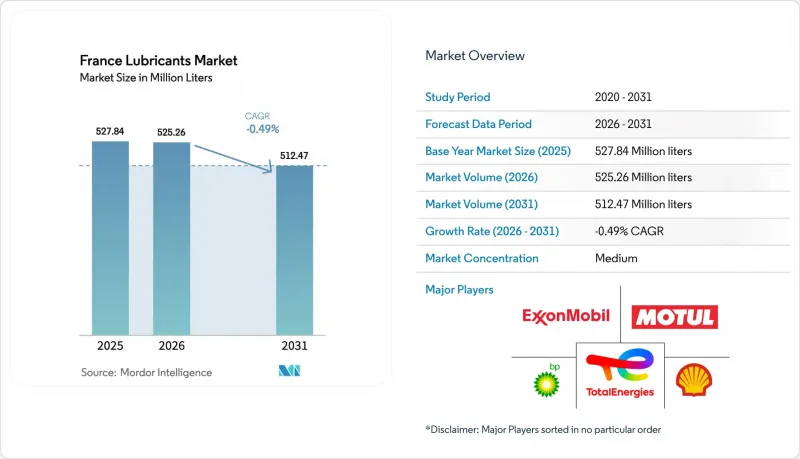
本報告按產品類型(汽車引擎油、工業引擎油、變速箱油、齒輪油、煞車油、液壓油、潤滑脂、渦輪機油等)、終端用戶產業(汽車、重型機械、航太、工業等)和基礎油類型(礦物油基潤滑油、半合成潤滑油等)分類。市場預測以銷售量(公升)為單位。
法國潤滑油市場趨勢與洞察
更嚴格的歐7排放氣體法規正在加速高性能合成潤滑油的普及。
將於2025年生效的歐7排放標準對硫酸鹽灰分、磷和硫的含量設定了閾值,而傳統礦物油無法滿足這些標準,這導致市場對低SAPS(硫酸鹽灰分、磷和硫)的合成或半合成潤滑油的需求日益成長。道達爾能源於2024年推出了Quartz EV3R系列產品,在滿足OEM(原廠設備製造商)規定的3萬公里換油週期目標的同時,碳排放量減少了35%。法國汽車製造商已將其出廠加註的潤滑油規格切換至符合歐盟7標準的等級,進一步鞏固了合成潤滑油的長期優勢。未在其產品線中提供經認證產品的經銷商,可能會被排除在經銷商網路內的保固相關權益之外。因此,由於重新使用礦物油將違反相關法規,合成潤滑油在法國潤滑油市場的佔有率正在結構性地擴大。
新冠疫情後法國車輛擁有量及行駛里程增加
到2024年,法國道路上的可充電車輛數量將超過200萬輛,比2022年增加40%。然而,由於供不應求,車主推遲了更換,傳統內燃機(ICE)車輛的數量也持續增加。根據法國國家統計與經濟研究所(INSEE)的交通指標,總行駛里程已恢復到疫情前水平,商業交通量比2019年成長了8%。這推動了都市區配送車輛對高黏度機油的需求。到2024年,法國車輛的平均車齡將達到10.2年,這將導致與維護相關的潤滑油消耗增加。在巴黎和里昂周邊的大型車隊中,更長的怠速熄火週期加速了機油氧化,從而增加了對具有卓越添加劑保留能力的高級合成機油的需求。整體而言,推動法國潤滑油市場銷售量的因素是每運作小時的消耗量,而不是車隊規模。
預計從2024年起,國內汽車產量下滑的趨勢將持續。
2024年,法國乘用車產量下降了18%。這是由於製造商將生產系統轉向電池車型,導致原廠磨合油的需求減少。 Stellantis公司將部分組裝轉移到海外,減少了用於機械加工和零件清洗的本地工業潤滑油的使用。銷量下降對潤滑油總量的影響更大,因為純電動車(EV)所需的潤滑油量比內燃機(ICE)汽車少約70%。索肖和米盧斯工廠的裁員對整個供應鏈產生了連鎖反應,減少了對專用工藝油的短期訂單。因此,在電動車銷量趨於穩定且電動車專用潤滑油產量擴大之前,法國潤滑油市場短期內將面臨不利局面。
細分市場分析
預計到2025年,汽車機油將佔法國潤滑油市場總需求的36.74%。同時,受法國延長核子反應爐壽命和加速離岸風力發電部署的推動,渦輪機油預計將以2.05%的複合年成長率實現最高成長。實際上,在高溫和小間隙運作的新一代渦輪機組中,合成油正逐漸佔據主導地位。由於再生煞車系統的引入導致液壓煞車的運作循環次數減少,煞車油的出貨量正在下降。然而,隨著建築電氣設備行業的成長,可生物分解液壓油的使用量正在增加。在可再生能源和物流行業的成長支撐下,風力發電機齒輪箱和重型卡車的齒輪油需求保持穩定。白油和加工油供應橡膠、塑膠和個人護理行業,形成了一個穩定但盈利的細分市場。空中巴士圖盧茲工廠對金屬加工液的需求正在逐步成長。該廠A320的加工量不斷成長,因此需要一種潤滑性高、發泡少的冷卻液。整體而言,產品組合偏向高性能、小批量生產的特殊產品,凸顯了法國潤滑油市場如何最佳化每公升產品的價值。
符合歐盟7排放標準的機油普及速度正在加快,預計到2025年,至少30%的工廠填充需求將轉向低SAPS(硫磷灰石)合成油。變速箱油的需求受益於強制延長換油週期,在該領域,OEM(原始設備製造商)的認證將決定供應商的准入資格。同時,變壓器油的需求與整合陸上可再生能源的電網強化項目密切相關。總體而言,渦輪機油的強勁表現和專業細分市場的需求在一定程度上抵消了主流機油面臨的結構性不利因素,法國潤滑油市場在應用領域保持多樣性。
其他好處:
- Excel格式的市場預測(ME)表
- 3個月的分析師支持
目錄
第1章:引言
- 研究假設和市場定義
- 調查範圍
第2章:調查方法
第3章執行摘要
第4章 市場狀況
- 市場概覽
- 市場促進因素
- 更嚴格的歐7排放氣體法規正在加速高性能合成油的普及。
- 新冠疫情後法國汽車擁有量及行駛里程增加
- 原廠設備製造商強制要求延長換油週期。
- 內河航運船隊的電氣化正在推動可生物分解液壓油的需求。
- 法國核能艦隊的維修週期推高了對專用齒輪油和渦輪機油的需求。
- 市場限制因素
- 自2024年起,國內汽車產量預計將在較長一段時間內放緩。
- 原油價格波動推高了基礎油成本。
- 法國蒸汽裂解裝置和I類生產線的停產導致原料供應短缺。
- 歐盟分類永續法規增加了中小攪拌機的合規成本。
- 價值鏈分析
- 法律規範
- 終端用戶趨勢
- 汽車產業
- 製造業
- 波特五力模型
第5章 市場規模與成長預測
- 依產品類型
- 汽車引擎油
- 工業機油
- 變速箱油
- 齒輪油
- 煞車油
- 油壓
- 潤滑脂
- 加工油(包括橡膠加工油和白油)
- 金屬加工用潤滑液
- 渦輪機油
- 變壓器油
- 其他產品類型
- 按最終用戶行業分類
- 車
- 搭乘用車
- 商用車輛
- 摩托車
- 海上
- 航太
- 重型機械
- 建造
- 礦業
- 農業
- 產業
- 發電
- 冶金/金屬加工
- 紡織品
- 石油和天然氣
- 其他終端用戶產業
- 車
- 依基油類型
- 礦物油性潤滑劑
- 合成潤滑油
- 半合成潤滑油
- 生物性潤滑劑
第6章 競爭情勢
- 市場集中度
- 策略趨勢
- 市佔率** (%) / 排名分析
- 公司簡介
- TotalEnergies
- Shell plc
- BP plc
- Exxon Mobil Corporation
- Motul
- FUCHS SE
- LIQUI MOLY GmbH
- Valvoline Inc.
- Chevron Corporation
- Eni SpA
- Repsol SA
- Bardahl Manufacturing Corporation
第7章 市場機會與未來展望
第8章:執行長應考慮的關鍵策略問題
According to Mordor Intelligence, the France lubricants market size was valued at 527.84 million liters in 2025 and estimated to grow from 525.26 million liters in 2026 to reach 512.47 million liters by 2031, at a CAGR of -0.49% during the forecast period (2026-2031).
This report is Segmented by Product Type (Automotive Engine Oil, Industrial Engine Oil, Transmission Fluids, Gear Oil, Brake Fluids, Hydraulic Fluids, Greases, Turbine Oil, and More), End-User Industry (Automotive, Heavy Equipment, Aerospace, Industrial, and More), and Base Stock Type (Mineral Oil-Based Lubricants, Semi-Synthetic Lubricants, and More). The Market Forecasts are Provided in Terms of Volume (Liters).
France Lubricants Market Trends and Insights
Stricter Euro-7 Emission Limits Accelerating Adoption of High-Performance Synthetics
Euro-7 rules in force from 2025 impose sulfated-ash, phosphorus, and sulfur thresholds that conventional mineral oils cannot meet, locking in demand for synthetic or semi-synthetic low-SAPS blends. TotalEnergies introduced its Quartz EV3R range in 2024, reducing carbon footprints by 35% while meeting OEM drain interval targets of 30,000 km. French assemblers have already shifted factory-fill specifications to Euro-7-compliant grades, cementing a permanent advantage for synthetics. Distributors that fail to list approved products risk being excluded from warranty-related benefits within dealership networks. The France lubricants market, therefore, sees synthetics gaining structural share as reverting to mineral alternatives would breach compliance.
Rising French Vehicle-Parc and Vehicle-Kilometers Post-COVID
More than 2 million rechargeable vehicles were on French roads by 2024, up 40% from 2022; yet the legacy ICE parc continued to grow as owners delayed replacements amid supply shortages. INSEE traffic indicators show that total vehicle-kilometers are back at pre-pandemic highs, and commercial traffic is up 8% compared to 2019, fueling the consumption of high-viscosity engine oils for urban delivery fleets. The national average vehicle age reached 10.2 years in 2024, resulting in increased maintenance-related lubricant throughput. Heavy-duty fleets stationed around Paris and Lyon operate extended idle-stop cycles, which accelerate oil oxidation, thereby reinforcing demand for premium synthetics with robust additive retention. Altogether, operating-hour intensity rather than fleet size is sustaining lubricant volumes in the France lubricants market.
Prolonged Slowdown in Domestic Auto Production from 2024
French passenger-car output declined 18% in 2024 as manufacturers retooled for battery models, reducing factory-fill demand for break-in oils. Stellantis shifted selected assembly lines abroad, reducing local industrial lubricant use for machining and component washing. Because pure EVs need about 70% less lubricant than ICE vehicles, unit losses are amplified in volume terms. Job cuts in Sochaux and Mulhouse cascaded down the supply chain, resulting in reduced short-run orders for specialty process oils. The France lubricants market, therefore, faces near-term headwinds until EV volumes plateau and specialized EV fluids scale up.
Other drivers and restraints analyzed in the detailed report include:
- OEM-Mandated Extended Drain Intervals
- Electrification of Inland-Waterway Fleet Spurring Demand for Biodegradable Hydraulic Oils
- Crude-Price Volatility Inflating Base-Oil Costs
For complete list of drivers and restraints, kindly check the Table Of Contents.
Segment Analysis
The France lubricants market share for automotive engine oils reached 36.74% of total demand in 2025. Turbine oils, however, are projected to post the fastest 2.05% CAGR as France extends the lifetimes of its nuclear reactors and accelerates the roll-out of offshore wind. In commercial practice, synthetics dominate new-generation turbine units that operate at higher temperatures and tighter clearances. Brake-fluid volumes contract as regenerative systems reduce hydraulic-brake duty cycles, whereas biodegradable hydraulic oils increase in use with the growing electric construction equipment sector. Gear oils serving wind-turbine gearboxes and heavy-duty trucks maintain a stable demand, supported by the growth of renewables and logistics. White and process oils serve the rubber, plastics, and personal-care industries, delivering flat though profitable niches. Metal-working fluids gain incremental volumes at Airbus' Toulouse hub, where increased A320 machining requires high-lubricity, low-foaming coolants. Overall, the product mix tilts toward high-performance, low-volume specialties, underlining how the France lubricants market optimizes value per liter.
The adoption of Euro-7-ready engine oils is accelerating, with at least 30% of factory-fill demand expected to shift to low-SAPS synthetics by 2025. Transmission-fluid demand benefits from extended-drain mandates, an area where OEM approvals dictate supplier access. Meanwhile, demand for transformer oils aligns with grid-reinforcement projects that integrate onshore renewables. Altogether, turbine-oil momentum and specialty niches partially offset structural headwinds in mainstream engine oils, keeping the France lubricants market diversified across applications.
Complete Report Scope:
- By Product Type
- Automotive Engine Oil
- Industrial Engine Oil
- Transmission Fluids
- Gear Oil
- Brake Fluids
- Hydraulic Fluids
- Greases
- Process Oil (Including Rubber Process Oil and White Oil)
- Metalworking Fluids
- Turbine Oil
- Transformer Oil
- Other Product Types
- By End-user Industry
- Automotive
- Passenger Vehicles
- Commercial Vehicles
- Two-Wheelers
- Marine
- Aerospace
- Heavy Equipment
- Construction
- Mining
- Agriculture
- Industrial
- Power Generation
- Metallurgy and Metalworking
- Textiles
- Oil and Gas
- Other End-Use Industries
- Automotive
- By Base Stock Type
- Mineral Oil-Based Lubricants
- Synthetic Lubricants
- Semi-Synthetic Lubricants
- Bio-Based Lubricants
List of Companies Covered in this Report:
- TotalEnergies
- Shell plc
- BP p.l.c.
- Exxon Mobil Corporation
- Motul
- FUCHS SE
- LIQUI MOLY GmbH
- Valvoline Inc.
- Chevron Corporation
- Eni S.p.A.
- Repsol S.A.
- Bardahl Manufacturing Corporation
Additional Benefits:
- The market estimate (ME) sheet in Excel format
- 3 months of analyst support
TABLE OF CONTENTS
1 Introduction
- 1.1 Study Assumptions and Market Definition
- 1.2 Scope of the Study
2 Research Methodology
3 Executive Summary
4 Market Landscape
- 4.1 Market Overview
- 4.2 Market Drivers
- 4.2.1 Stricter Euro-7 emission limits accelerating adoption of high-performance synthetics
- 4.2.2 Rising French vehicle-parc and vehicle-kilometres post-COVID
- 4.2.3 OEM-mandated extended drain intervals
- 4.2.4 Electrification of inland-waterway fleet spurring demand for biodegradable hydraulic oils
- 4.2.5 Maintenance cycle for France's nuclear-submarine fleet boosting specialty gear and turbine oils
- 4.3 Market Restraints
- 4.3.1 Prolonged slowdown in domestic auto production from 2024
- 4.3.2 Crude-price volatility inflating base-oil costs
- 4.3.3 Closure of French steam-cracker and Group-I lines tightening feed-stock supply
- 4.3.4 EU-taxonomy sustainability rules raising compliance costs for SME blenders
- 4.4 Value Chain Analysis
- 4.5 Regulatory Framework
- 4.6 End-User Trends
- 4.6.1 Automotive Industry
- 4.6.2 Manufacturing Industry
- 4.7 Porter's Five Forces
- 4.7.1 Bargaining Power of Suppliers
- 4.7.2 Bargaining Power of Buyers
- 4.7.3 Threat of New Entrants
- 4.7.4 Threat of Substitutes
- 4.7.5 Degree of Competition
5 Market Size and Growth Forecasts (Volume)
- 5.1 By Product Type
- 5.1.1 Automotive Engine Oil
- 5.1.2 Industrial Engine Oil
- 5.1.3 Transmission Fluids
- 5.1.4 Gear Oil
- 5.1.5 Brake Fluids
- 5.1.6 Hydraulic Fluids
- 5.1.7 Greases
- 5.1.8 Process Oil (Including Rubber Process Oil and White Oil)
- 5.1.9 Metalworking Fluids
- 5.1.10 Turbine Oil
- 5.1.11 Transformer Oil
- 5.1.12 Other Product Types
- 5.2 By End-user Industry
- 5.2.1 Automotive
- 5.2.1.1 Passenger Vehicles
- 5.2.1.2 Commercial Vehicles
- 5.2.1.3 Two-Wheelers
- 5.2.2 Marine
- 5.2.3 Aerospace
- 5.2.4 Heavy Equipment
- 5.2.4.1 Construction
- 5.2.4.2 Mining
- 5.2.4.3 Agriculture
- 5.2.5 Industrial
- 5.2.5.1 Power Generation
- 5.2.5.2 Metallurgy and Metalworking
- 5.2.5.3 Textiles
- 5.2.5.4 Oil and Gas
- 5.2.5.5 Other End-Use Industries
- 5.2.1 Automotive
- 5.3 By Base Stock Type
- 5.3.1 Mineral Oil-Based Lubricants
- 5.3.2 Synthetic Lubricants
- 5.3.3 Semi-Synthetic Lubricants
- 5.3.4 Bio-Based Lubricants
6 Competitive Landscape
- 6.1 Market Concentration
- 6.2 Strategic Moves
- 6.3 Market Share**(%)/Ranking Analysis
- 6.4 Company Profiles (includes Global level Overview, Market level overview, Core Segments, Financials as available, Strategic Information, Market Rank/Share, Products and Services, Recent Developments)
- 6.4.1 TotalEnergies
- 6.4.2 Shell plc
- 6.4.3 BP p.l.c.
- 6.4.4 Exxon Mobil Corporation
- 6.4.5 Motul
- 6.4.6 FUCHS SE
- 6.4.7 LIQUI MOLY GmbH
- 6.4.8 Valvoline Inc.
- 6.4.9 Chevron Corporation
- 6.4.10 Eni S.p.A.
- 6.4.11 Repsol S.A.
- 6.4.12 Bardahl Manufacturing Corporation
7 Market Opportunities and Future Outlook
- 7.1 White-space and Unmet-need Assessment
8 Key Strategic Questions for CEOs

 北美潤滑油市場:市場佔有率分析、產業趨勢與統計、成長預測(2026-2031)防銹潤滑劑氣霧劑:市場佔有率分析、行業趨勢和統計數據以及成長預測(2026-2031 年)
 2026-2030年全球潤滑油市場中國潤滑油市場:市場佔有率分析、產業趨勢與統計、成長預測(2026-2031年)印尼潤滑油市場:市場佔有率分析、產業趨勢與統計、成長預測(2026-2031)印度潤滑油市場:市場佔有率分析、產業趨勢與統計、成長預測(2026-2031)英國潤滑油市場:市場佔有率分析、產業趨勢與統計及成長預測(2026-2031)越南潤滑油市場:市場佔有率分析、產業趨勢與統計、成長預測(2026-2031)非洲潤滑油市場:市場佔有率分析、產業趨勢與統計、成長預測(2026-2031)馬來西亞潤滑油市場:市場佔有率分析、產業趨勢與統計、成長預測(2026-2031)