


 |
市場調查報告書
商品編碼
2116415
北美潤滑油市場:市場佔有率分析、產業趨勢與統計、成長預測(2026-2031)North America Lubricants - Market Share Analysis, Industry Trends & Statistics, Growth Forecasts (2026 - 2031) |
||||||

※ 本網頁內容可能與最新版本有所差異。詳細情況請與我們聯繫。
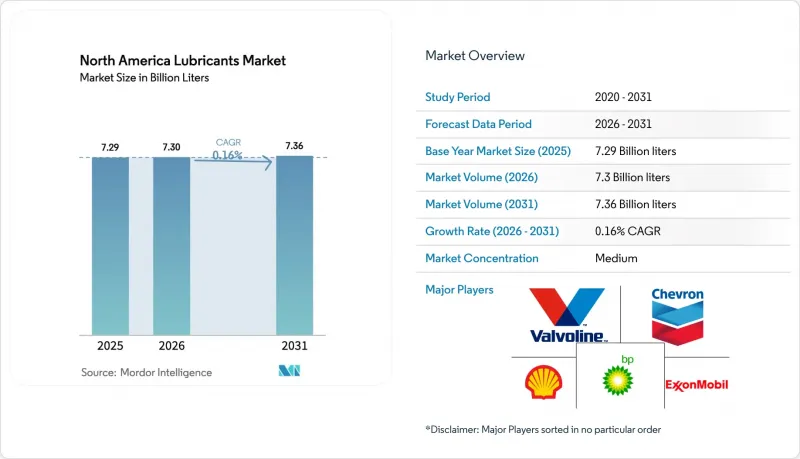
據 Mordor Intelligence 稱,2025 年北美潤滑油市場價值為 72.9 億公升,預計到 2031 年將達到 73.6 億公升,而 2026 年為 73 億公升,預測期(2026-2031 年)的複合年成長率為 0.16%。
本報告按產品類型(汽車引擎油、工業引擎油、變速箱油、齒輪油、煞車油、液壓油等)、終端用戶產業(汽車、航太、重型機械等)、基礎油類型(礦物油基、合成油等)和地區(美國、墨西哥、加拿大)進行細分。市場預測以銷售量(公升)為單位。
北美潤滑油市場趨勢與洞察
合成潤滑油的需求正在激增。
合成潤滑油在汽車和工業設備領域市場佔有率不斷成長,因為它們能夠減少停機時間、延長換油週期,從而提高資產利用率並降低生命週期成本。殼牌公司表示,超大規模資料中心營運商正在轉向使用其浸沒式冷卻液,以應對晶片級日益成長的熱負荷。美國石油學會 (API) 於 2024 年推出的 SQ 汽油機油類別要求使用熱穩定性合成基油,而計劃於 2025 年實施的 ILSAC GF-7 標準也在推動這一轉變。越來越多的原始設備製造商 (OEM) 保固條款指定使用合成潤滑油,這進一步增強了北美潤滑油市場對合成潤滑油的需求。擁有 III 類和 PAO 內部生產能力的製造商正在利用與優質礦物油之間日益縮小的價格差距。此外,熱效率的提高也有助於實現運輸和固定用引擎的脫碳目標。
工業生產的恢復
從2023年的低點回升後,建築、採礦和一般製造業正在推動液壓系統、變速箱和製作流程中潤滑油需求的成長。公共部門基礎設施支出刺激了對非公路機械的需求,這些機械需要低灰分液壓油以滿足最新的排放氣體法規。礦業公司傾向於使用合成潤滑脂,因為這種潤滑脂可以在高磨損環境下延長加油間隔。隨著汽車製造商轉向電池外殼和馬達生產線,工具升級換代的需求不斷增加,從而推動了對金屬加工液的需求。將生產轉移到墨西哥擴大了工廠潤滑油的需求,提振了北美潤滑油市場的中期前景。
原油和基礎油價格波動
美國墨西哥灣沿岸一級和二級煉油廠的關閉降低了供應柔軟性,並加劇了煉油廠計畫維護對公佈價格的影響。汽油需求的季節性激增迫使煉油商最大限度地提高燃料產量,導致基礎油供應緊張,並迫使獨立公司支付現貨溢價。大型綜合公司雖然能夠消化原料價格的波動,但如果布蘭特原油價差持續存在,它們會將成本轉嫁給下游企業。生物基基礎油的經濟效益取決於動物脂肪和廢棄食用油價格的波動,這使得採購計畫更加複雜。經銷商正在對庫存進行避險,但如果期貨價格走軟,他們將面臨持有高價庫存的風險,這將給整個北美潤滑油市場的短期利潤率帶來壓力。
細分市場分析
到2025年,汽車機油將佔北美潤滑油市場39.25%的佔有率。這主要歸功於輕型和重型車輛在車隊中的持續主導地位。該細分市場的銷售結構嚴重偏向合成油,合成油價格較高,因此能夠緩解銷售量逐步下降對收入的影響。工業機油雖然絕對銷售量(公升)較小,但其複合年成長率(CAGR)高達0.64%,主要得益於機械加工、發電和農業車輛等領域的現代化改造。變速箱油的需求呈現兩極化。傳統自動變速箱油的需求正在下降,而價格高昂、專為電力驅動設計的潤滑油則正在興起。齒輪油受益於礦業和風力發電機等對極壓性能要求極高的齒輪箱應用,而液壓油的需求則因基礎設施建設的擴張而增加,這些基礎設施建設對低毒性和阻燃等級的要求也隨之提高。
強勁的細分市場正在為北美潤滑油市場帶來平衡。潤滑脂在電動驅動軸承、風力發電機變槳系統以及需要NSF H1認證的食品加工設備領域中看到了機會。隨著汽車製造商加大對鋁製車身本體和電池外殼加工的資本投入,金屬加工液市場正在復甦。用於資料中心浸沒式冷卻的專用絕緣液目前佔總銷售量的不到1%,但正以兩位數的速度成長,這提升了高利潤複合產品的戰略價值。 OEM服務灌裝合約正在發揮客戶維繫機制的作用,而首次灌裝核准則是供應商競爭的關鍵領域。
其他好處:
- Excel格式的市場預測(ME)表
- 3個月的分析師支持
目錄
第1章:引言
- 研究假設和市場定義
- 調查範圍
第2章:調查方法
第3章執行摘要
第4章 市場狀況
- 市場概覽
- 市場促進因素
- 對高性能合成潤滑油的需求日益成長
- 建築業、採礦業和製造業的工業生產均有所復甦。
- 更嚴格的 CAFE 標準和 EPA 燃油經濟性法規正在推動對低黏度潤滑油的需求。
- 電子商務推動DIY售後市場通路的快速成長
- 資料中心採用介電浸沒式冷卻劑的比例正在迅速增加。
- 市場限制因素
- 原油和基礎油價格波動
- 電動車的加速普及導致對內燃機汽車和石油的需求下降。
- 對 PFAS 和微塑膠的嚴格監管正在威脅某些添加劑化學品。
- 價值鏈分析
- 法律規範
- 終端用戶趨勢
- 汽車產業
- 製造業
- 發電業
- 波特五力模型
第5章 市場規模與成長預測
- 依產品類型
- 汽車引擎油
- 工業機油
- 變速箱油
- 齒輪油
- 煞車油
- 油壓
- 潤滑脂
- 加工油(包括橡膠加工油和白油)
- 金屬加工用潤滑液
- 渦輪機油
- 變壓器油
- 其他產品類型
- 按最終用戶行業分類
- 車
- 搭乘用車
- 商用車輛
- 摩托車
- 海上
- 航太
- 重型機械
- 建造
- 礦業
- 農業
- 產業
- 發電
- 冶金與金屬加工
- 紡織品
- 石油和天然氣
- 其他終端用戶產業
- 車
- 依基礎油類型
- 礦物油性潤滑劑
- 合成潤滑油
- 半合成潤滑油
- 生物性潤滑劑
第6章 競爭情勢
- 市場集中度
- 策略趨勢
- 市佔率** (%) / 排名分析
- 公司簡介
- AMSOIL Inc.
- Bardahl
- BP plc
- Chevron Corporation
- CITGO Petroleum Lubricants
- Exxon Mobil Corporation
- FUCHS
- Idemitsu Lubricants America
- Kluber Lubrication
- Lucas Oil Products, Inc.
- Motul
- Petro-Canada Lubricants
- Phillips 66 Company
- Quaker Houghton
- Saudi Arabian Oil Co.
- Shell plc
- TotalEnergies
第7章 市場機會與未來展望
第8章:執行長面臨的關鍵策略挑戰
According to Mordor Intelligence, the North America lubricants market size was valued at 7.29 billion liters in 2025 and estimated to grow from 7.3 billion liters in 2026 to reach 7.36 billion liters by 2031, at a CAGR of 0.16% during the forecast period (2026-2031).
This report is Segmented by Product Type (Automotive Engine Oil, Industrial Engine Oil, Transmission Fluids, Gear Oil, Brake Fluids, Hydraulic Fluids, and More), End-User Industry (Automotive, Aerospace, Heavy Equipment, and More), Base Stock Type (Mineral Oil-Based, Synthetic, and More), and Geography (United States, Mexico, Canada). The Market Forecasts are Provided in Terms of Volume (Liters).
North America Lubricants Market Trends and Insights
Synthetic-Lubricant Demand Surge
Synthetic products earn a share across the automotive and industrial equipment sectors because they reduce downtime and extend oil-change intervals, which increases asset utilization and lowers lifecycle costs. Shell reports that hyperscale data-center operators are switching to its immersion-cooling fluids to handle rising chip-level heat loads. The American Petroleum Institute's SQ gasoline-engine oil category, introduced in 2024, requires thermally stable synthetic base stocks, and the ILSAC GF-7 standard slated for 2025 reinforces this shift. OEM warranty terms are increasingly specifying synthetic grades, thereby strengthening pull-through demand in the North American lubricants market. Producers with captive Group III and PAO capacity capitalize on narrowing price gaps versus premium mineral stocks. Greater thermal efficiency also supports decarbonization targets in transport and stationary engines.
Industrial Output Rebound
Construction, mining, and general manufacturing, which rebounded from the 2023 trough, bolsters lubricant consumption in hydraulic systems, gearboxes, and metalworking operations. Public-sector infrastructure outlays stimulate demand for off-highway machinery that relies on low-ash fluids, which are compatible with modern emission controls. Mining companies favor synthetic greases that lengthen relubrication intervals in abrasive environments. Metalworking-fluid uptake follows tooling upgrades as vehicle makers convert lines for battery housing and e-motor production. Mexico's nearshoring inflows magnify factory lubricant demand, lifting the medium-term outlook for the North American lubricants market.
Crude- and Base-Oil Price Volatility
Closures of Group I and Group II units on the U.S. Gulf Coast reduce supply flexibility and magnify the impact of refinery turnarounds on posted prices. Seasonal gasoline demand spikes incentivize refiners to maximize fuel output, tightening base-stock availability and forcing independents to pay spot premiums. Integrated majors absorb feedstock swings but pass costs downstream when Brent widths persist. Bio-based base-oil economics fluctuate with tallow and used-cooking-oil pricing, complicating procurement planning. Distributors hedge inventories yet risk carrying high-priced stocks when futures soften, weighing on near-term margins across the North American lubricants market.
Other drivers and restraints analyzed in the detailed report include:
- Tightening CAFE and EPA Rules
- Expansion of E-Commerce DIY Channels
- Electric-Vehicle Fleet Expansion
For complete list of drivers and restraints, kindly check the Table Of Contents.
Segment Analysis
Automotive engine oils accounted for 39.25% of the North American lubricants market size in 2025, as light-duty and heavy-duty vehicles continue to dominate the rolling stock. The subsegment's value mix tilts toward synthetics that command price premiums, softening the revenue impact of gradual volume decline. Industrial engine oils, although smaller in absolute liters, post the quickest 0.64% CAGR thanks to machinery modernization across metal-cutting, power generation, and agricultural fleets. Transmission-fluid demand shows a bifurcated path: conventional automatics decline, yet purpose-designed e-drive lubricants emerge, carrying a higher unit value. Gear oils benefit from mining and wind-turbine gearboxes that mandate extreme-pressure performance, and hydraulic fluids gain from infrastructure build-outs that specify low-toxicity, fire-resistant grades.
Resilient niche classes add balance to the North American lubricants market. Greases capture opportunities in electric drivetrain bearings, wind turbine pitch systems, and food-processing equipment requiring NSF H1 certification. Metalworking fluids rebound in step with automakers' tooling up for aluminum body-in-white and battery-case machining. Specialty dielectric fluids for data-center immersion cooling, although currently less than 1 % of total liters, grow at a double-digit pace and reinforce the strategic value of high-margin formulations. OEM service-fill contracts act as a lock-in mechanism, making first-fill approvals a critical battleground for suppliers.
Complete Report Scope:
- By Product Type
- Automotive Engine Oil
- Industrial Engine Oil
- Transmission Fluids
- Gear Oil
- Brake Fluids
- Hydraulic Fluids
- Greases
- Process Oil (Including Rubber Process Oil and White Oil)
- Metalworking Fluids
- Turbine Oil
- Transformer Oil
- Other Product Types
- By End-user Industry
- Automotive
- Passenger Vehicles
- Commercial Vehicles
- Two-Wheelers
- Marine
- Aerospace
- Heavy Equipment
- Construction
- Mining
- Agriculture
- Industrial
- Power Generation
- Metallurgy and Metalworking
- Textiles
- Oil and Gas
- Other End-Use Industries
- Automotive
- By Base Stock Type
- Mineral Oil-Based Lubricants
- Synthetic Lubricants
- Semi-Synthetic Lubricants
- Bio-Based Lubricants
List of Companies Covered in this Report:
- AMSOIL Inc.
- Bardahl
- BP p.l.c
- Chevron Corporation
- CITGO Petroleum Lubricants
- Exxon Mobil Corporation
- FUCHS
- Idemitsu Lubricants America
- Kluber Lubrication
- Lucas Oil Products, Inc.
- Motul
- Petro-Canada Lubricants
- Phillips 66 Company
- Quaker Houghton
- Saudi Arabian Oil Co.
- Shell plc
- TotalEnergies
Additional Benefits:
- The market estimate (ME) sheet in Excel format
- 3 months of analyst support
TABLE OF CONTENTS
1 Introduction
- 1.1 Study Assumptions & Market Definition
- 1.2 Scope of the Study
2 Research Methodology
3 Executive Summary
4 Market Landscape
- 4.1 Market Overview
- 4.2 Market Drivers
- 4.2.1 Rising demand for high-performance synthetic lubricants
- 4.2.2 Industrial output rebound across construction, mining and manufacturing
- 4.2.3 Stricter CAFE / EPA fuel-economy rules driving low-viscosity oils
- 4.2.4 Rapid growth of e-commerce DIY aftermarket channels
- 4.2.5 Surging adoption of dielectric immersion-cooling fluids in data centres
- 4.3 Market Restraints
- 4.3.1 Crude- and base-oil price volatility
- 4.3.2 Accelerating electric-vehicle parc lowers ICE-oil volumes
- 4.3.3 Tight PFAS and micro-plastics rules threatening some additive chemistries
- 4.4 Value Chain Analysis
- 4.5 Regulatory Framework
- 4.6 End-User Trends
- 4.6.1 Automotive Industry
- 4.6.2 Manufacturing Industry
- 4.6.3 Power Generation Industry
- 4.7 Porter's Five Forces
- 4.7.1 Bargaining Power of Suppliers
- 4.7.2 Bargaining Power of Buyers
- 4.7.3 Threat of New Entrants
- 4.7.4 Threat of Substitutes
- 4.7.5 Degree of Competition
5 Market Size and Growth Forecasts (Volume)
- 5.1 By Product Type
- 5.1.1 Automotive Engine Oil
- 5.1.2 Industrial Engine Oil
- 5.1.3 Transmission Fluids
- 5.1.4 Gear Oil
- 5.1.5 Brake Fluids
- 5.1.6 Hydraulic Fluids
- 5.1.7 Greases
- 5.1.8 Process Oil (Including Rubber Process Oil and White Oil)
- 5.1.9 Metalworking Fluids
- 5.1.10 Turbine Oil
- 5.1.11 Transformer Oil
- 5.1.12 Other Product Types
- 5.2 By End-user Industry
- 5.2.1 Automotive
- 5.2.1.1 Passenger Vehicles
- 5.2.1.2 Commercial Vehicles
- 5.2.1.3 Two-Wheelers
- 5.2.2 Marine
- 5.2.3 Aerospace
- 5.2.4 Heavy Equipment
- 5.2.4.1 Construction
- 5.2.4.2 Mining
- 5.2.4.3 Agriculture
- 5.2.5 Industrial
- 5.2.5.1 Power Generation
- 5.2.5.2 Metallurgy and Metalworking
- 5.2.5.3 Textiles
- 5.2.5.4 Oil and Gas
- 5.2.5.5 Other End-Use Industries
- 5.2.1 Automotive
- 5.3 By Base Stock Type
- 5.3.1 Mineral Oil-Based Lubricants
- 5.3.2 Synthetic Lubricants
- 5.3.3 Semi-Synthetic Lubricants
- 5.3.4 Bio-Based Lubricants
6 Competitive Landscape
- 6.1 Market Concentration
- 6.2 Strategic Moves
- 6.3 Market Share**(%)/Ranking Analysis
- 6.4 Company Profiles (includes Global level Overview, Market level overview, Core Segments, Financials as available, Strategic Information, Market Rank/Share, Products & Services, Recent Developments)
- 6.4.1 AMSOIL Inc.
- 6.4.2 Bardahl
- 6.4.3 BP p.l.c
- 6.4.4 Chevron Corporation
- 6.4.5 CITGO Petroleum Lubricants
- 6.4.6 Exxon Mobil Corporation
- 6.4.7 FUCHS
- 6.4.8 Idemitsu Lubricants America
- 6.4.9 Kluber Lubrication
- 6.4.10 Lucas Oil Products, Inc.
- 6.4.11 Motul
- 6.4.12 Petro-Canada Lubricants
- 6.4.13 Phillips 66 Company
- 6.4.14 Quaker Houghton
- 6.4.15 Saudi Arabian Oil Co.
- 6.4.16 Shell plc
- 6.4.17 TotalEnergies
7 Market Opportunities & Future Outlook
- 7.1 White-space and Unmet-Need Assessment
8 Key Strategic Questions for CEOs

 防銹潤滑劑氣霧劑:市場佔有率分析、行業趨勢和統計數據以及成長預測(2026-2031 年)法國潤滑油市場:市場佔有率分析、產業趨勢與統計及成長預測(2026-2031)
 2026-2030年全球潤滑油市場中國潤滑油市場:市場佔有率分析、產業趨勢與統計、成長預測(2026-2031年)印尼潤滑油市場:市場佔有率分析、產業趨勢與統計、成長預測(2026-2031)印度潤滑油市場:市場佔有率分析、產業趨勢與統計、成長預測(2026-2031)英國潤滑油市場:市場佔有率分析、產業趨勢與統計及成長預測(2026-2031)越南潤滑油市場:市場佔有率分析、產業趨勢與統計、成長預測(2026-2031)非洲潤滑油市場:市場佔有率分析、產業趨勢與統計、成長預測(2026-2031)馬來西亞潤滑油市場:市場佔有率分析、產業趨勢與統計、成長預測(2026-2031)