


 |
市場調查報告書
商品編碼
2116416
英國潤滑油市場:市場佔有率分析、產業趨勢與統計及成長預測(2026-2031)United Kingdom Lubricants - Market Share Analysis, Industry Trends & Statistics, Growth Forecasts (2026 - 2031) |
||||||

※ 本網頁內容可能與最新版本有所差異。詳細情況請與我們聯繫。
根據 Mordor Intelligence 估計,到 2026 年,英國潤滑油市場規模將達到 4.3301 億公升,高於 2025 年的 4.2278 億公升,預計到 2031 年將達到 4.8799 億公升。
預計從 2026 年到 2031 年,其複合年成長率將達到 2.42%。
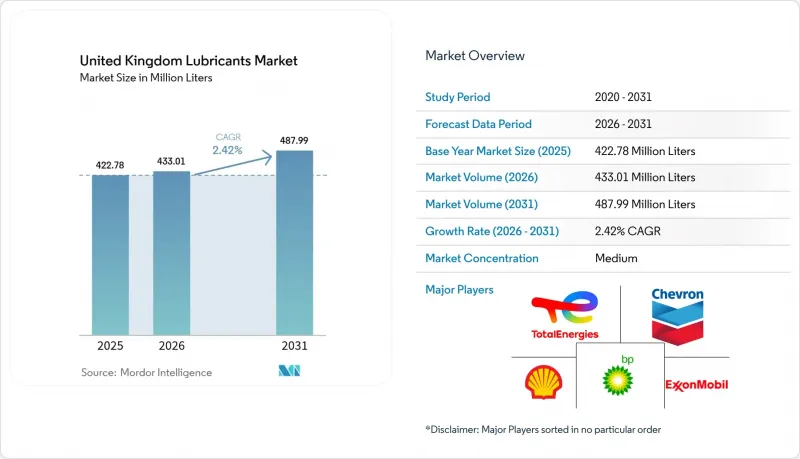
本報告按終端用戶行業(汽車、重型機械、金屬加工和冶金、發電及其他終端用戶行業)和產品類型(引擎油、變速箱油和齒輪油、液壓油、金屬加工液、潤滑脂及其他產品類型)進行細分。市場預測以銷售量(公升)為單位。
英國潤滑油市場趨勢與洞察
歐7排放氣體標準將促進優質合成機油的使用。
將於2025年實施的歐盟7排放標準將進一步收緊顆粒物和氮氧化物的閾值,使礦物油難以達到標準。因此,市場正轉向合成油,合成油具有更高的抗氧化性和更優異的低黏度油膜強度。現場數據顯示,合成潤滑油的使用壽命比礦物油長15-20%,雖然其標價更高,但可以減少停機時間和降低整體擁有成本。 2024年,英國商用車註冊量增加了8.2%,物流、建築和市政車輛對符合歐盟7標準的潤滑油的需求激增。擁有自有添加劑配方的供應商預計將獲得更高的利潤率,而傳統的礦物油生產商則正在退回到對價格敏感的傳統小眾市場。
製造業回流計畫正在提振對工業潤滑油的需求。
2024年,隨著企業將生產基地從亞洲遷至英國,國內產量增加了3.1%,帶動了金屬加工液、液壓油和NSF認證食品級潤滑油消費量的成長。政府計畫在2026年投入總計45億英鎊的激勵措施,重點扶持航太、電子和可再生能源設備產業,這些產業都存在大量的潤滑需求。在英格蘭中部和北部叢集,隨著新工廠全面投產,工業運作訂單激增25%至30%,這使得擁有技術服務團隊和響應迅速的倉庫的供應商獲得了顯著優勢。
電動車的普及正在蠶食傳統機油的需求。
2024年,電動車註冊量激增38%,達31.5萬輛,佔新車銷量的18.1%。這導致每輛車的機油需求量下降。車隊數據顯示,電動貨車的潤滑油用量比柴油車型減少60-70%,因為其動力系統已轉向採用密封軸承和冷卻液阻尼功能的電力電子設備。隨著2030年起禁止銷售新的內燃機汽車,儘管電動車專用溫度控管液不斷湧現,但機油的銷售量預計仍將持續下降。
細分市場分析
到2025年,汽車產業將佔英國潤滑油市場56.12%的佔有率,這反映了英國3,200萬輛汽車以及活躍的商用車車隊的規模。儘管隨著電氣化進程的推進,英國潤滑油市場中與汽車產業相關的市場規模預計將會放緩,但符合歐盟7排放標準的柴油貨車和輕型卡車的優質合成油仍能支撐其銷售和銷售額。大規模車隊營運商目前優先考慮延長換油週期和使用低SAP(硫酸鹽)配方,以滿足保固要求並降低整體擁有成本(TCO)。同時,使用植物來源原料的製造業回流正將潤滑油需求轉移到新建的超級工廠和食品加工生產線的重型機械,從而逐步縮小汽車行業的市場佔有率。
儘管發電業目前僅佔個位數佔有率,但隨著離岸風力發電裝置容量的擴張,預計將以2.85%的複合年成長率實現最高成長。渦輪機原始設備製造商(OEM)強制要求使用酯類增強型專用潤滑油和防水潤滑脂,從而將維護週期延長至七年,推動了高價銷售。施工機械、船舶和航太產業透過依賴油壓油、齒輪油和壓縮機油的各種機械配置來穩定基本負載需求。汽車零件供應商正在將研發預算重新分配到電動車的溫度控管油上,而工業專家則在投資現場服務團隊以支援電廠營運商,這表明收入集中度正逐漸從汽車產業分散到其他產業。
其他好處:
- Excel格式的市場預測(ME)表
- 3個月的分析師支持
目錄
第1章:引言
- 研究假設和市場定義
- 調查範圍
第2章:調查方法
第3章執行摘要
第4章 市場狀況
- 市場概覽
- 市場促進因素
- 英國的歐7排放標準/二氧化碳排放法規正在推動對優質合成油的需求。
- 製造業(如汽車、食品)的國內搬遷計劃
- 離岸風力發電的擴張需要長效渦輪潤滑脂。
- 在工廠引入基於物聯網的“潤滑油即服務”
- 與循環經濟相關的法規正在加速精煉基礎油的使用。
- 市場限制因素
- 電動車的快速普及導致機油銷售量下降。
- 原油和添加劑原料價格波動
- 英國基礎油煉製能力的下降增加了進口風險。
- 價值鏈分析
- 波特五力模型
- 分銷通路分析
第5章 市場規模與成長預測
- 按最終用戶行業分類
- 車
- 重型機械
- 金屬加工和冶金
- 發電
- 其他終端用戶產業
- 依產品類型
- 機油
- 變速箱油和齒輪油
- 油壓
- 金屬加工潤滑劑
- 潤滑脂
- 其他產品類型
第6章 競爭情勢
- 市場集中度
- 策略趨勢
- 市佔率和排名分析
- 公司簡介
- BP plc
- Chevron Corporation
- DriveTec
- Exol Lubricants Limited
- Exxon Mobil Corporation
- FUCHS
- Gazpromneft-Lubricants Ltd.
- Gulf Oil UK
- Kluber Lubrication
- Liqui Moly UK
- Metalube
- Millers Oils Ltd.
- Morris Lubricants
- Motul UK
- Shell plc
- TotalEnergies
- Valvoline Global Operations
第7章 市場機會與未來展望
According to Mordor Intelligence, the United Kingdom lubricants market size in 2026 is estimated at 433.01 Million Liters, growing from 2025 value of 422.78 Million Liters with 2031 projections showing 487.99 Million Liters, growing at 2.42% CAGR over 2026-2031.
This report is Segmented by End-User Industry (Automotive, Heavy Equipment, Metalworking and Metallurgy, Power Generation, and Other End-User Industries) and Product Type (Engine Oils, Transmission and Gear Oils, Hydraulic Fluids, Metalworking Fluids, Greases, and Other Product Types). The Market Forecasts are Provided in Terms of Volume (Liters).
United Kingdom Lubricants Market Trends and Insights
Euro 7 Emissions Standards Drive Premium Synthetic Adoption
Euro 7 rules, effective in 2025, impose tighter particulate and NOx thresholds that mineral oils struggle to meet, steering fleets toward synthetics with higher oxidation resistance and better low-viscosity film strength. Field data show that synthetics deliver 15-20% longer service life, reducing downtime and total ownership costs despite higher list prices. UK commercial-vehicle registrations climbed 8.2% in 2024, multiplying demand for Euro 7-grade lubricants in logistics, construction, and municipal fleets. Suppliers with proprietary additive packages enjoy margin upside, while legacy mineral producers retreat to price-sensitive legacy niches.
Manufacturing Reshoring Programmes Boost Industrial Lubricant Demand
Domestic output rose 3.1% in 2024 as firms relocated production from Asia, lifting consumption of metalworking fluids, hydraulic oils, and NSF-approved food-grade lubricants. Government incentives worth GBP 4.5 billion through 2026 target aerospace, electronics, and renewable-energy equipment, each rich in lubrication points. Midlands and Northern clusters report 25-30% spikes in industrial-fluid orders as greenfield plants ramp up, favoring suppliers with technical service teams and rapid-response warehouses.
Electric Vehicle Adoption Erodes Traditional Engine-Oil Demand
EV registrations surged 38% in 2024 to reach 315,000 units, accounting for 18.1% of new-car sales and reducing engine oil demand per vehicle. Fleet data indicate that electric vans reduce lubricant use by 60-70% compared to diesel models, as drivetrains shift to sealed bearings and coolant-damped power electronics. With a ban on new internal-combustion engine sales from 2030, engine oil volumes are expected to face permanent contraction despite the emergence of EV thermal-management fluids.
Other drivers and restraints analyzed in the detailed report include:
- Offshore Wind Expansion Creates Specialized Grease Market
- IoT Integration Transforms Lubrication Service Models
- Volatile Feedstock Costs Pressure Margin Sustainability
For complete list of drivers and restraints, kindly check the Table Of Contents.
Segment Analysis
The automotive segment accounted for 56.12% of the UK lubricants market in 2025, reflecting the nation's 32 million-vehicle parc and dense commercial fleet activity. The UK lubricants market size tied to the automotive sector is forecast to decelerate as electrification advances; yet, premium synthetics for Euro 7 diesel vans and light trucks continue to support both volume and value. Large fleet operators now prioritize longer drain intervals and warranty-compliant low-SAP formulations to lower the total cost of ownership. Meanwhile, plant-based manufacturing reshoring reallocates lubricant demand toward heavy equipment in new gigafactories and food-processing lines, gradually trimming the automotive share.
Power generation currently holds only a single-digit percentage but is expected to register the fastest 2.85% CAGR as offshore wind capacity scales. Turbine OEMs mandate tailored ester-enhanced fluids and water-resistant greases that can run for seven-year intervals between servicing, driving high-unit-value sales. Construction equipment, marine, and aerospace collectively stabilize base-load volumes through mixed machinery parks that rely on hydraulic, gear, and compressor oils. Automotive suppliers reposition R&D budgets toward EV thermal-management fluids, while industrial specialists invest in field-service teams to support power-plant operators, indicating a gradual dilution of vehicle-centric revenue concentration.
Complete Report Scope:
- By End-user Industry
- Automotive
- Heavy Equipment
- Metalworking and Metallurgy
- Power Generation
- Other End-user Industries
- By Product Type
- Engine Oils
- Transmission and Gear Oils
- Hydraulic Fluids
- Metalworking Fluids
- Greases
- Other Product Types
List of Companies Covered in this Report:
- BP p.l.c.
- Chevron Corporation
- DriveTec
- Exol Lubricants Limited
- Exxon Mobil Corporation
- FUCHS
- Gazpromneft - Lubricants Ltd.
- Gulf Oil UK
- Kluber Lubrication
- Liqui Moly UK
- Metalube
- Millers Oils Ltd.
- Morris Lubricants
- Motul UK
- Shell plc
- TotalEnergies
- Valvoline Global Operations
Additional Benefits:
- The market estimate (ME) sheet in Excel format
- 3 months of analyst support
TABLE OF CONTENTS
1 Introduction
- 1.1 Study Assumptions and Market Definition
- 1.2 Scope of the Study
2 Research Methodology
3 Executive Summary
4 Market Landscape
- 4.1 Market Overview
- 4.2 Market Drivers
- 4.2.1 Euro 7 / UK CO2-fleet rules spur premium synthetics
- 4.2.2 Manufacturing reshoring programmes (e.g., automotive, food)
- 4.2.3 Offshore-wind build-out needs long-life turbine greases
- 4.2.4 IoT-enabled "lube-as-a-service" adoption in factories
- 4.2.5 Circular-economy mandates accelerate re-refined base-oil use
- 4.3 Market Restraints
- 4.3.1 Accelerating electric-vehicle parc lowers engine-oil volumes
- 4.3.2 Volatile crude and additive feedstock prices
- 4.3.3 Shrinking UK base-oil refining capacity heightens import risk
- 4.4 Value Chain Analysis
- 4.5 Porter's Five Forces
- 4.5.1 Threat of New Entrants
- 4.5.2 Bargaining Power of Suppliers
- 4.5.3 Bargaining Power of Buyers
- 4.5.4 Threat of Substitutes
- 4.5.5 Competitive Rivalry
- 4.6 Distribution-Channel Analysis
5 Market Size and Growth Forecasts (Value)
- 5.1 By End-user Industry
- 5.1.1 Automotive
- 5.1.2 Heavy Equipment
- 5.1.3 Metalworking and Metallurgy
- 5.1.4 Power Generation
- 5.1.5 Other End-user Industries
- 5.2 By Product Type
- 5.2.1 Engine Oils
- 5.2.2 Transmission and Gear Oils
- 5.2.3 Hydraulic Fluids
- 5.2.4 Metalworking Fluids
- 5.2.5 Greases
- 5.2.6 Other Product Types
6 Competitive Landscape
- 6.1 Market Concentration
- 6.2 Strategic Moves
- 6.3 Market Share (%)/Ranking Analysis
- 6.4 Company Profiles (includes Global level Overview, Market level overview, Core Segments, Financials as available, Strategic Information, Market Rank/Share, Products and Services, Recent Developments)
- 6.4.1 BP p.l.c.
- 6.4.2 Chevron Corporation
- 6.4.3 DriveTec
- 6.4.4 Exol Lubricants Limited
- 6.4.5 Exxon Mobil Corporation
- 6.4.6 FUCHS
- 6.4.7 Gazpromneft - Lubricants Ltd.
- 6.4.8 Gulf Oil UK
- 6.4.9 Kluber Lubrication
- 6.4.10 Liqui Moly UK
- 6.4.11 Metalube
- 6.4.12 Millers Oils Ltd.
- 6.4.13 Morris Lubricants
- 6.4.14 Motul UK
- 6.4.15 Shell plc
- 6.4.16 TotalEnergies
- 6.4.17 Valvoline Global Operations
7 Market Opportunities and Future Outlook
- 7.1 White-Space and Unmet-Need Assessment

 北美潤滑油市場:市場佔有率分析、產業趨勢與統計、成長預測(2026-2031)防銹潤滑劑氣霧劑:市場佔有率分析、行業趨勢和統計數據以及成長預測(2026-2031 年)法國潤滑油市場:市場佔有率分析、產業趨勢與統計及成長預測(2026-2031)
 2026-2030年全球潤滑油市場中國潤滑油市場:市場佔有率分析、產業趨勢與統計、成長預測(2026-2031年)印尼潤滑油市場:市場佔有率分析、產業趨勢與統計、成長預測(2026-2031)印度潤滑油市場:市場佔有率分析、產業趨勢與統計、成長預測(2026-2031)越南潤滑油市場:市場佔有率分析、產業趨勢與統計、成長預測(2026-2031)非洲潤滑油市場:市場佔有率分析、產業趨勢與統計、成長預測(2026-2031)馬來西亞潤滑油市場:市場佔有率分析、產業趨勢與統計、成長預測(2026-2031)