


 |
市場調查報告書
商品編碼
2119361
防銹潤滑劑氣霧劑:市場佔有率分析、行業趨勢和統計數據以及成長預測(2026-2031 年)Rust Stop Lubricants Aerosol - Market Share Analysis, Industry Trends & Statistics, Growth Forecasts (2026 - 2031) |
||||||

※ 本網頁內容可能與最新版本有所差異。詳細情況請與我們聯繫。
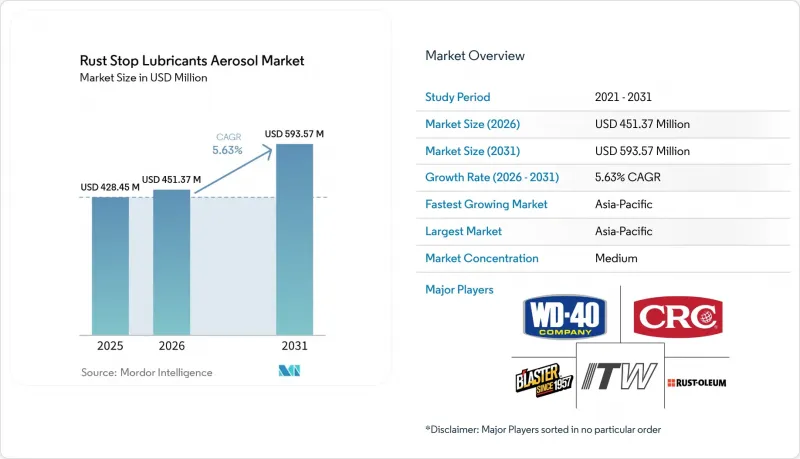
據 Mordor Intelligence 稱,2025 年防銹潤滑劑氣霧劑市值估計為 4.2845 億美元,預計到 2031 年將從 2026 年的 4.5137 億美元成長至 5.9357 億美元,2026 年至 2031 年的複合年成長率為 5.5.5.5.5. 的複合年成長率為 5.63%。
本報告按產品類型(例如,多用途潤滑劑、滲透潤滑劑)、終端用戶行業(例如,汽車、工業製造)和地區(亞太地區、北美地區、歐洲地區、南美地區、中東和非洲)進行細分。市場預測以貨幣價值(美元)表示。
全球防銹潤滑劑氣霧劑市場趨勢及洞察
預防性維護計畫正在擴大對氣霧潤滑劑的需求基礎。
預防性維護持續推動對氣霧潤滑劑的需求,因為在故障導致正常運作中斷之前,定期進行潤滑和防腐蝕工作至關重要。美國運輸部指出,腐蝕相關故障佔交通基礎設施維護成本的25%,因此防腐蝕是實際的維護重點。狀態監測計畫能夠在設備問題發展成重大故障之前及早發現它們,使氣霧局部潤滑成為設備操作人員的實用解決方案。這些計劃支援旨在最大限度減少意外停機時間、降低可避免中斷並促進潤滑和防腐蝕耗材定期採購的維護實踐。防銹潤滑劑氣霧劑市場正受惠於那些優先考慮小規模、頻繁干預而非大規模維修的計劃,這一趨勢在以設備運轉率指南的設施中尤為明顯。
汽車和工業領域的維修活動支持高頻消費。
汽車維修需求持續旺盛,因為舊式車輛在例行檢查中需要進行防銹處理和潤滑。獨立維修店、車隊服務中心以及負責處理腐蝕緊固件、接頭、鉸鏈、鏈條、管件和其他部件的維修部門,都為氣霧劑防銹潤滑劑市場提供了支援。隨著工業領域設備的升級,透過機器改造、機器人設備、精密組裝和輸送機系統,潤滑點數量不斷增加。這些都需要可靠的運作和金屬零件的保護,從而為氣霧劑耗材提供了廣泛的維護機會。美國職業安全與健康管理局 (OSHA) 的安全標準和美國環保署 (EPA) 的排放法規建議採用書面維護程序,使設施的日常維護更加規範和可追溯。這種情況促使人們頻繁購買氣霧劑防銹潤滑劑,用於計劃內的工作以及不定期的大規模維護項目。
遵守 VOC、易燃性和化學品法規的成本正在給化合物製造商的利潤率帶來壓力。
北美和歐洲的噴霧潤滑油製造商正面臨日益嚴格的監管,這些監管推高了配方、測試、報告和文件編制的成本。美國環保署 (EPA) 於 2025 年 1 月最終確定了《國家氣霧劑塗料揮發性有機化合物 (VOC) 排放標準》的修訂版,隨後將合規期限延長至 2027 年 1 月 17 日。加州也維持著自己的 VOC 排放要求,這進一步加重了在多個司法管轄區銷售齒輪、鏈條和滲透潤滑油的供應商的合規負擔。配方變更可能需要重新測試、更新安全資料表 (SDS)、產品註冊、零售商文件編制,以及應對不斷變化的化學品和危險品資訊溝通要求。對於規模小規模的製造商而言,由於監管專家數量有限、研發能力不足,以及難以將固定的合規成本分攤到廣泛的產品系列中,滿足這些要求可能極具挑戰性。因此,在防銹噴霧潤滑油市場,那些能夠承擔合規工作並繼續向專業人士和消費者提供可靠產品的供應商可能更具優勢。
細分市場分析
2025年,滲透型潤滑劑佔據了防銹潤滑劑氣霧劑市場43.28%的佔有率,這主要得益於維修店對卡死緊固件、鏈條和管件的常規使用。重複購買反映了汽車維修和MRO管道在所有地區的成熟採購習慣。預計到2031年,防銹和特殊潤滑劑將以6.48%的複合年成長率成長,因為用戶在船舶、可再生能源和戶外基礎設施應用領域對持久保護膜的需求日益成長。 「FUCHS CEPLATTYN 300 SPRAY」是一款用於風力發電機機齒輪的乾膜氣霧劑,它清楚地體現了在濕潤滑脂不適用的高負荷、多塵環境下的需求。隨著維修團隊選擇針對特定運作條件量身訂製的產品,特種應用防銹潤滑劑氣霧劑市場也從中受益。
多用途潤滑劑維持穩定的市場地位,仍是WD-40多用途產品等品牌的核心產品。儘管該品類已趨於成熟,但WD-40報告稱,2025會計年度該產品的淨銷售額仍達4.7796億美元。 「其他」類別包括用於電子組裝和食品加工環境的矽基、乾膜和防腐蝕潤滑劑。歐盟生態標章標準以及NSF International (NSF) H1和H2認證正在推動產品在永續性和食品接觸條件至關重要的應用領域的選擇。 2025年,CRC Industries推出了生物基動力潤滑劑,這是一款以植物油為基底、添加陶瓷的噴霧劑產品。本產品符合經濟合作暨發展組織 301B生物分解標準,體現了CRC Industries在防腐蝕潤滑劑噴霧劑產業對創新的重視。
區域分析
預計到2025年,亞太地區將佔據防銹潤滑劑氣霧劑市場36.50%的佔有率,並將在2031年實現6.87%的最高複合年成長率。中國憑藉其龐大的製造地支撐著該地區的生產,而印度的需求則主要來自鐵路擴建、施工機械維護以及蓬勃發展的汽車售後市場。日本和韓國則對適用於精密製造應用的乾膜型和特殊氣霧劑的需求做出了貢獻。印度在工業走廊和物流網路方面的基礎設施投資正在增加設備安裝量,並由此產生相關的維護需求。該地區成熟的汽車和製造群以及不斷擴展的維修網路也進一步支撐了市場規模。
北美和歐洲是高階配方和受法規主導的產品變更的關鍵市場。美國環保署 (EPA) 氣霧劑塗料法規的最後期限是 2027 年 1 月,促使供應商開發反應性較低的配方並準備相關文件。北美汽車和航太產業叢集正在推動對符合正規維護規範的特殊產品的需求。在德國,氣霧劑產品產量預計將從 2024 年的 9.32 億件增至 2025 年的 9.34 億件,其中防腐蝕塗料在 2025 年的成長率將達到 3%。
在南美洲,農業設備、海上油氣和建築維護等行業正在推動生產進一步成長。在巴西,儘管由於消費者購買力下降,2025年上半年氣霧罐的出貨量有所下降,但工業維護產品的需求並未受到消費者信心直接影響。中東和非洲受益於紅海和海灣走廊的油氣維護活動和海上作業。在沙烏地阿拉伯和南非,工程承包商正在開發維護、維修和營運 (MRO) 採購系統,從而支撐了區域需求。 2025年,B'laster 透過 Repco 拓展了澳洲和紐西蘭市場,展現了北美品牌如何擴大其在太平洋地區維修網路的覆蓋範圍。由於各國維修實務、環境暴露程度和經銷網路覆蓋範圍的差異,防銹潤滑劑氣霧劑市場在不同地區呈現不同的特徵。
其他好處:
- Excel格式的市場預測(ME)表
- 3個月的分析師支持
目錄
第1章:引言
- 研究假設和市場定義
- 調查範圍
第2章:調查方法
第3章執行摘要
第4章 市場狀況
- 市場概覽
- 市場促進因素
- 老舊設備的預防性維護
- 汽車和工業領域維修活動的擴展
- 對多功能滲透潤滑劑性能的需求
- 電子商務和數位採購的成長
- 在惡劣的海洋、沿海和戶外環境中防止腐蝕。
- 低揮發性有機化合物、生物基和更安全配方的創新。
- 市場限制因素
- 與遵守 VOC、易燃性和化學品法規相關的成本。
- 基礎油、溶劑、添加劑和推進劑的價格波動
- 氣溶膠的運輸、儲存和處置的限制
- 使用非氣霧劑產品、塗料和機械修復方法的替代方案。
- 價值鏈分析
- 波特五力分析
第5章 市場規模與成長預測
- 依產品類型
- 多用途潤滑劑
- 滲透潤滑劑
- 防銹劑和特殊潤滑劑
- 其他(矽基、乾膜、防腐蝕潤滑劑)
- 按最終用戶行業分類
- 車
- 工業製造
- 維護、修理和營運 (MRO)
- 其他(船舶、航太、施工機械、農業、家用和DIY)
- 按地區
- 亞太地區
- 中國
- 印度
- 日本
- 韓國
- 其他亞太國家
- 北美洲
- 美國
- 加拿大
- 墨西哥
- 歐洲
- 德國
- 英國
- 法國
- 義大利
- 其他歐洲國家
- 南美洲
- 巴西
- 阿根廷
- 其他南美國家
- 中東和非洲
- 沙烏地阿拉伯
- 南非
- 其他中東和非洲國家
- 亞太地區
第6章 競爭情勢
- 市場集中度
- 策略趨勢
- 市佔率和排名分析
- 公司簡介
- 3M
- American Polywater Corporation
- B'laster LLC
- Cortec Corporation
- CRC Industries
- Exxon Mobil Corporation
- FUCHS
- Illinois Tool Works Inc.
- Kano Laboratories LLC
- Lubrication Engineers
- Rust-Oleum Corporation
- Shell plc
- TotalEnergies
- WD-40 Company
- Zep Inc.
第7章 市場機會與未來展望
According to Mordor Intelligence, the rust stop lubricants aerosol market size is estimated at USD 428.45 million in 2025 and is estimated to grow from USD 451.37 million in 2026 to USD 593.57 million by 2031, at a CAGR of 5.63% during the forecast period (2026-2031).
This report is Segmented by Product Type (Multi-Purpose Lubricants, Penetrating Lubricants, and More), End-User Industry (Automotive, Industrial Manufacturing, and More), and Geography (Asia-Pacific, North America, Europe, South America, and Middle-East and Africa). The Market Forecasts are Provided in Terms of Value (USD).
Global Rust Stop Lubricants Aerosol Market Trends and Insights
Preventive Maintenance Programs Extend the Demand Base for Aerosol Lubricants
Preventive maintenance creates recurring demand for aerosol lubricants because scheduled lubrication and corrosion-control work occurs before failures disrupt normal operations. The U.S. Department of Transportation has linked corrosion-related failures to 25% of transportation infrastructure maintenance costs, making corrosion protection a practical maintenance priority. Condition-monitoring programs identify equipment issues at an early stage, before they develop into major failures, making aerosol spot lubrication a practical response for equipment operators. These programs support maintenance practices that limit unplanned downtime, reduce avoidable disruption, and encourage regular procurement of lubrication and corrosion-control consumables. The rust stop lubricants aerosol market benefits from programs that favor small, frequent interventions over large repair events, particularly in facilities where equipment availability guides maintenance decisions.
Automotive and Industrial Repair Activity Sustains High-Frequency Consumption
Automotive repair is a recurring source of demand because older vehicles require corrosion treatment and lubricant application during routine service. The rust stop lubricants aerosol market is supported by work on corroded fasteners, joints, hinges, chain links, and pipe fittings in independent workshops, fleet maintenance locations, and service departments. Industrial upgrades add lubrication points through machine retrofits, robotic equipment, precision assembly lines, and conveyor systems that require reliable movement and protection of metal components, providing a broad maintenance setting for aerosol consumables. OSHA safety practices and EPA emissions requirements encourage documented service procedures, which make routine facility maintenance more formal and traceable. These conditions support frequent purchases of rust stop lubricant aerosol products for planned work rather than only for infrequent bulk maintenance projects.
VOC, Flammability, and Chemical Compliance Costs Compress Formulator Margins
Aerosol lubricant producers in North America and Europe face regulations that raise formulation, testing, reporting, and documentation costs. The Environmental Protection Agency (EPA) finalized amendments to the National VOC Emission Standards for Aerosol Coatings in January 2025 and later extended the compliance date to January 17, 2027. California maintains separate VOC requirements, adding another layer of compliance for gear, chain, and penetrant lubricant suppliers selling across multiple jurisdictions. Reformulation can require retesting, updated safety data sheets, product registrations, retailer documentation, and alignment with changing chemical and hazard communication requirements. Smaller producers may find these requirements difficult to meet due to fewer regulatory specialists, less research capacity, and a limited ability to spread fixed compliance costs across a broad portfolio. The rust-stop lubricant aerosol market may therefore favor suppliers that can absorb compliance work while maintaining reliable products available to professional and retail customers.
Other drivers and restraints analyzed in the detailed report include:
- Multifunctional Penetrant-Lubricant Performance Reshapes Buyer Criteria
- E-Commerce and Digital Procurement Accelerate Access and Buyer Power
- Raw Material and Propellant Volatility Undermines Forward Planning
For complete list of drivers and restraints, kindly check the Table Of Contents.
Segment Analysis
Penetrating lubricants accounted for 43.28% of the rust stop lubricants aerosol market share in 2025, supported by regular workshop use for seized fasteners, chain links, and pipe fittings. Repeat sales reflect established buying habits in automotive repair and MRO channels across all regions. Rust prevention and specialty lubricants are projected to grow at a 6.48% CAGR through 2031, as users specify long-dwell protective films in marine, renewable energy, and outdoor infrastructure applications. FUCHS CEPLATTYN 300 SPRAY is a dry-film aerosol for wind-turbine gear teeth and illustrates demand in high-load, dust-exposed settings where wet greases are unsuitable. The rust stop lubricant aerosol market for specialized uses benefits when maintenance teams select products for specific operating conditions.
Multi-purpose lubricants retain a stable role and remain central to brands such as WD-40 Multi-Use Product. WD-40 Company reported USD 477.96 million in net sales for the product in fiscal year 2025, despite category maturity. The other category includes silicone-based, dry-film, and corrosion-inhibiting lubricants that serve electronics assembly and food processing environments. EU Ecolabel criteria and NSF International (NSF) H1 and H2 registrations support product selection where sustainability and food-contact conditions are relevant. CRC Industries introduced Bio-Based Power Lube in 2025 as a vegetable oil-based, ceramic-fortified aerosol with Organisation for Economic Co-operation and Development (OECD) 301B biodegradability compliance, illustrating the innovation focus within the rust stop lubricants aerosol industry.
Complete Report Scope:
- By Product Type
- Multi-Purpose Lubricants
- Penetrating Lubricants
- Rust Prevention and Specialty Lubricants
- Others (Silicone-Based, Dry Film, Corrosion Inhibitor Lubricants)
- By End-User Industry
- Automotive
- Industrial Manufacturing
- Maintenance, Repair and Operations (MRO)
- Others (Marine, Aerospace, Construction Equipment, Agriculture, Household and DIY)
- By Geography
- Asia-Pacific
- China
- India
- Japan
- South Korea
- Rest of Asia-Pacific
- North America
- United States
- Canada
- Mexico
- Europe
- Germany
- United Kingdom
- France
- Italy
- Rest of Europe
- South America
- Brazil
- Argentina
- Rest of South America
- Middle-East and Africa
- Saudi Arabia
- South Africa
- Rest of Middle-East and Africa
- Asia-Pacific
Geography Analysis
Asia-Pacific accounted for 36.50% of the rust stop lubricants aerosol market share in 2025 and is expected to post the fastest regional CAGR of 6.87% through 2031. China supports output through its large manufacturing base, while India adds demand from rail expansion, construction equipment maintenance, and a developing automotive aftermarket. Japan and South Korea contribute to demand for dry-film and specialty aerosols suited to precision manufacturing applications. Infrastructure investment in industrial corridors and logistics networks in India is increasing equipment deployment and creating subsequent maintenance needs. The regional market size is further supported by established vehicle and manufacturing clusters and expanding repair networks.
North America and Europe are important markets for premium formulations and regulatory-driven product changes. The Environmental Protection Agency (EPA) aerosol coatings rule has a January 2027 compliance date, prompting suppliers to develop lower-reactivity formulations and prepare related documentation. North American automotive and aerospace clusters support demand for specialty products aligned with formal maintenance practices. Germany produced 934 million aerosol units in 2025, up from 932 million in 2024, and corrosion-protection coatings posted 3% growth in 2025.
South America provides additional output through agribusiness equipment, offshore oil and gas, and construction maintenance. Brazil recorded weaker aerosol can deliveries in the first half of 2025 as consumer purchasing power declined, while demand for industrial maintenance products was less directly affected by consumer confidence. The Middle-East and Africa benefit from oil and gas maintenance activity and maritime operations through the Red Sea and Gulf corridors. Saudi Arabia and South Africa support regional demand as engineering contractors formalize Maintenance, Repair, and Operations (MRO) procurement. B'laster expanded into Australia and New Zealand through Repco in 2025, demonstrating how North American brands are broadening access to Pacific workshop networks. The rust stop lubricants aerosol market retains a varied regional profile, as repair practices, environmental exposure, and distribution coverage differ across countries.
- 3M
- American Polywater Corporation
- B'laster LLC
- Cortec Corporation
- CRC Industries
- Exxon Mobil Corporation
- FUCHS
- Illinois Tool Works Inc.
- Kano Laboratories LLC
- Lubrication Engineers
- Rust-Oleum Corporation
- Shell plc
- TotalEnergies
- WD-40 Company
- Zep Inc.
Additional Benefits:
- The market estimate (ME) sheet in Excel format
- 3 months of analyst support
TABLE OF CONTENTS
1 Introduction
- 1.1 Study Assumptions and Market Definition
- 1.2 Scope of the Study
2 Research Methodology
3 Executive Summary
4 Market Landscape
- 4.1 Market Overview
- 4.2 Market Drivers
- 4.2.1 Preventive Maintenance for Aging Equipment
- 4.2.2 Expansion of Automotive and Industrial Repair Activity
- 4.2.3 Demand for Multifunctional Penetrant-Lubricant Performance
- 4.2.4 Growth of E-Commerce and Digital Procurement
- 4.2.5 Corrosion Protection in Harsh Marine, Coastal, and Outdoor Environments
- 4.2.6 Low-VOC, Bio-Based, and Safer Formulation Innovation
- 4.3 Market Restraints
- 4.3.1 VOC, Flammability, and Chemical Compliance Costs
- 4.3.2 Volatile Base Oil, Solvent, Additive, and Propellant Costs
- 4.3.3 Aerosol Transport, Storage, and Disposal Constraints
- 4.3.4 Substitution by Non-Aerosol, Coating, and Mechanical Repair Methods
- 4.4 Value Chain Analysis
- 4.5 Porter's Five Forces Analysis
- 4.5.1 Threat of New Entrants
- 4.5.2 Bargaining Power of Suppliers
- 4.5.3 Bargaining Power of Buyers
- 4.5.4 Threat of Substitutes
- 4.5.5 Competitive Rivalry
5 Market Size and Growth Forecasts (Value)
- 5.1 By Product Type
- 5.1.1 Multi-Purpose Lubricants
- 5.1.2 Penetrating Lubricants
- 5.1.3 Rust Prevention and Specialty Lubricants
- 5.1.4 Others (Silicone-Based, Dry Film, Corrosion Inhibitor Lubricants)
- 5.2 By End-User Industry
- 5.2.1 Automotive
- 5.2.2 Industrial Manufacturing
- 5.2.3 Maintenance, Repair and Operations (MRO)
- 5.2.4 Others (Marine, Aerospace, Construction Equipment, Agriculture, Household and DIY)
- 5.3 By Geography
- 5.3.1 Asia-Pacific
- 5.3.1.1 China
- 5.3.1.2 India
- 5.3.1.3 Japan
- 5.3.1.4 South Korea
- 5.3.1.5 Rest of Asia-Pacific
- 5.3.2 North America
- 5.3.2.1 United States
- 5.3.2.2 Canada
- 5.3.2.3 Mexico
- 5.3.3 Europe
- 5.3.3.1 Germany
- 5.3.3.2 United Kingdom
- 5.3.3.3 France
- 5.3.3.4 Italy
- 5.3.3.5 Rest of Europe
- 5.3.4 South America
- 5.3.4.1 Brazil
- 5.3.4.2 Argentina
- 5.3.4.3 Rest of South America
- 5.3.5 Middle-East and Africa
- 5.3.5.1 Saudi Arabia
- 5.3.5.2 South Africa
- 5.3.5.3 Rest of Middle-East and Africa
- 5.3.1 Asia-Pacific
6 Competitive Landscape
- 6.1 Market Concentration
- 6.2 Strategic Moves
- 6.3 Market Share (%)/Ranking Analysis
- 6.4 Company Profiles (includes Global Overview, Market Overview, Core Segments, Financials as available, Strategic Information, Products and Services, and Recent Developments)
- 6.4.1 3M
- 6.4.2 American Polywater Corporation
- 6.4.3 B'laster LLC
- 6.4.4 Cortec Corporation
- 6.4.5 CRC Industries
- 6.4.6 Exxon Mobil Corporation
- 6.4.7 FUCHS
- 6.4.8 Illinois Tool Works Inc.
- 6.4.9 Kano Laboratories LLC
- 6.4.10 Lubrication Engineers
- 6.4.11 Rust-Oleum Corporation
- 6.4.12 Shell plc
- 6.4.13 TotalEnergies
- 6.4.14 WD-40 Company
- 6.4.15 Zep Inc.
7 Market Opportunities and Future Outlook
- 7.1 White-Space and Unmet-Need Assessment

 北美潤滑油市場:市場佔有率分析、產業趨勢與統計、成長預測(2026-2031)法國潤滑油市場:市場佔有率分析、產業趨勢與統計及成長預測(2026-2031)
 2026-2030年全球潤滑油市場中國潤滑油市場:市場佔有率分析、產業趨勢與統計、成長預測(2026-2031年)印尼潤滑油市場:市場佔有率分析、產業趨勢與統計、成長預測(2026-2031)印度潤滑油市場:市場佔有率分析、產業趨勢與統計、成長預測(2026-2031)英國潤滑油市場:市場佔有率分析、產業趨勢與統計及成長預測(2026-2031)越南潤滑油市場:市場佔有率分析、產業趨勢與統計、成長預測(2026-2031)非洲潤滑油市場:市場佔有率分析、產業趨勢與統計、成長預測(2026-2031)馬來西亞潤滑油市場:市場佔有率分析、產業趨勢與統計、成長預測(2026-2031)