


 |
市場調查報告書
商品編碼
2121833
全球塑膠包裝:市場佔有率分析、產業趨勢與統計及成長預測(2026-2031年)Global Plastic Packaging - Market Share Analysis, Industry Trends & Statistics, Growth Forecasts (2026 - 2031) |
||||||

※ 本網頁內容可能與最新版本有所差異。詳細情況請與我們聯繫。
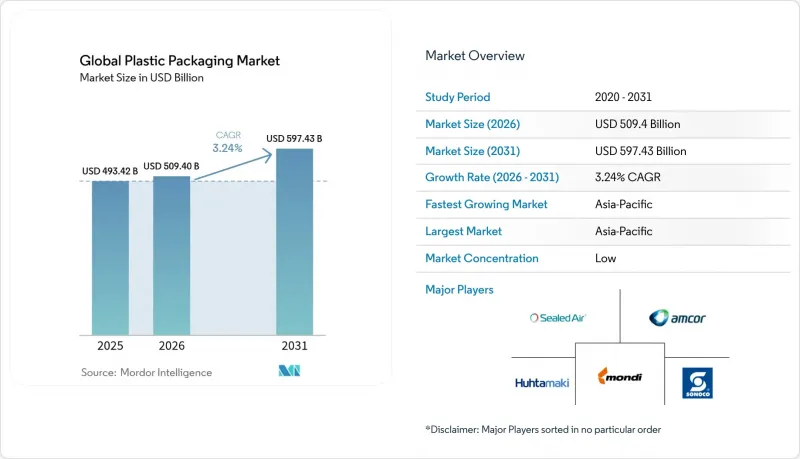
根據 Mordor Intelligence 估計,2026 年塑膠包裝市場規模將達到 5,094 億美元,高於 2025 年的 4,934.2 億美元,預計到 2031 年將達到 5,974.3 億美元。
預計從 2026 年到 2031 年,其複合年成長率將達到 3.24%。
本報告按包裝類型(硬質包裝、軟質包裝)、材料(聚乙烯、PET、聚丙烯、聚苯乙烯/EPS、PVC、其他)、終端用戶行業(食品、飲料、醫療/製藥、其他)、分銷管道(直銷、間接銷售)和地區進行細分。市場預測以美元計價。
全球塑膠包裝市場趨勢與洞察
電子商務的快速發展正在推動對耐用型末端物流包裝的需求。
在最後一公里配送模式中,包裹需要多次搬運並按體積重量收費,品牌商越來越傾向於使用薄膜、包裝袋和郵寄袋等包裝材料,因為與硬質材料相比,這些材料可以減少高達 75% 的空隙。亞馬遜的「無挫包裝」協議目前已覆蓋超過 30 萬個 SKU,成為事實上的行業標準,鼓勵中小型經銷商採用符合該標準的聚乙烯和聚丙烯包裝解決方案。自動化分類線需要能夠承受光學檢測的單一材料結構。複合包裝有分類拒收和成本高昂的返工風險。包裝體積減少 15% 可以降低 12% 的運費,足以抵消高性能軟性薄膜 8-10% 的額外材料成本。帶有阻隔塗層的軟性材料還能為電子產品和溫度敏感型藥品提供更佳的保護,從而將目標市場拓展到食品領域之外。
簡便食品和飲料的消費量正在激增。
都市化、家庭規模縮小以及工作時間延長正在推動人們對單份、常溫保存食品的需求。 2024年,都市區消費者加工食品消費量較去年成長8.2%,創歷史新高。多層軟性包裝兼具阻隔性,在保存期限和安全性方面均優於紙質包裝。飲料業的創新者們正在為包裝添加繫繩式瓶蓋和防篡改功能,以避免因違反監管規定而受到處罰,但這會使每件產品的製造成本增加0.02至0.04歐元。延長保存期限的包裝使乳製品和果汁品牌能夠將產品運送到沒有成熟冷鏈的農村地區,進一步鞏固了軟性包裝在新興市場的優勢。
全球禁止及課稅一次性塑膠製品
加州禁止塑膠袋、英國禁止濕紙巾以及南澳洲利亞的EPS(發泡聚苯乙烯)法規,實際上在一夜之間將整個產品類型從市場上清除出去。這些法規的執行包括進口限制和巨額罰款,迫使企業緊急重新設計產品並進行資本支出。提案塑膠袋禁令的學術研究估計,該禁令每週將造成34萬美元的稅收損失,凸顯了其深遠的經濟連鎖反應。跨國公司正努力應對不同司法管轄區對「一次性使用」的不同定義,這使得全球SKU的統一變得更加複雜。隨著立法者將範圍擴大到顯而易見的一次性產品之外,餐飲服務業和二次包裝形式也面臨更多量化風險。
細分市場分析
預計到2025年,軟包裝將佔銷售額的54.10%,預計以4.41%的年均成長率成長至2031年,顯示塑膠包裝市場的擴張速度遠超硬質包裝。燃油成本上漲和按體積重量計費的運費制度的實施,進一步加速了軟包裝向袋裝、郵寄包裝和薄膜包裝的轉變,這些包裝方式可以降低運輸物流成本。隨著加工商採用符合生產者延伸責任制(EPR)框架且不影響保存期限的單一材料方案,對薄膜和包裝的需求正在成長。雖然在貨架上結構和高階展示至關重要的場合,硬質瓶、罐和托盤仍然必不可少,但隨著可重複密封拉鍊、吸嘴和自立式包裝的出現,其市場佔有率正在逐漸下降,傳統功能優勢也隨之減弱。隨著品牌所有者精簡供應商,能夠同時提供軟包裝和硬質包裝的綜合供應商正在獲得更高的市場佔有率。
如果樹脂價格上漲超過成本轉嫁能力,硬質包裝細分市場的利潤率將面臨壓力,而軟包裝由於單位重量更輕,可以緩解這種影響。玻璃和金屬替代品仍然屬於小眾市場,僅限於飲料和罐頭食品領域。托盤製造商在餐飲服務業通路中保持著重要地位,因為可相容於烤箱和微波爐等功能可以帶來溢價。總體而言,軟包裝在銷售和成長率方面的主導地位鞏固了其在預測期內推動塑膠包裝市場發展的核心地位。
預計到2025年,聚乙烯將佔據塑膠包裝市場41.85%的佔有率,而聚丙烯則以5.55%的複合年成長率遙遙領先,成為成長最快的樹脂系列。聚丙烯具有高耐熱性、更高的透明度和卓越的密封強度,使其能夠實現單一材料解決方案,既能確保食品安全,又能滿足回收要求。聚對苯二甲酸乙二醇酯(PET)憑藉其成熟的瓶到瓶回收循環,在飲料領域保持著強勁的地位,但機械回收的局限性限制了再生材料的使用,除非進行成本高昂的化學回收能力提升。聚氯乙烯(PVC)、聚苯乙烯和其他苯乙烯基樹脂由於環境法規日益嚴格以及品牌商不願採用而正在失去市場佔有率,這為生物基和特種共聚物留下了利基市場。
從化學回收的經濟效益來看,具有穩定解聚通道的樹脂優勢更為顯著。因此,儘管PET和PP專案吸引了更多資本投資,但PS和PVC專案難以克服投資障礙。樹脂供應商正透過應用工程團隊來提升自身競爭力,這些團隊能夠指導加工商進行材料轉換,這項服務在不斷發展的生產者延伸責任制(EPR)和FDA食品接觸法規框架下備受重視。
區域分析
預計到2025年,亞太地區將佔全球銷售額的40.80%,年複合成長率達6.78%,成為塑膠包裝市場成長的不可忽視的驅動力。儘管中國佔據市場主導地位,但日益嚴格的廢棄物進口法規和對碳中和的承諾正迫使中國本土生產商投資回收能力。隨著有組織的零售和電子商務滲透率的提高,印度、越南和印尼的銷售也實現了兩位數的成長。由於外匯波動和地緣政治因素的影響,跨國品牌所有者正在將其採購來源多元化,轉向東協國家,以減少對單一國家的過度依賴。
在北美,受醫藥需求、生鮮食品物流以及先進回收設施發展等因素的推動,塑膠包裝市場呈現中個位數的穩定成長。各省對塑膠廢棄物的監管規定使情況變得複雜,但同時也為利用再生材料和單一材料進行創新的企業創造了機會。加拿大計劃在全國推廣生產者延伸責任制(EPR),這正在加速向可回收包裝的轉型,並促進跨境夥伴關係。
歐洲是生產者責任延伸制度(EPR)和碳排放總量控制法規的中心,雖然價值成長速度較慢,但對全球設計標準的影響卻舉足輕重。人事費用和能源成本的上漲推動了製程自動化和輕質樹脂的發展,同時監管機構也在提高再生材料含量標準,並鼓勵對化學回收利用進行投資。由於品牌商尋求成本低於西歐的地區作為生產接近性,東歐的加工商正在吸引回流項目,從而促進了資本流入波蘭和匈牙利。
儘管拉丁美洲、中東和非洲的市場佔有率落後於其他國家,但它們正經歷著快速的在局部擴張。巴西受益於需要阻隔性包裝的農產品和食品出口,而海灣合作理事會(GCC)則利用其石化產業的整合優勢,以具競爭力的價格出口樹脂。在非洲市場,禁止一次性產品的立法正在逐步推進,這為能夠以實惠的價格提供低克重、高阻隔阻隔性解決方案的軟包裝製造商創造了機會。
其他好處
- Excel格式的市場預測(ME)表
- 3個月的分析師支持
目錄
第1章:引言
- 研究假設和市場定義
- 調查範圍
第2章:調查方法
第3章執行摘要
第4章 市場狀況
- 市場概覽
- 市場促進因素
- 電子商務的快速發展正在推動對耐用型末端物流包裝的需求。
- 簡便食品和飲料的消費量正在激增。
- 相對於其他基材的成本競爭力
- 擴大化學回收基礎設施
- 向單材料薄膜過渡以符合EPR法規
- 由於歐盟「繫繩式瓶蓋」法規,特殊瓶蓋的數量增加。
- 市場限制因素
- 全球禁止及課稅一次性塑膠製品
- 石油基原物料價格波動
- 品牌所有者正在轉向紙質軟包裝。
- 可重複灌裝/再利用模式正在削弱銷售量成長。
- 供應鏈分析
- 監理展望
- 技術展望
- 波特五力分析
- 投資分析
第5章 市場規模與成長預測
- 按包裝類型
- 硬質包裝類型
- 瓶子罐
- 蓋子與封口裝置
- 托盤和容器
- 其他
- 軟性包裝類型
- 收納袋
- 薄膜包裝
- 其他
- 硬質包裝類型
- 材料
- 聚乙烯(HDPE、LDPE、LLDPE)
- 聚對苯二甲酸乙二醇酯(PET)
- 聚丙烯(PP)
- 聚苯乙烯(EPS)
- 聚氯乙烯(PVC)
- 其他(EVOH、生質塑膠等)
- 按最終用戶行業分類
- 食物
- 飲料
- 醫療和藥品
- 化妝品和個人護理
- 其他
- 透過分銷管道
- 直銷
- 間接銷售
- 按地區
- 北美洲
- 美國
- 加拿大
- 墨西哥
- 歐洲
- 德國
- 英國
- 法國
- 義大利
- 西班牙
- 俄羅斯
- 其他歐洲國家
- 亞太地區
- 中國
- 印度
- 日本
- 韓國
- 澳洲和紐西蘭
- 其他亞太國家
- 中東和非洲
- 中東
- 阿拉伯聯合大公國
- 沙烏地阿拉伯
- 土耳其
- 其他中東國家
- 非洲
- 南非
- 奈及利亞
- 埃及
- 其他非洲地區
- 中東
- 南美洲
- 巴西
- 阿根廷
- 南美洲其他地區
- 北美洲
第6章 競爭情勢
- 市場集中度
- 策略趨勢
- 市佔率分析
- 公司簡介
- Amcor PLC
- Mondi PLC
- Sealed Air Corporation
- ALPLA Group
- International Paper
- Pact Group
- Plastipak Holdings Inc.
- Huhtamaki Oyj
- UFlex Limited
- Constantia Flexibles
- Tetra Pak International SA
- Novolex
- Anchor Packaging LLC
- Liquibox(Olympus Partners)
- Quadpack Industries SA
- Dart Container Corporation
- American Packaging Corporation
- Printpack Inc.
- Winpak Ltd.
- Sigma Plastics Group
- Sonoco Products Company
- Transcontinental Inc.
- Greif, Inc.
- Coveris Group
- Nampak Ltd.
第7章 市場機會與未來展望
According to Mordor Intelligence, plastic packaging market size in 2026 is estimated at USD 509.4 billion, growing from 2025 value of USD 493.42 billion with 2031 projections showing USD 597.43 billion, growing at 3.24% CAGR over 2026-2031.
This report is Segmented by Packaging Type (Rigid Packaging Type, Flexible Packaging Type), Material (Polyethylene, PET, Polypropylene, Polystyrene and EPS, PVC, Others), End-User Industry (Food, Beverage, Healthcare and Pharmaceuticals, and More), Distribution Channel (Direct Sales, Indirect Sales), and Geography. The Market Forecasts are Provided in Terms of Value (USD).
Global Plastic Packaging Market Trends and Insights
E-commerce Boom Demanding Durable Last-Mile Packs
Last-mile delivery models expose packages to multiple handling events and dimensional weight billing, prompting brand owners to favor films, pouches, and mailers that shrink void space by up to 75% versus rigid alternatives. Amazon's frustration-free packaging protocol, now covering more than 300,000 SKUs, shapes de facto industry specifications and pushes SME sellers toward compliant polyethylene and polypropylene solutions. Automated sortation lines require mono-material constructions that withstand optical detection; mixed-material packs risk rejection and costly rework. A 15% reduction in package volume translates to 12% lower freight expenditure, more than offsetting the 8-10% material premium for high-performance flexible films. Barrier-coated flexibles also extend protection to electronics and temperature-sensitive pharmaceuticals, broadening addressable segments beyond food.
Surge in Convenience-Food and Beverage Consumption
Urbanization, smaller household sizes, and longer working hours spur demand for single-portion, shelf-stable meals. Processed-food uptake among urban consumers rose 8.2% year-on-year in 2024, the fastest climb on record.Multilayer flexibles combining oxygen and moisture barriers plus microwave compatibility outperform paper-based options on shelf-life and safety. Beverage innovators add tethered closures and tamper-evident features, absorbing EUR 0.02-0.04 extra per unit in manufacturing cost to avoid regulatory penalties. Extended shelf-life packs enable dairy and juice brands to reach rural areas lacking cold chains, further cementing flexible dominance in emerging markets.
Global Single-Use Plastic Bans and Taxes
California's bag prohibitions, the UK's wet-wipe ban, and South Australia's EPS restrictions remove entire product categories virtually overnight. Enforcement includes import restrictions and stiff fines, driving emergency reformulations and CapEx outlays. Academic work on Ghana's proposed bag bans estimates weekly tax-revenue losses of USD 0.34 million, underscoring broader economic spillovers. Multinationals grapple with divergent definitions of "single-use" across jurisdictions, complicating global SKU harmonization. As legislators widen scope beyond obvious disposable items, additional volume risks emerge for food-service and secondary-packaging formats.
Other drivers and restraints analyzed in the detailed report include:
- Cost-Competitive Performance Versus Alternate Substrates
- Expansion of Chemical-Recycling Infrastructure
- Volatile Petro-Feedstock Prices
For complete list of drivers and restraints, kindly check the Table Of Contents.
Segment Analysis
Flexible formats commanded 54.10% of 2025 sales and are forecast to grow at 4.41% annually through 2031, expanding the plastic packaging market far faster than rigid alternatives. Fuel cost inflation and dimensional-weight freight tariffs reinforce a structural migration toward pouches, mailers, and wrap films that cut outbound logistics charges. Films and wraps gain further traction as converters deploy mono-material options that satisfy EPR frameworks without compromising shelf life. Rigid bottles, jars, and trays retain indispensability where structure or premium shelf presence is paramount, yet their share gradually declines as resealable zippers, spouts, and stand-up formats erode historical feature advantages. Integrated suppliers offering both formats secure higher wallet share as brand owners streamline vendor bases.
Rigid-package sub-segments confront margin pressure when resin spikes outpace pass-through ability, whereas flexible peers mitigate exposure through lighter gram-weight per unit. Glass and metal replacements remain niche, limited to beverages and canned foods. Tray makers preserve relevance in food-service channels where oven-safe or microwave-ready features command price premium. Overall, flexibles' dual leadership in volume and growth cements their central role in driving the plastic packaging market over the forecast horizon.
Although polyethylene held 41.85% plastic packaging market share in 2025, polypropylene's superior 5.55% CAGR positions it as the fastest-advancing resin family. PP's higher heat resistance, improved clarity, and better seal integrity facilitate mono-material solutions that meet recyclability mandates while safeguarding food safety. PET protects its beverage stronghold owing to established bottle-to-bottle recycling loops, yet mechanical-recycling limitations cap recycled content without costly chemical-recycling capacity additions. PVC, polystyrene, and other styrenics retreat under stricter environmental rules and brand-owner deselection, opening space for bio-based and specialty co-polymer niches.
Chemical-recycling economics further favor resins with stable depolymerization pathways; hence PET and PP attract greater capex, while PS and PVC projects struggle to clear investment hurdles. Resin suppliers differentiate through application engineering teams that guide converters during material transitions, a service highly prized amid evolving EPR frameworks and FDA food-contact rules.
Complete Report Scope:
- By Packaging Type
- Rigid Packaging Type
- Bottles and Jars
- Caps and Closures
- Trays and Containers
- Other Product Types
- Flexible Packaging Type
- Pouches and Bags
- Films and Wraps
- Other Product Types
- Rigid Packaging Type
- By Material
- Polyethylene (HDPE, LDPE, LLDPE)
- Polyethylene Terephthalate (PET)
- Polypropylene (PP)
- Polystyrene and EPS
- Polyvinyl Chloride (PVC)
- Others (EVOH, Bioplastics, etc.)
- By End-user Industry
- Food
- Beverage
- Healthcare and Pharmaceuticals
- Cosmetics and Personal Care
- Other End-user Industry
- By Distribution Channel
- Direct Sales
- Indirect Sales
- By Geography
- North America
- United States
- Canada
- Mexico
- Europe
- Germany
- United Kingdom
- France
- Italy
- Spain
- Russia
- Rest of Europe
- Asia-Pacific
- China
- India
- Japan
- South Korea
- Australia and New Zealand
- Rest of Asia-Pacific
- Middle East and Africa
- Middle East
- United Arab Emirates
- Saudi Arabia
- Turkey
- Rest of Middle East
- Africa
- South Africa
- Nigeria
- Egypt
- Rest of Africa
- Middle East
- South America
- Brazil
- Argentina
- Rest of South America
- North America
Geography Analysis
Asia-Pacific controlled 40.80% of global revenue in 2025 and is expanding at 6.78% CAGR, making it the undisputed engine of plastic packaging market growth. China accounts for the lion's share, though stricter waste-import rules and carbon-neutrality pledges compel local producers to invest in recycling capacity. India, Vietnam, and Indonesia record double-digit volume gains as organized retail and e-commerce penetration deepens. Currency volatility and geopolitics prompt multinational brand owners to diversify sourcing into ASEAN nations, reducing overreliance on any single country.
North America manifests steady mid-single-digit expansion underpinned by pharmaceutical demand, fresh-produce logistics, and the build-out of advanced-recycling hubs. State-level plastic-waste legislation adds complexity, yet it simultaneously opens opportunities for recycled and mono-material innovators. Canada's forthcoming nationwide EPR framework accelerates shift toward recyclable packs, encouraging cross-border partnerships.
Europe, the epicenter of EPR and tethered-cap mandates, experiences modest value growth but exerts outsized influence on global design standards. High labor and energy costs incentivize process automation and resin lightweighting, while regulators push recycled-content thresholds that drive chemical-recycling investments. Eastern European converters attract reshoring projects as brands seek regional proximity without Western Europe's cost base, spurring capital inflows into Poland and Hungary.
Latin America and the Middle East & Africa trail in share but register pockets of rapid expansion. Brazil benefits from agrifood exports that require barrier packaging, whereas GCC nations leverage petrochemical integration to export competitively priced resin. African markets begin to legislate single-use bans, creating fertile terrain for flexible producers that can deliver low-gram-weight, high-barrier solutions at affordable price points.
- Amcor PLC
- Mondi PLC
- Sealed Air Corporation
- ALPLA Group
- International Paper
- Pact Group
- Plastipak Holdings Inc.
- Huhtamaki Oyj
- UFlex Limited
- Constantia Flexibles
- Tetra Pak International SA
- Novolex
- Anchor Packaging LLC
- Liquibox (Olympus Partners)
- Quadpack Industries SA
- Dart Container Corporation
- American Packaging Corporation
- Printpack Inc.
- Winpak Ltd.
- Sigma Plastics Group
- Sonoco Products Company
- Transcontinental Inc.
- Greif, Inc.
- Coveris Group
- Nampak Ltd.
Additional Benefits:
- The market estimate (ME) sheet in Excel format
- 3 months of analyst support
TABLE OF CONTENTS
1 INTRODUCTION
- 1.1 Study Assumptions and Market Definition
- 1.2 Scope of the Study
2 RESEARCH METHODOLOGY
3 EXECUTIVE SUMMARY
4 MARKET LANDSCAPE
- 4.1 Market Overview
- 4.2 Market Drivers
- 4.2.1 E-commerce boom demanding durable last-mile packs
- 4.2.2 Surge in convenience-food and beverage consumption
- 4.2.3 Cost-competitive performance versus alternate substrates
- 4.2.4 Expansion of chemical-recycling infrastructure
- 4.2.5 Shift to mono-material films for EPR compliance
- 4.2.6 EU tethered-cap rule driving specialty closures volume
- 4.3 Market Restraints
- 4.3.1 Global single-use plastic bans and taxes
- 4.3.2 Volatile petro-feedstock prices
- 4.3.3 Brand owners pivoting to paper-based flexibles
- 4.3.4 Refill/reuse models cannibalising volume growth
- 4.4 Supply-Chain Analysis
- 4.5 Regulatory Outlook
- 4.6 Technological Outlook
- 4.7 Porter's Five Forces Analysis
- 4.7.1 Threat of New Entrants
- 4.7.2 Bargaining Power of Buyers/Consumers
- 4.7.3 Bargaining Power of Suppliers
- 4.7.4 Threat of Substitutes
- 4.7.5 Intensity of Competitive Rivalry
- 4.8 Investment Analysis
5 MARKET SIZE AND GROWTH FORECASTS (VALUE)
- 5.1 By Packaging Type
- 5.1.1 Rigid Packaging Type
- 5.1.1.1 Bottles and Jars
- 5.1.1.2 Caps and Closures
- 5.1.1.3 Trays and Containers
- 5.1.1.4 Other Product Types
- 5.1.2 Flexible Packaging Type
- 5.1.2.1 Pouches and Bags
- 5.1.2.2 Films and Wraps
- 5.1.2.3 Other Product Types
- 5.1.1 Rigid Packaging Type
- 5.2 By Material
- 5.2.1 Polyethylene (HDPE, LDPE, LLDPE)
- 5.2.2 Polyethylene Terephthalate (PET)
- 5.2.3 Polypropylene (PP)
- 5.2.4 Polystyrene and EPS
- 5.2.5 Polyvinyl Chloride (PVC)
- 5.2.6 Others (EVOH, Bioplastics, etc.)
- 5.3 By End-user Industry
- 5.3.1 Food
- 5.3.2 Beverage
- 5.3.3 Healthcare and Pharmaceuticals
- 5.3.4 Cosmetics and Personal Care
- 5.3.5 Other End-user Industry
- 5.4 By Distribution Channel
- 5.4.1 Direct Sales
- 5.4.2 Indirect Sales
- 5.5 By Geography
- 5.5.1 North America
- 5.5.1.1 United States
- 5.5.1.2 Canada
- 5.5.1.3 Mexico
- 5.5.2 Europe
- 5.5.2.1 Germany
- 5.5.2.2 United Kingdom
- 5.5.2.3 France
- 5.5.2.4 Italy
- 5.5.2.5 Spain
- 5.5.2.6 Russia
- 5.5.2.7 Rest of Europe
- 5.5.3 Asia-Pacific
- 5.5.3.1 China
- 5.5.3.2 India
- 5.5.3.3 Japan
- 5.5.3.4 South Korea
- 5.5.3.5 Australia and New Zealand
- 5.5.3.6 Rest of Asia-Pacific
- 5.5.4 Middle East and Africa
- 5.5.4.1 Middle East
- 5.5.4.1.1 United Arab Emirates
- 5.5.4.1.2 Saudi Arabia
- 5.5.4.1.3 Turkey
- 5.5.4.1.4 Rest of Middle East
- 5.5.4.2 Africa
- 5.5.4.2.1 South Africa
- 5.5.4.2.2 Nigeria
- 5.5.4.2.3 Egypt
- 5.5.4.2.4 Rest of Africa
- 5.5.4.1 Middle East
- 5.5.5 South America
- 5.5.5.1 Brazil
- 5.5.5.2 Argentina
- 5.5.5.3 Rest of South America
- 5.5.1 North America
6 COMPETITIVE LANDSCAPE
- 6.1 Market Concentration
- 6.2 Strategic Moves
- 6.3 Market Share Analysis
- 6.4 Company Profiles (includes Global level Overview, Market level overview, Core Segments, Financials as available, Strategic Information, Market Rank/Share for key companies, Products and Services, and Recent Developments)
- 6.4.1 Amcor PLC
- 6.4.2 Mondi PLC
- 6.4.3 Sealed Air Corporation
- 6.4.4 ALPLA Group
- 6.4.5 International Paper
- 6.4.6 Pact Group
- 6.4.7 Plastipak Holdings Inc.
- 6.4.8 Huhtamaki Oyj
- 6.4.9 UFlex Limited
- 6.4.10 Constantia Flexibles
- 6.4.11 Tetra Pak International SA
- 6.4.12 Novolex
- 6.4.13 Anchor Packaging LLC
- 6.4.14 Liquibox (Olympus Partners)
- 6.4.15 Quadpack Industries SA
- 6.4.16 Dart Container Corporation
- 6.4.17 American Packaging Corporation
- 6.4.18 Printpack Inc.
- 6.4.19 Winpak Ltd.
- 6.4.20 Sigma Plastics Group
- 6.4.21 Sonoco Products Company
- 6.4.22 Transcontinental Inc.
- 6.4.23 Greif, Inc.
- 6.4.24 Coveris Group
- 6.4.25 Nampak Ltd.
7 MARKET OPPORTUNITIES AND FUTURE OUTLOOK
- 7.1 White-space and Unmet-need Assessment

 2026年全球聚苯乙烯包裝市場報告
 全球一次性塑膠包裝:市場佔有率分析、產業趨勢與統計及成長預測(2026-2031年)
 2035 年前食品飲料塑膠包裝市場分析與預測:類型、產品類型、技術、應用、材料類型、製造流程、最終用戶、功能中東和非洲塑膠包裝市場:市場佔有率分析、行業趨勢和統計數據以及成長預測(2026-2031 年)亞太地區塑膠包裝:市場佔有率分析、產業趨勢與統計及成長預測(2026-2031)印度塑膠包裝:市場佔有率分析、產業趨勢與統計及成長預測(2026-2031)日本塑膠包裝市場:市場佔有率分析、產業趨勢與統計及成長預測(2026-2031)美國塑膠包裝:市場佔有率分析、產業趨勢與統計及成長預測(2026-2031)英國塑膠包裝:市場佔有率分析、產業趨勢與統計、成長預測(2026-2031)印尼塑膠包裝市場:市場佔有率分析、產業趨勢與統計及成長預測(2026-2031)